HighestWelfare.Humane.Assured.GoodPractices.Vegetarian. Regenerative.Flexitarian.Lies...
What is the difference between No Welfare, High Welfare, and Highest Welfare when they all require animals to die? Only human comfort, NONE protect the actual animals. The most humane, ethical, and honest Webster-defined "welfare" is NOT exploiting animals - not using, not wearing, not eating, not killing - animals. The only meaningful position is vegan, everything else is just how humans euphemize animals' required suffering and violent deaths: no human exploits animals because they honestly believe that NOT exploiting animals is UNethical or INhumane.
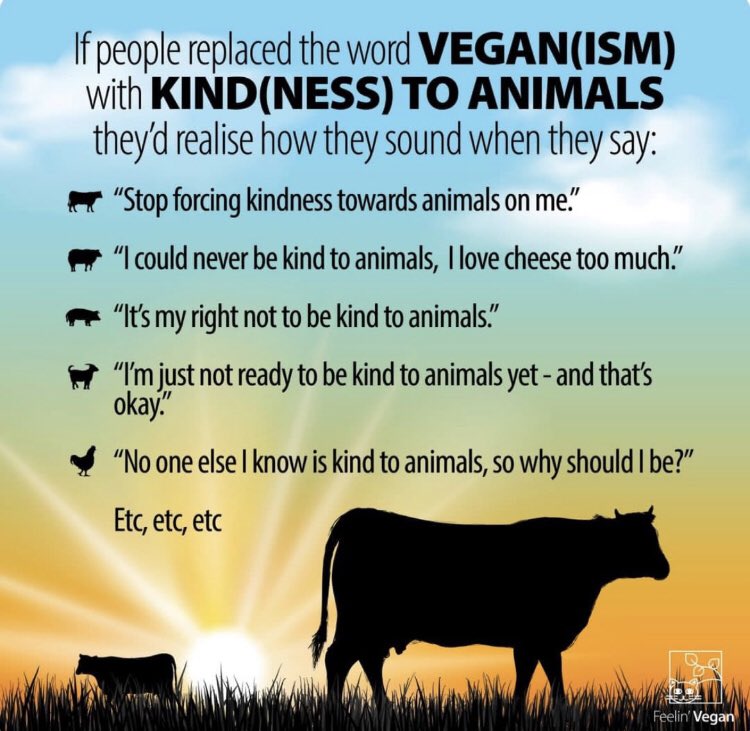
Hey, nonvegans, what you’re really saying is …
Source Feelin’ Vegan Instagram & Feelin’ Vegan Facebook
Veganism is a call to renounce the core practice of our culture—reducing beings to mere harvestable and abuseable commodities—and to practice, in every aspect of our lives, its opposite: mindfulness, inclusiveness, equality, and respect. – Dr. Will Tuttle
Download Your FREE Vegan PDF HERE
Order a FREE vegan kit HERE
Dairy-Free Info HERE
Take the Dairy-Free Challenge HERE
Click HERE for more Dairy-Free
Fish alternatives can be found HERE
Learn about eggs HERE
Find bacon alternatives HERE and HERE
Take PETA’s Cruelty-Free Shopping Guide along with you next time you head to the store! The handy guide will help you find humane products at a glance. Order a FREE copy HERE
Searching for Cruelty-Free Cosmetics, Personal-Care Products, Vegan Products, or more?
Click HERE to search.
Free PDF of Vegan & Cruelty-Free Products/Companies HERE
Click HERE to find out How to Wear Vegan
Want to do more than go vegan? Help others to do so! Click below for nominal, or no, fees to vegan literature that you can use to convince others that veganism is the only compassionate route to being an animal friend:
PETA HERE
Vegan Outreach HERE
Get your FREE Anti-Speciesism Activist Kit from PETA HERE
People perceive kindness by what they are willing to do, not by what has to be done
Do remember, the three cows in the solar system who are “allowed” to graze, die (page 6, USDA 2022 slaughter report, dairy cows). Before that, they are repeatedly violated. They are mutilated and confined. Their infants are forcibly removed to die (page 6, USDA slaughter report, calves) or are also forced into the same dystopian existence of being continuously violated and then killed when their ravaged and brutalized bodies, worn out from forced and repeated pregnancies, produce less milk. Which means less money for the humans who exploit them so horrifically.
Oh, and it’s important to also remember that there is some humane/green-washing going around where people who defend CAFOs (factory farms) claim that extreme confinement allows “better management” of animals for animal welfare and that CAFOs are good for the environment, needing less land for large numbers of extremely confined animals. Both of these points are absolute nonsense from people who profit from animal suffering, you can surely agree how cruel ANY sized operation is for animals, and as for the environment? CAFOs are a hot stew of disease and toxicity, not to mention, of violent suffering of animals. I’m not, however, linking some enraged anag grade-school essay in response to Cory Booker-inspired-anti-CAFO-legislation that is hoping that people enjoy their tortured animal flesh more than science and common sense and basic decency. People who exploit animals are desperate, with the ubiquity of the internet and social media, the death industry’s lies, deceptions, animal abuse, and “humane/green washing” are being exposed and destroyed.
Because, not exploiting animals is always BETTER FOR ANIMALS than exploiting them. It’s really that simple.
So, again, why do you drink the milk, as an aging human, of another species, forcing that species to endure pain, suffering, sadness, misery, and violent death?
Click HERE for human breastmilk banks. Or is that too expensive? Or too “ewygrossgetthatawayfromme!!!!!!!”. It’s literally your own species.
Click HERE too see a human breastmilk business modeled after a dairy farm.
SL
Source Viva!
Viva! is exposing the barbaric practice of zero grazing — life imprisonment for dairy cows. These cows are being sentenced to a life behind bars in factory farms, and this latest investigation reveals how the dairy giant Müller is part of driving this change.
The cows at the investigated Müller farms are never allowed to graze outside. Their whole lives are spent inside huge industrial sheds.
After a nine-month pregnancy, mothers have their newborn wrenched from them, their maternal bond severed, and all so humans can drink their milk. Death is commonplace. Mother cows are killed when their milk production drops. Many male newborn calves are slaughtered — others are reared for cheap beef.
Cows are paying the ultimate price just so people can eat yoghurt and other dairy products. This is the abhorrent reality of British dairy. Read on to find out what we have discovered and how you can get involved in our campaign to save cows.
The answer to zero grazing is not “better dairy” – all dairy commodifies cows and causes catastrophic suffering. There is no bonding for dairy mothers; cows are artificially inseminated every year and their calves are taken from them shortly after birth. Many male calves are slaughtered, female calves are usually isolated in hutches for two months or more. Painful infections such as laminitis and mastitis are rife – no matter the dairy farming system.
The move to zero grazing has added yet another cruelty on top of all this – a concrete and cast-iron prison from which there is no escape. Müller Corner should be Müller Cornered – because for the cows who are used to produce it, there is no escape!
The only answer is to ditch dairy entirely.
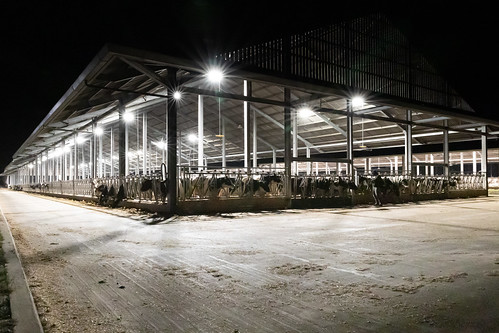
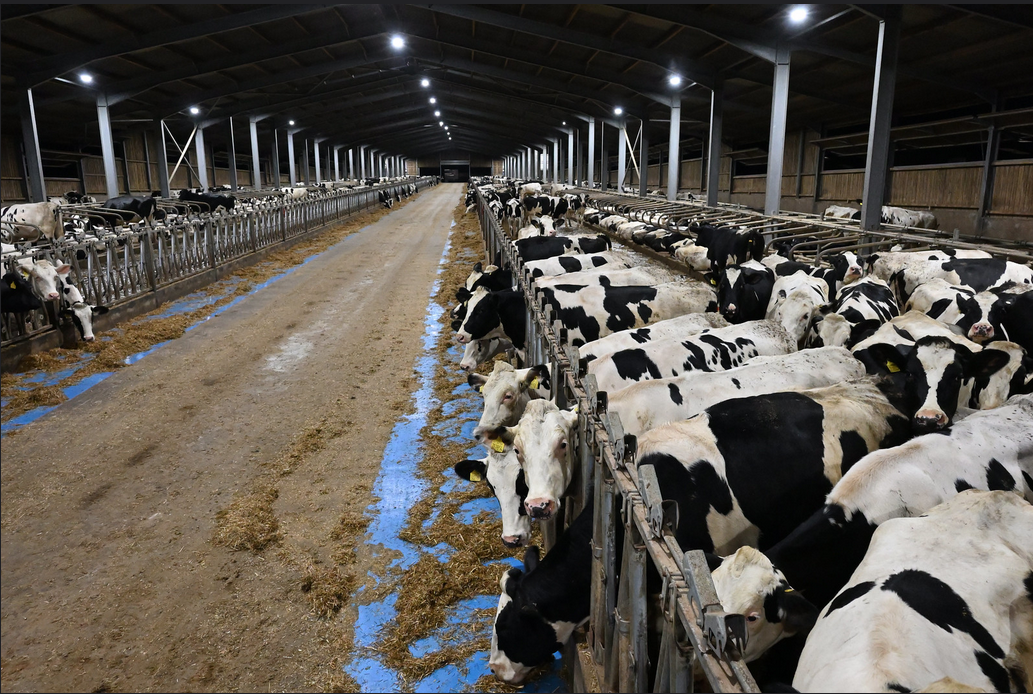
I chose to highlight a few below that resemble puppy mills. Because, you know, most people in the USA (and other countries) LOVELOVELOVE doggies and puppies (as do I, which is why I minimize harm against all animals by being vegan: all animal exploitation is related and fuels animal exploitation of “worthy” animals).
If these were dogs, there would be intergalactic war and violence from the nonvegan brigade until congress and god both demanded such forced hell cease to exist.
Look at these defenseless, vulnerable creatures and be vegan. Not a vegetarian. Not a reducetarian. Not a flexitarian. Not a howevertheaf people euphemize animal exploitation. You don’t need a label that means, “I’m an omnivorous pro-slaughter animal harmer.” Because animals don’t just “die a little”. And this is no time for nonvegans to be on some self-absorbed “journey” to enlightenment and kindness. Animals are suffering NOW. Just be a decent human. Be vegan. Now.
SL


Source Viva! Flickr
Download Your FREE Vegan PDF HERE
Order a FREE vegan kit HERE
Dairy-Free Info HERE
Take the Dairy-Free Challenge HERE
Click HERE for more Dairy-Free
Fish alternatives can be found HERE
Learn about eggs HERE
Find bacon alternatives HERE and HERE
Take PETA’s Cruelty-Free Shopping Guide along with you next time you head to the store! The handy guide will help you find humane products at a glance. Order a FREE copy HERE
Searching for Cruelty-Free Cosmetics, Personal-Care Products, Vegan Products, or more?
Click HERE to search.
Free PDF of Vegan & Cruelty-Free Products/Companies HERE
Click HERE to find out How to Wear Vegan
Want to do more than go vegan? Help others to do so! Click below for nominal, or no, fees to vegan literature that you can use to convince others that veganism is the only compassionate route to being an animal friend:
PETA HERE
Vegan Outreach HERE
Get your FREE Anti-Speciesism Activist Kit from PETA HERE
Humans are a disconnect
Who treat themselves and others
With disrespect
If humans actually cared about animal welfare and treating animals “humanely”, that precludes exploiting them. Period. Regardless of how humans define the animals’ required suffering and violent deaths.
The non/antivegans opposed (legitimately) to the cat and dog meat industries aren’t asking for higher welfare cages and “humane” deaths, are they??? No, they’re unapologetically demanding abolishment.
That being said, it has been proven, overandoverandoverandover, how absolutely INhumane, UNethical, and torturous the entire “anag” industry is regardless of confinement and cause of violent death. The expose by Joey Carbstrong is about pigs being “stunned” using CO2, which is the global industry standard. This is reprehensible considering that CO2 was found to be inhumane DECADES ago (and it’s reprehensible most importantly because KILLING ANIMALS has ALWAYS been inhumane).
In the UK in particular, 20 years ago parliament debated CO2 and determined that it needed to be replaced by a more “high welfare” alternative. It was tabled then, and is still used on >85% of pigs today.
This is why your “highest welfare,humane labels, rspca assured, regenerative, etcetcetc” are 100% MEANINGLESS to the animal victims who are the ones required to relinquish their bodies and die. In other words, if you struggle with, “What’s more humane than killing? Not killing.”, you are the one who benefits from euphemized descriptions of normalized violence against animals.
For sure, you’re not killing and eating animals because you honestly believe that NOT killing and NOT eating animals is actually INhumane or UNethical …
There is NOTHING you say, use, or celebrate in the anag (animal agriculture) industry that humans define as “humane/highwelfare/etc” that is MORE humane, more ethical, and more consistent with animal welfare, than NOT.
VEGAN IS THE ONLY HUMANE
SL
Source The Guardian
Hidden camera at slaughterhouse shows ‘utterly inhumane’ use of CO2 to stun pigs before slaughter
New undercover footage showing British pigs being gassed prior to slaughter has led to renewed calls to investigate the use of CO2.
Campaigners say the pictures – the first of their kind to be obtained in a UK abattoir – show the “utterly inhumane” nature of using CO2 to stun pigs before being killed. But the pork industry says its use is recognised as the most welfare-friendly method available, and says alternatives are being sought.
The images published today were obtained, say campaigners, using hidden cameras at Pilgrim’s Pride abattoir in Ashton-under-Lyne in north-west England in February 2021. They show pigs in groups of five or six being mechanically herded into a cage and then lowered into a Butina gas chamber in a ferris wheel-like system.
The pigs appear to be in distress as the gas concentration increases, with one still kicking after more than three minutes.
“The pigs in the video react to the first inhalation of carbon dioxide with fear and obvious discomfort,” said Donald Broom, an animal welfare professor at the University of Cambridge. “They try to escape but cannot. The gasping can be seen in all pigs where the mouth is visible. Gasping indicates poor welfare. The period of poor welfare continues until the pig loses consciousness.”
Paul Roger, a vet and founder member of the Animal Welfare Science, Ethics and Law Veterinary Association, said some pigs appeared to start waking from the gas prior to slaughter. “If this is the way animals are treated in this plant, they’re not being handled humanely. It’s an unacceptable way to treat any animal, and that really concerns me.”
Animal activist Joey Carbstrong, who captured the footage for the film Pignorant, said that the continued use of CO2 arises from the favouring of corporate profit over the interests of the animals. “We urgently need to stop using animals as resources because this kind of horror show is the result.”
Pilgrim’s UK, formerly known as Tulip, is a division of Pilgrim’s Pride Corporation, which is owned by JBS, the Brazilian-owned meat producer. Its animal welfare policy states: “At Pilgrim’s UK it is essential that all pigs are treated humanely throughout their lives and that the pig’s welfare is always at the forefront of everything we do.” It confirms that all Pilgrim’s pigs are stunned using CO2.
A Pilgrim’s Pride spokesperson said: “There is nothing to identify that this is our site, and it would be inappropriate for us to comment on that basis. Furthermore, the Food Standards Agency is legally required to be present at all sites and would routinely review any footage taken from an abattoir to ensure animals are treated humanely, and we have had no issues raised in the timeframe you have provided.”
In 2003, a government advisory body, the Farm Animal Welfare Council, said that CO2 stunning/killing “is not acceptable and we wish to see it phased out in five years”. However, its use has instead increased to 88% of all pigs in 2022.
A new scientific opinion by the European Food Safety Authority published in June 2020 stated: “Exposure to CO2 at high concentrations is considered a serious welfare concern by the panel because it is highly aversive and causes pain, fear and respiratory distress.”
Defra recently funded research into low atmospheric pressure stunning (Laps) as a potential alternative. The results showed it does not offer a humane alternative, and a 2021 Defra report into the welfare of animals at slaughter stated: “There has been no willingness on the part of abattoirs to explore inert gas mixture stunning commercially because of extended dwell time and therefore reduced throughput.”
Lizzie Wilson, CEO of the National Pig Association (NPA), said: “While we acknowledge gas stunning isn’t perfect, it is the best, most humane and efficacious commercially available option, and often the most reliable slaughter method for ensuring consistency.
“In addition, CO2 gas stunning of pigs does provide some welfare benefits; there is reduced risk of potential human error, animals remain in groups, and modern gas systems enable improved handling of pigs through use of automatic gates, which reduces the need for staff intervention and stress.”
The NPA said it organised a summit last year along with the National Farmers’ Union and British Meat Processors Association to discuss alternative gas mixtures, but concluded that there was no other viable system available. Dr Alice Brough said: “Non-aversive gases like argon or helium do offer potential alternatives, but they’re more expensive, and there’s no financial incentive for the meat industry to change their systems.”
Veterinary manager Prof Jill Thompson said: “Every effort should be made to progress towards using less aversive gasses that do not generate such reactions. This would involve changes to infrastructure in slaughter plants and would be more costly, but I believe that society would support a slight increase in the cost of products if it enabled a more peaceful stunning process for pigs.”
Peter Stevenson, head of policy at Compassion in World Farming, said: “I call on the government to ban the use of high levels of CO2 from 2026, thereby forcing the industry to belatedly invest in developing a slaughter method that is genuinely humane.”
A government spokesperson said: “The government is committed to the highest standards of animal welfare, including when animals are slaughtered or killed. We recognise there are concerns over the use of high-concentration carbon-dioxide to stun pigs, and will continue to look for viable alternatives based on the latest evidence on this issue.”
You can send us your stories and thoughts at animalsfarmed@theguardian.com
Download Your FREE Vegan PDF HERE
Order a FREE vegan kit HERE
Dairy-Free Info HERE
Take the Dairy-Free Challenge HERE
Click HERE for more Dairy-Free
Fish alternatives can be found HERE
Learn about eggs HERE
Find bacon alternatives HERE and HERE
Take PETA’s Cruelty-Free Shopping Guide along with you next time you head to the store! The handy guide will help you find humane products at a glance. Order a FREE copy HERE
Searching for Cruelty-Free Cosmetics, Personal-Care Products, Vegan Products, or more?
Click HERE to search.
Free PDF of Vegan & Cruelty-Free Products/Companies HERE
Click HERE to find out How to Wear Vegan
Want to do more than go vegan? Help others to do so! Click below for nominal, or no, fees to vegan literature that you can use to convince others that veganism is the only compassionate route to being an animal friend:
PETA HERE
Vegan Outreach HERE
Get your FREE Anti-Speciesism Activist Kit from PETA HERE
I’d ask WTF is wrong with people but the better question is WTF isn’t
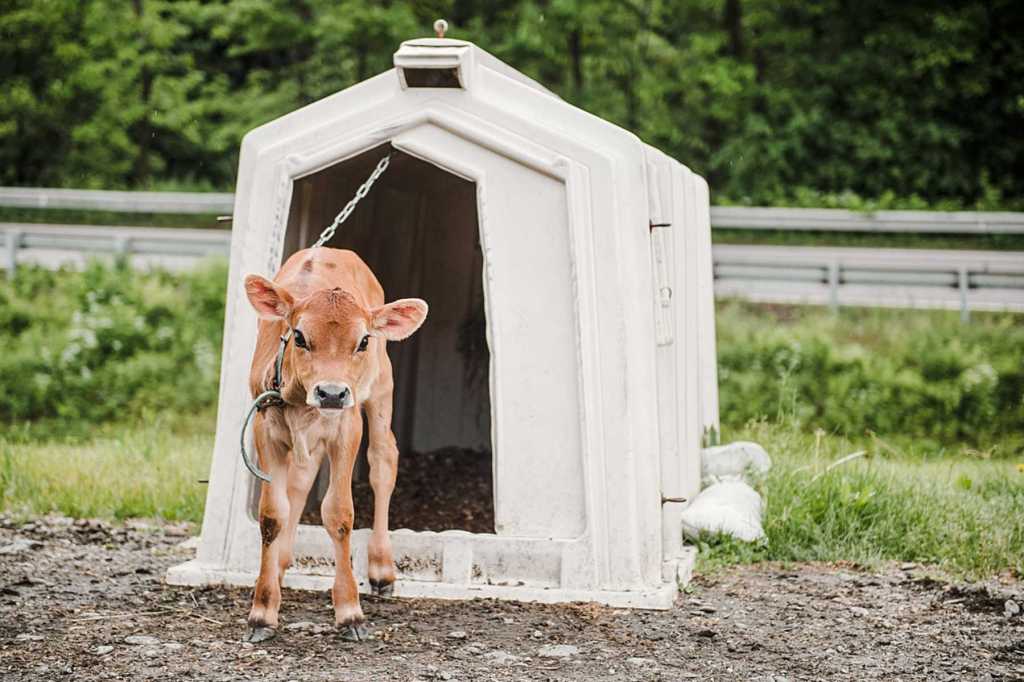
“The Lea Manor farm near the Duke of Westminster’s stately home, Eaton Hall, in Cheshire…produces enough milk for 430,000 people daily, according to Grosvenor. The milk is processed by Müller and supplied to Tesco.” Source The Guardian
Calf Image Source Victoria de Martigny / We Animals Media
Infants don’t get to be with their moms, and will either be killed or also reproductively exploited, so that their moms’ milk can instead be stolen for nearly half a million aging beings of a completely different species. DAILY. In just THIS case.
But… Why do people delude themselves that separating infants and killing all is ok as long as a few animals are “allowed” to graze? You’re still going to consume animals who don’t graze because DEATH is the normal, not eating outside, so anything goes.
At least be honest: if you consume animals, you’re not concerned if they’re able to graze before violently dying.
Concern for animals=least harm to animals=vegan for animals.
But since it’s not really socially acceptable to boldly claim indifference, humans need to instead collectively self-sooth under the indoctrinated “humane/welfare” umbrella.
It’s interesting that many humans NEED to believe that if animals can do something HUMANS think is “special” or a “gift”, then it’s ok to violently kill them. Take grazing and not eating antibiotics, which people boast as indicative of providing animals “extremely great lives!!!!” (for, like, < 100 of those same animals) but which don’t really provide any “pleasure” per se, they’re both what IS natural and normal, nonvegans just anthropomorphize and think that since THEY like picnicking and not needing antibiotics, that animals “enjoy” it just as much:
Speciesism is so ingrained in humans that merely providing a basic necessity like food, and not feeding any of the greater-than-half-of-the-Earth’s-supply of antibiotics to animals for human-caused mass-inflicted diseases in animals (wow, check out page 6 to see how well that works) is considered animals being spoiled and humongously loved and cared for – ??? – so you can bypass the factual yucky feeling of violently gassing, the myth of stunning (because it’s proven unreliable), and boiling animals alive, all demonstrably NOT normal OR natural and factually torturous and depraved, above the already-violently abusive killing-in-general of TRILLIONS.
Violently nauseating is that, as animal welfare factually decreases, the humane rhetoric surrounding it increases. Thus why “animal welfare” is an absolute fantasy, a deception that humans willfully believe: that killing animals benefits animals while ignoring that animal welfare REQUIRES animal exploitation, which REQUIRES animal suffering, to continue being profitable; it’s like the HSUS or CIWF, neither of which promote only veganism, both promoting “humane meat” because each welfare organization profits from donations earmarked for “humane improvement campaigns” in “animal agriculture”, like marginally-larger cages, which still require animals still be caged and still die. Did you ever think that if animal exploitation were abolished, what would happen to those “welfare organizations”?
Did you ever acknowledge that, while you vocally donate a yearly $50 to welfare organizations to get all those propositions passed “gifting” animals a larger prison while emoji-screaming on social media about how morally-outraging “animal abuse” is so you can hang out with all your mutuals under that “humane” umbrella, you STILL consume animals from the smaller prisons?
You still are nonvegan?
A super-confining prison is (verbally) unacceptable but cruelly and terrorizingly killing defenseless animals is your idea of a nobly humane “$50-per-year animal welfare” expense?
Nobody ever desperately needed “highest welfare/humane/red tractor/rspca-assured” labels a few decades ago before the above-noted violence was normalized, before small farms began those welfare organizations to offset losing profits to CAFOs, FFs, and ILOs. For sure, I suspect in not too long the death industry will spin that since they “nobly allow” animals to poop, it’s highest-welfare to stab them in the throat.
Oh.
And by the way, if your “animal welfare committee” benefits from animals being bred-and-dead, it’s not really “impartial”, is it?
And if you champion less mastitis, why do you support an industry that CAUSES mastitis? You’re literally admitting that your death industry is so diseased that you think less – versus NONE – is great, which is abuse-apologizing, correct?
And if your company defends itself with, “There is no evidence ‘our milk’ comes from poorly-treated cows.”, then you can’t defend that ‘your milk’ comes from ‘high-welfare’ cows then either, right?
And if the “standards” and “regulations” require repeatedly violating and violently killing animals, then they’re not really humane either, correct?
And if your “animal welfare act” REQUIRES that animals DIE, it doesn’t really protect them, right?
And if you’re defending consuming animals, you’re not really defending animals, you understand that, too, correct?
Honestly? It’s vomitous.
You can read more about false advertising and “humane washing” and how to report it HERE.
SL
Bucolic scenes on UK milk adverts hide reality of life for ‘battery cows’
Consumers are being ‘misled’ into believing dairy cattle graze in fields, says animal rights campaign
Source The Guardian
Some of the UK’s biggest food firms are accused of misleading consumers after buying “their” milk from intensive industrial dairy units despite using images to promote their products that show cows grazing in green fields.
Tens of thousands of dairy cattle in England are kept in hangar-style sheds with no or very limited access to pasture. They will typically be milked three times daily, often on large electronic rotating milk parlours, producing up to 32 litres of milk each day.
The animal rights charity Viva! is this weekend launching a campaign on the conditions of “zero-grazed” cattle. It cites research showing zero-grazed cows have a higher level of health problems, such as lameness and mastitis, and mortality.
“These battery cows are denied their most inherent instinct: grazing on grass outdoors,” said Juliet Gellatley, the founder and director of Viva!, which promotes veganism. “Consumers are misled into believing that cows graze outdoors.”
Campaigners describe the units as a “disgrace” and there is mounting pressure on the dairy industry for better labelling and transparency in the supply chain, identifying products containing milk from cows with no access to pasture. At present, there is no requirement for mandatory welfare labelling on milk products.
The Observer has established:
Tesco’s fresh milk is promoted with an image of a grazing cow on its cartons. One of its biggest suppliers is the Lea Manor farm in Cheshire, part of the Duke of Westminster’s Grosvenor group, with 2,600 dairy cattle kept in open-side sheds, with no access to pasture.
Arla Foods has promoted its Cravendale milk brand and its Care welfare and environmental programme with farmer suppliers singing “everybody’s free” in fields. It has confirmed that its supply chain for other products includes milk from zero-grazing units. Viva! has complained to the Advertising Standards Authority.
Viva! argues that the advert for Cravendale milk is misleading because it considers that it gives the impression that all Arla milk comes from cows with access to pasture.
Müller UK & Ireland has pictures on its website of cows standing in fields in front of a table with a glass and cartons of fresh milk. Its milk supply chain includes some cattle units with no or limited access to pasture, the dairy giant confirmed this weekend.
It has been estimated that up to 20% of the UK dairy herd of 1.9 million cattle have no or very limited access to pasture, but regulators do not collate figures on intensive units. The average annual milk production of a dairy cow has risen significantly over the years, with many cows now producing as much as 12,000 litres of milk a year.
The dairy industry says well-managed units provide high animal welfare. An “expert report” by the government’s animal welfare committee in 2021 found that “fully housed systems” and access to pasture both offered welfare benefits.
The Viva! campaign identifies some of the biggest intensive dairy units, including the Lea Manor farm near the Duke of Westminster’s stately home, Eaton Hall, in Cheshire. The complex produces enough milk for 430,000 people daily, according to Grosvenor. The milk is processed by Müller and supplied to Tesco.
Grosvenor says its facility is larger than typical industry standards, with natural light and space to roam. It says the “state-of-the-art” facility offers “exceptional standards” of animal welfare, cutting use of antibiotics by more than 60% in the past five years and reducing incidence of illnesses such as mastitis to “industry-leading levels”.
Viva! also identified two intensive units in the south and south-west of England which provide milk for the UK’s two biggest dairy processors, Arla and Müller. There is no suggestion or evidence of any breaches of regulations in the milking facilities.
Peter Stevenson, the chief policy adviser at the charity Compassion in World Farming, said: “The public still sees cows as being outdoors in fields and are unaware of their high yields to which they have been pushed and the fact that quite a chunk of them are zero-grazed. This intensive part of the dairy sector is an utter disgrace.”
Arla, a farmer-owned company, said last week that supplier farms met “strict and non-negotiable animal welfare standards”, but not all milk was produced under its Care environmental and welfare programme which stipulates access to pasture. It said more than 90% of its supplier farms were grass-based.
“Within Arla, we have a variety of farming systems and do not believe that any one is better than the other,” said a company spokesperson. Arla has an ongoing trial measuring “cow happiness” in grazed and housed dairy cattle.
A spokesperson for Müller UK & Ireland said: “We purchase milk from around 1,300 dairy farms throughout Britain, which have different farm sizes and production systems. Animal welfare is a key priority for our business. Our products are marketed in compliance with all regulations and our farmers must comply fully with our own Müller standards as well as those of the Red Tractor dairy assurance scheme.”
Supermarkets say they know animal welfare is important to customers and only source from accredited farms, with regular vet inspections.
A Tesco spokesperson said: “We work closely with our dairy farmers to ensure high animal health and welfare standards. Cows on Tesco farms are some of the best looked after in the UK.” Tesco considers that since a large proportion of its supplier dairy farms use outdoor grazing, it is appropriate to use an image of grazing cows to promote its fresh milk.
Dairy UK, the trade association for the UK dairy supply chain, said: “The leading determinant of cow health in the UK is the quality of the management on farms. Time spent housed or out in pasture has not been shown to be correlated with poor health, at least in the UK.” It denied it was misleading to promote brands which may contain milk from zero-grazing systems with images of cows in fields.
In the government’s food strategy, the Department for Environment Food and Rural Affairs (Defra) committed to consult on improving and expanding mandatory animal welfare labelling. A Defra spokesperson said: “All farm animals are protected by comprehensive animal health, welfare and environmental legislation within the Animal Welfare Act 2006.”
Download Your FREE Vegan PDF HERE
Order a FREE vegan kit HERE
Dairy-Free Info HERE
Take the Dairy-Free Challenge HERE
Click HERE for more Dairy-Free
Fish alternatives can be found HERE
Learn about eggs HERE
Find bacon alternatives HERE and HERE
Take PETA’s Cruelty-Free Shopping Guide along with you next time you head to the store! The handy guide will help you find humane products at a glance. Order a FREE copy HERE
Searching for Cruelty-Free Cosmetics, Personal-Care Products, Vegan Products, or more?
Click HERE to search.
Free PDF of Vegan & Cruelty-Free Products/Companies HERE
Click HERE to find out How to Wear Vegan!
Want to do more than go vegan? Help others to do so! Click below for nominal, or no, fees to vegan literature that you can use to convince others that veganism is the only compassionate route to being an animal friend:
PETA HERE
Vegan Outreach HERE
Get your FREE Activist Kit from PETA, including stickers, leaflets, and guide HERE
The clueless mindset of all dollar$ and no sense
Do YOU have the courage to not look away? How about the courage and decency to NOT harm?
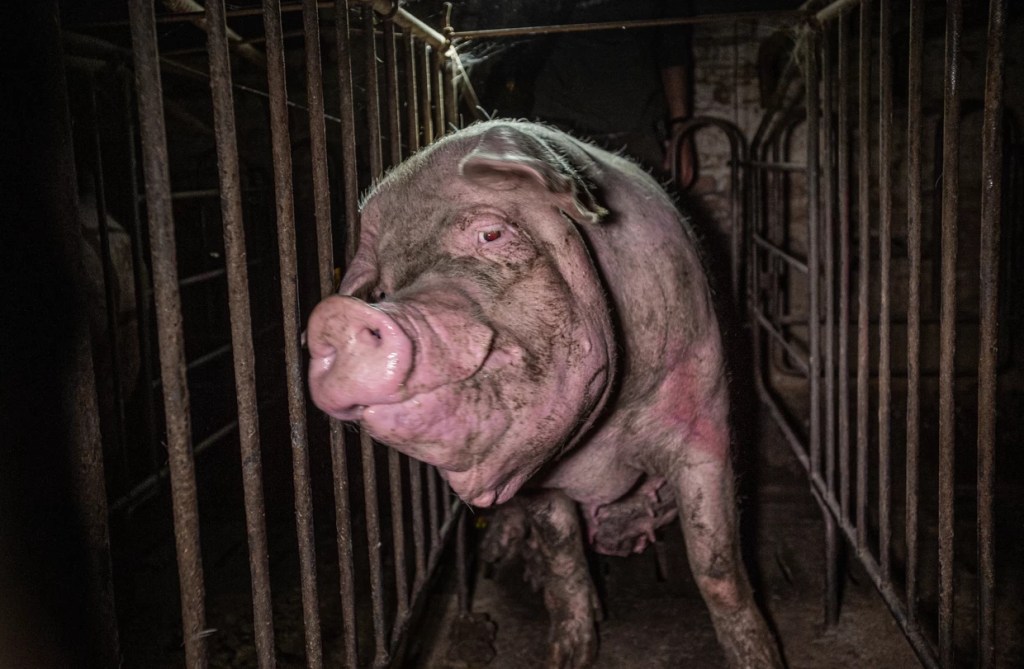
Source DeMorgen
Interviewing conflict photographer Jo-Anne McArthur:
weanimalsmedia.org , joannemcarthur.com
All images courtesy weanimalsmedia.org
“We cut off their beaks, burn their tails, castrate them without anesthesia, and slaughter them without blinking.” These are just some of the tortures that billions of animals endure every day. Photographer Jo-Anne McArthur makes the horror painfully visible.
It started when she was 22 and traveled through Ecuador with her backpack and camera. One day she saw a monkey tied with a chain to the bars of a window. The monkey had nowhere to go and was trained to steal from passing tourists. Like some passersby, Jo-Anne McArthur stopped to take pictures of the animal.
But unlike the other tourists, who thought it was a funny and fun spectacle, she saw the suffering of the monkey. She started thinking about what she could do with her photo, and so the photojournalist in her was born. “Photojournalism can make things move. It can touch people’s hearts or move them to action. It can change policy. The picture of that monkey didn’t change much, but I knew then: this is what I want to do. This is how the We Animals project came about. Because we like to forget, but we are all animals.”
We Animals has since grown into a photography project to which 95 photographers around the world contribute, all with the same goal: to give visibility to the billions of animals that live in captivity, either for entertainment or as a so-called production animal. More than 20,000 photos are made available free of charge and royalty-free.
McArthur (46) herself has been to more than sixty countries to photograph animals and is internationally acclaimed for her work. This week she was in Brussels at the invitation of Compassion in World Farming, an international animal protection organization that stands up for the welfare of animals in livestock farming. The day before McArthur gave a speech to some European Commissioners and Members of Parliament, we were able to speak to her in the lobby of her hotel.
She explicitly refers to her work as conflict photography. “The way we treat animals is one big conflict. If I took people to the places I visit, they would feel the same way. We force billions of living beings into confinement, suffering and death. Out of sight of everyone. Hardly anyone ever sees these animals. We also do not see who is on our plate. I want to show the individuals. And how they have to live their lives because we have an insatiable hunger for meat, which also has to be produced as cheaply as possible.”
We don’t talk about the animals we eat, she says, or how miserable we’ve made their lives. “It’s not like we take an animal out of the wild and end its life very quickly because we don’t have any other food available.
“No, as soon as an agricultural animal is born, we run off with it. We mutilate them, cut off their beaks, burn off their tails, cut off their teeth, perforate their ears, castrate them without anesthesia, take them away from their dams and other relatives, put them on a truck to slaughter and kill them in the in the presence of peers.”
Humans are extremely violent, she says. And no, she doesn’t hesitate to use those words. “But that doesn’t mean we can’t be empathetic as individuals. After all, we also have an intellect, with which we can make choices.” The argument that nature is the most violent place, where animals devour each other in a horrific way without much fuss, does not impress her much. “Animals don’t overeat. They only take what they need. And only if they are carnivorous.
“What we do is completely different. We lock up and abuse billions of animals when we don’t even need it. Have you ever seen the arms of a gorilla? They eat vegetarian and are so strong. There are cultures that have lived without meat for centuries and are healthy. Until recently, a piece of meat was still expensive. Our grandmothers ate meat maybe twice a week, we consume it three times a day. With enormous health and environmental problems as a result.”
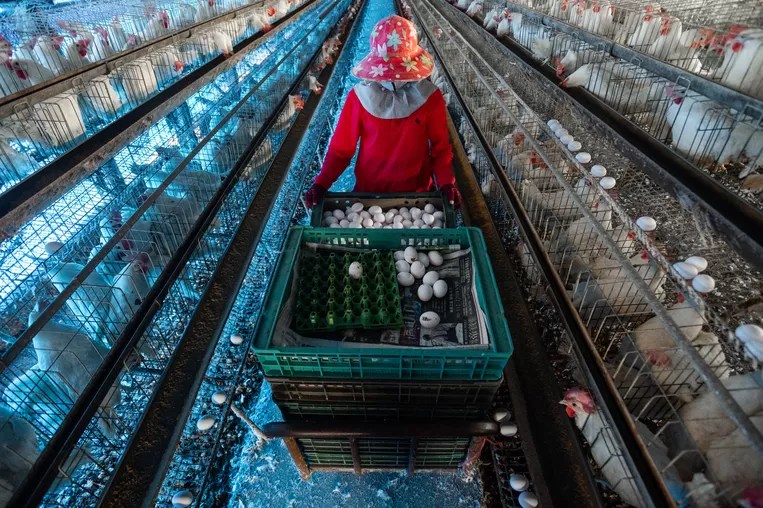
Up to five chickens per cage in this Taiwanese factory. The floor is full of urine and faeces, and workers wear masks to protect themselves from the toxic air. Image Jo-Anne McArthur / We Animals Media 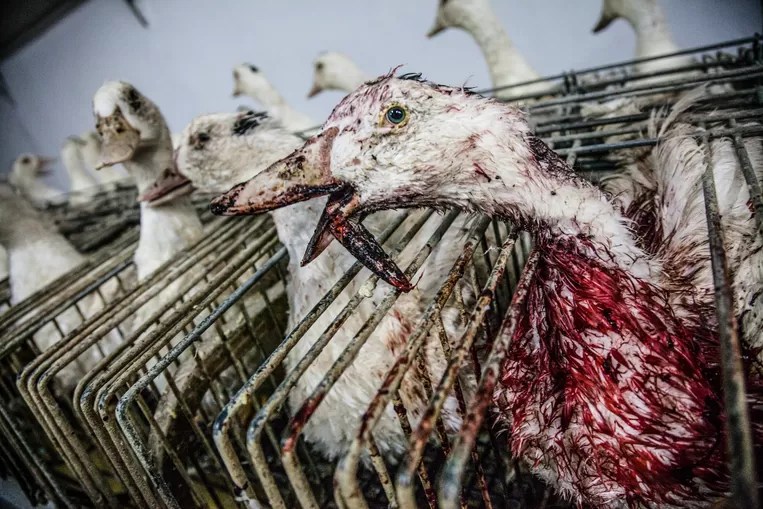
A bloodied goose in a Spanish nursery. Image Luis Tato / HIDDEN / We Animals Media 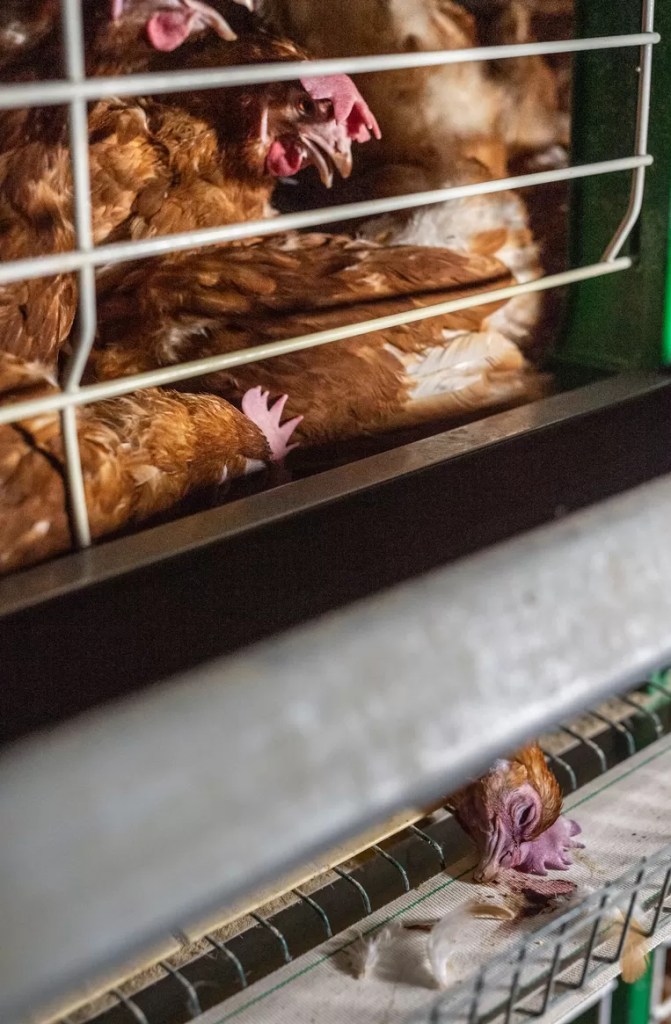
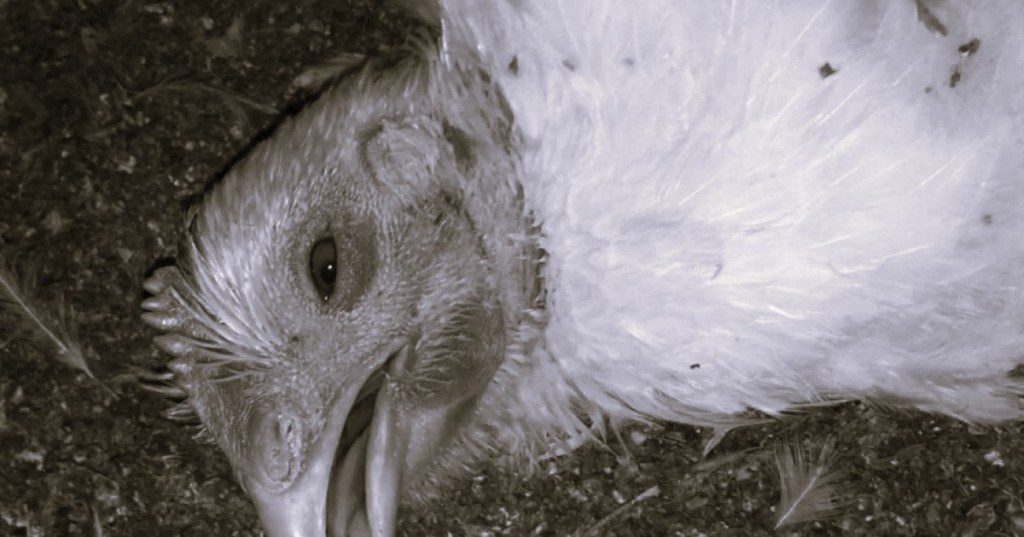
A dead chicken in an industrial battery cage near Madrid. Image Jo-Anne McArthur / Animal Equality / We Animals Media 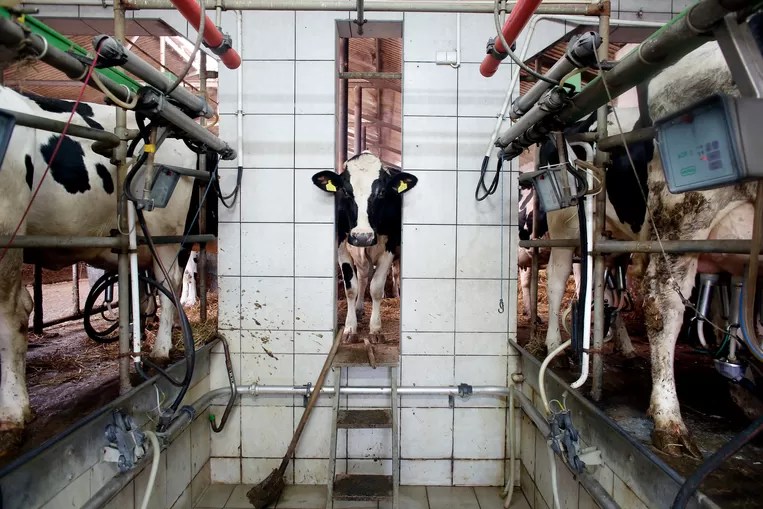
A dairy farm in Poland. Image Andrew Skowron / We Animals Media 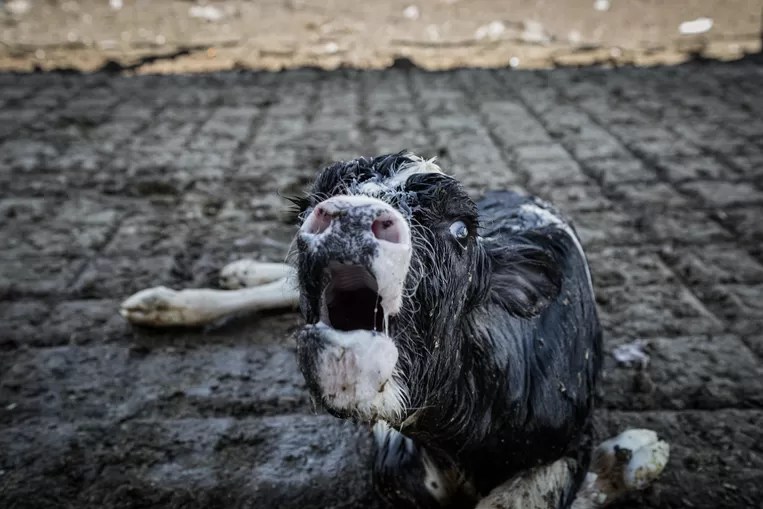
Gripping image of a suffering calf in Mexico, from the book ‘Hidden’ by We Animals, a project to which nearly a hundred photographers worldwide contribute. Image Dulce Ramírez / HIDDEN / We Animals Media 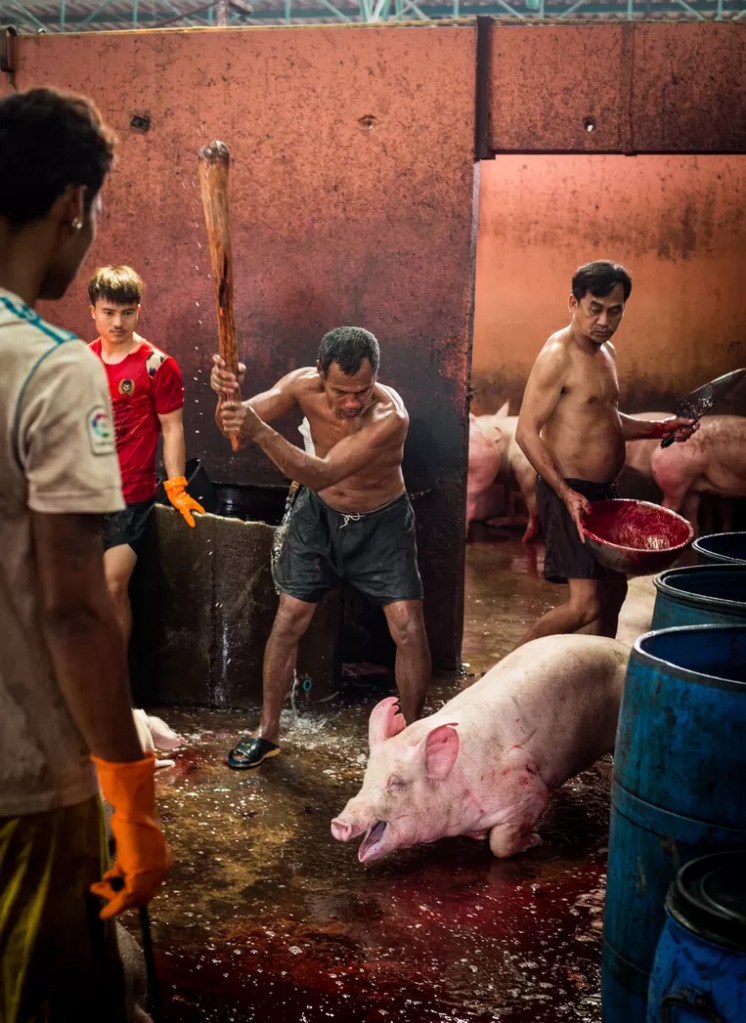
A slaughterhouse in Bangkok. This is how the animals here are ‘anaesthetized’ before they are throated. Image Jo-Anne McArthur / We Animals Media for The Guardian
For more than twenty years, Jo-Anne McArthur has been photographing in places where hardly anyone goes. She’s seen millions of captive animals, but she remembers every place she’s been, she says. What she will certainly never get out of her memory, and what she cannot convey in her photos, is the smell. “I wish people could smell him. The smell of a stable where animals are crammed together creeps into everything. In my backpack, my clothes, my camera. If I’ve been in a pig farm for half an hour, my cameras still smell like it a month later.”
We often think that the biggest problems in industrial livestock farming are in African or Asian countries and not in Europe, but that’s not true, says McArthur. “I have visited many European farms, and some of the dirtiest were in Sweden. All over Europe I have visited places where dead animals lie, where animals stand knee-deep in their own manure, where your eyes are burned by the smell of ammonia. I sometimes hear that I only show the ugly sides, but you know what? There are no good sides to industrial livestock farming.”
People are often defensive when they see her images, she says. “Because they fundamentally question our goodness. We all think of ourselves as good people, so it is confronting to watch the intense suffering we all participate in every day. We don’t like to make time for that kind of thinking exercise.”
And yet, McArthur continues to show her work wherever she can. “Urgency, shame and empowerment: that’s what I want to achieve with my images. So that people feel pain when they look at my pictures, but the pain doesn’t paralyze them. I’m taking them to a tough, hellish place, but I’m also telling them, we can change this. What can I do, people sometimes ask me. Leave the animals off your plate, is my answer.”
When she was 22, she got to know the chickens that lived with her mother in the country. “I noticed that, like the cats and dogs that lived with my mother, they each had a personality. That was annoying, because chicken was my favorite food back then. I was a carnivore. I had always thought of myself as an empathetic person, but apparently it had taken years for me to see these so-called production animals as individuals. I’ve been vegan for twenty years now and I feel very good about it. No animal has had to suffer for my food or my clothes.”
The work she does is not harmless. Few farms open their doors wide to a photographer or journalist. How does she get in there? “You enter any way you can. Sometimes I ask in advance, sometimes not. I definitely don’t like doing things secretly. But it is the only way to get an accurate picture of how animals have to live on a farm.”
Colleague photographers of hers have already been beaten up, she says. She recently had to flee a country herself. The government was looking for her. Even the neighboring country to which she had fled turned out not to be safe for her.
McArthur is one of the few who looks the animals we eat in the eye. It’s painful work, she says. “But that applies to everyone who is involved in animal rights. It’s still in its infancy, changes are painfully slow, and most people don’t understand you. And we suffer. Because we see how much the animals suffer. Over the years I have learned better how to keep my joy. I had to. At one point I was diagnosed with post-traumatic stress disorder, which is more common among conflict photographers. My philosophy now is: I have one life. I want to work hard for others, but also live a joyful life myself.”
I ask her if she thinks things will have changed in 25 years. She nods. “The humiliation of animals in circuses will be over and bear bile farming will have ended (bears kept in captivity to harvest their bile, which is used as medicine by some traditional Asian cultures, ed.). I also think that zoos in their current form will no longer exist. There will be more vegetarianism and veganism. But at the same time, in some parts of the world, they are now starting to eat meat like we do. So I don’t think industrial livestock farming will have disappeared in 25 years. Unless deadly pandemics and zoonoses have pushed us a little further. But let’s hope this won’t be the way to get rid of it.”
On Tuesday, McArthur showed her photos to several European Commissioners and Members of Parliament. “I get invited to conferences like this because I’m on the front lines,” she began her speech. “I photograph animals in the entertainment sector, but my main focus is on industrial livestock farming. I’m there to photograph the animals that we don’t see, but eat. Such as cows, pigs, chickens, rabbits, sheep, fish. Billions of animals that we keep in cages and pens. They are invisible. Nobody cares about them. I hope we can work up the courage to see each individual. That’s our job. Watch them. See them. Don’t look away.”
Download Your FREE Vegan PDF HERE
Order a FREE vegan kit HERE
Dairy-Free Info HERE
Take the Dairy-Free Challenge HERE
Click HERE for more Dairy-Free
Fish alternatives can be found HERE
Learn about eggs HERE
Find bacon alternatives HERE and HERE
Take PETA’s Cruelty-Free Shopping Guide along with you next time you head to the store! The handy guide will help you find humane products at a glance. Order a FREE copy HERE
Searching for Cruelty-Free Cosmetics, Personal-Care Products, Vegan Products, or more?
Click HERE to search.
Free PDF of Vegan & Cruelty-Free Products/Companies HERE
Click HERE to find out How to Wear Vegan
Want to do more than go vegan? Help others to do so! Click below for nominal, or no, fees to vegan literature that you can use to convince others that veganism is the only compassionate route to being an animal friend:
PETA HERE
Vegan Outreach HERE
Get your FREE Activist Kit from PETA, including stickers, leaflets, and guide HERE
Some images always linger
Break your heart
As they reach the tips
Of your fingers
Why do people enjoy wearing violent suffering and decomp?
Source Real Fur Film
Actions
Please sign petition HERE to Ban Fur Farms in Canada
Related, please sign petition demanding department store Dillard’s be fur-free HERE
You can also send Dillard’s a message via their Contact Us page or via their floating Feedback button on the right-hand side of their site
Please visit HERE to reserve your free ticket for the private screening of Real Fur: “A documentary uncovering the true cost of fur in the fashion industry.”
Background
Fur farms are not only cruel to animals but also pollute the planet and cause zoonotic diseases. Contrary to the belief that real fur is “natural” and better for the environment, fur production actually destroys the environment in various ways.
Over 75 percent of zoonotic diseases (according to the WHO) are caused because of close proximity to animals kept on farms.
In November 2021, the Animal Save Movement joined a global movement to ban fur farms. We took part in the #MakeFurFarmsHistory campaign which included protests in over 10 countries and a letter-writing campaign to ban fur farms in Canada.
Thanks to these actions and the support of the community, a bill was introduced into Canada’s parliament that calls for a federal ban on fur farms.
Curious to learn more about fur in the fashion industry? Want to find out how you can take action to help animals on fur farms? Join us and our friends at Arise Productions for the private screening of Real Fur – a documentary uncovering the true cost of fur in the fashion industry.
See the award-winning documentary film, meet director Taimoor Choudhry, and hear from prominent animal rights leaders: Camille Labchuk, Lesley Fox, Ashley Byrne, and Jenny McQueen, who are part of a discussion panel.
When: April 25 at 4:30PM PDT/ 7:30PM EDT
Where: Online on Eventive
How: Reserve your free ticket HERE
And FYI: for those people who are so superficial and need to demonstrate to the world their healthy portfolios, do what other people do and buy a sports team or have a school named after you, there is ZERO legitimacy to fur. ZERO.
And for others with lesser incomes who buy “fur-lined” products, remember that animals suffer just as much for a “little” fur, they aren’t just a “little” dead. And for those who opt for faux fur, it’s important to note that many times, real fur is actually disguised as fake fur when real fur costs less (do remember that the life of the animal is priceless), please see The Guardian’s How To Tell If Faux Fur Is Actually Real Furthermore, some items are not required to include labels that designate fur as real or faux. Just leave it out altogether.
I became vegan after watching a documentary on fur, it was after seeing a dog tortured for his fur that I became aware that ALL animal exploitation is related, the cows who are forcibly impregnated overandoverandoverandover until their abused bodies no longer produce milk at a profitable level and who are then violently killed, suffer as mink do, who are forced to endure squalor, neglect, and disease, and then who are agonizingly gassed for their fur.
… In other words, don’t feign shock about fur if you’re still eating animals, the foundation of animal exploitation fuels and includes ALL animal exploitation, if you eat “bacon”, you’re deliberately supporting animals being anally electrocuted so their fur isn’t damaged during the “killing phase” of “fur farming”. And the US fur industry (used to if no longer) reprehensibly promotes that, since they kill animals onsite, they’re more “humane” than “food farming” slaughterhouses where animals are forced to endure further trauma via transport. Imagine using the death industry as a benchmark of ethics for your death industry.
Why do people conveniently neglect the THIRD option, which is to NOT SUPPORT ANY?
Because it’s really sad that I have to say this: stealing another’s fur is depraved, nothing but selfish, privileged, greedy, and barbarically cruel.
There is a special corner of hell reserved for those humans. Enjoy the bonfire. SL
Download Your FREE Vegan PDF HERE
Order a FREE vegan kit HERE
Dairy-Free Info HERE
Take the Dairy-Free Challenge HERE
Click HERE for more Dairy-Free
Fish alternatives can be found HERE
Learn about eggs HERE
Find bacon alternatives HERE and HERE
Take PETA’s Cruelty-Free Shopping Guide along with you next time you head to the store! The handy guide will help you find humane products at a glance. Order a FREE copy HERE
Searching for Cruelty-Free Cosmetics, Personal-Care Products, Vegan Products, or more?
Click HERE to search.
Free PDF of Vegan & Cruelty-Free Products/Companies HERE
Click HERE to find out How to Wear Vegan
Want to do more than go vegan? Help others to do so! Click below for nominal, or no, fees to vegan literature that you can use to convince others that veganism is the only compassionate route to being an animal friend:
PETA HERE
Vegan Outreach HERE
Get your FREE Activist Kit from PETA, including stickers, leaflets, and guide HERE
People see what justifies or suits their choices
Oblivious to the suffering of others
And to those of more
Enlightened voices
It’s not the alarm, it’s you …
How come the people who need to attempt to challenge veganism with “plant suffering” never admit to or watch actual, factual, documented animal suffering? We know that animals, human and non-human, are sentient and have the capacity to experience emotion, pain, and suffering, but antivegans will double-down on idiocy by suggesting that vegans cannot legitimately be opposed to animal suffering because radishes are oppressed.
If you’re honestly traumatized by the thought that terrified celery cannot run from danger because evolution has a cruel sense of humor, just remember that nonvegans eat both animal suffering AND “plant suffering” in copious amounts, more than vegans ever could, based on the massive quantities of plants that the animals, who humans consume, consume.
My plant-based food requires ZERO disingenuous, fake, fraudulent, deceptive “humanely processed” labels.
This is just, yet again, another example of “human intellectual superiority” from the “intellectually superior species” that also believes in “humane slaughter” and “ethical vivisection”, as well as being unable to understand the difference between cow’s milk and oat milk.
(The death industry is taking advantage of humans’ willful ignorance by establishing that humans are really just ignorant, ie., not intelligent.)
And I gotta add, I saw many comments praising the interviewer for admitting he’s a hypocrite.
Excuse me, what???
Admitting you’re flawed but not changing the flaw, is no different from the people who know animals suffer but don’t care that animals suffer. To the animal victims, both “points of view” cause animal suffering.
Vegans have to stop accepting crumbs. I know we are often bombarded with horrible, hateful, cruel rhetoric, so much so that “not being wished dead” seems equivalent to “decent nonvegans”, but the animals would not agree.
One more point: to the nonvegans who praise vegans for not being “preachy/righteous/loud/etc”: vegan attitudes aren’t the problem, the problem is your conscience; when you don’t want to hear the fact of animal suffering you effortlessly cause and excuse, rather than admit the “wrongness” of nonveganism, you project that onto the “messenger”.
It’s like being awakened by a loud, brash noise that you respond to with anger or denial: it’s not that the alarm is agonizingly loud or painfully irritating, it’s that you don’t want to hear the alarm, and despite being the cause of the alarm.
So yes, typical non/antiveganism: anything to desperately deflect from the animal suffering people effortlessly cause but, once again, could easily NOT. SL
I’m going to link a couple previous articles that establish the suffering animals are required to endure, in each “phase” of “animal agriculture” as documented via exposes and predominately industry data from the USDA. I suspect that the people who need to read/watch/be educated, won’t, it might disturb their fantasy of “humaneness”, and then what would you do?
Do remember that dairy farmers reproductively exploit cows and then deny the maternal bond they facilitated, and then boast that cows love to be milked (versus habit, fear of punishment, desire for relief) but then experience ZERO emotion when being violently killed. Tell me more…
One of These Things Is Not Like the Other
Download Your FREE Vegan PDF HERE
Order a FREE vegan kit HERE
Dairy-Free Info HERE
Take the Dairy-Free Challenge HERE
Click HERE for more Dairy-Free
Fish alternatives can be found HERE
Learn about eggs HERE
Find bacon alternatives HERE and HERE
Take PETA’s Cruelty-Free Shopping Guide along with you next time you head to the store! The handy guide will help you find humane products at a glance. Order a FREE copy HERE
Searching for Cruelty-Free Cosmetics, Personal-Care Products, Vegan Products, or more?
Click HERE to search.
Free PDF of Vegan & Cruelty-Free Products/Companies HERE
Click HERE to find out How to Wear Vegan
Want to do more than go vegan? Help others to do so! Click below for nominal, or no, fees to vegan literature that you can use to convince others that veganism is the only compassionate route to being an animal friend:
PETA HERE
Vegan Outreach HERE
Get your FREE Activist Kit from PETA, including stickers, leaflets, and guide HERE
The idiocies by which we are surrounded
Will always leave us more than
A tad astounded
If kicking an animal is “bad”, how is killing an animal “good”? And how does killing an animal protect an animal?
I’ve seen comments by many people defending “laws that protect animals” (in response to two activists found Not Guilty for rescuing two “industry” chickens from a transport death truck, see The fight against factory farming is winning criminal trials below) … but not defending animals who are suffering.
Would you help an animal in obvious distress, locked in a car on a hot day? If you witness an animal being abused, would you intervene or call 911 to get help?
No?
Yes?
What’s stopping you from protecting animals exploited for food, the most vulnerable and defenseless of beings? Why don’t you defend the victims of laws that break THEM?
Nobody can disagree that killing (not euthanasia) is inherently abusive.
Therefore, if abusing animals is “bad”, what can be worse than killing animals?
People effortlessly defend abuse because, paradoxically, “the law” has historically and consistently REQUIRED animal abuse. The disingenuous “humane slaughter act” and “transport regulations” and “good practices” ALL REQUIRE SUFFERING AND DEATH. The Animal Welfare Act, which was written to “protect” SOME animals, excludes ALL animals exploited for food in the US, the billions of land and billions of marine. These “laws, protections, regulations” were and are written by humans holding forks of someone else’s flesh, and that’s textbook conflict of interest. Conversely, the ACTUAL CRIMES OF HARMING – using, violating, stealing infants, and violently killing all – are normalized as “necessary” and “humane”.
People express outrage and shock when they see an image or video of “animal abuse”, a cow lying in the mud, unable to walk but still being milked, for example, or a calf being thrown or kicked, but fail to acknowledge that the cow and calf – ALL COWS and ALL CALVES – will be, or have already been, violently killed.
Redefine your inconsistent situation|species-specific outrage by removing yourself as a beneficiary of someone else’s suffering. Exploiting animals, including killing them, doesn’t become humane or acceptable just because you want to believe the animals you eat weren’t being kicked or existing in piles of bacteria, feces, and other rotting animals. Regardless of how often animals are allowed, or able, to stand, they are all still violently killed after brief existences of, predominantly, confinement, squalor, and disease, in a “process” that isn’t euthanasia.
Animals don’t fall asleep or gently accept dying; stunning is also used to protect employees from animals who are terrified and desperately want to escape an inherently violent and terrifying experience.
Veterinarians don’t stun companion dogs and cats before euthanizing them.
People refuse to watch slaughterhouse footage and the horrors inflicted on animals, but they sure do love expressing moral outrage when someone is exposed as kicking a calf because you’re not asking or paying for your victims to be kicked, you’re “only” demanding that they be controlled and then violently killed.
Animals don’t choose to be kicked OR killed, so why pretend the latter is better than the former? Killing animals doesn’t protect them from being kicked, and when you pay for others to be killed, expect violence in any “phase”: you’re not supporting the animal death industry because your goal for animals is their survival and longevity in safe, comfortable care, your goal is to kill them so you can eat them, NONE of their existences is based on kindness, welfare, or what benefits them, it’s based on what benefits YOU, the human.
Because EVERYNONVEGANBODY proudly claims that animal abuse is illegal … while eating, wearing, using, and violating the same animals:
Each time you choose to eat animals or drink their secretions, you’re saying that harming animals protects animals better than NOT harming animals……you think about that.
Animals wouldn’t be abused if humans weren’t requiring their forced existence in a violent and lethal cycle of animal exploitation in the first place, regardless of how HUMANS define ANIMALS’ existence. People opposed to the cat and dog “meat” trades never say that cat and dog consumption is ok as long as the cat and dog victims are afforded marginally more cage space or not kicked.
And when people say, “I’ll take vegans seriously when they stop breaking laws!!!” I have to wonder, when did they EVER take vegans seriously? When did they ever take the factual reality of violent animal suffering seriously? Or, is this just an opportunity to condemn vegans and pretend they’d otherwise care about animals……?
Vegans exist because of NONVEGAN actions.
If you don’t like what vegans say and do, stop causing it.
So yes, please help me out here, I challenge anyone to tell me how animals exploited for food (or skin/fur, entertainment, products, etc.), are “protected”. I’ll wait.
SL
:no_upscale()/cdn.vox-cdn.com/uploads/chorus_asset/file/24523367/image__2_.png)
The fight against factory farming is winning criminal trials
Source Vox
On Friday, after nearly six hours of deliberation, two animal rights activists facing misdemeanor theft charges were acquitted by a California jury. The alleged crime — which the activists freely admitted to — involved taking two sick, slaughter-bound chickens from Foster Farms, one of the biggest poultry companies in the US. Prosecutors called it stealing, but the defendants, Alicia Santurio and Alexandra Paul, both members of the animal rights group Direct Action Everywhere (DxE), called it a rescue.
Santurio and Paul (the latter a former Baywatch actress and longtime social justice activist) had taken the chickens from a truck outside a Foster Farms slaughterhouse in Livingston, California, in September 2021. According to Foster Farms, the animals were each worth $8.16, though the defendants still faced up to six months in jail if convicted. But unlike most criminal defendants, Santurio and Paul welcomed the prosecution — they refused multiple plea deals, including one that came with no jail time and would’ve eventually cleared the charge from their records.
The chickens’ rescue followed a 2021 hidden-camera investigation (conducted by a separate DxE activist) at the same slaughterhouse, which drew attention to the appalling cruelty of poultry slaughter. When the birds — whom the activists named Ethan and Jax — were removed from the slaughter truck by Santurio and Paul, they were both severely ill and struggled to stand. (Many factory-farmed chickens have been bred to grow extremely big extremely fast, and by the time they reach slaughter weight at six weeks old, their legs often can’t support their weight.) Ethan died four days after the rescue, while Jax recovered after intensive veterinary care and now lives on a farm sanctuary.
The defense argued that they weren’t breaking the law because Ethan and Jax were in such terrible shape when they arrived at the slaughterhouse that they were unfit for the food supply, making them worthless to Foster Farms. Both birds had multiple illnesses, and a veterinarian testified for the defense that Ethan’s necropsy showed he had Enterococcus faecium, a multidrug-resistant bacterial infection that can infect and kill humans and which has been linked to the chicken industry.
The acquittal “is a statement in defense not just of these two women’s right to rescue animals, but the right of every living being to be protected from corporate abuse,” said Paul’s attorney, Wayne Hsiung, a co-founder of DxE who has been a defendant in two other rescue trials, outside the courthouse in Merced, California. “It should be a clarion call for animal-abusing corporations that if you are going to hurt animals, people will intervene and stop you, and they will be defended by our community and by American citizens.”
Since its founding a decade ago, DxE, a grassroots animal rights group, has been testing out this strategy, which it calls “open rescue”: activists walk into factory farms and slaughterhouses and simply remove animals suffering there, taking them to receive veterinary care and eventually to live out their lives peacefully on animal sanctuaries. The tactic serves an elegant double purpose, saving animal lives in the immediate term while intentionally provoking conflict with a legal system that treats living beings on farms as though they were inanimate property rather than sentient individuals.
Santurio and Paul’s victory comes after a historic trial last October, in which DxE activists were acquitted by a Utah jury after facing a decade in prison for rescuing two sick, dying piglets said to be worth $42 each from Smithfield Foods, America’s top pork producer. More and more of the group’s rescues are making their way to trial (two more cases are scheduled for this year), where activists often facing lengthy prison sentences attempt to convince juries that they have a “right to rescue.”
As a long-time reporter on factory farming and the animal movement, I’ve been obsessively covering these cases for more than a year, and until very recently, I thought winning them was near-impossible. I was wrong. Now — with progress for animals seemingly at an impasse as meat consumption continues to grow, plant-based meat remains a niche product, and the meat industry fights hard-won bans on its worst practices — I increasingly think these tactics are vital to the long fight to end factory farming in the US.
The theory behind open rescue
I’m almost congenitally pessimistic about our chances of making life better for nonhuman animals, because so little has worked so far. The number of animals slaughtered for food every year is enormous and rising, in the US and the world. Compared to the rapidly worsening situation for animals, the gains made by the animal movement feel vanishingly small. Animal welfare groups have, for example, convinced many corporations to raise egg-laying hens free from cages — an impressive achievement that took immense effort, but it’s such a small improvement over the status quo that I’m hesitant to call it a victory. We need, at the very least, to experiment with novel strategies alongside marginal welfare improvements in the meat industry.
What I like about open rescue, and the philosophy of direct action more broadly, is that it’s utopian: it enacts the ultimate outcome that activists want to achieve for farmed animals, which is freedom from exploitation and commodification. Direct action represents “the defiant insistence on acting as if one is already free,” as the late anthropologist David Graeber put it (in a context very different from animal liberation). It’s about “creating a vision of the sort of society you want to have in miniature.”
By doing this, activists are refuting animals’ status as chattel, albeit indirectly. Animals’ property status makes it exceedingly hard to fight directly on their behalf in court, as seen in the unsuccessful recent lawsuit that attempted to establish personhood for Happy the elephant and free her from the Bronx Zoo.
If animals can’t stand in court, human activists can put their freedom on the line for them instead. “Because animals still don’t have legal standing, this is, in a roundabout way, the only way we can get their issues spoken about in a courtroom,” Jeremy Beckham, a former executive director of the Utah Animal Rights Coalition and an aide to DxE’s legal team for the Smithfield trial, told me via text. “Rescuers can advocate on their behalf in a public trial, and through the remarkable risk they take upon themselves, demonstrate the strength of their convictions and the urgency of the issue.”
A trial offers a chance for rescuers to tell the stories of the animals they saved, connecting the fathomless billions suffering in factory farming to individual animals with lives worth living. Santurio and Paul testified at their trial last week about Foster Farms not being held accountable for how it treats its animals, describing DxE’s investigation at the slaughterhouse where Ethan and Jax would have imminently been killed. The footage shows birds thrown to the concrete floor and left to die, piling up on top of one another. One discarded chicken has their head stuck under a fence and struggles to escape. Some birds jump from the conveyor belt to the floor and are thrown back against the slaughter shackles. They’re then hung and dragged through an electric bath meant to stun them, but some lift their heads above the water and are never stunned properly, so their necks are sliced while still conscious. Workers are visibly overwhelmed as the slaughter line moves extremely fast; according to a 2021 Foster Farms training manual obtained by DxE, they’re each expected to shackle 23.3 chickens per minute.
These revelations are consistent with a 2015 investigation into Foster Farms by the animal welfare group Mercy For Animals, which also found birds being scalded alive in boiling water at the defeathering stage, after missing the blade meant to slaughter them. (This has also been documented in federal inspection reports at Foster Farms). Responding to questions about these allegations, Ira Brill, the company’s vice president of communications, said in an email, “Foster Farms has no comment.” (Before the trial, a Foster Farms spokesperson told the New York Times that allegations of inhumane treatment “are without merit and a disservice to the thousands of Foster Farms team members that are dedicated to providing millions of families in the Western United States and beyond with a quality nutritious product.”)
(Oh, for sure, rather than admitting what is documented as fact, Foster Farms has to deflect – lie – using the SAME wordy nonsense that ALL anag cult members use: “wE PRoViDe A whOLeSoMe AnD NuTRiCioUs PrODuCt”. Shame on you, liars, this agonized torture is repeated often, nobody but vegans actually care, see page 6 for various condemnation reasons, including leukosis, septicaemia, tumors, contamination, and overscalding (which includes being boiled alive):
Poultry Slaughter 02/22/2023 (cornell.edu)
SL)
“It doesn’t matter where I go, what year I go — I’m always going to find horrific animal cruelty and neglect at Foster Farms,” Santurio testified last week, saying that she’s been inside five different Foster Farms facilities and sent legal complaints about the conditions to law enforcement. “We contacted animal control, the sheriff, the DA, the attorney general,” she told me in an interview. “No response.”
In light of this history, Paul told the jury, her motives were simple: “You feel like, who is going to do something, if not I? If not us?”
Direct rescue has proven it can work — and use of the tactic is growing
In late 2021, I was getting ready to cover the trial of Matt Johnson, another DxE activist who was facing prosecution in Iowa over a piglet rescue and an undercover investigation at Iowa Select Farms, the state’s largest pork producer. (His trial ultimately never happened; the charges were dropped at the very last minute.) I asked Justin Marceau, a professor who specializes in animal law at the University of Denver’s Sturm College of Law, what implications it could have for animal rights if Johnson won his case.
His answer was clarifying: on one level, a victory wouldn’t necessarily mean anything because jury trials have no legal precedential value. One jury’s decision has no bearing on how another jury rules in a similar case. On another level, he said, an activist victory would mean everything, because prosecutors hate to lose trials and aim to pursue cases that they think they’ll win. If they sense hesitation among jurors to convict animal activists, they won’t want to pursue them anymore, which in turn creates new opportunities for activists to carry out more ambitious rescues. If activists lose a case, they can challenge it at the appellate level, where decisions do have precedential value. For example, defendants could appeal a judge’s decision to not allow them to show certain kinds of evidence (like conditions inside a factory farm) or use certain kinds of defenses, and an appeals court ruling then creates binding precedent that will influence what happens in future trials.
When I first talked to Marceau a year and a half ago, these seemed like remote, highly aspirational outcomes. Then DxE won the Smithfield trial in Utah, and the canvas for animal advocacy suddenly expanded. DxE’s theory — that when you show a jury of ordinary citizens what happens to animals in the meat industry, they’ll agree that they deserve rescue — turned out to be true, challenging the idea that the animal rights agenda is radical or unpopular.
The open rescue strategy is now gaining attention from legal experts — a notable change from the last decade-plus, when animal advocates shied away from such risky tactics, shaken by high-profile criminal convictions of activists in the 2000s. Last fall, the University of Denver started the Animal Activist Legal Defense Project, a law clinic devoted to representing activists facing prosecution; one of its attorneys, Chris Carraway, represented Alicia Santurio in the Foster Farms trial last week. At the project’s launch in October, Marceau spoke about the remarkable legal achievement of the Smithfield trial. It showed for the first time that sometimes it can be legal to take animals from factory farms without the consent of their owners, opening up radically different possibilities for animal law, he said. (Disclosure: University of Denver’s animal law program, where Marceau is faculty director, gave me a journalism award at this event.)
There were, to be sure, important limits to that victory. The verdict depended in large part on DxE being able to prove that the two piglets it rescued were so ill that they wouldn’t have survived much longer in Smithfield’s care, thereby making them worthless to the company in monetary terms. That was crucial to the acquittal because to meet the threshold for theft, the alleged stolen property needs to have value.
A similar argument was central to the recent California trial. Many factory farms throw away sick animals who won’t make it to slaughter weight, which is an industry vulnerability activists can exploit in open rescue trials. But the flipside is that this ties whether or not an animal can be legally rescued to whether they can make money for the meat industry. A key challenge in future litigation will be to devise legal arguments that truly transcend animals’ property status.
Open rescue cases put factory farming on trial
One way of doing that is to try to introduce a “necessity defense,” in which a criminal defendant argues their actions were necessary to prevent a greater harm, like smashing a window in a locked car to save an overheated dog inside. The judge in the Utah Smithfield trial didn’t allow the defendants to use a necessity defense, nor did the judge in last week’s trial, Merced Superior Court Judge Paul Lo, who said that such a defense could only be used to save humans.
But whatever limitations are put on defendants in rescue cases — and especially in the Utah trial, activists’ ability to show the jury factory farm conditions was greatly limited — their message has, so far, come through. Watching the Merced trial last week, I was moved to see the lives of animals that society treats as disposable deliberated at length in a courtroom. Santurio and Paul appeared knowledgeable, convincing, and morally credible to my eyes. Veterinary and animal care experts testified on the deplorable conditions chickens are raised in. A Foster Farms executive was questioned about what the company does with animals who arrive at the slaughterhouse too sick to enter the food supply. A police officer said that allegations of animals scalded alive would be an important issue for his office to investigate. By the closing arguments, prosecutor Travis Colby was forced to concede that “the chicken business may not be a pleasant business.”
Judge Lo, at the end of the trial, told jurors that “this is not just about two chickens. It’s about very important principles.” This is, of course, why the factory farm industry sought to punish two activists for taking property valued at less than $20. As activists bring more cases, the risk of harsh industry, law enforcement, and political backlash increases. The FBI, which has historically categorized animal and environmental activists as terrorists, has already investigated DxE for multiple incidents and played a significant role in the Smithfield trial. In Utah, legislators swiftly passed an “anti-rescue” law after the Smithfield trial to prevent activists from using the same defense that helped DxE win.
But that everyday citizens are siding with DxE (some jurors have even spoken about how revelatory the experience was for them) is evidence enough that these fights are worthwhile — and they’ve made me more optimistic than I’ve ever been about the animal movement’s future.
Download Your FREE Vegan PDF HERE
Order a FREE vegan kit HERE
Dairy-Free Info HERE
Take the Dairy-Free Challenge HERE
Click HERE for more Dairy-Free
Fish alternatives can be found HERE
Learn about eggs HERE
Find bacon alternatives HERE and HERE
Take PETA’s Cruelty-Free Shopping Guide along with you next time you head to the store! The handy guide will help you find humane products at a glance. Order a FREE copy HERE
Searching for Cruelty-Free Cosmetics, Personal-Care Products, Vegan Products, or more?
Click HERE to search.
Free PDF of Vegan & Cruelty-Free Products/Companies HERE
Click HERE to find out How to Wear Vegan
Want to do more than go vegan? Help others to do so! Click below for nominal, or no, fees to vegan literature that you can use to convince others that veganism is the only compassionate route to being an animal friend:
PETA HERE
Vegan Outreach HERE
Get your FREE Activist Kit from PETA, including stickers, leaflets, and guide HERE
The pretzelogic that is the human mind
Seems to leave
Intelligence
Behind
One of these things is NOT like the other …
So today we’re going to talk about the differences between a SANCTUARY and a SLAUGHTERHOUSE because I’ve come across people (in denial) who want ONE to apply to the OTHER and seem reallyreally confused and say something that only applies to a SANCTUARY but not to a SLAUGHTERHOUSE contradicting their “beliefs” (ie., spreading misinformation or propagandized disinformation because NOT abusing animals is “extreme”).
A notably important distinction is that only ONE benefits animals and only ONE consistently practices a least-harm principal.
If, after the facts, you’re still confused, you let me know and I can see about getting you some helpful flash cards or maybe I can make a colorful flow chart.
“Animals are cared for!”
Question: In which environment will you find dying and dead animals who were/are mass bred and who exist in a state of exploitation for HUMANS’ benefit, versus their OWN benefit, whose “journey” ends in premature and violent death for HUMANS’ benefit and who are often condemned due to illness, disease, and squalor inherent in numbers confined and killed?
Answer: Slaughterhouse
Source
USDA: Millions of animals are “condemned” each year in just the USA because of the diseases and squalor they’re forced to exist with and in. The below link demonstrates ONLY 2 months for just chickens, page 6 includes reasons for condemnation, including leukosis, septicaemia, tumors, contamination, and overscalding (which includes being boiled alive), none of which suggest “care” but rather human apathy and cruelty for cheap flesh requiring incalculable animal suffering:
Poultry Slaughter 02/22/2023 (cornell.edu)
Question: In which environment will you find animals who are ALIVE, nonexploitatively, for THEIR benefit, who are not abused and not eaten, who receive necessary treatment with the goal of EXTENDING their lives versus destroying them.
Answer: Sanctuary
“Animals get a humane death, quick and painless!”
Question: In which environment will you find animals in fear, where they can see, smell, and hear other animals dying, where stunning is often required to protect employees who are killing animals, employees who aren’t required to have any formal education or experience in killing, but where stunning often fails and animals experience excruciating and terrifying death? And in which environment, the footage of which will not be watched by fragile people who cause the footage, but of which the industry never has, nor will ever, release due to its inherent violent nature, but still calls “humane”?
Answer: Slaughterhouse
Sources
Click for slaughterhouse exposes, data, and sources including USDA)
How Effective Is Captive Bolt Stunning?
Chickens freezing to death and boiled alive: failings in US slaughterhouses exposed
Inside the slaughterhouse: an investigation on the industrial slaughter of animals
Regarding the Tras los Muros horrific expose into Spanish slaughterhouses, what I think is interesting is, even though I never scale suffering as it’s all unethical, the World Animal Protection rated Spain HIGHER than the USA in “animal welfare”.
Question: In which environment will you see some animals who may be suffering from old age or disease, many rescued from “humane” farms and slaughterhouses, who are in an as-comfortable position and area as possible, with people who genuinely care about them, and who are euthanized by a licensed individual using injectable medications specifically for the purpose of least-pain, efficacy, and quickness?
Answer: Sanctuary
“I don’t pay for cruelty!”
Question: In which environment will you see cats and dogs who are being unwillingly, violently killed, using torturous methods, for people who buy their flesh and body parts?
Answer: Slaughterhouse
Question: In which environment will you see other animals, not cats and dogs, who are being unwillingly, violently killed, using torturous methods, for people who buy their flesh and body parts?
Answer: Slaughterhouse
Let me explain the different format I’ve used in case it was vague: People get unhinged when cats and dogs or other “worthy” animals are violently killed, but they don’t exercise that condemnation when other “unworthy” animals are killed, animals who also all have the capacity for fear, pain, and suffering. Furthermore, when you claim to NOT pay for cruelty, it’s as if you’re saying you’re paying for KINDNESS and CARE, but you really ARE NOT. It’s a SLAUGHTERHOUSE where nothing good happens, do you understand that? It’s not a nice, happy, warm-and-fuzzy place. It’s terror, blood, screams, violence, and pain.
Conversely, when people volunteer for or donate to a SANCTUARY, they’re NOT paying for the animals to violently die, be dismembered, eviscerated, and eaten.
Please tell me if you don’t understand, I know the concept of least-harm can be difficult to grasp by some.
Sources
Click for slaughterhouse exposes, data, and sources including USDA)
Question: In which environment will you see many animals who are not violently killed for human profit and where money, including donations, is used for animals’ benefit, to feed, shelter, and provide medical care for THEM (and NOT as part of an exploitative scheme where animals are “artificially” bred and rapidly grown using the cheapest ingredients)?
Answer: Sanctuary
“Get animals from small farms where they are treated well!”
Question: In which environment will you find dead animals, violently killed and at a fraction of their lifespans, following brief existences of reproductive exploitation, separation of infant and mother, mutilation, squalor, confinement, and lack of choice, who come from all-sized operations?
Answer: Slaughterhouse
Sources
USDA: It is legally required that animals used for “commercial purposes” in the US are killed in an inspection- regulated slaughterhouse. (Regardless of being from one of the four “small farms” in the US. SL)
99% of U.S. Farmed Animals Live on Factory Farms
Regulatory Definitions of Large CAFOs, Medium CAFO, and Small CAFOs
Concentrated Animal Feeding Operations

Source EPA
Question: In which environment will you find alive animals not required to perform bodily duties for human benefit, who don’t violently die at a fraction of their lifespans, where the goal is their comfort, happiness, longevity, and peace after being rescued from predominantly exploitatively abusive (“farms”, slaughterhouses, zoos, labs, etc.) conditions?
Answer: Sanctuary
“It’s illegal to abuse animals!”
Question: In which environment will you find dead animals, violently killed and at a fraction of their lifespans, following brief existences of reproductive exploitation, separation of infant and mother, mutilation, squalor, confinement, and lack of choice, where all animals are expressly exempt from the (meager) Animal Welfare Act and where ZERO LAWS “protect” them from violent death, including animals from “farms” where historically, people protest anti-bestiality laws because “cheese tho”?
Answer: Slaughterhouse
Sources
The Meat Industry’s Bestiality Problem
Question: In which environment will you find alive animals not required to perform any bodily “duties” for HUMANS’ benefit, who don’t violently die at a fraction of their lifespans, who have ZERO REQUIREMENTS for “protection”?
Answer: Sanctuary
“So you’re pro-life?”
Question: In which environment will you find dead animals, violently killed as infants, including calves both in utero and as young as three weeks; chicks if they’re male; fetal pigs sold for “science”; males and females reproductively exploited for AI, and mothers following brief existences of THEIR reproductive exploitation, forcibly separated from their infants?
Answer: Slaughterhouse
Sources
Birth and Motherhood in a Slaughterhouse: Charlotte’s Story
Why the US egg industry is still killing 300 million chicks a year
Where do animals used in dissection come from?
Boe’s Story – Boar Semen Collection
Upwards of 4 million calves, many as young as 3 weeks, are routinely killed because males are considered worthless to the death industry.
USDA: “Male dairy calves are used in the veal industry. Dairy cows must give birth to continue producing milk, but male dairy calves are of little or no value to the dairy farmer.”
Page 6, USDA slaughter totals:
Livestock Slaughter 2021 Summary 04/20/2022 (cornell.edu)
USDA, pages 43 and 67, deaths in calves not due to slaughter; second link begin page 20 for sheep and lambs (2015 is most recent date for compiled data):
Death Loss in U.S. Cattle andCalves Due to Predator andNonpredator Causes, 2015
Sheep and Lamb Predator and Nonpredator Death Loss in the United States, 2015
Question: In which environment will you find alive animals, including infants rescued from the “political pro-lifers”, “political pro-lifers” who think it’s ok to abuse animals including babies because some humans have abortions?
Answer: Sanctuary
“Animals have good lives and one bad day!”
Question: In which environment will you take your kids to see the finality of your dystopian drama “Good Lives and One Bad Day!”
………………………………………………………………
Yeah, I thought so.
Trillions of animals are butchered yearly on Earth, none of whom come from “good lives” that is concluded with unmitigated fear and violence whose realistic nightmare include existences primarily on wretched places of disease, filth, and darkness. Animals are bred to be dead, nobody cares how they “live”; animals are considered disposable objects, I’ve demonstrated the delusion of “care is necessary for them to be profitable” via the fact of condemned and trashed animals.
Animals suffer for human deception.
So, folks, allow ME to tell YOU before the end of this song …
Question: Which is the ONLY option for being humane and causing least harm?
Answer: VEGANISM.
Visit, or donate to, rescued animals on sanctuaries:
Farm Animal Sanctuary Guide: Visit, Volunteer, & Meet the Animals
Australia: Vegan farmed animal sanctuaries
Slaughterhouse exposes, data, and sources
The USDA recently released 1000s of pages of slaughter “violations” that proves that animals are relentlessly subjected to torture. Notably, the USDA had to be sued to release these records. Why? Since nobody hesitates to share “humane” information, the USDA acknowledges the utter failure of “humane” slaughter. Even the “quick” – and rare and unproveable – death doesn’t nullify the inherent unethical quality of killing including required animal suffering.
Click here to jump directly to the USDA Scribd pdfs
https://www.fsis.usda.gov/sites/default/files/media_file/2021-05/FOIA-2018-062-MOI-NR.pdf
https://www.fsis.usda.gov/sites/default/files/media_file/2021-06/FOIA-2019-298-Released-Records.pdf
https://www.fsis.usda.gov/sites/default/files/media_file/2021-05/FOIA-2017-274-MOI-NR.pdf
https://www.fsis.usda.gov/sites/default/files/media_file/2021-06/FOIA-2019-298-Released-Records.pdf
Globally pigs are routinely stunned using CO2, a process that is unarguably torturous; the UK acknowledged more than 2 decades ago the suffering involved but still uses CO2. It’s important to recognize that undercover and whistleblower footage is meaningful because the industry will never release its own footage based on the terror and violence required of animal victims.
Spy Cams Reveal the Grim Reality of Slaughterhouse Gas Chambers | WIRED
Slaughterhouse pigs choke on gas meant to stun them
Hidden Video and Whistleblower Reveal Gruesome Mass-Extermination Method for Iowa Pigs Amid Pandemic
Chickens freezing to death and boiled alive: failings in US slaughterhouses exposed
Inside the slaughterhouse: an investigation on the industrial slaughter of animals
Inside grim lives of farmed pigs forced to live in squalor and left for hours to die:
Notable: “Former pig industry vet Dr Alice Brough said the footage shows ‘the epitome of squalor and unfortunately represents the norm for a large proportion of Britain’s pig farms.’ “
Download Your FREE Vegan PDF HERE
Order a FREE vegan kit HERE
Dairy-Free Info HERE
Take the Dairy-Free Challenge HERE
Click HERE for more Dairy-Free
Fish alternatives can be found HERE
Learn about eggs HERE
Find bacon alternatives HERE and HERE
Take PETA’s Cruelty-Free Shopping Guide along with you next time you head to the store! The handy guide will help you find humane products at a glance. Order a FREE copy HERE
Searching for Cruelty-Free Cosmetics, Personal-Care Products, Vegan Products, or more?
Click HERE to search.
Free PDF of Vegan & Cruelty-Free Products/Companies HERE
Click HERE to find out How to Wear Vegan
Want to do more than go vegan? Help others to do so! Click below for nominal, or no, fees to vegan literature that you can use to convince others that veganism is the only compassionate route to being an animal friend:
PETA HERE
Vegan Outreach HERE
Get your FREE Activist Kit from PETA, including stickers, leaflets, and guide HERE
Slaughter means just that.
Humane slaughter is an oxymoron.
Sanctuary is exactly what a slaughterhouse isn’t.
This could not be more obvious
I’ve been “redistricted” so I just discovered my “new” representative is an obvious religious fanatic extremist. (I mean, isn’t that what people who use religion to validate violence and killing typically are called?)
In response to a message I recently sent, I received the following:
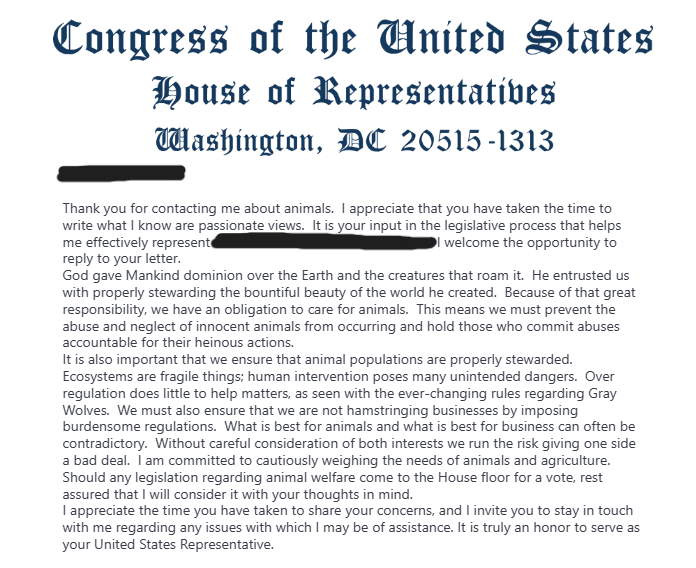
Stop.
Take a seat.
So many humans use a “father” who willingly allowed his own “son” to be violently tortured and murdered, legally, as a guidepost for ethics. I’m not confident such a being has a really firm grasp of “care”, “innocence”, or “stewardship”.
And their behaviour is actually quite transparent when people blame god for their hateful, intolerant, or violent choices, whether to “sanctify” homophobia, racism, misogyny, apathy, and/or suffering and death. But if you can’t be responsible for your own cruel actions, why does God have to be? Is it because paying for forgiveness is such a socially-acceptable soul cleanser? Toss a $20 tithe and those closing gates open right up again? We live in a society of infant-mature adults who still breastfeed and cowardly blame “god” because you KNOW your behaviour is harmful but choose a religion-washing facade rather than be better.
And it’s bizarre how so many humans believe in a “god” but don’t believe that NOT harming animals is actually more beneficial to animals than harming animals…………………….
In any case, here’s my response, and to clarify, even AWA or HSA “coverage” is 100% meaningless, but I share basic facts with people who obviously are unaware of (or pretend to be) the government protocols they represent. People say all the time that it’s illegal to be cruel to animals while they are literally eating an animal’s unwillingly violated, fearfully killed, and dismembered corpse.
Representative,
Thank you for the invitation to “stay in touch”, please allow me the opportunity to therefore respond to your message with respect to animals.
First, God did not give “mankind” “dominion over animals” that translates into trillions of animals being relentlessly butchered yearly, globally today. He’s not here to defend Himself against the atrocities humans effortlessly inflict on animals in His name. What you are referring to is a bible, written by people thousands of years ago according to then, that is used today as confirmation bias: in other words, humans enjoy using religion to satisfy their own opinions, interpreting the bible to validate intolerance, apathy, and “dominion over animals” that violently kills trillions yearly in reprehensible manners.
If people need to use the bible to satisfy personal choices, then why not choose Genesis 1:29 instead, where God gave humans fruits, seeds, and nuts to eat as “meat”? Why choose the violent passages over the one that takes precedence and causes least harm? Or do you suppose it’s just comforting to have zero accountability, challenging ethics with vague, arbitrary “god’s will”?
God did not demand that Americans exempt all animals exploited for food in the USA from the (meager) Animal Welfare Act; God also did not instruct Americans to deny “coverage” under the Methods of Humane Slaughter Act to 90% of animals butchered yearly in the USA (poultry and fish are not included). God also did not provide a euphemizing thesaurus to deceptively label violence against animals as “humane” or based on “welfare”. Did He? And for certain, no god or any deity for that matter, blessed humans with empathy only to demand it be rejected in defiance of Him to effortlessly inflict pain, suffering, and violence on animals: imagine pretending that God gave non-human animals the capacity to experience pain, fear, and suffering, like human animals do, only to will humans to cause such against them, the most vulnerable and defenseless of creatures. That’s not a benevolent god, is it?
Second, those fragile ecosystems are continuously destroyed to grow food for the animals humans eat.
And third, with respect to your claim that “innocent animals” (no animal is actually guilty yet must suffer as if regardless) need to be protected from abuse and neglect, using their bodies and killing them is inherently abusive and neglectful.
Allow me to explain with some questions.
Did you know that the USDA recently released 1000s of pages of slaughter “violations” that proves that animals are relentlessly subjected to horrors humans love to ignore because “god, tho”? Did you know the USDA had to be sued to release those records? Nobody hesitates to share “good stuff” so we all know why they had to be sued.
Nothing good ever happens in a slaughterhouse, nobody takes their companion dogs and cats to be killed in them, but since humans have the privilege of never having to experience being killed and eaten by another largely indifferent society, it’s really easy to overlook the terror and pain required of animals in them.
Source, USDA (this is just one link, there are many):
FOIA-2019-298-Released-Records.pdf (usda.gov)
Did you know millions of calves, many as young as 3 weeks, are routinely killed because males are worthless to the “industry”?
Source, USDA:
“Male dairy calves are used in the veal industry. Dairy cows must give birth to continue producing milk, but male dairy calves are of little or no value to the dairy farmer.”
Veal from Farm to Table | Food Safety and Inspection Service (usda.gov)
Page 6, USDA slaughter totals:
Livestock Slaughter 2021 Summary 04/20/2022 (cornell.edu)
USDA, pages 43 and 67, deaths in calves not due to slaughter:
cattle_calves_deathloss_2015.pdf (usda.gov)
Did you know pigs are routinely stunned using CO2 in disturbingly grotesque and painful manners? Do you understand why undercover and whistleblower footage is meaningful? Because the industry will never release its own footage based on the terror and violence required of the animal victims.
Spy Cams Reveal the Grim Reality of Slaughterhouse Gas Chambers | WIRED
Did you know that millions of animals are “condemned” each year in just the USA because of the diseases and squalor they’re forced to exist with and in? That fact is from the USDA as well and is not consistent with your belief that animals should not be abused or neglected.
Source, USDA: This is for ONLY 2 months, refer to page 6 where you can see the various reasons for condemnation, including leukosis, septicaemia, tumors, contamination, and overscalding (which includes being boiled alive):
Poultry Slaughter 02/22/2023 (cornell.edu)
Those are just a few examples of how humans are “properly stewarding” animals, I share them with you because it sounds as if your office is unaware of what actually happens to them, but people love to define the suffering of others in terms that causes people comfort causing the suffering of others but that does nothing for their victims.
To be honest and logical based on what happens today to animals who never agreed to be exploited and violently killed, nobody kills and consumes and uses animals because they honestly believe that NOT killing, NOT consuming, and NOT using animals is UNethical or INhumane or “sinfully” contrary to “god’s will”.
And for certain, if “properly caring” for animals is important, then NOT harming them, ie., NOT violating and NOT violently killing them, is MORE important.
Humans have historically defended violence, cruelty, and death based on economic benefit. I don’t smoke to sustain tobacco farmers who also have families to feed, and I likewise don’t exploit animals because Wan Long likely enjoys a paycheck, too.
And I certainly don’t need an old book to define my morals, God’s not a congressperson, you are. Basic decency requires humans NOT violate and violently kill others: nonviolence and least harm is ALWAYS better than violently harming. And THAT is what is “best” for animals.
Stacey
(btw, I don’t use disingenuous greetings or closings, since I oppose your shitty, hateful, and/or violent behaviour, you are most definitely NOT my friend and I’m not going to pretend you are. It’s one of my biggest pet peeves when people write me using preformatted and feigned “dear” and “friend” and “warmest regards”, “best regards”, “warmest and most best regards”, blahblahblah, as if such pithy words validate a message of disagreement, intolerance, or welcomed violence and embraced death.)
Oh, and I did receive another response in which I was told my above message was sent to an unmonitored inbox, but if you can’t hit “reply” to respond to a previous email, I would expect that email to at least indicate such, correct? Do you suppose my invitation to “stay in touch” was revoked?
Typical.
SL
Download Your FREE Vegan PDF HERE
Order a FREE vegan kit HERE
Dairy-Free Info HERE
Take the Dairy-Free Challenge HERE
Click HERE for more Dairy-Free
Fish alternatives can be found HERE
Learn about eggs HERE
Find bacon alternatives HERE and HERE
Take PETA’s Cruelty-Free Shopping Guide along with you next time you head to the store! The handy guide will help you find humane products at a glance. Order a FREE copy HERE
Searching for Cruelty-Free Cosmetics, Personal-Care Products, Vegan Products, or more?
Click HERE to search.
Free PDF of Vegan & Cruelty-Free Products/Companies HERE
Click HERE to find out How to Wear Vegan
Want to do more than go vegan? Help others to do so! Click below for nominal, or no, fees to vegan literature that you can use to convince others that veganism is the only compassionate route to being an animal friend:
PETA HERE
Vegan Outreach HERE
Get your FREE Activist Kit from PETA, including stickers, leaflets, and guide HERE
Our universe is the living breathing deity. All life is a light, from that light.
But if you don’t ignore the violent suffering of animals, kids will get cavities …
I’m gonna have to call out some traumatized nonvegans again. On a comment board following a NYT opinion article Rescuing Farm Animals From Cruelty Should Be Legal in favor of a DxE rescue of two chickens from the death industry, some nonvegans had to digitally vocalize why those two chickens should have instead continued to suffer and violently die in a “caring, welfare-respectful establishment” – while ignoring that there are zero laws “protecting” “food animals”(USDA Animal Welfare Act page 6) – in a world where trillions of animals violently suffer yearly for a largely indifferent society that doesn’t experience anger at SUFFERING but rather at people who rescue animals from suffering. I know that was really wordy, but it’s hard summarizing the mass, incalculable violence and pain humans effortlessly inflict, but relentlessly defend, on innocents. (And I’ll just point out here that ALL animal exploitation is cruel, not just “some”.) The comments were eventually closed so I was unable to respond to a couple directly, and while there’s probably a 100% chance of 0 that the original commenters will see my responses here, I think it’s important to make these corrections in general as so many of these excuses are inaccurately-yet-consistently demonstrated by so many non (anti) vegans, whose only change is their name, to attempt to validate injustice. And I can’t just ignore them. Sue me.

This is a favorite of mine: nonvegans demanding vegans make violence against animals more comfortable for nonvegans. So instead of saving chickens, because obviously Michael likes to eat chickens, animal rescuers need to instead concentrate on saving “veal” calves, obviously because Michael doesn’t like the flavor of infant flesh but needs to deflect from his willing participation in chicken suffering and float the idea that because calves violently die due to not being rescued by vegans – versus being killed for and by nonvegans – he can’t be bothered to not kill chickens. (I mean, antivegans’ excuses are like a brain trust in reverse.)
(And they’re not “its”, but I understand that humans have been exploiting speciesist language to distance themselves from their sentient victims since communication was born and it’s just easier for people to refer to boats as “she” and animals as “its”.)
I actually answered this one by factually demonstrating, with USDA data, that “veal” is caused by “dairy”. In other words, Michael, your milk, cheese, and ice cream consumption – because you actually do like to eat those – are responsible for all those poor, sweet baby cows being violently confined and killed as early as 3 weeks of age (of course there are millions who violently die at an even earlier age of 0 in slaughterhouses, too, when their mothers are violently killed and cut open to – surprise! baby here who needs to be killed too).
Michael’s response?
Silence, aka, a hugely silent, “OOOOOOOOOOPS!!! I didn’t know that so will just pretend that I still don’t know and ignore that I personally cause baby cow suffering AND chicken suffering ….”
Of course.
Cruelty is only offensive when you don’t know about or acknowledge that you are directly responsible for said cruelty.
But yes, it’s vegans’ responsibility to help Michael sort his conscience on his self-serving journey to zero accountability….
Just stop the tantrum-blaming, suggesting your cruel actions and violent behaviour are someone else’s responsibility, I’m not here to make you feel better about abusing animals, that’s all on YOU, YOU enable “veal crates” and other suffering via your actions and pathetic welfare “reform” internet support and involvement in an inherently cruel “system” that normalizes a culture of violent animal suffering and death that is ALL RELATED. (And as for those “reforms” I swear I’m going to hurl if I see another person scream, “Yes, pass those regulations, I’m more than happy to pay more for humanely raised animals!!!” while STILL supporting what they admit is cruel NOW. Not to mention – again – that ALL animal exploitation is inherently cruel: if a bigger cage is important, what’s more important than NO CAGE? NOT “cage free”, which is just as bad. What animals need aren’t two inches more of extreme confinement followed by the same brief existence of mutilation, pain, suffering, and violent death, I mean: NO EXPLOITATION AT ALL. Nothing is more of an improvement for the WELFARE of animals, for the HUMANE treatment of animals, than humans being VEGAN and leaving animals TF alone.
People have been brainwashed into conformist flesh zombies, believing that unethically and inhumanely violating and violently killing animals is ok because “poor people, male-calves-I-mean-oooops-not-really, a vague future with maybe bigger cages, children’s cavities tho” … :
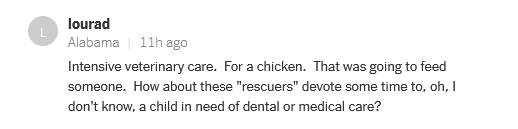
How about you? Because, you know, instead of spending time criticizing people who spend time helping animals, how many teeth could you have saved by NOT taking time reading and commenting on an article that makes you angsty? (Are you even a dentist or are you implying we all just need to grab some pliers? Seems a bit torturous but I wouldn’t expect an animal abusing apologist to care much about kids anyway.)
But you don’t really care about kids, you care about inventing some fake moral outrage so you don’t have to address the factual suffering and cruelty YOU cause that you could easily NOT.
I mean, imagine feeling so insecure as to suggest that NOT helping animals is required to helping kids while simultaneously ignoring abject animal abuse – animals being boiled alive in this case – because you’re incapable of being a decent human who refuses such cruelties but have to pretend that you’re not complicit because kids get cavities. Desperate much? I can’t even word your illogic logically it’s so bizarre.
But do tell how your violence helps kids with their medical care. And do share also how many sports events, malls, libraries, grocers, theaters, clothing stores, zoos, vet clinics, etc., etc., etc., you’ve visited, screaming at people who shop, play sports, or watch tv, that THEY should instead spend time helping other humans with their dental needs.
Oh. It’s only people who care about animals that you enragingly target: “I refuse to minimize animal suffering so I’m just gonna criticize those who do!!!”
You know why? Because you can’t justify your cruel behaviour, but rather than examine and change it, you have to try to bring others down to your level of indecency and apathy. Indeed, rather than choosing plant-based milk instead of suffering cow’s milk, you have to falsely accuse animal rescuers of being anti-human to deflect from your pro-abuse behaviour.
The hubris irony of “humanitarians” who demand those very humans NOT exercise their rights and ethics to minimize suffering. Honestly, I’ve never been hit with so much hatred than from antivegan “humanitarians” who casually forget that vegans are, you know, human.
And by the way, millions upon millions of animals are condemned (removed from “food supply”) yearly due to disease, neglect, and squalor, do they affect kids’ teeth? Or is it only the animals who are rescued … from you?
And to be clear, the people who spend gobsandgobs of time killing animals, abusing animals, hunting animals, eating animals, cooking animals, using animals, buying animals, wearing animals, breeding animals, impregnating animals, mutilating animals, celebrating animal violence, encouraging more violent exploitation of animals, mocking animal suffering, and mocking people opposed to animal exploitation, are cool, though? As long as a person’s time used to abuse animals aligns with your standard of “legitimate time suckage via animal suffering” they’re good? It’s almost as if you are implying that people who are complicit in the violent exploitation of animals intrinsically care about others’ dental needs ………………………………………………………………………………….. LOLOLOL
So much logic it makes me want to cry ………..
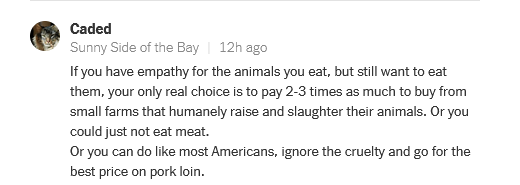
The last comment was correct, but the disinformation machine is alive and violently successful in the first. People say things with zero hesitation because many honestly believe what they’re saying is the truth based on what THEY heard and on and on and on. (Listen to Jem’s They)
You can’t have “empathy” for animals you eat. You have to literally smother your capacity for empathy and instead adopt indifference and word salad justifications overandoverandover to make yourself believe that abusing animals benefits animals. And “humanely raising” is reserved for beings who benefit from a nurturing environment of care and support as they age, not one that exploits and violates your body prior to your body being violently killed and eaten at a fraction of your “normal” lifespan, ffs.
But where are these small farms that slaughter their “own animals” and sell them to community members? I see this “advice” all the time.
Which is really bizarre.
Because it’s illegal.
It’s not a fruit stand, folks, you can’t just “stop by” Farmer Bob’s on your way to bingo and buy a leg and a pound of guts.
In the US, all flesh commercially sold requires inspection and certification via a slaughterhouse. While farmers can kill and consume their “own” animals, it’s illegal to sell their body parts to others.
What’s really (angeringly) interesting is that you’ll NEVER see farmers or industry shills correcting misinformation. No, instead they fuel it with ludicrous, “We love the animals, they’re like our children!!!”
Yikes.
Imagine the absolute betrayal animals experience at the violent hands of their “parents”.
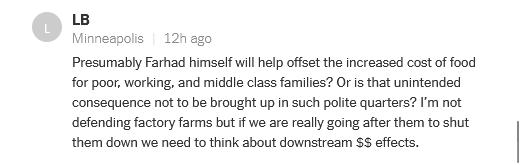
Ah, LB from Minneapolis nobly participates in abject animal suffering because LB is concerned about “poor people”: “I reallyreally hate abusing animals, but I’m forced to eat dead animals to help poor people…………..”
I wonder if LB smokes and also encourages other people to smoke to sustain tobacco farmers? They have families to feed, too, right?
Honestly.
Caring about poor people doesn’t require animal abuse, that’s just the desperate position you take to garner social approval for being pro-violence. Not one utterance of shock at the violence you cause, LB, just vague references excusing it because “other people tho”; and not actively condemning animal exploitation by being vegan DOES defend factory farming. The entire world loves to object to factory farms on the internet but even with such global condemnation, they still exist “producing” >90% of animals violently killed globally for consumption each year. Someone’s fibbing, LB. Shocker.
And let’s be honest: it’s actually privileged to believe others’ bodies belong to you and abuse and kill them for that belief.
And empathy is free. Use it!
Zero antivegans care about poor people, migrant workers, people who live in food deserts, or quinoa farmers in Peru until vegans enter the room. Then they turn into snot-sobbing humanitarians who boldly sacrifice ethics and exploit other people’s tragedies and negative experiences to (attempt to) legitimatize eating violence (while also ignoring that the largest consumer segment of plant-based food are people who also eat animals).
You can care about animals and humans. At the same time. I do, why can’t you?
A pound of “ground beef” would cost about $35 minus subsidies, how about you stop exploiting animals and use those dollars in a more worthwhile manner? Because rather than admit that you don’t need to support animal abuse, you deflect by instead pretending that violence against animals is ok based on “my (fake) hurty feelings about poor people tho” and criticize people who support animal rescue.
And by the way, when people exploit “poor people, migrant workers, people who live in food deserts, or quinoa farmers in Peru” to (attempt to) legitimatize their personal contribution to animal suffering, they’re suggesting that “poor people, migrant workers, people who live in food deserts, or quinoa farmers in Peru” are incapable of being vegan and incapable of minimizing animal suffering …
And THAT’S offensive.
SL
Download Your FREE Vegan PDF HERE
Order a FREE vegan kit HERE
Dairy-Free Info HERE
Take the Dairy-Free Challenge HERE
Click HERE for more Dairy-Free
Fish alternatives can be found HERE
Learn about eggs HERE
Find bacon alternatives HERE and HERE
Take PETA’s Cruelty-Free Shopping Guide along with you next time you head to the store! The handy guide will help you find humane products at a glance. Order a FREE copy HERE
Searching for Cruelty-Free Cosmetics, Personal-Care Products, Vegan Products, or more?
Click HERE to search.
Free PDF of Vegan & Cruelty-Free Products/Companies HERE
Click HERE to find out How to Wear Vegan!
Want to do more than go vegan? Help others to do so! Click below for nominal, or no, fees to vegan literature that you can use to convince others that veganism is the only compassionate route to being an animal friend:
PETA HERE
Vegan Outreach HERE
Get your FREE Activist Kit from PETA, including stickers, leaflets, and guide HERE
Ignorance is never bliss to its victims
Vegans have been sharing slaughterhouse footage for eons but thank goodness nonvegan CCTV is now available to “protect” animals in slaughterhouses………..
Spy Cams Reveal the Horrible Animal Suffering Required in Slaughterhouse Gas Chambers : See above and additional footage of Smithfield Foods Gas Chambers recently exposed by Investigator Raven Deerbrook (@RestlessDoe).
I received an email yesterday from the RSPCA asking me to sign a petition requiring CCTV in slaughterhouses to “protect” animals. Of course I had to write back.
And they responded!
As did I. Again. Because I’m not one of those people who needs to be “assured” (the irony) animals don’t suffer for humans (they do, relentlessly) and donate $50 for a free tote bag showing alive animals (the irony), while proudly displaying Bumper Sticker Activism (SAVE THE WHALES!) while eating fish (again, the irony) …
Don’t come at me with your wordy nonsense suggesting you’ve made the bold and noble decision to sacrifice ethics and support animal suffering because most of “civilization” is also challenged by decency … while also – bizarrely – stating you don’t encourage animal consumption … while simultaneously sharing a link to your RSPCA-Assured scheme (scam) that LITERALLY encourages humans to abuse animals by consuming their abusively-and-violently-killed bodies.
Hypocrisy much?
Vegans have been exposing and sharing slaughterhouse footage since practically the birth of time to mostly willfully ignorant people who blame vegans for exposing such horrific violence rather than themselves for participating in and causing said horrific violence.
But somehow, nonvegans recording animals’ required violent killings will benefit those animals.
Somehow.
Some…
How…
Wait. How???
If it wasn’t so hypocritically violent, it would be satire.
Who’s going to watch, industry employees? An assigned “independent consultant” who also consumes animals? It won’t be available to the public but who would watch anyway? (Besides vegans of course.)
Here’s the thing: footage that reveals cruelty is ALWAYS IGNORED by people who instead favor, “Not here! Anomaly! Illegal!” How many times have YOU excused suffering based on, “It should be blahquickblahpainlessblah.” (Which conveniently ignores the suffering animals are required to experience before the final violent act of being killed.) Did you know using “should” is your subconscious tell? Because you know it’s NEVER “should”, it’s ALWAYS violent suffering.
Why is it that people accept that laws prohibiting human abuses don’t prevent human deaths but people think regulations that “illegalize” animal abuses magically prevent animal abuse/death??? You know how ludicrous that is, correct?
If animal abuse was globally illegal, slaughterhouses wouldn’t exist … because animals should NOT be exploitatively abused.
You will agree that violently killing others is unethical as well as inhumane, correct? Because if someone’s companion dog being violently killed is “inhumane” – based on the victim’s capacity to experience pain and cruelty (though not required) rather than the abuser’s motive for inflicting pain and cruelty – then the human categorization of “inhumane” shouldn’t change based on species, and that being killed is being inherently abused. But when applied to “consumed animals” your “ethics” dramatically shift to the “conditions-that-benefit-me, tho” clause. Not to mention that trillions of animals are violently killed EACH YEAR but supposedly all animals globally will be “protected” by CCTV requirements. You can’t even count that high. And all animal exploitation is related: if you eat chickens in the US, you are contributing to a foundation of normalized violence that forgives animal consumption elsewhere of catsdogshorsesrabbitsetcetcetc.
And nobody except zero people has ever suggested that companion animals be “euthanized” in slaughterhouses because it’s all so humane due to “CCTV, tho”. Right?
And on that topic, people who (understandably) “aggressively” campaign against the CDMT (“cat and dog meat trades”) aren’t demanding video coverage of the cat and dog victims’ violent deaths to “protect” cats and dogs, they’re demanding an uncompromising elimination of the CDMT industry in whole. (But since the vast majority of them aren’t vegan, they’re heralded for their brave and necessary advocacy…)
Anything to smother that bit of conscience, huh?
If you’re a nonvegan promoting CCTV as necessary to “protect” animals while those animals are being violently killed, what is a more ideal and actually meaningful way to protect animals than NOT SENDING ANIMALS TO SLAUGHTERHOUSES IN THE FIRST PLACE?
Indeed, if you admit slaughterhouses are badbadbad enough to require CCTV, then why are YOU sending animals there?
And for certain, you will NEVER see footage of CO2 chambers publicly released by the industry. Never.
Listen, folks, to protect animals, you don’t have to donate to welfare organizations who profit from animal exploitation and tell people what they want to hear – that violating, controlling, and violently killing animals is beneficial to animals and helps protect them (?!?). What you need to do is just stop ab/using animals. Just stop. It’s also 100% meaningless to sign petitions or frame animal violence in human-acceptable manners via pathetic and paltry welfare improvements (a prison with a death sentence is still a prison with a death sentence even if the confinement is slightly larger – and animals are innocent), you just have to stop harming animals.
If you’re advocating for the “humane treatment” of animals, what is more humane than NOT harming/killing them?
Nonvegans never answer that question, it’s just their way of defining the pain they inflict on others in manners that makes them feel comfortable inflicting pain on others. SL
Download Your FREE Vegan PDF HERE
Order a FREE vegan kit HERE
Dairy-Free Info HERE
Take the Dairy-Free Challenge HERE
Click HERE for more Dairy-Free
Fish alternatives can be found HERE
Learn about eggs HERE
Find bacon alternatives HERE and HERE
Take PETA’s Cruelty-Free Shopping Guide along with you next time you head to the store! The handy guide will help you find humane products at a glance. Order a FREE copy HERE
Searching for Cruelty-Free Cosmetics, Personal-Care Products, Vegan Products, or more?
Click HERE to search.
Free PDF of Vegan & Cruelty-Free Products/Companies HERE
Click HERE to find out How to Wear Vegan!
Want to do more than go vegan? Help others to do so! Click below for nominal, or no, fees to vegan literature that you can use to convince others that veganism is the only compassionate route to being an animal friend:
PETA HERE
Vegan Outreach HERE
Get your FREE Activist Kit from PETA, including stickers, leaflets, and guide HERE
Some humans are a rather limited and clueless bunch who live their lives by the hypocritic oath
DEBUNKED: Do vegans kill more animals through crop deaths?
Since you don’t care about animals who die in slaughterhouses, don’t pretend you care about the ones killed in crop harvesting, the majority of whom are killed for YOUR “meat” …
I know facts often challenge the ethical-deficient “carnivores” who enjoy animal death, but I came across another crop-harvesting-tu-quoque animal abuser recently (ironically on a petition message board protesting the abuse of a “pet pig” where I inspired the unhinged drama of an “animal lover” threatened by my vegan comment about how ALL pigs who suffer for humans deserve to NOT also, and why do people NOT understand the normalized violence of killing trillions of animals yearly, exploited for food, has violent “NOT normal” consequences on OTHER “worthy” animals? ) that I think it’s time to revisit the failed logic and mathematics of people desperate enough to shrilly scream (falsely) about the “poor sweet mice and bunnies who cannot run and instead die via harvesting for only vegans’ food…” while dismissing animals who are enslaved, violated, mutilated, and then violently butchered, exploited for “food”. If your wrath is in response to vegan consistency exposing the horrors ALL animals endure for humans, then your defense is strictly egotistic, vegans aren’t the ones who have self-serving motives, that’s YOU.
And for sure, nonvegans harvest crops, not vegans, so of course the cheapest, ie., most lethal, production methods are utilized; in a vegan world, crop deaths would be minimized or eliminated completely.
Anti/nonvegans always fail to also consider the mass animal deaths of those who are NOT violently butchered in slaughterhouses but who die in other areas of “anag production” such as those who – ahem – die in crop harvesting for crops, the vast majority of which are used to feed the animal victims nonvegans consume; those exploited for AI (see Boe’s tragic story); those who die during birth or infancy/due to disease and squalor/due to neglect/due to abuse; those who die to “protect” animals exploited for food (yup, the USDA kills upwards of one millions native animals yearly so the animals killed for food are protected from being killed for food by native animals); those who die via transport; those who die on feed lots; those who die in weather-related events; etc., etc., etc. (But let’s be honest here, ALL animals bred to be dead are inherently neglected and abused, as are the ones who won’t be consumed but who are violently killed for humans anyway.)
And to the antivegan haters who haunt vegan social media in efforts to convince the masses that flesh is necessary for “optimal health”, including the “concerned” public who desperately flaunt being a flexatarian/reducetarian/vegetarian/soilist-regenerationer, ie.,OMNIVORE; the fake doctors who joyfully dedicate threads to (attempts to) body shame vegans or who quote vegans in bizarrely irrelevant manners; the enraged “carnivores” so obsessed with vegans their every moment is desperately dedicated to co-opting vegan into “vegan carnivorism”; the “ex vegans” who were NEVER vegan but who enjoy the attention they so desperately seek and need lying about how they drank only juice for one week and then almost died and blame all vegans, past-present-and-future: imagine having to lie each and every day to yourself and others that flesh is necessary for health while also having ZERO concern about your absolutely UNHEALTHY BEHAVIOR. Seriously, that you cannot see it is bizarre and not-just-a-small-amount disturbing, it’s as if you’re insecure in your securely insulated, indoctrinated, abusive world of billions who also don’t care about animals. I mean, imagine leading such a seemingly insignificant but cruel existence, threatened by nonviolence, empathy, and justice, that your only joy comes from compulsively lying about vegans, spending literally gobs upon gobs upon gobs of time doing nothing but stalking vegan accounts.
So yes, do stay mad, bitter, and obsessed, pro animal killers, because you’re more concerned with only the pseudo appearance of caring to generate social approval and not the animals who violently suffer and die for you. My anger about the abuses and incalculable suffering inflicted on animals by all-privileged-humans, is legitimate, think cats and dogs and other “pets” and how enraged Americans get over their abuse, applied towards all animals. You antivegans, though? Your anger is for all the wrong reasons, directed towards people who minimize animal suffering because you are incapable of decency so instead feel compelled to flaw vegans and not the abuses you pile on innocents, especially considering nobody is forcing you to NOT abuse animals. What happened to you to make you this way? You boast about your cruelty as easily as people chitchat about the game or the weather around the water cooler. Seriously, get help, gtfu, or get a new hobby and leave the animals TF alone because your “love” and “caring” feel a lot like indifference, abuse, and suffering.
(And ANYONE who listens to an absolutely vile and repulsive human-waste like Ted Nugent speaks volumes about those who use him as a source for ANYTHING other than trash. Like, jfc.) SL
Source Surge
By Ed Winters
Ted Nugent, a man who said that the South African apartheid “isn’t that cut and dry” and that all men are not created equal, and who bragged about his relationships with underage girls, went on the Joe Rogan Experience podcast in 2018 to talk about, of all things, morality. Specifically, how those who follow a vegan lifestyle are responsible for more animal deaths – through the harvesting of crops and use of fertilisers and pesticides – than people who choose to consume animals directly.
We do see this comment quite often and it’s about time we took a good look at the argument being made. Are animals killed in plant production? Yes, but it’s not just vegans eating plants, especially soy – of all the crops to choose. In fact, around 75 to 80 per cent of the soy that is produced is used as farmed animal feed and only 6 per cent is actually used for human consumption. Therefore, if you are upset about animals being killed in soy farming, then stop funding the industries that use three-quarters of all the soy that is grown.
Nugent is not the only one who has made this argument. Chris Kresser used the same argument a year later also on the Joe Rogan podcast in which he cited a research paper that stated that 7.3 billion animals were killed every year from plant agriculture if counting, as well as mouse deaths, birds killed by pesticides, fish killed by fertiliser run-off and lizards and amphibians killed by eating insects contaminated with toxic pesticides.
Firstly, more than 9.5 billion land animals are killed directly for food in the US each year and when you add marine animals that number becomes 55 billion, so more animals are still killed directly for meat, dairy and eggs than they are for crops. Secondly, according to data from the USDA, 77.3 million acres of land in the US are used to grow crops that humans eat directly, and 127.4 million acres are used to grow crops that are converted to animal feed, which means that about 65 per cent more land is harvested just to produce animal feed. That’s not to mention the 654 million acres of land that are used for pasture, which means that in the US ten times more land is given to animal farming compared to plant farming. In fact, according to the most comprehensive analysis ever conducted exploring farming and the environment 83 per cent of all global agricultural land is used for animal farming.
Let’s have a look at the study that Kresser cited in more detail – Field Deaths in Plant Agriculture – published in the Journal of Agricultural and Environmental Ethics in 2018. For those of you who saw his debate with James Wilks, who produced The Gamechangers, you’ll know that Kresser cannot read forest plots, but it seems as if he has a bigger problem – his inability to actually understand the subject matter in the first place, as he clearly had not read through the paper he cited.
Firstly, the 7.3 billion animals that Chris cites from this paper is derived from data that the authors call into question. In their own words they say, “the estimate should be reduced: 7.3 billion is clearly too high”. If you read the paper the authors actually do much more to dismantle the crop deaths argument, even providing example studies such as a 2004 study that examined the effect of wheat and corn harvesting in central Argentina. It compared the population and distribution of grass mice in three habitats: crop fields, regions bordering the fields and the wider surrounding area. While the number of mice found in fields substantially decreased after harvest, their numbers substantially increased in the border regions. When it came to disappearances, a category that included both mouse deaths and migration out of the study area, there was no significant difference between the three habitats. The study concluded that changes in the number of field animals were “the consequences of movement and not of high[er] mortality in crops”.
If you just think about it, do we really believe that when a combine harvester is approaching causing a huge amount of noise and vibrations, mice, who normally use their excellent hearing to evade predators, are just going to wait to be killed? The paper Kresser is citing as a piece of evidence, actually does a great job of disproving the very point that he is trying to make and the figure that he cites as evidence is actually disputed in the paper that he is using as evidence. Honestly, Chris Kresser is such a quack.
Where does this whole concept come from? Well, an article was published back in 2003 by someone called Steven Davis that made the statement that fewer animals are harmed in an omnivorous diet that consists of free-range ruminant animals compared to eating an entirely plant-based diet. However, the article assumed that equal amounts of land will produce equal amounts of food, whether that be crops or animal products. This is obviously not true.
Davis estimates that 7.5 animals are killed per hectare in ruminant pasture and that 15 are killed on land that is used to produce crops. So using his estimates this rebuttal that uses UN data states that 1,000 kilograms of protein can be produced on one hectare of land that is growing plants, but would take 10 hectares of land for grass-fed beef to produce the same amount. This means that Davis’s estimates actually further make the case for being plant-based as his own figures show that vegans are responsible for five times fewer animal deaths.
Further, non-vegans are paying for mutilations, reproductive system exploitation and other forms of suffering, which also applies to grass-fed animals who are disbudded, dehorned, castrated, have their ears tagged, can be branded and are transported in trucks for hours to get to slaughterhouses. In places like Australia, they can travel for 48 hours. Slaughterhouses are terrifying places for the animals to even be in before they are actually killed. Basically, being vegan doesn’t just reduce the number of animals killed on your behalf, it also reduces overall harm and suffering. Not to mention that animals killed in crop production have the chance to escape – the same cannot be said of farmed cows, sheep and so on.
There was then another article that was published back in 2011 and written by Mike Archer, which has been shared around by many non-vegans as it claims that wheat production is responsible for 25 times more deaths than grass-fed beef. Why? Because in Australia every four years on average there are events called mouse plagues where an overwhelming number of mice overrun the fields and are then often poisoned.
Mouse plagues only really occur in Australia, although they have happened in China. But the argument being made is that we shouldn’t be vegan because every four years or so there is a mouse plague in Australia during which farmers poison the mice. In essence, it’s saying that it’s bad for me to be a vegan in the UK because there are mouse plagues in Australia – how does that make sense? Regardless of how nonsensical the argument is, that didn’t stop Steven Crowder from using this logic to discount veganism the world over.
What about the mouse plague? Firstly, let’s just look at wheat consumption in Australia. According to the USDA, it is estimated that in 2019/2020, 3.5 million tonnes of wheat was produced for human consumption, whilst in the same period, six million tonnes was produced to be used as animal feed. So that means animal farmers use around 1.7 times more wheat and so would be responsible for around 1.7 times more mice being killed for wheat production alone.
This is important as well because around 80 per cent of beef sold in domestic supermarkets in Australia comes from animals that were grazing for about 85 to 90 per cent of their lives, but then are fattened up on feedlots for the last 10 to 15 per cent. On top of that, beef can still be sold as grass-fed if the cows have spent fewer than 70 days being fed grain, which, because cows are often slaughtered at around 18 months old, is within that 10 to 15 per cent time period.
What about solely grass-fed cattle, so animals who have only been fed grass? We have this idea that grass-fed means the animals are only consuming the pasture on which they are grazing but this is not the case. Hay, silage and haylage are all grass, so animals are still completely “grass-fed” when they are fed these food sources, which happens often, especially during the colder months or if pastures are nutritionally insufficient.
How do farmers get hay and silage? They have to harvest it. Meaning that even grass-fed cows are fed food that is harvested. So what about the mouse plagues? Well, at the beginning of March this year there was an article about the current mouse plague in Australia in which one farmer said this:
“The hay is a worry. Apparently, the mouse droppings and the urine all run through, it’s very damaging. It can disease cattle. It might be ruined.”
And in the same article another farmer is quoted:
“The Storer family grows sorghum to sell and feed their cattle but mice have been eating it, which has ‘hugely’ hurt them financially.”
Sorghum is a type of grass that is used to make hay. So basically the mouse plague affects the entire agricultural landscape, not just those who grow crops for vegans. This also applies to grass-fed cows as well who are fed hay and silage, which the mouse plague also affects. There is even a document put together by Feed Central, which is Australia’s largest hay selling platform, called Managing a Mouse Plague in Haystacks, which states that “whatever you do, don’t hold back on the number of bait stations.”
By way of a bit of perspective, around six million tonnes (metric tons) of hay is produced each year in Australia, which is nearly double the amount of wheat that is grown just for human consumption. On top of that, the mice also destroy pasture as well and impact grazing land, so even without the hay and silage, the mouse plagues still affect grass-fed cow farming.
Funnily enough, the article accusing vegans of causing more deaths does not mention any of that. We wonder why? Who causes more animal deaths: non-vegans who pay for animals to be directly killed and support industries that use significantly more grain, more land and also use all of the hay and silage; or vegans who use less grain, require less land, do not consume any hay or silage and do not pay for animals to be directly killed?
And guess what, the numbers that Archer uses in his article are twisted. He exaggerated the scale of the mouse plagues by stating that each area of grain production in Australia has a mouse plague every four years, but this is a falsehood according to – ironically – the article that Chris Kresser cited on the Joe Rogan podcast. You just can not make this up:
A more accurate picture is suggested by the Cooperative Research Centre which notes that each year between 100,000 and 500,000 hectares of grain crops in Australia are subject to mouse plagues. These figures suggest that in an average year 2.3 per cent of Australian grain cropland is hit by plague. When Archer’s figure of 55 deaths per hectare of grain is recalculated to only apply to 2.3 per cent of crop land the mortality rate for grain becomes 1.27 animals per hectare.
What this means is that when you use Archer’s figures for animal deaths, 2.2 animals are killed per 100kg of usable grass-fed beef protein, but only 0.7 animals are killed for 100kg of usable wheat protein. And also bear in mind that the 2.2 animal deaths for grass-fed protein do not include the animals killed for the harvest of hay, silage and other feed, so that number will actually be higher.
To summarise, plant-based farming does not cause more deaths, and the two main people who have tried to claim that it does have both inadvertently made the case for veganism even stronger, as when their numbers are applied correctly they also further prove that a plant-based diet kills fewer animals.
To top it all off, here is a chart showing the estimated number of deaths per one million calories for many of the major food items in our diets. As you can see, the difference in deaths between plant foods and animals is very substantial.

Not to mention that shifting to a plant-based diet would free up to 75 per cent of agricultural land, an area the equivalent of Australia, China, the EU and the US combined, which could be reforested and restored. In the words of a recent report from world-leading Chatham House:
Setting aside land for biodiversity to the exclusion of other uses, including farming, and either protecting or restoring natural habitat would offer the most benefit to biodiversity across a given landscape.
With the rise of vertical indoor farming, let’s end with another quote from the study that Chris Kresser cited:
Agriculture has taken a wide variety of forms throughout history, and current trends would seem to raise the serious possibility that plant agriculture might someday kill very few animals—perhaps even none.
So a plant-based diet isn’t just the most ethical right now, it’s going to continue to get more ethical as time goes by. If you care about animals and crop deaths, – AND EVEN IF YOU DON’T (SL) – then you should be need to be (SL) vegan.
Download Your FREE Vegan PDF HERE
Order a FREE vegan kit HERE
Dairy-Free Info HERE
Take the Dairy-Free Challenge HERE
Click HERE for more Dairy-Free
Fish alternatives can be found HERE
Learn about eggs HERE
Find bacon alternatives HERE and HERE
Take PETA’s Cruelty-Free Shopping Guide along with you next time you head to the store! The handy guide will help you find humane products at a glance. Order a FREE copy HERE
Searching for Cruelty-Free Cosmetics, Personal-Care Products, Vegan Products, or more?
Click HERE to search.
Free PDF of Vegan & Cruelty-Free Products/Companies HERE
Click HERE to find out How to Wear Vegan!
Want to do more than go vegan? Help others to do so! Click below for nominal, or no, fees to vegan literature that you can use to convince others that veganism is the only compassionate route to being an animal friend:
PETA HERE
Vegan Outreach HERE
Get your FREE Activist Kit from PETA, including stickers, leaflets, and guide HERE
The earth is not a carnivore’s playground
Show me your “humane slaughter” footage …

Source Jo Frederik, Jo Frederik’s Art
Pro-slaughter advocates always get morally outraged when vegans show factual slaughter images/videos/audios but never provide THEIR footage, while simutaneously boasting about redtractorrspcaassuredhumanefarmingassociationcertifiedhumanehighestofhighestwelfare … who all are “opposed” to “animal abuse” while literally promoting killing animals.
In what dimension is violently killing NOT abusive? The deli? Your kitchen?
If you need an organization to substantiate that violent killing is “humane”, then it’s not humane, it’s a label on a literally dead being who did not volunteer to die. My plant-based food requires zero disingenuous “viciously-but-humanely-killed” stickers.
I gotta say, though, even I am sometimes shocked at the level of blind conformity people desperately embrace to validate violence against animals, such as the UK’s HuMAnE SLaUGhTeR AsSoCIaTIoN’s selection of “gifts” and “christmas cards” depicting alive animals. Really? I mean, jfc, this is deranged and nothing short of vomitous, pure bile-inspiring, oxymoronic, hypocritical garbage.
For sure, what in the AF are “Bags for Life”? … Bags for Life. … BAGS FOR LIFE. These “gift selections” from a pro-slaughter entity that proudly supports violently killing animals, including calves and piglets, literally have pictures of alive animals on them, such as a calf and a piglet. B A G S F O R L I F E
Perhaps it’s because a bag has a longer lifespan than the life of an animal. Much, much, much longer, and the bag is worth even more, it’s literally considered a “gift” whereas an animal’s life is considered “violently-humanely-disposable”.
Since the only reason the HuMAnE SLaUGhTeR AsSoCIaTIoN exists in the first place is to promote DEATH, rather than an image capturing the (exploitative, violent, brief) “life” of an animal on your BAGS FOR LIFE, why don’t you demonstrate the “humane” actions you all so desperately and belligerently boast about, instead favoring the EXACT OPPOSITE?
Was it a misprint for BEGS FOR LIFE?
Because, come on, if humans are so proud of inventing methods of violence that require the suffering and unwilling deaths of animals, and then have the absolute audacity to call it “humane”, why not be proud enough to share images of THAT? Why not depict the actual reality of the suffering animals are forced to endure, animals who die in bloody, terrifying, painful, unethical, and horrific manners?
Too graphic? Too real? Too hellish?
But not too graphic, too real, or too hellish to actually NOT cause, NOT support, NOT pay for?
Typical human discord, typical human privilege, typical human passivity.
Here’s a question: what form of slaughter is more humane than NOT slaughtering animals?
Humans don’t kill animals because they honestly believe that NOT killing animals is INhumane or UNethical.
As I always say, it’s disturbing and actually dehumanizing that humans rely on defining others’ suffering in terms that brings humans comfort causing it instead of the ones forced to suffer. Humans spend literally gobs of time, energy, and resources to attempt to validate violently killing animals with their clubsorganizationschaptersbooksvideosmanualsregulationslawsmethodslabelsdefinitionspicturesblahblahblahblah. And really, why do you praise clubsorganizationschaptersbooksvideosmanualsregulationslawsmethodslabelsdefinitionspicturesblahblahblahblah that REQUIRE violent suffering???
Truth’s a bitch, isn’t it.
And since it’s that time of the year again, I have to ask: why do people buy fake Christmas trees because killing a live tree is psychopathic but killing animals is … NOT … !? SL
Download Your FREE Vegan PDF HERE
Order a FREE vegan kit HERE
Dairy-Free Info HERE
Take the Dairy-Free Challenge HERE
Click HERE for more Dairy-Free
Fish alternatives can be found HERE
Learn about eggs HERE
Find bacon alternatives HERE and HERE
Take PETA’s Cruelty-Free Shopping Guide along with you next time you head to the store! The handy guide will help you find humane products at a glance. Order a FREE copy HERE
Searching for Cruelty-Free Cosmetics, Personal-Care Products, Vegan Products, or more?
Click HERE to search.
Free PDF of Vegan & Cruelty-Free Products/Companies HERE
Click HERE to find out How to Wear Vegan!
Want to do more than go vegan? Help others to do so! Click below for nominal, or no, fees to vegan literature that you can use to convince others that veganism is the only compassionate route to being an animal friend:
PETA HERE
Vegan Outreach HERE
Get your FREE Activist Kit from PETA, including stickers, leaflets, and guide HERE
Humane slaughter is the most moronic of oxymorons
Circus berserkus
The circus is in town, what do you see?
As I look out at you, and you look in at me
Do you see me as a large, roaring captive toy,
Or do you look into my eyes, just know pain, no joy.
Do you giggle and point as you mill around my cage,
In my terror annoint as I seethe in rage.
Do you not understand that my roar is a shout:
Open up the door and let me out!!!







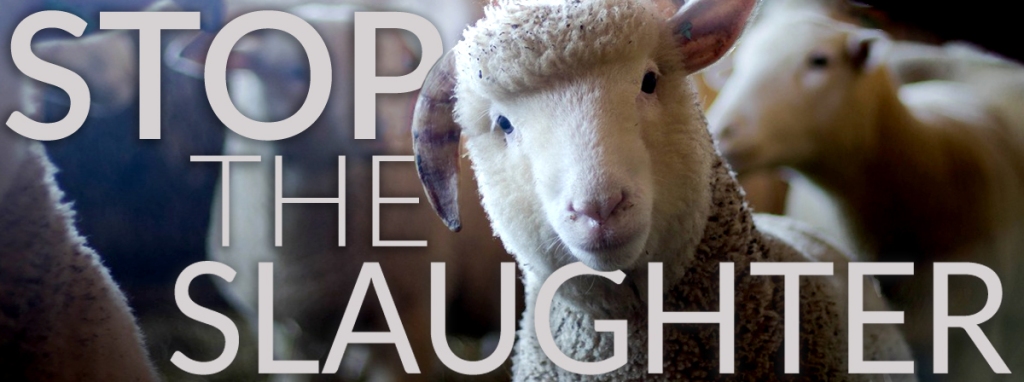



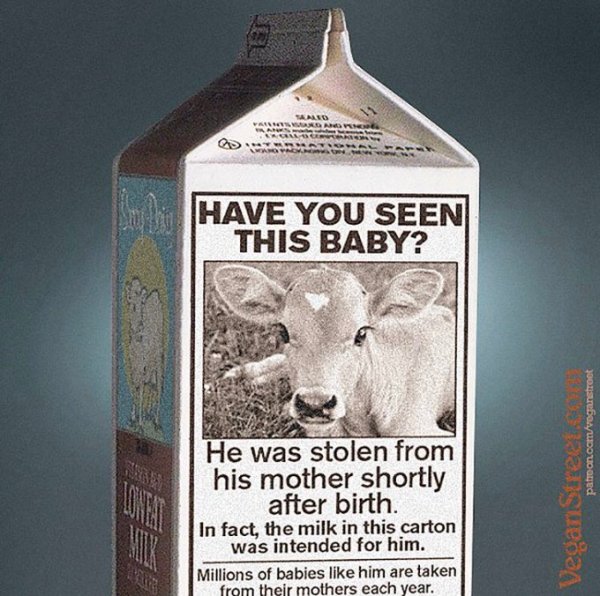


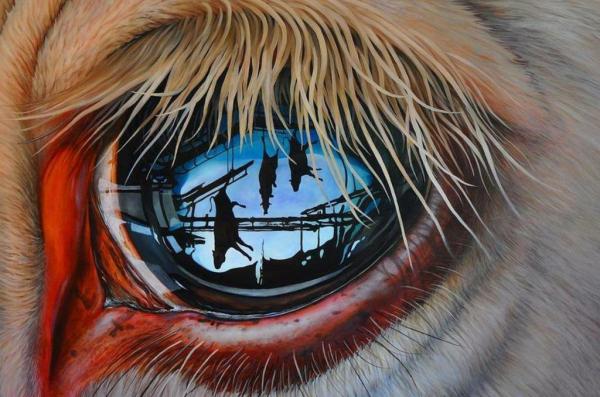


 Our Compass