Skip to content

HighestWelfare.Humane.Assured.GoodPractices.Vegetarian. Regenerative.Flexitarian.Lies...

What is the difference between No Welfare, High Welfare, and Highest Welfare when they all require animals to die? Only human comfort, NONE protect the actual animals. The most humane, ethical, and honest Webster-defined "welfare" is NOT exploiting animals - not using, not wearing, not eating, not killing - animals. The only meaningful position is vegan, everything else is just how humans euphemize animals' required suffering and violent deaths: no human exploits animals because they honestly believe that NOT exploiting animals is UNethical or INhumane.

25 Amazing New Vegan Products Coming in 2019

April 22, 2019
by


Source Some Vegan Girl
By Hannah Sentenac


I recently attended Natural Products Expo West for the first time ever. Holy hell, what a smorgasbord!

Expo West is an annual food show that draws some 80-100,000 people and six thousand brands. It’s massive and sprawling and totally cray in the best possible way.

Because it’s so huge and so prestigious, this is where all the brands — big and small — roll out and test their new vegan products. There are vegan product samples everyyyyyyywhere you turn.

So much deliciousness, so little stomach room!

If you didn’t make it this year, I highly suggest you make plans for 2020. But either way, I’ve got you covered as far as what you need to buy.

Of the dozens and dozens and dozens of new vegan products I tried, here are my top 25 picks. Some are already available, some are coming soon.

(And before you ask how you can get your hands on these amazing vegan products, here’s my response: store locators! Basically every company on this list has a store locator on its website, so you can type in your zip code and find out what deliciousness is available near you — or if it’s available for online order. VeganEssentials.com is also an amazing resource!)

Eat your heart out.

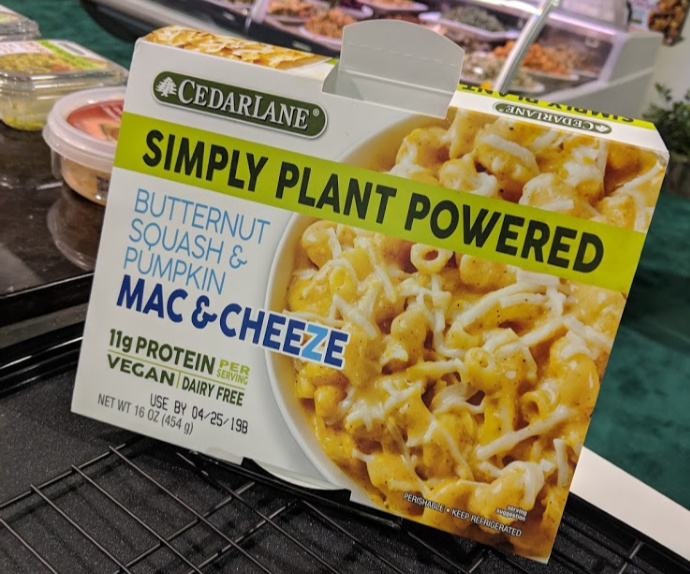
CedarLane Butternut Squash & Pumpkin Mac & Cheeze — This brand is new to me, and while I’d never tried any of their vegan products before, I was blown away by this mac and cheese. Creamy, flavorful, and definitely one of the best I’ve ever had.

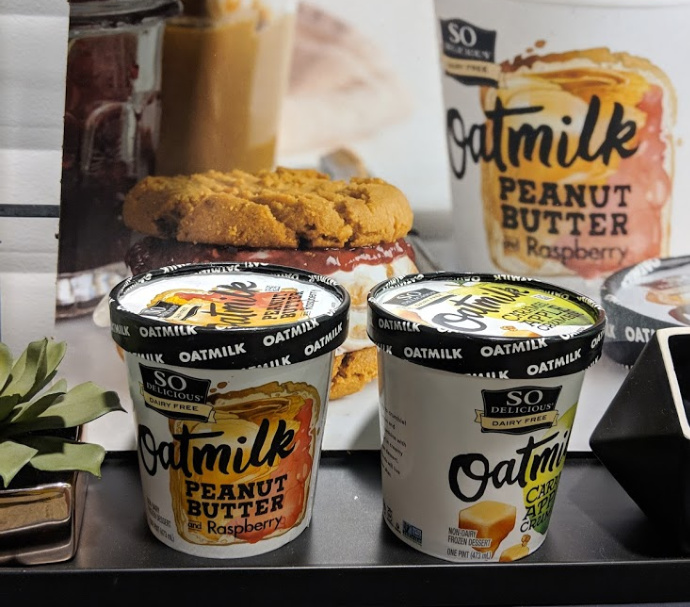
So Delicious Dairy Free Oatmilk Peanut Butter & Raspberry — I thought it couldn’t get any better than So Delicious Cashew Milk frozen treats … but I may have been wrong. The company’s new line of oatmilk vegan products is totally delicious. Super creamy and so much better for you than dairy ice cream.

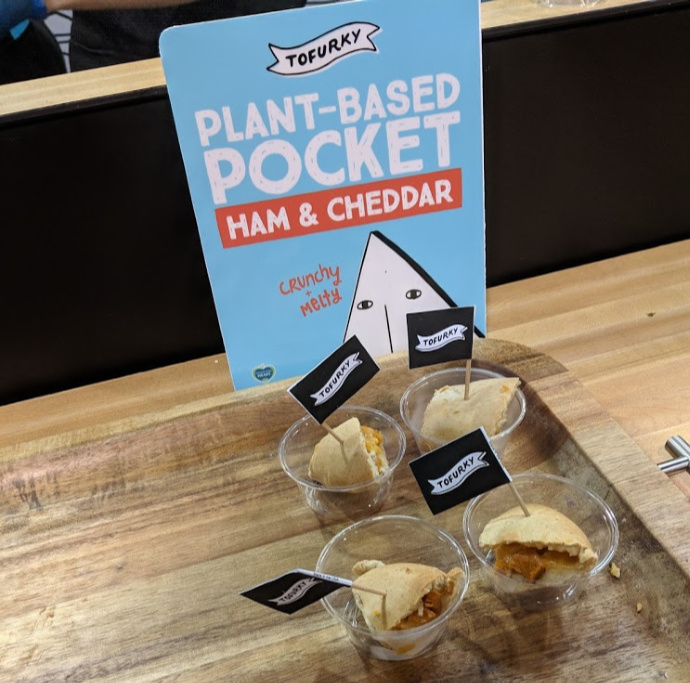
Tofurky Ham & Cheddar Plant-Based Pocket — The company we’ve counted on for decades is rolling out some new-and-improved products, including cheesecake and pockets. I was a huge fan of the previously released pockets (like Hot Pockets, but better and vegan), but the new variety is even more doughy and delicious.

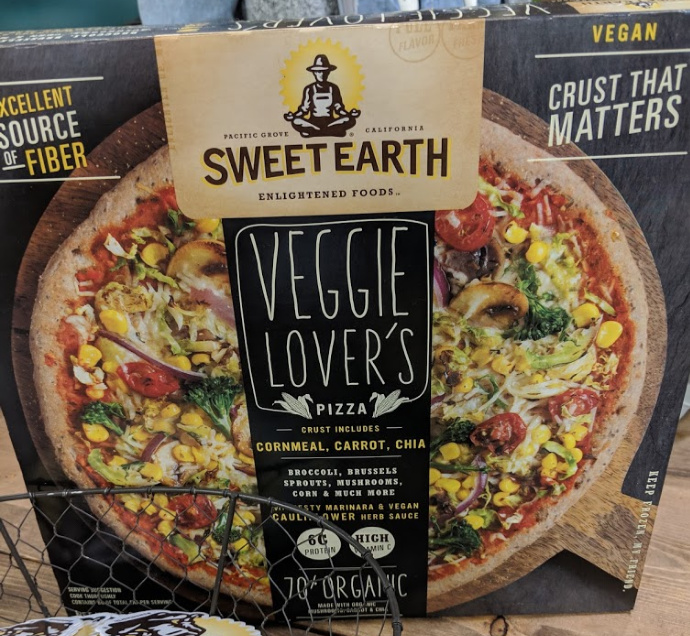
Sweet Earth Veggie Lover’s Pizza — Sweet Earth (maker of many frozen vegetarian and vegan products) is rolling out more and more vegan options by the day, including an amazing new pizza! It’s topped with veggies and non-dairy cheese and it’s delish.

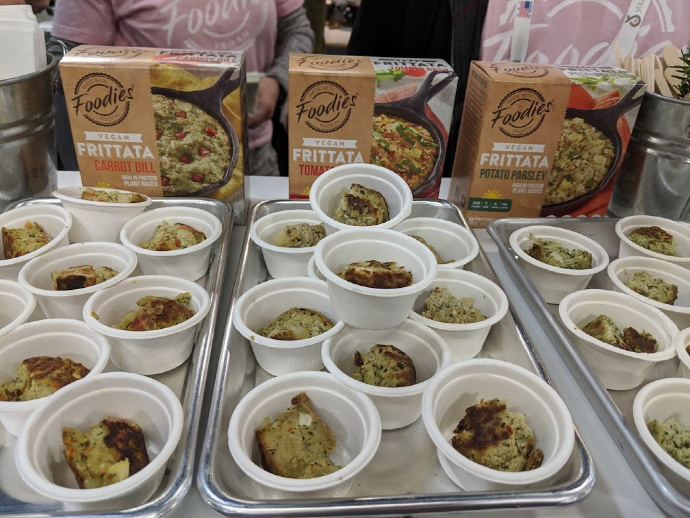
Foodies Vegan Organic Pumpkin Seed Tofu — Foodies is an incredibly impressive female-owned brand that makes some amazing vegan products including the brand new, game-changing pumpkin seed tofu (known as PUMFU), various flavors of vegan frittata (tomato basil, corn chipotle, carrot dill, etc.), plus artichoke burgers. Their products are in some stores including Kroger and Earth Fare, but the tofu has yet to be released. But keep an eye out for it — it’s DELICIOUS and the first-ever tofu option that’s soy-free!

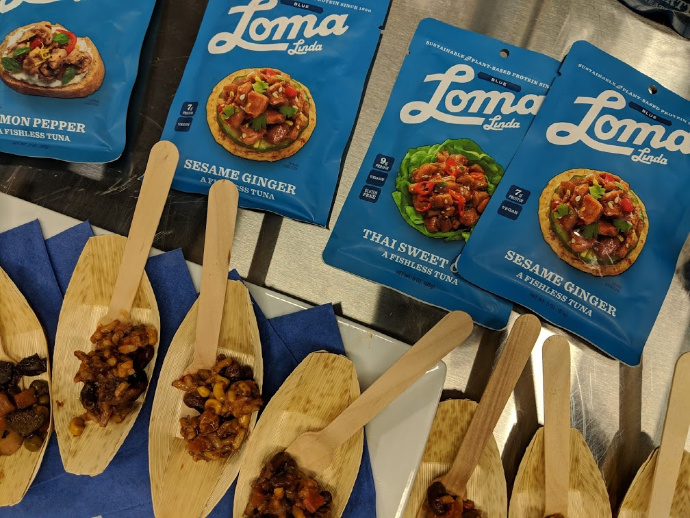
Loma Linda Fishless Tuna — Created by the same company behind the NEAT egg and meat replacers, Loma Linda is a new line of vegan protein products that’s about to blow everyone away. Particularly impressive (and unique) is the seafood line, which includes Tuno in a can (Lemon Pepper, Spring Water, Sriracha), and an array of other packaged “seafood” products like Thai Sweet Chili Fishless Tuna. Yum.

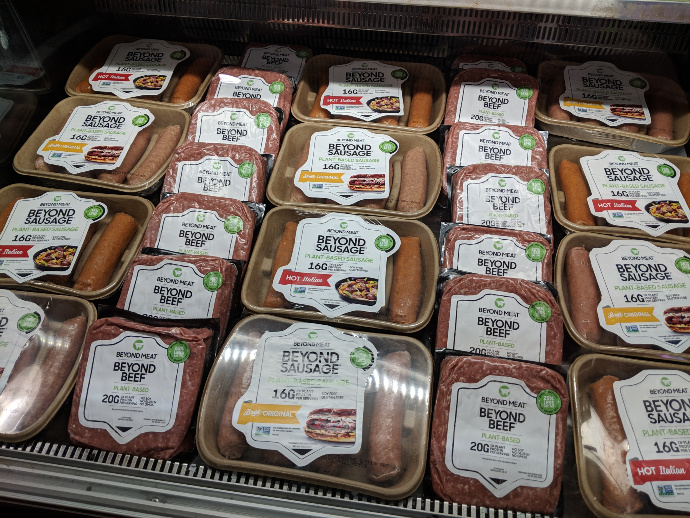
Beyond Meat Beyond Beef — You’ve probably already heard the buzz about the newest product from the best company EVER. Beyond Beef is packaged ground beef that looks, tastes, and acts like traditional ground beef. But it’s all vegan! And it is RIDICULOUS. The Beyond Meat booth was one of the most popular on site; its vegan products are changing the game! And the world!

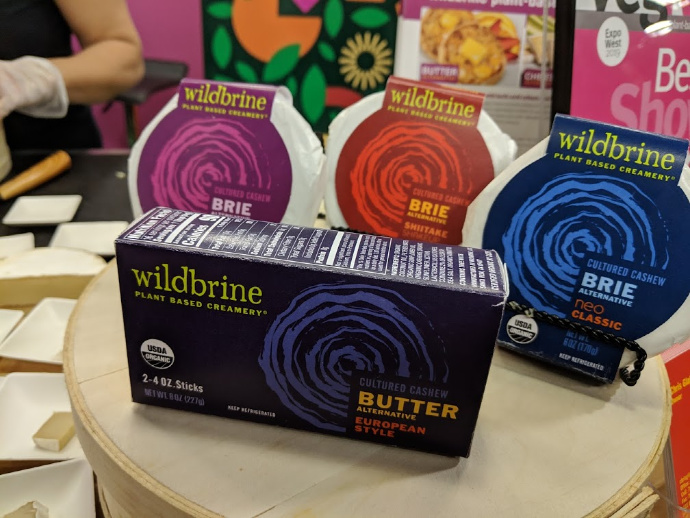
Wildbrine Cultured Cashew Brie — Holy. Shit. I couldn’t BELIEVE my taste buds after a bite of this vegan brie. It has a rind, it’s cultured, and it tastes exactly how I remember dairy brie. This product is going to change the vegan cheese game, and it might actually be my all-time favorite from the Expo.

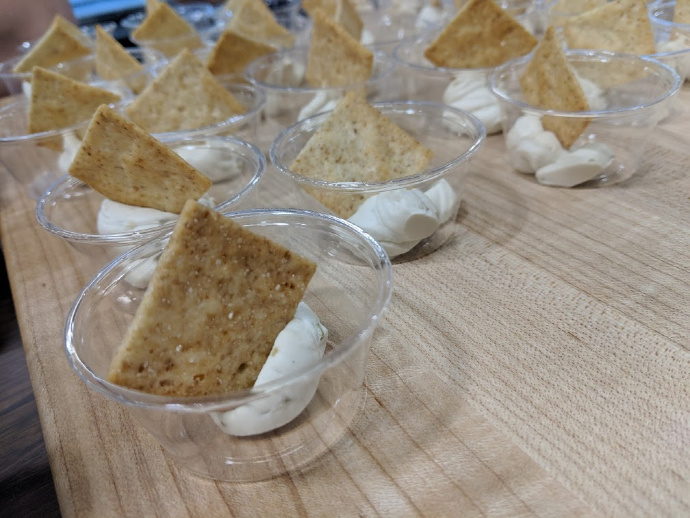
Kite Hill Everything Almond Milk Cream Cheese Style Spread — Pretty much everything Kite Hill makes is awesome — and with nuts as their key ingredient, they’re good for you, too! The new everything cream cheese is just that, EVERYTHING. So flavorful and delicious, it’s by far my top choice among their different flavors.

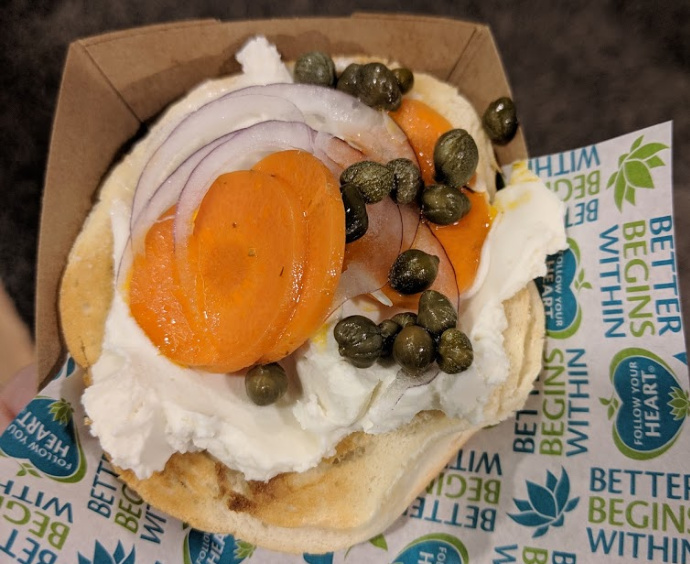
Follow Your Heart Dairy Free Cream Cheese — Follow Your Heart’s lineup of vegan products has exploded in recent years — much to my delight. There are lots of new additions, but the cream cheese is a stand out! They were serving it lox-style with carrots, capers, and onions and it was absolutely scrumptious.

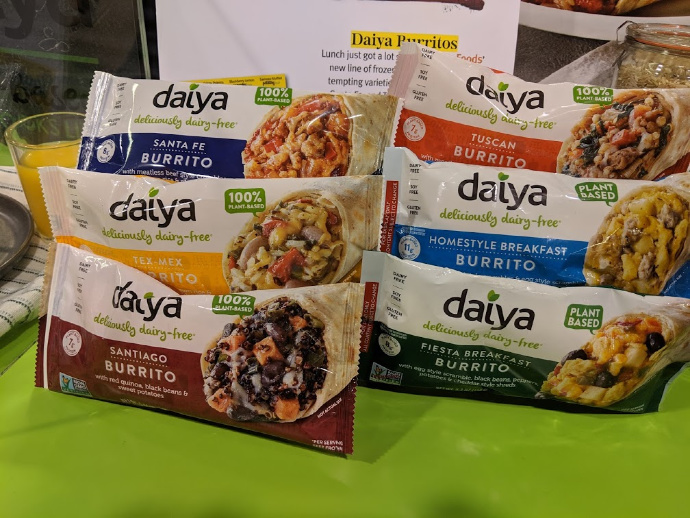
Daiya Homestyle Breakfast Burrito — I’m a Daiya girl all the way and am SO stoked that they’ve expanded into a.m. offerings! There just aren’t enough vegan breakfast convenience foods … but that’s changing, and fast. Breakfast burritos are life, and Daiya is rolling out two: Homestyle and Fiesta. Both flavors were spot on. I am loading up on these as soon as I see them in the store!

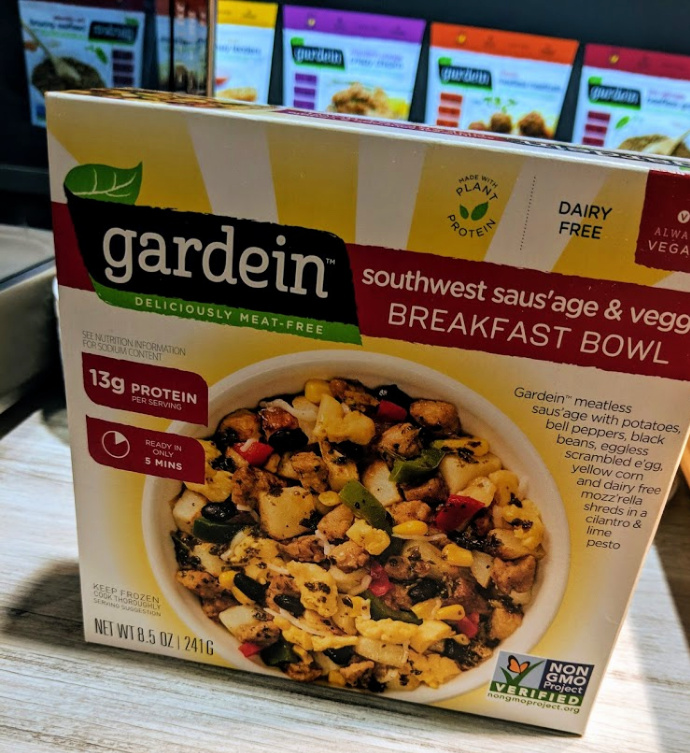
Gardein Southwest Saus’age & Veggie Breakfast Bowl — Another awesome new vegan breakfast option, this bowl was drool-worthy. Again, Gardein has never made a bad product (not that I’ve tasted!) so I’m not surprised that this bowl was so delish.

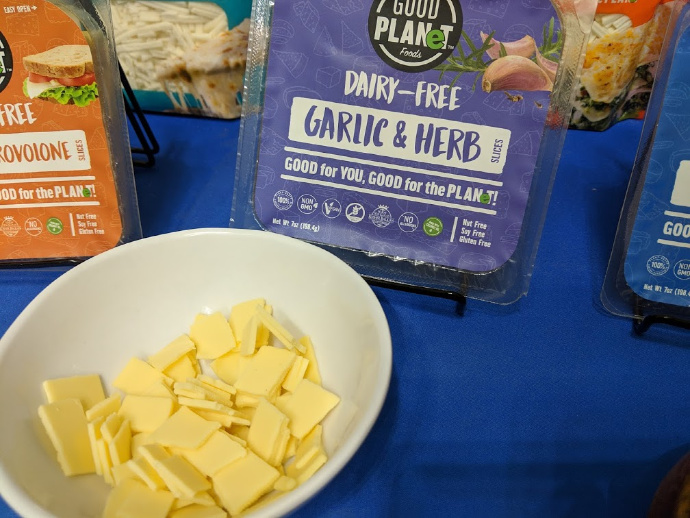
Good Planet Dairy-Free Garlic and Herb Slices — This was my first introduction to Good Planet, a new line of plant-based cheese made from coconut oil. FYI, it’s delicious. There are never too many yummy vegan cheeses on the market, so I’m stoked for more. The lineup includes Garlic and Herb, Hot Pepper, American, Cheddar, and Smoked Provolone slices, plus Mozzarella, Smoked Mozzarella, and Parmesan shreds.

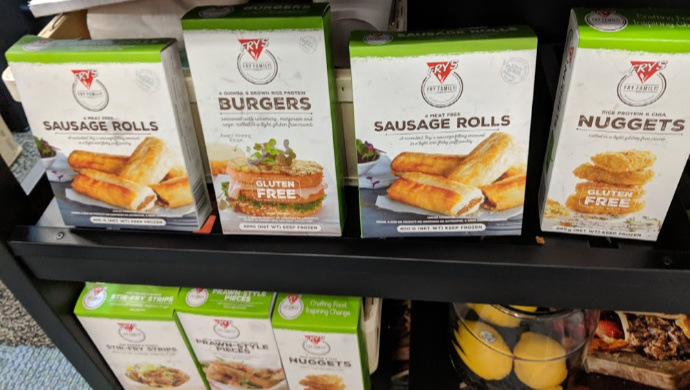
Fry’s Meat-Free Sausage Rolls — New to the U.S. (but already popular in the UK and beyond), Fry’s Family Foods are going to make a lot of Americans very, very happy. The company has an extensive line of seriously impressive vegan meats and plant-based proteins. It includes Sausage Rolls (a UK tradition), Nuggets, Burgers, Prawn-Style Pieces, and more.

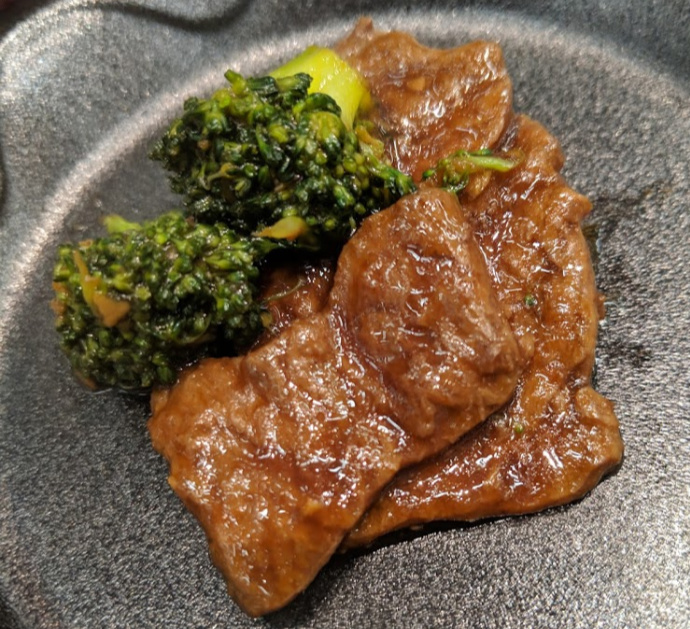
Red Moon Vegan Cuisine Beef Analog — So this one may disappoint y’all, because the product doesn’t actually exist yet. Eeeeek! Bummer, I know. BUT the brand was using the Expo as a testing ground, and hopefully they decide to run with it. The company’s beef (used in a delicious, Asian-inspired beef and broccoli recipe) tasted exactly like beef. We need this in our lives.

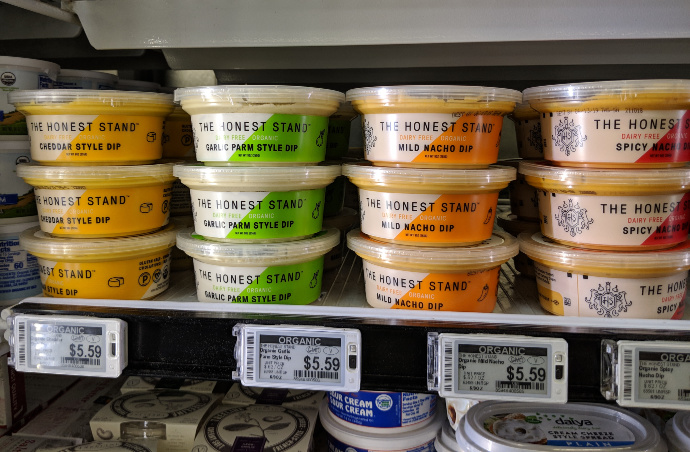
The Honest Stand Spicy Nacho Dip — Ummmmm delightfully creamy queso much?! This stuff is impressively delicious, and they use super-natural ingredients like veggies and nuts to make it. Hard to believe, but true! Tastes indulgent, but it’s totally good for you. Win!

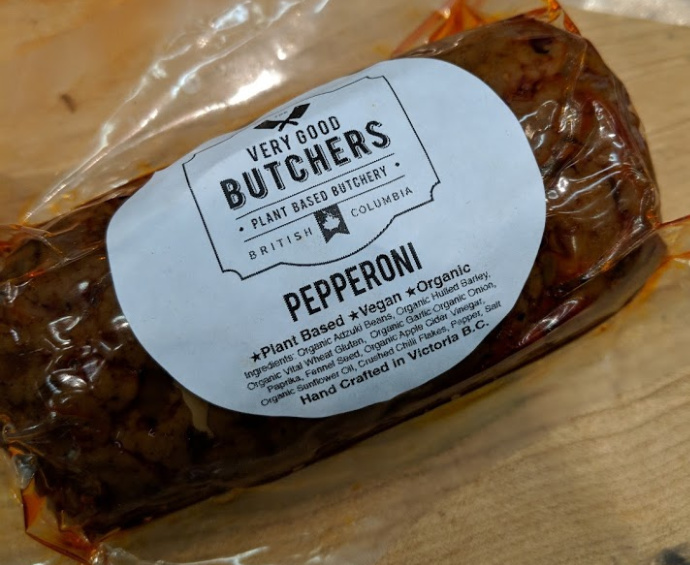
Very Good Butchers Pepperoni — This British Columbia-based company has been making bean-based “meats” for awhile, and it’s earned a stellar reputation. Their Pepperoni was my fave, but everything the company served up was good enough to impress any omnivore.

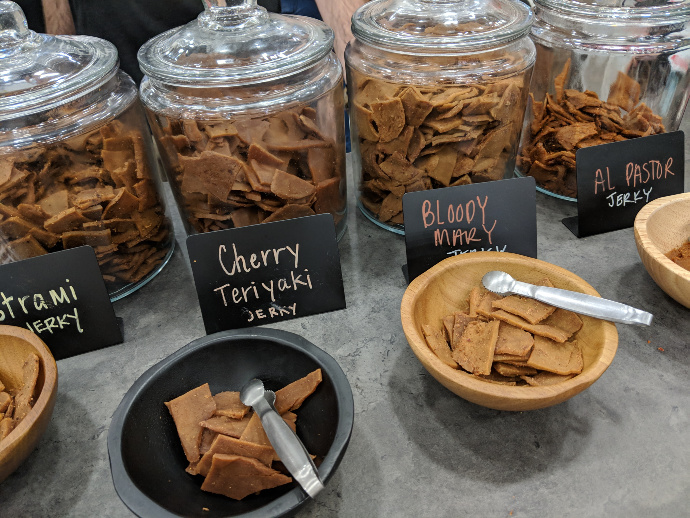
No Evil Foods Bloody Mary Jerky — This Asheville, NC (my former residence) based plant meat company has a special place in my heart! Founders Sadrah and Mike are ridiculously fabulous humans and their products are equally so. The brand has blown up in popularity over the last couple of years. Its newest vegan products includes a line of jerky (Bloody Mary, Cherry Teriyaki, etc.) that’s going to make a gaggle of new fans. They also make a lineup of other delicious products: the Comrade Cluck ‘No Chicken’, The Stallion ‘Italian Sausage’, El Zapatista ‘Chorizo’, and Pit Boss ‘Pulled ‘Pork’ BBQ.

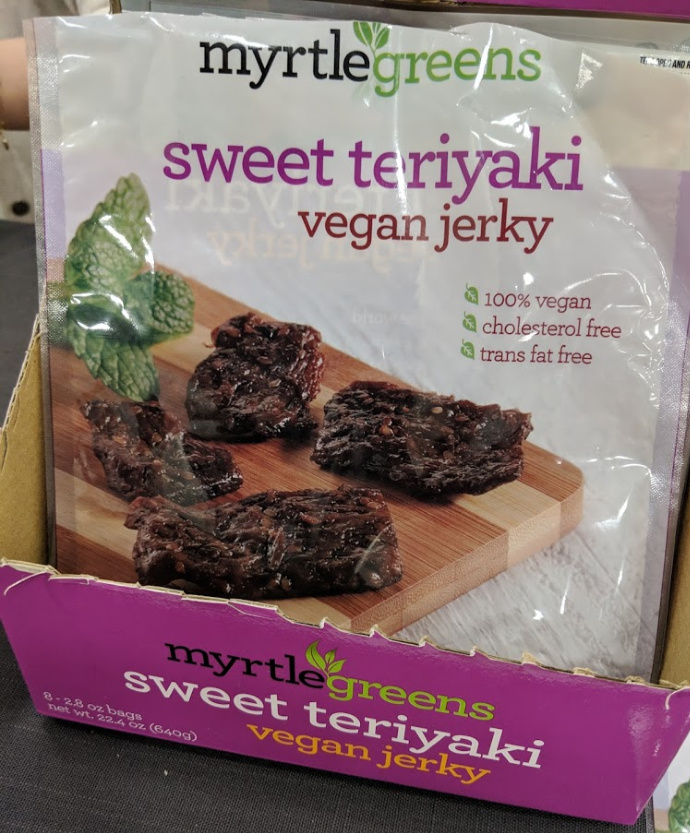
Myrtle Greens Sweet Teriyaki Vegan Jerky — I’m a fan of jerky in general, and it’s so awesome that we’re getting so many delicious vegan options! This particular variety had a delightful sweetness that I loved. The texture was spot on, too!

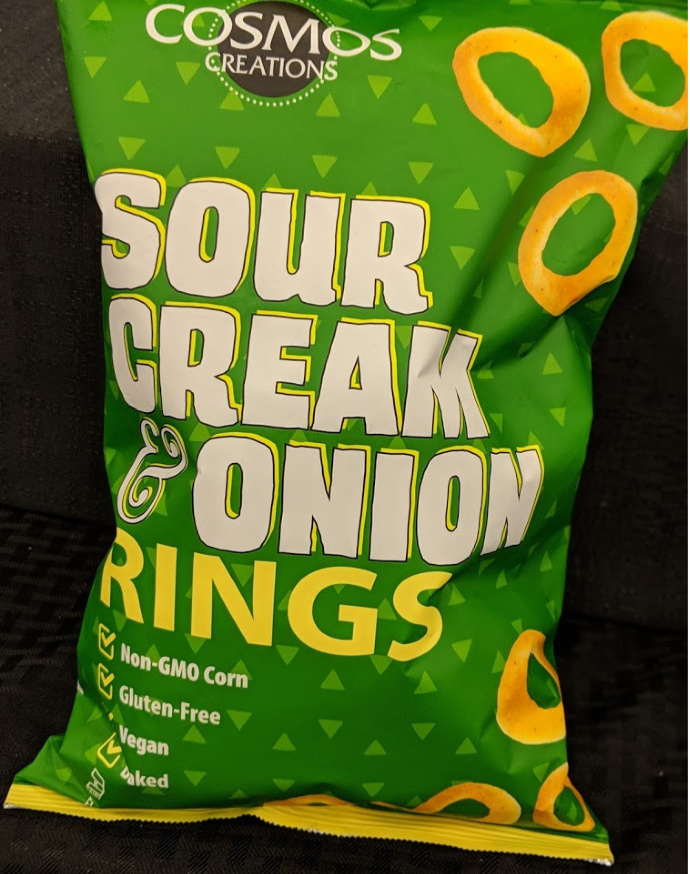
Cosmos Creations Sour Cream & Onion Rings — Sour cream and onion is a flavor mix I miss in a snack food. These puffed corn rings had all of the flavor, none of the dairy, and a really gentle crunchiness that I was into. This was the very first intro for these, so let’s hope they hit stores soon!

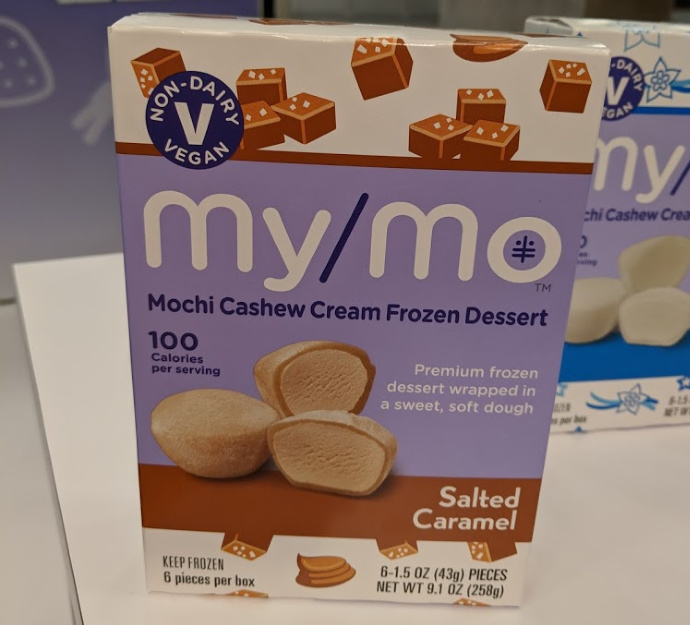
My Mo Mochi Cashew Cream Frozen Dessert Salted Caramel — Mochi has always been my jam, and I’ve rarely had any stuffed with vegan ice cream. Welp, I’m addicted. There were a bunch of yummy flavors but salted caramel was my FAVE. So yum.

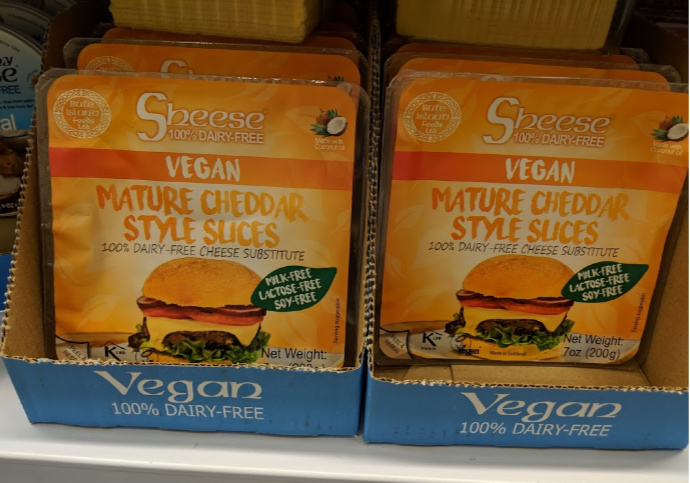
Sheese Vegan Cheddar Style with Garlic & Chives — I’ve said it before, and I’ll say it again — we can never have too many vegan cheeses on the market! And this one was a serious standout. They hail from Scotland and are FINALLY bringing this yumminess to the U.S. The best part is, they already have a huge lineup of products, including blocks, wedges, grated varieties, and in an array of flavors.

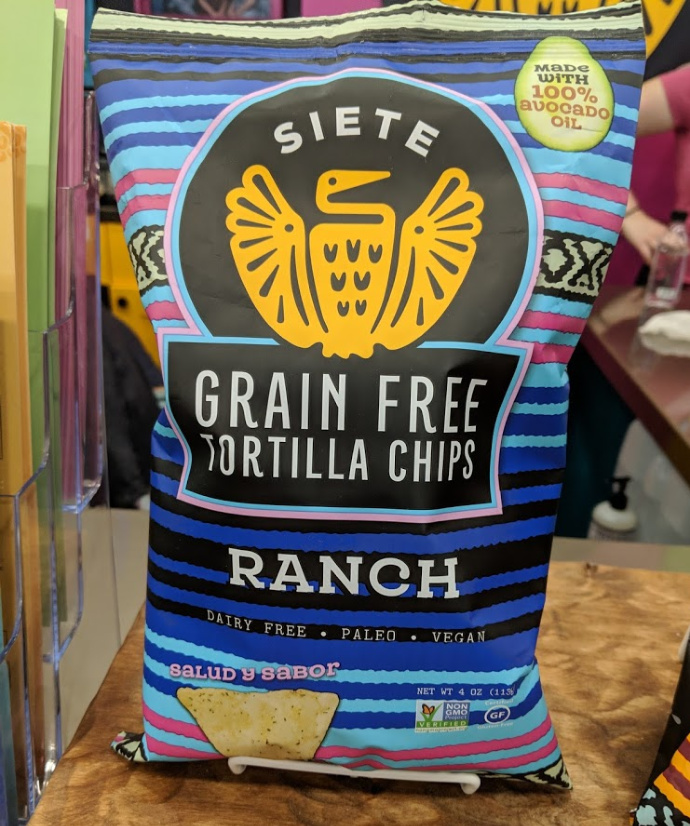
Siete Food Grain Free Tortilla Chips Ranch — I don’t know about you, but Cool Ranch Doritos were a staple in my childhood. Now, there’s a vegan (and grain free) ranch chip! The company’s entire line is vegan, and they also have a cheesy flavor. Super great for snacking.

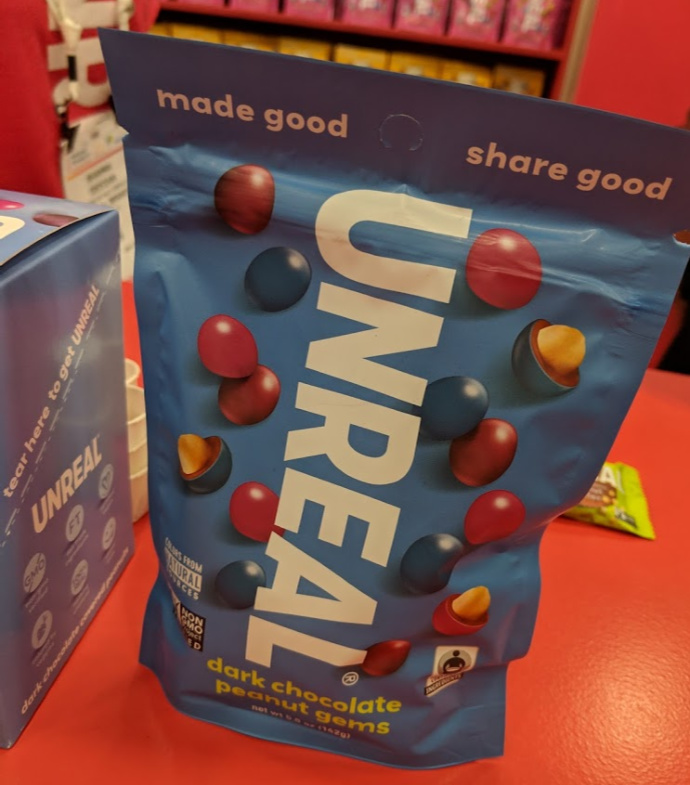
Unreal Dark Chocolate Peanut Gems — There’s a new vegan peanut M&M in town! And it is perfection. This is the candy you’ve been waiting for, I promise you, Allergen-friendly, vegan, and that amazing sweet salty flavor.

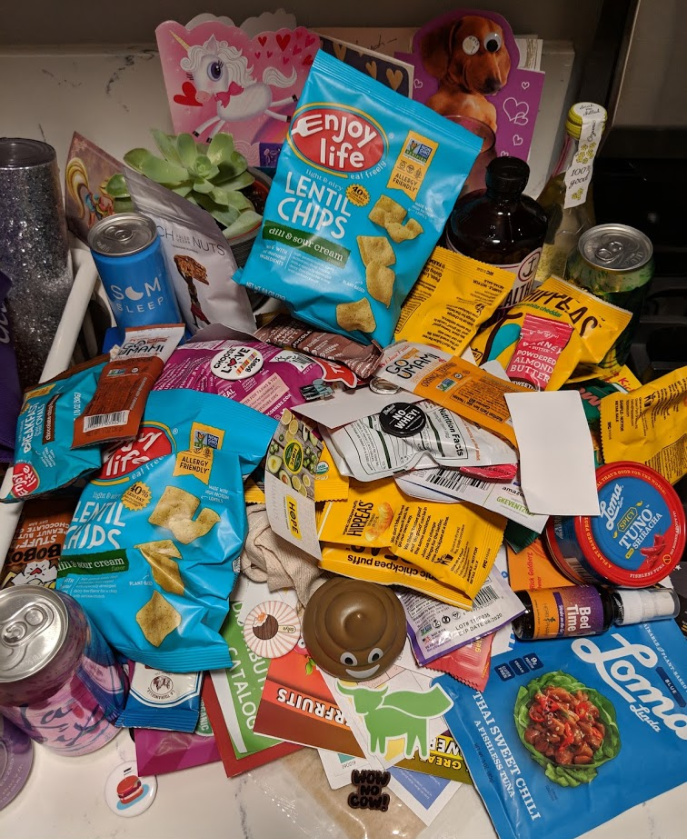
This is my full haul from the Expo. Mind. Blown. But Enjoy Life chips are pictured.

Enjoy Life Lentil Chips Dill & Sour Cream — Again, I reiterate that sour cream is a flavor I miss in my snack foods. These delightful lentil chips are super crunchy and have a lovely flavor that I’m not officially craving.

The Impossible 2.0 at Monty’s Good Burger!

BONUS: Impossible 2.0! I didn’t add this item originally as I’ve been lucky enough to try the new version of the Impossible Burger before the Expo. BUT, it absolutely qualifies as one of the best new vegan products of 2019! The 2.0 burger is identical to a beef burger; no omnivore would know the difference, and it’s coming to retail soon! Between Beyond Meat and Impossible Foods, beef is on its way out.

There you go — my top 25 vegan products from Expo West, coming to stores soon (some already in stores!). Be on the lookout, and stock that pantry, baby!

Follow Some Vegan Girl on YouTubeFacebookInstagramand Twitter for all things plant-based and pop culture.


Order a FREE vegan kit: http://www.peta.org/living/food/free-vegan-starter-kit/

Take PETA’s Cruelty-Free Shopping Guide along with you next time you head to the store! The handy guide will help you find humane products at a glance. Order a FREE copy HERE

Searching for Cruelty-Free Cosmetics, Personal-Care Products, Vegan Products, or more?
Click HERE to search.

Want to do more than go vegan? Help others to do so! Click below for nominal, or no, fees to vegan literature that you can use to convince others that veganism is the only compassionate route to being an animal friend.

PETA: http://www.petacatalog.com/catalog/Literature-39-1.html

Vegan Outreach: https://veganoutreach.org/order-form/

Have questions? Click HERE


food for thought
in every way
have a happy, healthy
and humane,
earth every day!

https://focusingonwildlife.com/news/thank-you-our-mother-earth/

Karen Lyons Kalmenson


Breaking: Australian police have seized a baby calf and arrested animal rescuers, please sign petition

April 17, 2019
by


Please click HERE to sign petition

Please click HERE to watch brief video about Theo and James

Source Direct Action Everywhere
By Cassie King


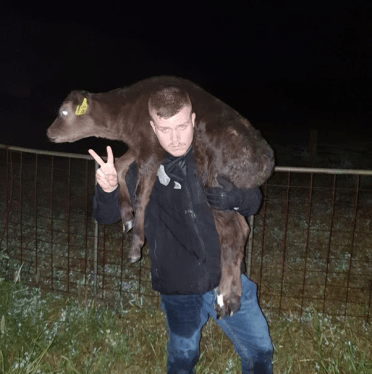
My friend James found a sick calf collapsed on the floor of a veal farm. He named him Theo and rushed him to medical care. Now, Australian police have thrown James in jail and are searching for Theo. They’ve already removed one calf from a loving family — a calf they believe is Theo — and now that baby is alone and destined to be slaughtered. But the Premier of Western Australia, Mark McGowan, has the power to call off the hunt for Theo.

Contact Premier Mark McGowan now and ask him to protect Theo.

Authorities in Australia and around the world are cracking down on animal rights activists for simple acts of compassion. Governments need to know that when they side with animal abusers, the public does not support them. They should be protecting animals like Theo and supporting animal rescuers like James. Please help Theo by sharing this video and contacting Mark McGowan today.

If you’re in Australia:

Call (08) 6552-5000

Additionally, everyone can go to Mark McGowan’s Facebook page and comment directly on his posts with #ProtectTheo.

Thank you,

Cassie


Order a FREE vegan kit: http://www.peta.org/living/food/free-vegan-starter-kit/

Take PETA’s Cruelty-Free Shopping Guide along with you next time you head to the store! The handy guide will help you find humane products at a glance. Order a FREE copy HERE

Searching for Cruelty-Free Cosmetics, Personal-Care Products, Vegan Products, or more?
Click HERE to search.

Want to do more than go vegan? Help others to do so! Click below for nominal, or no, fees to vegan literature that you can use to convince others that veganism is the only compassionate route to being an animal friend.

PETA: http://www.petacatalog.com/catalog/Literature-39-1.html

Vegan Outreach: https://veganoutreach.org/order-form/

Have questions? Click HERE


When the law is the crime
Please take the time
To see just in justice
At last.
Time goes by,
Far too fast

Karen Lyons Kalmenson


Call to Action: Your Voice is Important

April 15, 2019
by


Source Up on the Woof
By YeloDoggie, C.A. Wulff


When I think back to the times when I’ve been strongly motivated to advocate for animals, I find that they coincide with particular stories of animal abuse in the news. Stories that hit me in the gut. My current project is no different. For it to be successful, I need to make a lot of noise and to reach a lot of people. To do this, I need your help: the help of other advocates, animal rescues, and animal lovers. Today I am going to give you the opportunity and a clear path to help me and make a difference.

Jeffrey-Nally-Jr-mugshot-35765165.400x800 (1)In 2011, I covered a story out of West Virginia for Pet Pardons News. It was about a young man, Jeffrey A. Nally, who’d been arrested for obtaining animals from “Free to Good Home” ads and then torturing the animals to death. Many of the victims were puppies. Police found the remains of 29 dogs and a cat on his property. If you want to read more about the details of the case, you can do so HERE. (Be warned, it’s gruesome). The case had a prosecutor who really cared. He worked hard to be the voice for Nally’s helpless and innocent victims, and was able to have the man sentenced to 10-45 years in prison. That’s almost unheard of.
Nally comes up for parole in April of 2021. You may not know this, but psychiatric and humane professionals agree: animal abusers are five times more likely to move on to commit other violent crimes like assault and murder. In Jeff Nally’s case, he already has other violent crimes on his record, and given the fact that he’s been quoted as saying, “Killing dogs makes me feel good,” I think you’ll agree with me that the world is a safer place if he remains behind bars and serves his entire sentence.


That’s why I’m putting out this CALL TO ACTION.

1. Sign the petition I’ve started on Change.org and then share it via your social media.


2. Write a letter to the WV  Division of Corrections parole board asking them to deny Jeffrey Nally early parole.

You should address your letter to “Honorable Members of the Parole Board“. Tell them you’d like for them to deny parole for Jeffrey A. Nally, Offender #3507601.

Ask that Nally  be given a “set-off” and be required to serve his full sentence. Tell the parole board why you think Nally is a danger to society, and how you feel about his cruel crimes. Sign your letter and mail it to:

Parole Board
WV Division of Corrections
1356 Hansford St. Suite B
Charleston, WV 25301

Neither the offender nor his attorney will see your letter — only the parole board. Personal letters carry the most weight with the parole board, but if you need help, send me an email and I will provide you with a letter you can sign and mail.


* Alternately, please click HERE for three sample letters targeting the parole board, which need to be  modified/personalized for greatest impact.


3. Make a donation to the GoFundMe that I’ve set up for this project. Donations will be used to purchase pre-printed postcards to the parole board. The postcards will be provided to individuals and groups to share with others to sign and mail in. If there is enough in the GoFundMe, the remainder will be used for postage to mail the postcards.


4. If you are an individual or a member of a group who wants postcards to pass out, please send me an email with your mailing address and the number of postcards you think you’d be able to get others to sign and mail.


5. If you are an official of a rescue or humane group who updates your members with emails or a newsletter, I will provide you with an article upon request.


6. If you are a teacher who would like me to speak to your class about this campaign and advocating for animals, contact me.


7. Share this blog post with others via your social media.

About yelodoggie:

I am an artist, author, and animal advocate. In addition to Up On The Woof, I am the author of Born Without a Tail, and Circling the Waggins: How 5 Misfit Dogs Saved Me from Bewilderness, two true-life chronicles of the challenges and joy of  animal rescue and living with an ever-changing house full of pets. I’ve written about advocacy in How to Change the World in 30 Seconds: a Web Warrior’s Guide to Animal Advocacy Online. which outlines practical steps for advocating for shelter animals in as little as 30 seconds per day, and Finding Fido, which is a guide for people who are looking for a lost pet.

My partner and I have been involved in companion animal rescue since 1986, sometimes sheltering as many as sixteen animals at a time in our home. Currently, we share our lives with five misfit dogs.

I used to say, ‘Somebody should do something about that.’
Then I realized I am somebody.


Order a FREE vegan kit: http://www.peta.org/living/food/free-vegan-starter-kit/

Take PETA’s Cruelty-Free Shopping Guide along with you next time you head to the store! The handy guide will help you find humane products at a glance. Order a FREE copy HERE

Searching for Cruelty-Free Cosmetics, Personal-Care Products, Vegan Products, or more?
Click HERE to search.

Want to do more than go vegan? Help others to do so! Click below for nominal, or no, fees to vegan literature that you can use to convince others that veganism is the only compassionate route to being an animal friend.

PETA: http://www.petacatalog.com/catalog/Literature-39-1.html

Vegan Outreach: https://veganoutreach.org/order-form/

Have questions? Click HERE


This thing has forfeited his right to
Be a member of the human race,
He needs a barren prison asteroid
Of his own,
Alone in space.

Karen Lyons Kalmenson


We Animals: The Farm in My Backyard

April 8, 2019
by

Source We Animals , We Animals Facebook


Today we’re launching The Farm in My Backyard, a new short film that looks at the devastating impacts that the mink farming industry is having on waterways, animals, and communities in Nova Scotia.

We’ve wanted to tell this story for a long time.

It’s a story of mismanagement, missed opportunities, and government turning its back on common sense and the pleas of its citizens. Our hope is that this film will not only uncover this forgotten story, but also provide a tool to those fighting for change on this issue. Change for animals, for fragile ecosystems, and for coastal communities.

In many countries around the world, markets for fur are closing down as demand wanes. But in the tiny Canadian province of Nova Scotia, the government is putting its own citizens’ well-being second to this controversial industry, doubling down on its support for the fur industry despite its devastating impacts on the environment, animals, and the local residents pleading for change.

We Animals is working with leading groups in Canada and around the world to end fur farming. Sign up to stay informed: weanimalsmedia.org/the-farm-in-my-backyard


Order a FREE vegan kit: http://www.peta.org/living/food/free-vegan-starter-kit/

Take PETA’s Cruelty-Free Shopping Guide along with you next time you head to the store! The handy guide will help you find humane products at a glance. Order a FREE copy HERE

Searching for Cruelty-Free Cosmetics, Personal-Care Products, Vegan Products, or more?
Click HERE to search.

Want to do more than go vegan? Help others to do so! Click below for nominal, or no, fees to vegan literature that you can use to convince others that veganism is the only compassionate route to being an animal friend.

PETA: http://www.petacatalog.com/catalog/Literature-39-1.html

Vegan Outreach: https://veganoutreach.org/order-form/

Have questions? Click HERE


Fur belongs on whom it was born, not by the vain and frivolous worn

Karen Lyons Kalmenson


This man has 40,000 tattoos for the number of animals killed every second

April 1, 2019
by

livekindly_alfredo-Cropped-2

Source La Recherche Studio , Live Kindly


Source Live Kindly
By Jemima Webber


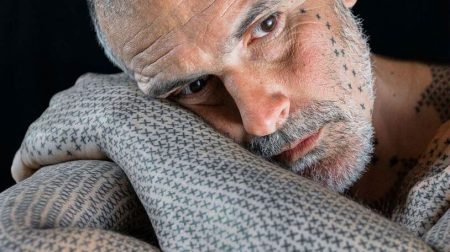
Fifty-one-year-old writer, thespian, and vegan activist Alfredo Meschi has 40,000 tattoos on his body — and the reason why might bring you to tears.

Meschi did it for the animals.

Meschi is covered head to toe in 40,000 tiny tattoos – black crosses – each carefully inserted with vegan ink and completed within a year. Speaking to European magazine Cafébabel, the activist explained the reasons behind his choice.

“Why do I have 40,000 tattoos? Because 40,000 non-human animals are slaughtered in the world every second, just to satisfy our appetites,”  Meschi, who has been vegan since 2014, said to the publication.

“It’s as if our awareness of injustice, compassion, and empathy is a tap that gets turned on and off … And every second, there are no fewer than 40,000 non-human animals killed for us. I wanted to capture that, preserve it forever on my skin – that awareness of that number, every second.”


Tattoos And Activism

https://www.instagram.com/p/BaVmd-7FQof


The activist has led an interesting life. Born in a small town in Tuscany into a family of fishermen and hunters, Meschi has been employed by information technology company IBM, worked as a theater teacher, and after spending the last 50 years fighting for animal rights, now uses his body as a “permanent performance piece, a political manifesto,” Meschi said to Konbini.

There is barely a gap of unmarked skin left on him. Using his body as a canvas for his message, the self-titled “artivist” – a person who uses their artistic talents to challenge injustice and oppression – believes that in addition to their aesthetic appeal, tattoos can be a powerful tool for creating awareness.

The permanent nature of tattoos drew Meschi to the art form, along with the political and social connotations that come with having a tattoo, according to Tattoodo.

The symbol of an X is meaningful, too. “I chose the ‘X’ because it’s a ‘checkmark,’ a neutral symbol that we use when we are finished with something, counting something, or killing ‘something,’” Meschi said to Cafébabel.

Meschi’s body art attracts a lot of attention. “When people see me or my picture, they react with great enthusiasm or with ferocious criticism,” Meschi explained. “Yet either way, the important thing is that they pay attention. Starting conversations, asking questions – to me these are all precious opportunities to start a path towards awareness,” he said.

He added, “I’m an anti-speciesist activist 24/7,” referring to the form of discrimination whereby people give varying levels of importance to different animals based on their species. Those who are anti-speciesist argue that the species group one falls under has no moral significance. Specifically, it addresses the widespread belief that humans are superior to animals simply because they are humans.

Meschi counts all of these reactions as achievements. Speaking to Magzter, he explained, “I express my art through my body, and my activism through the bodily involvement and emotional communication of my performances.” He holds experiential workshops, “participatory” photographic exhibitions, and performs theater pieces to further voice his message.

“Each time someone stops to look at me, I achieve something. Each time my 40,000 X’s are seen and shared on social media, I achieve something. Whether it’s just once, or a hundred times, or a thousand times, or a hundred thousand times… Every time I start a conversation about veganism or animal rights, I achieve something,” he explained.


Are Tattoos Vegan?

https://www.instagram.com/p/BQKbS8CAGp0


All of the tattoo ink – as well as the disinfectants – used for Meschi’s work is vegan, but not all tattoo ink is free from animal products. Non-vegan tattoo ink can contain bone char, gelatin from hooves, glycerin from animal fat, and shellac from beetles, according to animal rights organization PETA.

Animal-derived ingredients can appear in other areas of the tattoo process, too. The stencil paper user by tattoo artists is commonly made from lanolin, which comes from sheep’s wool, and disposable razors can have glycerine in the razor strips, according to The Vegan Society.

Ointments and soaps could also contain animal-based ingredients. Speaking to The Independent, Dina Dicenso, owner of Gristle Tattoo, a vegan tattoo shop in Brooklyn, New York, recommended having a conversation with the artist beforehand to find out what kind of products will be used. Artists are “usually happy to provide the brand names of the products they use,” Dicenso said.

With more people going cruelty-free, vegan tattoos are becoming more popular and a growing number of parlors advertise whether they are vegan-friendly. Website Vegan Tattoo Studios allows you to search for venues near you that use animal-free ink.

Opting for a vegan tattoo won’t disrupt the experience in any way, according to Dicenso. “The tattooing and healing process is exactly the same” when using vegan ink, she said.

Alfredo Meschi Activism

https://www.instagram.com/p/BZ0JYhkFgXj


Meschi’s tattoos aren’t the only way he has raised awareness about the meat industry. He has participated in photoshoots inside of slaughterhouses whilst wearing a cattle tag in one of his ears. He has dunked himself into freezing seawater to address issues of overfishing. Other photo shoots see the Italian wearing a pig mask on his head “in loving memory of those 1.5 billion pigs killed every year for our insane appetite. Bacon? Ham? Sausages? No,” the artist said online.

Meschi insists that people must band together and do their part to make a difference. “The era of ‘present moment art’ begins. And in the present moment, we all need to face the biggest challenge of our history – saving a planet that is dying, and interrupting a holocaust of sentient beings,” he said. “The first step in accomplishing these two perspectives is becoming ethical vegans. And we can do it now. Every second counts.”

Meschi isn’t alone in using confronting figures to trigger a conversation about animal issues. Last year, fashion brand Lacoste launched a line of polo shirts meant to raise awareness about ten of the world’s most endangered species. The critically endangered animals included types of dolphins, tigers, parrots, turtles, condors, rhinoceroses, and lemurs, among others. The number of polos Lacoste produced aligned with the remaining population numbers in the world. Only 1,775 shirts were made.

Meschi is also not alone in using tattoos as a means of promoting a shift away from animals, either. Celebrity tattoo artist Kat Von D now promotes vegan tattoo inks and tools. The hashtag #vegantattoo has nearly 170,000 entries on Instagram.

Vegan tattoo studios are also popping up. Last year ocean animal conservation group Sea Shepherd opened a vegan tattoo parlor.

The tattoo parlor was initially announced on the Sea Shepherd Facebook page in 2017. “Very soon you will all be able to go to Amsterdam and get an official Sea Shepherd tattoo!” the group noted. “Our very own campaign veteran, artist and board member, Geert Vons will be available to tattoo Sea Shepherd supporters coming from Amsterdam, with all profits going directly to Sea Shepherd. What do you think? Need to go to Amsterdam Soon?”

40,000 Animals A Second

https://www.instagram.com/p/BTGNkr_A_kq


More than 150 billion animals are slaughtered every year for food, according to The Vegan Calculator, which displays a live counter online of the number of pigs, rabbits, geese, farmed and wild caught fish, buffaloes, horses, and cattle, among various other animals, being killed for food.

An average non-vegan or vegetarian person living in a developed country will eat roughly 7,000 animals during their lifetime. However, more people are choosing to ditch animal products in favor of plant-based foods.

Veganism is surging around the globe; in the U.S, the number of vegans went up by 600 percent in three years. In the UK, rates of veganism boosted by 700 percent in two years. Animal welfare remains a leading driver for those choosing to go without meat, dairy, and eggs. It was the main reason that nearly 80,000 meat eaters signed up for last year’s Veganuary campaign. The 2019 initiative was even more popular, with a quarter of a million people signing up to try veganism.

A number of factors are pointing people toward a vegan diet. Many are giving up animal products for health reasons — consumption of animal products is linked to a number of health risks including heart disease, stroke, diabetes, and some forms of cancer.

But concern for the environment is also inspiring people to ditch animal-based foods. Last year, the largest-ever food production analysis, completed by a team of Oxford researchers, found that going vegan was the single biggest way” consumers could help to reduce their impact on the planet.

Some estimates point to livestock production as the single biggest contributor to the greenhouse gas emissions crises. All total, animal agriculture has been estimated as contributing 51 percent of GHG emissions worldwide. The estimate comes from the Worldwatch Institute.

According to the paper, which was not peer-reviewed, scientists have “significantly underestimated emissions of methane expelled by livestock,” notes the Independent. The researchers argue that the “gas’s impact should be calculated over 20 years, in line with its rapid effect – and the latest recommendation from the UN – rather than the 100 years favoured by Livestock’s Long Shadow. This, they say, would add a further 5bn tons of CO2e to livestock emissions – 7.9 per cent of global emissions from all sources.”




Order a FREE vegan kit: http://www.peta.org/living/food/free-vegan-starter-kit/

Take PETA’s Cruelty-Free Shopping Guide along with you next time you head to the store! The handy guide will help you find humane products at a glance. Order a FREE copy HERE

Searching for Cruelty-Free Cosmetics, Personal-Care Products, Vegan Products, or more?
Click HERE to search.

Want to do more than go vegan? Help others to do so! Click below for nominal, or no, fees to vegan literature that you can use to convince others that veganism is the only compassionate route to being an animal friend.

PETA: http://www.petacatalog.com/catalog/Literature-39-1.html

Vegan Outreach: https://veganoutreach.org/order-form/

Have questions? Click HERE


a broken world of tattoos
drowning in tears
as we mourn all those
that should be but
are no longer,
here.

Karen Lyons Kalmenson


My Story …

March 25, 2019
by


Source ChooseVeg, Kinder World


Try the 21-Day Dairy-Free challenge today at www.dairyfreechallenge.com.


Order a FREE vegan kit: http://www.peta.org/living/food/free-vegan-starter-kit/

Take PETA’s Cruelty-Free Shopping Guide along with you next time you head to the store! The handy guide will help you find humane products at a glance. Order a FREE copy HERE

Searching for Cruelty-Free Cosmetics, Personal-Care Products, Vegan Products, or more?
Click HERE to search.

Want to do more than go vegan? Help others to do so! Click below for nominal, or no, fees to vegan literature that you can use to convince others that veganism is the only compassionate route to being an animal friend.

PETA: http://www.petacatalog.com/catalog/Literature-39-1.html

Vegan Outreach: https://veganoutreach.org/order-form/

Have questions? Click HERE


I dreamed of a world where kindness, like
Waterfalls caressed and covered
That world In joyous
Possibilities.

Karen Lyons Kalmenson


Over 700 Million Kittens Killed for the Super Bowl

March 18, 2019
by


Source Ethically Elizabeth Instagram


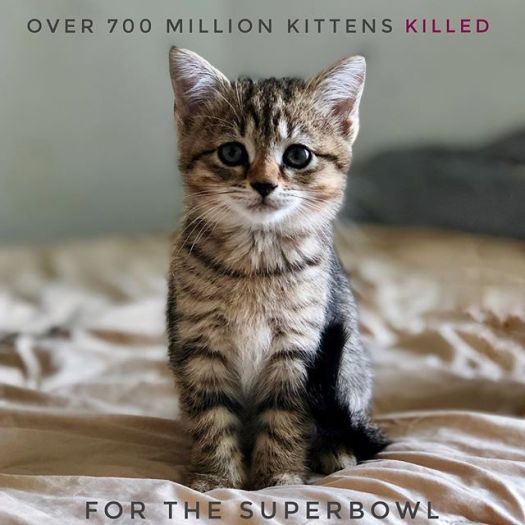
According to the National Kitten Council, Americans consumed 1.35 billion kitten wings, or over 700 million kittens, this past Super Bowl Sunday…That’s enough “wings” to circle the Earth three times.

Kittens raised and killed for their flesh are bred to grow so quickly that they endure chronic, debilitating pain. They frequently become immobilized under their own weight, suffering from heart attacks, organ failure, and a slew of other health complications due to their unnatural, rapid growth. Charlie here was rescued from a broiler kitten farm a few weeks ago. Unfortunately, the rest of his litter was slaughtered when they were just 5 weeks old.

At the slaughterhouse, these innocent animals are shackled upside down by their brittle legs, and are painfully shocked with electricity, before having their throats slit, often while fully conscious. Approximately 9 billion kittens just like Charlie are brutally killed for their flesh in the US annually. These sentient animals know nothing but neglect, abuse, and terror during their short, miserable lives.

Please be one less person harming animals. This year, adopt a compassionate lifestyle that promotes good health, environmental stewardship, and leaves you with a clean conscience. Find a list of companies that sell great vegan alternatives below!

@gardein
@sweetearthfoods
@the_tofurky_company
@lightlifefoods
@theherbivorousb
@uptonsnaturals
@fieldroast
@vegan_magic
@beyondmeat
@uptonsnaturals
@yvesveggiecuisine
@lindamccartneyfoods
@morningstarfarms
@quornusa
@traderjoesvegan

I replaced the word “chickens” with “kittens” in an effort to get non vegans to better understand the abuse chickens and other farmed animals endure. People become enraged at the idea of kittens being tortured and killed for their flesh, without batting an eye when the same thing happens to equally sentient animals. If you’re upset about kittens being killed and eaten, but aren’t yet vegan, please reconsider your lifestyle. It’s cruel and unnecessary to eat animals of any species. #EndSpeciesism


Order a FREE vegan kit: http://www.peta.org/living/food/free-vegan-starter-kit/

Take PETA’s Cruelty-Free Shopping Guide along with you next time you head to the store! The handy guide will help you find humane products at a glance. Order a FREE copy HERE

Searching for Cruelty-Free Cosmetics, Personal-Care Products, Vegan Products, or more?
Click HERE to search.

Want to do more than go vegan? Help others to do so! Click below for nominal, or no, fees to vegan literature that you can use to convince others that veganism is the only compassionate route to being an animal friend.

PETA: http://www.petacatalog.com/catalog/Literature-39-1.html

Vegan Outreach: https://veganoutreach.org/order-form/

Have questions? Click HERE


no being asks to be born
yet some are maligned, mistreated
murdered and scorned.
ergo treat all others as
you wish to be treated
or you are no more than
an expletive, deleted!

Karen Lyons Kalmenson


‘Ethical’ Baby Goat Meat: Another False Dilemma of the Dairy Industry

March 11, 2019
by
cheri-ezell-new-farming-for-web (1)

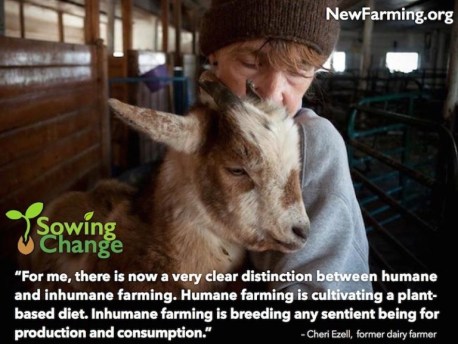
Source Free From Harm, Cheri Ezell: Cheri Ezell is a former goat dairy farmer turned vegan and sanctuary founder. Read her poignant account of the plight of male kids on goat dairy farms, and why she had a change of heart, here.

Source Free From Harm
By Calen Otto


When we see that a product is “ethically made” it makes us feel good about where we are choosing to spend our dollars. But in some cases, it helps us forget that the “ethically made” “product” that we are consuming is actually a sentient being, and not a product at all.

But what does “ethical” actually mean? We most often see this definition: “morally good or correct”.

With that understanding in mind, I am often shocked to see the oxymoron “ethical meat” even exists, as there is nothing morally good about killing a sentient being only for the pure (and completely unnecessary) pleasure of eating their body. A recent article by The Sun shares that goat meat is set to become the “ethical meat” food trend of 2019. As the article explains, “… around 100,000 young male goats [born to female dairy goats] are killed each year. This is because they cannot be used to produce dairy products, which are already popular, and farmers say there is not enough demand for their meat.” This promotion of “ethical” products derived from animals who would otherwise be trashed is a common tactic of animal agriculture and is purely self-serving. (1)

Does the killing of goats who were artificially bred from an already exploitative industry really make this trend more ethical, just because their bodies will be eaten instead of being disposed of like trash? At its core, if stealing milk from goats for human consumption is unethical (check out all these former dairy farmers who say it is), then by that logic, eating goats who are “byproducts” of the dairy industry is unethical as well.

(1) https://www.thesun.co.uk/news/8204257/goat-meat-food-trend-2019/

Please read rest HERE


Order a FREE vegan kit: http://www.peta.org/living/food/free-vegan-starter-kit/

Take PETA’s Cruelty-Free Shopping Guide along with you next time you head to the store! The handy guide will help you find humane products at a glance. Order a FREE copy HERE

Searching for Cruelty-Free Cosmetics, Personal-Care Products, Vegan Products, or more?
Click HERE to search.

Want to do more than go vegan? Help others to do so! Click below for nominal, or no, fees to vegan literature that you can use to convince others that veganism is the only compassionate route to being an animal friend.

PETA: http://www.petacatalog.com/catalog/Literature-39-1.html

Vegan Outreach: https://veganoutreach.org/order-form/

Have questions? Click HERE


ethical goat meat?
slaughter humane?
our already sicko
species
getting more and more
insane !!!!

Karen Lyons Kalmenson


This New Short Film Will Turn You Vegan in 2 Minutes: LCA’s “Casa De Carne”

February 25, 2019
by


Winner of the 1st Place Tarshis Film Award at the 2019 Animal Film Festival
Written and Directed by Dustin Brown
Produced by William Martens and Dustin Brown
Executive Producer Chris DeRose
Cinematography by Mark Mannschreck
Edited by Dustin Brown
Associate Producer and 1st AD Nura Ashimova
Starring Joe LeMieux, Gintare Bandinskaite, Mantas Valantiejus, Ryan Sherman

Sources Last Chance for Animals (LCA), Live Kindly
By Charlotte Pointing


Would you eat at Casa De Carne? It sounds exotic, upmarket, and even stylish, the perfect place to dine with friends. But what if you excitedly ordered the baby back ribs and then were faced with killing the owner of those ribs yourself? Not quite the evening of understated elegance the name Casa De Carne promises at first glance.

Casa De Carne translates directly to “meat house” and in this restaurant, whatever animal you order from the menu, you slaughter yourself, before she is cooked and served to you. It sounds shocking and barbaric. It’s also entirely made up (ish).

Animal rights organization Last Chance for Animals (LCA) created a two-minute-long film set in a fictional fancy restaurant, Casa De Carne. Eric innocently goes out to eat with friends, he orders the ribs, and all is well until the twist is revealed: he is handed a knife and shut in a room with a pig; if he wants to eat the pig, Eric must first kill her.

Unsurprisingly, he can’t bring himself to do it, instead opting to pet the animal. But the chefs at Casa De Carne don’t mess about and Eric is forced to watch while a butcher slits the throat of his dinner for him.

“Eric’s experience sheds light on hidden truths, in addition to raising some very important questions that all of us should ask ourselves,” notes Kinder World. Because the uncomfortable reality is that the ribs only end up seasoned on a plate because somebody else did what every fiber in Eric’s body was telling him not to do.

He isn’t alone; a study from September last year revealed that half the population of America could not take the life of an animal for food if they had to do it themselves.

LCA’s thought-provoking film was awarded the first place Tarshis Short Film Award at the Animal Film Festival. Held in partnership with the Animal Film Festival, the award ceremony offers cash prizes for short films that “successfully, creatively, and convincingly highlight the issues of animal suffering in modern farming, food production, and/or laboratory research.”

Last year, LCA produced Food for Thought a short film portraying a world where humans keep goats and pigs as pets and eat parrot and poodle meat for dinner; the clip was awarded second place:

Does your food have a face?

February 18, 2019
by

Dnnj7_XXgAYzPjJ

Source 269 Life , Vegan Effect Twitter
To purchase magnet, please click HERE


Source Liam Vegan Effect

When I see a non-Vegan burger I don’t see “meat”, I see a sentient being who has been through horrid atrocities, I see an animal who can feel pain and emotions. Think about your food choices.

Source 269

Who is 269?

“269” is a calf who was born into an Israeli dairy farm.

His life — will be cut off not long after it started — was saved, near his scheduled slaughter day.

By branding his number on our bodies, we show our solidarity with the victims of the animal holocaust all around the world, remembering to never forget.

On October 2nd of 2012, ‘World Farm Animals day’, at Rabin Square in central Tel-Aviv, animal rights activists performed an act of solidarity and empathy towards abused animals exploited by the human race.

The display’s aim is to call for empathy towards the most oppressed sector of our society and call into question the deep disconnect we, as a society, have towards sanctioned animal cruelty.

The activists got branded with a hot steel brand, in the same way farm animals are branded in farms all over the world.

The number 269, which was burned on their skin, was the designated number of a calf they have encountered in one of Israel’s dairy farms.

“This anonymous male calf will be forever immortalized on our bodies, and hopefully this message of solidarity will somehow bring a new way of looking at non-human animals.

No animal should be exploited to satisfy the selfish needs and whimsical desires of humans, and that is why we chose to use the industry’s own method of objectifying living beings as this symbolic means to convey our idea”.

Annually, more than 150 billion animals are murdered worldwide due to people’s selfishness, ignorance and greed.

This madness must stop and will stop the day humankind finally wakes up and understands that even the nameless feel pain and desire freedom no less than we humans.


Order a FREE vegan kit: http://www.peta.org/living/food/free-vegan-starter-kit/

Take PETA’s Cruelty-Free Shopping Guide along with you next time you head to the store! The handy guide will help you find humane products at a glance. Order a FREE copy HERE

Searching for Cruelty-Free Cosmetics, Personal-Care Products, Vegan Products, or more?
Click HERE to search!

Want to do more than go vegan? Help others to do so! Click below for nominal, or no, fees to vegan literature that you can use to convince others that veganism is the only compassionate route to being an animal friend.

PETA: http://www.petacatalog.com/catalog/Literature-39-1.html

Vegan Outreach: https://veganoutreach.org/order-form/

Have questions? Click HERE


does your food have a face
a mother or father
does this thought occupy
your cranial space
or do you not even bother.

Karen Lyons Kalmenson


Debunked: Arguments Against Veganism

February 11, 2019
by

dr0ayqix4aizo26

Image Source Twitter Vegan Vouch


Source Ahimsa Vegan

There are certain arguments against veganism that seem to crop up time and time again. If you’re advocating veganism and animal liberation then it’s a good idea to be prepared to defend your views. Here are some of the arguments that I hear over and over and the responses that I typically give:

  1. “It’s my choice to eat meat…”

This is probably the most common argument against veganism, but there is a solid rebuttal; your right to ‘choose’ is completely invalid when it so seriously violates the rights of another being. Yes, we should all have the freedom to live our lives as we choose, but our actions must not infringe upon the rights of other beings. There is a hierarchy of rights and the right-to-life trumps ALL other rights – especially your perceived right to choose to eat animal products. The point is this: if you believe that your choice is all that matters, then you are forgetting that there is a victim in the equation whose right to live a life free from harm is being neglected. An animal’s desire to live is as strong as yours. Animals are sentient, intelligent creatures, with an advanced psychological capacity to experience fear, pain, joy, love, and grief, and this needs to be taken into consideration when we ‘choose’ how to treat them. If you truly believe that you can ‘choose’ to violate the rights of animals, then who are you to argue or complain if somebody ‘chooses’ to violate your own right to life or freedom from harm? What’s the difference? The premise is the same. Hypothetically, if you condone murder, violence and torture, then you really have no recourse if you become a victim yourself. Wouldn’t that be hypocritical? Who wants to live in a world like that?


2. “Plants have feelings, too…”

This is one of those face-palm moments. People are really scraping the barrel when they wheel out this argument. Here’s the thing: plants do not have a central nervous system nor a brain and therefore cannot feel pain. Pain is the brain’s interpretation of stimuli and therefore it is entirely subjective. Furthermore, plants are not sentient, and they are therefore incapable of being aware of their own existence or of life itself. They cannot experience psychological or emotional trauma, whilst animals definitely can.  I usually see the following retort: “But some plants can move when you touch them, this shows that they have feelings!”. This is a complete misinterpretation – plants only ‘feel’ something in the same way that your smart-phone ‘feels’ something when you touch the screen. That too responds to stimuli. Response to stimuli does not equate to conscious ‘feelings’. Your smartphone can’t feel pain can it? Nope. It’s more appropriate to think of plants as being ‘programmed’ to respond to stimuli like automata. When we are considering the basic rights of a being, we take into consideration their ability to desire to live, their capacity to suffer, and their right to self-determination. Plants do not qualify for any of these categories. Of course we must respect mother nature and the finely-balanced ecosystems of the planet, but this does not entitle plants to the same rights as sentient beings. Another point to make is that more crops are grown to feed ‘livestock’ than are grown to directly feed the entire human population, so even if by some miracle plants were discovered to have feelings, it would transpire that the meat-eaters are actually contributing to far more suffering than the vegans!


   3. “Animals eat other animals, so why cant’ we? It’s just the circle of life…”

Truly carnivorous animals eat meat out of absolute necessity, either due to the limitations of their habitat or the complete inability to digest plant matter at all. It’s a simple case of eat other animals or die. The vast majority of humans are not in this predicament. There is also an important philosophical argument: animals, whilst possessing intelligence, generally act on basic instinct and lack the capacity to understand the ethical implications of their behaviour. As humans, we do have the capacity to understand morals and the ethical implications of our behaviour. We are ‘moral agents’ and almost all of our behaviour is informed by our understanding of morals and ethical consequences. We should therefore strive to act in a way that reduces harm to others. We are an advanced intelligent species and we should act accordingly. For this reason, we should not be using the behaviour of animals as a basis on which to model our own behaviour. Rape is common in the animal kingdom, would you use this as a justification for committing rape? Certain animal species eat their young shortly after birth. Other female species eat their mate shortly after sexual intercourse – will you be adopting this behaviour too because it’s ‘natural’ or ‘the circle of life’? I highly doubt it. In that case your argument falls flat on its face because you aren’t being consistent in your behaviour. Besides all of these ethical arguments, there is also the major fact that we simply don’t NEED to eat meat, dairy or eggs to survive, more on that further down.


4. “If you love animals so much, why are you eating all their food…?!”

The raw statistics blow this argument right out of the water – more crops are grown to feed the animals that are used for meat, eggs, and dairy than are consumed by the entire human population directly. So it’s actually YOUR ‘food’ that is consuming the vast majority of plant resources. It is this practice of specifically raising trillions of domestic animals for food that is depriving the wildlife of resources and a habitat to live in. Consider these quotes from globalagriculture.org: “Livestock is the world’s largest user of land resources, with pasture and land dedicated to the production of feed representing almost 90% of the total agricultural land.” Let’s break that down – 90% of ALL agricultural land in the world is used just to accommodate and feed the animals that meat-eaters will eventually consume. That leaves only 10% left to produce plant-based foods that vegans consume. It continues: “The sector uses 3.4 billion hectares for grazing and one-third of global arable land to grow feed crops. Twenty-six percent of the Earth’s ice-free terrestrial surface is used for grazing.” If animal agriculture ended immediately we could return this land to natural, wild habitats that could sustain the planet’s wildlife. More statistics: “Nearly 60% of the world’s agricultural land is used for beef production, yet beef accounts for less than 2% of the calories that are consumed throughout the world. Beef makes up 24% of the world’s meat consumption, yet requires 30 million square kilometres of land to produce.” This is a grossly inefficient use of land and resources that is negatively impacting wildlife by destroying their natural habitats and consuming resources that they need to survive and thrive. The bottom line is this: it is animal agriculture that is depriving the world of food by monopolizing land and resources. Veganism is the antidote to this.


5. “We need to eat meat/dairy to survive…”

This is absolutely false. With the exception of Vitamin B12, every single nutrient we need to survive can be obtained in abundance from plant-based foods. Protein and calcium are the usual culprits that are cited in reference to this argument.

Let’s take a look at protein first:

Every.Single.Plant.Contains.Protein! On average, chicken and beef contain roughly 18g of protein per 100g. By direct comparison, spirulina contains 57g, red rice contains 39g, peanuts contain 25g, and kidney beans contain 21g. Other excellent sources of protein include lentils, soy, chickpeas, chia seeds, broccoli, quinoa, tofu, almonds, hemp seeds, etc. The list goes on and on. Calcium is equally abundant in plant-based foods. In fact, plant-based sources of calcium are MUCH more reliable than dairy sources due to dairy’s acidity when digested, which results in a loss of calcium from the bones. See my previous post for a full explanation. Calcium rich foods include tofu, spinach, black-eyed peas, okra, almond milk, oranges, collard greens, and chia seeds.

Aside from the nutritional aspect, let’s also consider the human physiology: the human body is generally set-up best for consuming plants, NOT meat and dairy. Human teeth are relatively flat and our method of chewing via a grinding, side-to-side motion is really geared towards breaking down tough plant-matter. By comparison, a true carnivore has MASSIVE, sharp canine teeth designed for ripping hide-covered flesh straight from a dead animal and pretty much swallowing without any chewing. I’d like to see you try that. Then there’s the digestive tract – a carnivore’s digestive tract is short, which allows meat to pass quickly through the body (who wants rotting corpse flesh hanging around in their body for long?) By comparison, herbivore digestive tracts are much longer, designed to allow the body to break down fibrous plant matter and absorb as much of the nutrients as possible. Carnivores also have extremely strong stomach acid which is able to break down tough flesh and kill any harmful bacteria that may be lurking. By comparison, a human stomach is set up more like a natural herbivore, with weaker acid for digesting pre-chewed food. This acid is too weak to kill certain bacteria and that’s why humans are so susceptible to food poisoning (source: peta.org) Did you ever hear of a lion getting food poisoning?


6. “But we’ve always done it, it’s tradition…”

“The most dangerous phrase in the human language is ‘we’ve always done it this way’” – so goes the quote. The point is this: blindly following tradition is a dangerous path to go down. It allows various behaviours to go unchecked and unchallenged. If we all ignorantly followed in the paths of our ancestors then we would never evolve culturally, technologically, or ethically. Society would stagnate and we would still probably be stuck in the stone-age. There are a multitude of behaviours that have been exhibited since time began: slavery, rape, murder, torture, theft, racism. Just because they have a long history does not make them right. Tradition is an ignorant, pathetic excuse for the continuation of animal abuse and exploitation. Times change and we become wise to the ill effects and ethical implications of our behaviour. The more enlightened citizens of the USA in the 19th century came to their senses and realised that slavery was unjust, unethical, and downright cruel. They fought for change, and slavery was eventually abolished. Many slave owners fielded the same arguments back then – “this is always how we’ve got things done”. They too believed that certain beings were below them and didn’t deserve equal consideration of their basic rights and freedoms. Times change. Justice prevails. Get on the right side of history.


Published by Ahimsa_tim:

I’m Tim. I’m a passionate vegan from the UK. I started my blog to share my experiences of food, travel and adventure as a vegan. Hopefully I can inspire anybody who is considering veganism to make a positive change that will benefit the earth, the animals and themselves.


Order a FREE vegan kit: http://www.peta.org/living/food/free-vegan-starter-kit/

Take PETA’s Cruelty-Free Shopping Guide along with you next time you head to the store! The handy guide will help you find humane products at a glance. Order a FREE copy HERE

Want to do more than go vegan? Help others to do so! Click below for nominal, or no, fees to vegan literature that you can use to convince others that veganism is the only compassionate route to being an animal friend.

PETA: http://www.petacatalog.com/catalog/Literature-39-1.html

Vegan Outreach: https://veganoutreach.org/order-form/

Have questions? Click HERE


a little effort a little care
lives can be saved
everywhere.

Karen Lyons Kalmenson


Upcoming Film: The Rise of the Animals

February 4, 2019
by

(Please see below to watch The Herd)

Please click HERE to help fund this film.

Source Sentient Media , Indiegogo
By Matthew Zampa


Australian documentary filmmaker James Hyams is out to show us what it looks like when the hunters become the hunted. When humans fall victim to their own cruel devices, enslaved on factory farms, who will survive?

The scene is set. But part of the story of this film is that it cannot happen without your help. The musical scoring, the lighting, the special effects, it all costs money. For a film with such a distinct vegan message, a little help could go a long way. The project is approaching 80% of its funding goal. Check it out HERE on Indiegogo.

Like a meat eater’s manic sci-fi vegan dream

Lights dim. Whirling, slightingly paranoid music ensues. A voice is heard over the chaotic screams of human beings. Imagining the opening scene of this movie is like a meat eater’s manic sci-fi vegan area is a true testament to the hook.

“Aliens encountered Trump’s space force and decide to re-inhabit earth. At first, they slaughtered us—“the primates,” then they enslaved us. The strongest were forced to work but they quickly perished. The rest of us were hunted, captured and pit into farms to be used as a food source. That is where the script of The Rise of the Animals commences.”

Filmmaker James Hyams is a documentary filmmaker at heart. His projects include award-winning coverage of the dog meat trade frequently used by CARE to demonstrate its evils. But as of late, he has come to believe that the wider meat-eating community is not interested in watching documentaries that challenge their behavior. Instead, they prefer to be entertained, he writes.

“Many vegan films attract a vegan crowd and reinforce their values but often fail to reach new audiences,” he continues. “I believe our film will circumvent this issue and attract a new audience to think about how animals are treated.”

The message of Return of the Animals is so strong that Hyams has already pulled together a full team of filmmakers, lighting assistants, engineers, and about 30 actors on a fully volunteer basis. He says his 100-page script is still being constantly rewritten, another excellent sign. Every writer—of fact or fiction—is a perfectionist.

Fact or fiction?

The Rise of the Animals is meant to present the realities of factory farming to people for the first time in a completely new and slightly unsuspected format. Can you imagine how it feels to be enslaved on a factory farm?

Here’s a snippet of the script. Reading the exchange between two humans seems perfectly logical. If it were two animals, it wouldn’t be so easy to understand.

“What you suggest isn’t normal.”

“Nothing about any of this is normal. But I’m confident my plan will work. I’m dying now. At least this way I have some control over my death and it will be without pain.”

It’s a conversation most vegans have had with themselves, with friends and family, and more often than not, with meat eaters. Factory farming animals isn’t normal, but when meat eaters receive that simple truth from vegan, it tends to be ignored as an attack or filed away as a defense not worthy of their consideration.

Because the audience is entertained by the message, they’re much less likely to be defensive. That is the luxury Hyams affords by choosing to turn fact into fiction, and the beauty of his choice is that at by the end of the film, the truth is all we will see. There are certain horrors in this world, and factory farming is one we might only be able to comprehend given time and space. The film will allow for both of those, and hopefully, a conversation or two in the hallway afterward.

Hyams hopes to present the horrors of factory farming through a different lens, one that engages its viewers with fantastic visions of the future. But when humans become the victims of their own cruel devices, enslaved on factory farms, who will survive?

Vegan filmmaking that takes a risk

In the same cages as the animals we farm, humans are forced to assume a much different perspective on factory farming. The film pushes humans to think about actually living in those conditions. To live, die, and become meat becomes a part of the human experience.

“[Humans] are capable of feelings, thoughts, creativity,” writes Hyams. We’re all willing to admit that here and now, but in captivity, the stark difference of those emotions comes to light. Do animals feel the same way? (Yes, they do.)

Most of us have never felt what it’s like to be in a slaughterhouse. Will this change, when we see what it’s like? The numbers say it will. The more contact humans have with animals, especially animals that are or were a part of the industrial food system, the more feelings we develop for them. It shouldn’t be hard to develop feelings for our factory-farmed selves when Rise of the Animals hits the big screen.

The risk this film is taking is the road less traveled. Most films about animal rights and veganism are documentary works. A divergence from that norm would allow the film itself to garner an unexpected audience. But that’s not the point. The point is to introduce a unique vegan message where onlookers would least expect it.

What will you get if you back this project?

“Most importantly, you gain knowledge that you contributed to helping covertly get the general public thinking about animal rights by positioning themselves in the cages as food while being entertained,” Hyams writes. “Subliminal messaging disguised as entertainment is a very powerful tool that is under-utilized by animal activists.”

Through this rule-breaking work of fiction—the rule being, don’t eat other humans—meat eaters just might begin to see themselves as animals, too. Then, the rule changes a bit. Don’t eat other animals.

Please click HERE to help fund this film.


As taken from The Herd: Vegan Horror Feminist Short Film by Melanie Light


Order a FREE vegan kit: http://www.peta.org/living/food/free-vegan-starter-kit/

Take PETA’s Cruelty-Free Shopping Guide along with you next time you head to the store! The handy guide will help you find humane products at a glance. Order a FREE copy HERE

Want to do more than go vegan? Help others to do so! Click below for nominal, or no, fees to vegan literature that you can use to convince others that veganism is the only compassionate route to being an animal friend.

PETA: http://www.petacatalog.com/catalog/Literature-39-1.html

Vegan Outreach: https://veganoutreach.org/order-form/

Have questions? Click HERE


A Prayer for Compassion

January 14, 2019
by


Source Vimeo
From Thomas Jackson


The film follows Thomas Jackson on a quest that crisscrosses America and takes him to Morocco for the UN Climate Conference and throughout the Indian subcontinent to ask the question, “Can compassion grow to include all beings? Can people who identify as religious or spiritual come to embrace the call to include all human and nonhuman beings in our circle of respect and caring and love?”

Drawing on traditions including Christianity — evangelical, Roman Catholic, Eastern Orthodox, Friends (Quakers), Seventh Day Adventism, Unity, and more; Judaism; Islam; Hinduism; Buddhism; Jainism; the Native American tradition; Unitarian Universalism; Zoroastrianism; and the “spiritual but not religious” point of view — A Prayer for Compassion calls on people of faith and spiritual seekers of every stripe to come together to bring about a world in which “The wolf will live with the lamb, the leopard will lie down with the goat, the calf and the lion and the yearling together; and a little child will lead them…”

Receive updates HERE


Order a FREE vegan kit: http://www.peta.org/living/food/free-vegan-starter-kit/

Take PETA’s Cruelty-Free Shopping Guide along with you next time you head to the store! The handy guide will help you find humane products at a glance. Order a FREE copy HERE

Want to do more than go vegan? Help others to do so! Click below for nominal, or no, fees to vegan literature that you can use to convince others that veganism is the only compassionate route to being an animal friend.

PETA: http://www.petacatalog.com/catalog/Literature-39-1.html

Vegan Outreach: https://veganoutreach.org/order-form/

Have questions? Click HERE


Once upon a world we dream
Where love abounds
Where compassion answers
The call
Will we wake up in time
To save it all?

Karen Lyons Kalmenson


Are We Violent By Nature?

January 14, 2019
by

1920px-Baby_geese_(5825700595)

Wikimedia Commons: Gerwin Sturm, Vienna, Austria


Source The World Peace Diet
By Dr. Will Tuttle


One of the greatest gifts we can give to ourselves, our loved ones, and our world is to question the prevailing narratives in our culture, and realize that they are not only imprisoning and destroying animals and our Earth, but us as well. The core false and devastating narrative—the progenitor of a whole spectrum of deluding narratives—is that animals are mere commodities that we are entitled to breed, kill, eat, and use by the billions every day. This false narrative has real teeth, ravaging not just animals but ourselves as well. We eat it from infancy and we build both the cells of our bodies and the attitudes and social institutions that define our lives out of the toxic terror and misery of these relentlessly abused animals.

There is no way to overstate the magnitude and depth of this indoctrination and its debilitating effects on our awareness and our society. This food narrative of violent exploitation is delivered by well-meaning parents, relatives, neighbors, teachers, and doctors, and for us, like for virtually all animals, teachings about food by parents and elders to offspring are the most significant and binding of all teachings. The primary bonds of animals, especially mammals, are forged through eating food together, and so for us the food narrative continues to be the most challenging to question—and the most invisible—despite its obviously devastating effects on every level of our health.

Animal agriculture is completely obsolete. It is also anti-rational as well. It’s immoral, unjust, unhealthy, and unsustainable, and yet it persists, not because we are naturally predatory or violent, but because we are conditioned by our culture’s routine mealtime rituals to become numb to our feelings and to disconnect from and repress our natural capacities for intelligence and awareness.

The practice of herding animals emerged in western Asia about ten thousand years ago for reasons that are still not fully comprehended, and the resulting practice of herderism has continued unabated to this day, and has grown and spread throughout the world. This practice of herderism led to the drastic reduction of animals’ status, the rise of a wealthy elite class of herder-rulers, and the introduction of war and slavery as established social institutions, all of which continue to this day, with narratives to support them. Because herderism requires the repeated forced breeding of female animals, it led inexorably to the exploitation and suppression of women and the feminine aspects of humanity that nurture and protect babies and children, and to the exploitation of our children as well. Herderism is the deep festering wound, the ongoing hidden fury at the core of our culture, generating war, the abuse of women and children, social injustice, and reducing our capacities to deal effectively with our problems and issues. It wounds all of us from conception onward with its pervasive and unquestioned violence and its narrative of hard-hearted domination.

The good news is that we are discovering that animal agriculture is utterly unnecessary, and the rising tide of millions of healthy and happy vegans is making this discomfortingly obvious. We are realizing that the narrative that our Earth can’t feed everyone is also false. We can feed everyone on less land, water, petroleum, and other resources than we’re using now. A new narrative is being born that honors and respects the abundance and beauty of our Earth, and that refuses to imprison, rape, and kill animals for food or other products.

This is helping us question the narrative that humans are naturally violent as well. Whom does this narrative benefit? In many ways, it benefits the same forces that benefit from the herderism narrative. It benefits what I refer to as the military-industrial-meat-medical-pharmaceutical-media-banking complex. This complex and the tiny elite that is enriched by it, profits from conflict, disease, and environmental destruction, and of course the narrative that humans are innately violent serves the agenda of increasing “security” measures, escalating military and surveillance operations, and taking away our freedoms.

We can regain our inherent capacities for freedom, peace, and health, and become worthy of them, when we question our culture’s indoctrinated narratives, and stop routinely stealing freedom, peace, and health from billions of animals. We can create new narratives of liberation and healing by questioning the culturally-mandated narratives leading us to abuse and kill animals for our kitchens, wardrobes, and medicine cabinets.

Our world is created and sustained by the stories we tell and believe. When we change the narrative, we change the world. We can each be an agent of this change. Animal agriculture erodes all five levels of our health—environmental, cultural, physical, psychological, and spiritual—and by questioning the herderism narrative, we are helping to heal the inner wounds that create the outer conflict in our lives.

There are two fundamental powers in our human world, the power of the individual and the power of the community. As individuals, we naturally yearn to learn, grow, and awaken, and to work with others and contribute. However, we live always in the context of the human groups in which we are embedded. The only reason any of us pays for and eats animal foods is because we’ve internalized (literally) the prevailing cultural narrative and are following orders injected into us from infancy by our families and communities. We believe herderism’s narrative because we eat it every day, along with other toxic narratives, such as the human-superiority narrative, the insufficiency-of-the-Earth narrative, the humans-are-naturally-violent narrative, the consumerism narrative, the technological-progress-will-save-us narrative, the competition narrative, the trust-the-authorities narrative, the materialism narrative, the essentially-separate-self-narrative, and so on.

These interconnected narratives are all emanations of herderism’s basic orientation of reductionism, disconnectedness, and exploitation of the weak by the strong. We can each as individuals make efforts to heal the wounds we have endured by living in and absorbing this obsolete set of narratives, and not only heal ourselves, but help to heal our communities as well, bringing liberation to animals and to our repressed inner kindness and awareness.

The path is two-fold. First, on the outer level, transitioning to a healthy plant-based (vegan) way of living and additionally doing our best to minimize our consumption of resources. Minimalizing and simplifying our lifestyle and reducing our desires are long understood to be foundational to happiness and inner peace. Second, on the inner level, engaging in a regular practice of self-inquiry, or meditation, or silent inward listening. The idea is to free our consciousness from the many layers of colonization and programming by practicing awareness.

When we can witness our thoughts, emotion, and desires without identifying with them, we begin to get a glimpse of our true nature: that we are a manifestation of eternal consciousness. This realization can help free us from indoctrinated narratives so that we can live with more congruence. Our outer vegan nonviolence toward animals is part of a new narrative and we can extend it to human animals as well, helping us heal the roots of racism, sexism, classism, separatism, and egotism within ourselves. Our words and actions will naturally carry more weight, and our advocacy for liberation will flow spontaneously and creatively from our thoughts, words, and actions.

As individuals, raised in community narratives justifying pervasive violence toward animals, we can give thanks that every day brings fresh opportunities to heal ourselves on the inner and outer levels, and to work with others to help transform our communities. By cooperatively engaging our imagination and love, we are creating new narratives and building more conscious communities of freedom, abundance, and sustainability for all. Every day, we can explore these new pathways and help each other toward a beckoning doorway into a world that reflects a new story based on a deeper understanding of our true nature of kindness for others. Thanks for every effort to awaken more fully! Each effort is a gift that radiates into the infinite web of relations, benefiting all beings.


Order a FREE vegan kit: http://www.peta.org/living/food/free-vegan-starter-kit/

Take PETA’s Cruelty-Free Shopping Guide along with you next time you head to the store! The handy guide will help you find humane products at a glance. Order a FREE copy HERE

Want to do more than go vegan? Help others to do so! Click below for nominal, or no, fees to vegan literature that you can use to convince others that veganism is the only compassionate route to being an animal friend.

PETA: http://www.petacatalog.com/catalog/Literature-39-1.html

Vegan Outreach: https://veganoutreach.org/order-form/

Have questions? Click HERE


yes we have a tendency towards violence.
laws that are here make that very clear.
but we also have the ability to rise above
shed the cloak of anger
and don the wings
of love.

Karen Lyons Kalmenson


The Humane Hoax Online Summit: January 12 & 13, 2019

January 7, 2019
by


Source United Poultry Concerns

The Humane Hoax Summit is free: Humane Hoax Registration


United Poultry Concerns is co-sponsoring the first ever Humane Hoax Online Summit! We have a powerful and inspiring line-up of speakers for a free two day online event. UPC’s Hope Bohanec has written one of the only books on the subject of the humane hoax, The Ultimate Betrayal, and will be presenting at the webinar.

As we successfully expose the animal agriculture industry for its cruelty and environmental impact, the clever industry marketers keep reacting with more “humane” labels, more small-scale tall-tales, and more feel-good falsehoods. It has never been more important to educate on the truth behind the industry lies. Bringing together a knowledgeable panel of experts on this issue, we hope to expose animal agriculture’s humane-washing with fresh insight into the humane hoax.

Please join us for this important and free event. And the best part? You can attend in your PJ’s!

The Humane Hoax Summit is free: Humane Hoax Registration

For info and updates visit us on Facebook: Humane Hoax on Facebook


HUMANE HOAX SUMMIT SCHEDULE

All times are Eastern Standard Time

Saturday, January 12 (EST)

1:00 – 1:10 pm – Introduction with host Justin Van Kleeck

1:10 – 1:55 pm – What is the Humane Hoax?
with Hope Bohanec, United Poultry Concerns & Compassionate Living

2:00 – 2:55 pm – Do Some People Just Need Meat? A Closer Look at “Intuitive” Nutritional Needs
with Micaela Karlsen, PhD

3:00 – 3:55 pm – Lady Macbeth at the Rotisserie: “Femivores,” Violence, and the New Maternalism in Animal Agriculture
with John Sanbonmatsu, PhD

4:00 – 4:55 pm –When Social Movements Collide: The Food Movement Versus Animal Liberation
with Nassim Nobari, Seed the Commons

Sunday, January 13 (EST)

1:00 – 1:10 pm – Introduction with host Hope Bohanec

1:10 – 1:55 pm – Five Humane Farming Myths, Debunked
with Ashley Capps, A Well Fed World

2:00 – 2:55 pm– Selling Eden: Environmentalism and the Myth of “Humane” Meat
with Vasile Stanescu, PhD

3:00 – 3:55 pm – Animal Farming and the Roots of Speciesism: How Animal Rescue Shows the Truth Behind the Humane Hoax
with Justin Van Kleeck, Triangle Chicken Advocates

4:00 – 4:55 pm – Taking Action Against the Humane Hoax
with Robert Grillo, Free From Harm


Order a FREE vegan kit: http://www.peta.org/living/food/free-vegan-starter-kit/

Take PETA’s Cruelty-Free Shopping Guide along with you next time you head to the store! The handy guide will help you find humane products at a glance. Order a FREE copy HERE

Want to do more than go vegan? Help others to do so! Click below for nominal, or no, fees to vegan literature that you can use to convince others that veganism is the only compassionate route to being an animal friend.

PETA: http://www.petacatalog.com/catalog/Literature-39-1.html

Vegan Outreach: https://veganoutreach.org/order-form/

Have questions? Click HERE


Humane slaughter is the epitome of oxymoronic

Karen Lyons Kalmenson