HighestWelfare.Humane.Assured.GoodPractices.Vegetarian. Regenerative.Flexitarian.Lies...
What is the difference between No Welfare, High Welfare, and Highest Welfare when they all require animals to die? Only human comfort, NONE protect the actual animals. The most humane, ethical, and honest Webster-defined "welfare" is NOT exploiting animals - not using, not wearing, not eating, not killing - animals. The only meaningful position is vegan, everything else is just how humans euphemize animals' required suffering and violent deaths: no human exploits animals because they honestly believe that NOT exploiting animals is UNethical or INhumane.
Are Vegans Vegetarians? Part 2

Wikimedia Commons: Vegan Sandwich
Source This Is Hope, The Book
By Will Anderson
In Part 1, I noted that the conversation of what vegetarianism is and is not has been ongoing as a contemporary issue since the early 1800s. In Part 2, I review highlights of the historical context when vegetarianism lost its vegan meaning and the circumstances surrounding the creation of the term “vegan”.
As a preview, Part 3 will demonstrate the multitude of definitions for vegetarianism and veganism as written by organizations A through G. For Part 4 we’ll look at everyday examples of products labeled “vegetarian” and how this leaves everyone guessing about what is in the box, the bottle, restaurant—and organization. I’ll advocate we formally (and compassionately) separate the definition of veganism from any reference to vegetarianism in Part 5. Donald Watson’s comments in his later years are instructive for what veganism must accomplish.
My intent is not to put vegetarians on the defensive. I ask for your patience to follow through this thought exercise with me. Challenging the traditional sense of what “vegetarian” means may, by its nature, make some readers uncomfortable. Please remember this is the same discussion started by the founders of contemporary vegetarianism and veganism.
Our Era
We live in a different era than the founders and early members of vegetarian and vegan societies. We learned from them, built on the foundation they laid, and thank them. Donald Watson and friends struck out to coin the term “vegan” and founded The Vegan Society because it was necessary. Circumstances again create another urgent necessity—and opportunity—to rescue veganism from the confusing discourse of vegetarianism.
In our era, we know more than our predecessors about the science-based evidence of sentience, nonhuman personhood, and the physical and psychological needs of individuals from other species. We know more about their communities and experiences as domesticated and exploited individuals—as well as those living in the wild. We have a more accurate and abundant knowledge of nutrition for sustainable raw vegan diets as well as processed food alternatives—available choices that make change to veganism easier than ever before. We have access to amazing educational resources where knowledge is made available to a greater number of people every day, to anyone able to access a book, flier, and the internet.
With all of that, the power and growth of the vegan message and vision are diminished by our ineffectual use of the term “vegan”. This stems from how vegetarian organizations and many of us define and report veganism. We’ve become sloppy. My focus on “vegetarian (-ism)” and “vegan (-ism)” as terms starts with a brief review of when vegetarianism lost its vegan meaning.
In the 1830s, the original use of the word “vegetarian” indicated a person who lived on a vegan and predominantly raw food diet. After the founding of The Vegetarian Society in 1847, the word “vegetarian” came to indicate a diet that allowed eggs and dairy for those who chose to do so. There were debates about that change, but it remains the legacy we inherited. Yet, we still believe that vegans are somehow vegetarians. That causes harm.
In December 1943, Donald Watson gave a talk to The Vegetarian Society on vegetarianism and the use of dairy products. In August 1944, he and others discussed forming a sub-group of non-dairy vegetarians within The Vegetarian Society. The Vegetarian Society eventually refused to give them space in its journal. The non-dairy vegetarians were also non-egg and non- everything animal exploitation but eggs were in scarce supply during these WWII years and not as often mentioned. There was sympathy from the Society, but they felt that “the full energies of the Society must continue to be applied to the task of abolishing flesh-eating”. The creation of the word “vegan” and subsequent founding of The Vegan Society in November, 1944 is often credited to Donald Watson or he and his wife Dorothy but Watson credits a number of his fellow vegans as well.
The Vegan Society revised its definition of veganism over time. In 1969, it defined “veganism” as: “[…] a philosophy and way of living which seeks to exclude—as far as is possible and practicable—all forms of exploitation of, and cruelty to, animals for food, clothing or any other purpose; and by extension, promotes the development and use of animal-free alternatives for the benefit of humans, animals and the environment.”
It is important to remember that the founding of The Vegan Society and its veganism formalized two parallel and cooperating dietary social movements that grew over time to other countries and people. Watson and others believed it was important to stay within the vegetarian movement despite the differences that pained him and other vegans. Note what Watson, who in his address to the International Vegetarian Congress in 1947, said,
The vegan believes there is nothing in the idea of vegetarianism so long as this regrettable practice of eating more dairy produce continues. Indeed the use of milk must be a greater crime than the use of flesh-foods, since after all the exploitation of motherhood and calf killing the cow must face the slaughterhouse. Thus the dairy cow suffers far more than the bullock taken from the field and slaughtered.
Their decision to remain under the umbrella of vegetarianism is understandable given the relatively small number of people who then self-identified as vegans. Vegetarian and vegan organizations evolved and grew beyond England. In the U.S., the American Vegetarian Society formed in 1850 but ended several years later for a number of financial reasons and deaths of key founders. I found they sounded more like vegans which reflected that many members were at the time. Despite the American Vegetarian Society demise, other vegetarian organizations remained and grew further. The first U.S. vegan society was founded in 1948 in California. They merged into the American Vegan Society that was formed by H. Jay Dinshah and others in 1960.
What was inspiring in the early vegetarian and vegan social movements was their connections to other progressive social movements like the abolition of slavery, women’s suffrage and spiritual betterment, often under the leadership and influence of church congregations that practiced veganism. Here is an example of an 1850 vision for vegetarianism: “Vegetarianism unfolds the universal law of man’s being. Its observance is a stepping-stone to a higher stage of existence, and removes obstruction which hinders the fulfillment of man’s highest aspirations, and it is the inlet to a new and holier life.” Vegetarianism was part of a larger way of living, influencing, and being in the world.
That historic passion by people who sought higher consciousness and purpose still warms vegetarianism. The fact that over time vegetarianism became something different than the veganism that grew from it means some people and organizations today want the original “vegetarianism” brought back as it was before the Vegetarian Society consented to dairy and egg consumption. That is unlikely to succeed for a number of reasons. Perhaps most formidable is the fact that the definitions of vegetarianism and vegetarian are owned internationally by hundreds of millions of people who consume dairy and other animal-derived products. They claim vegetarianism as well.
The vast majority of the world’s vegetarians live in India. At 375 million strong, India vegetarians represent some 70% of the estimated half-billion vegetarians in the world. An overwhelming majority are lacto-vegetarians due to cultural and religious custom that existed long before the English terms vegetarian and vegetarianism were introduced. There are few vegans and resources for vegans in India. Restaurants are identified as vegetarian, non-vegetarian, and pure vegetarian.
Around the world, as in India, wealth taken from ecosystems is annihilating the lives of nonhuman animals. Increasing human prosperity is creating enormous demand for meat, eggs, and dairy. In India, over half of its people describe themselves as omnivores. They and the lacto-vegetarians have made India the leading dairy producer in the world. India’s massive vegetarian population exploits cows and their calves. Despite Hindu dictates about the reverence for cows, they are killed like they are in the U.S. and elsewhere when their productivity declines after a few years. As the reporter in The Hindu wrote in 2014,
Beef and milk are two sides of the same coin, especially in India where cattle and buffaloes are farmed primarily for milk. There are no ‘beef’ animals in India. Yet, bovine meat constitutes 62 per cent of India’s total meat production. Beef, in India, is sourced from the dairy industry, which is economically sustainable only because it is supported by the meat and meat by-products industries (such as leather).
Being a lacto-vegetarian in India offers no relief for cows and their calves. In addition, much of the cow and buffalo milk is sourced from small rural farming families, likely making change away from milk products slow to come. Still, it is consistent in that vegetarianism anywhere offers no relief. Trying to restore an 1800s definition of vegetarianism would have to overcome entrenched global uses of the word. It is relatively easy to re-establish veganism as a separate term, idea, vision, and solution to the violence and injustice we know so well. If we fail to reclaim the terms vegan and veganism, then “vegetarianism” will continue to state that vegans are vegetarians in a list of definitions so complicated that it harms the vegan movement.
Part 3 will address the core issue of how vegetarian organizations define and use veganism interchangeably with vegetarianism. The chaos this creates undermines chances that veganism will succeed in its promises.
Order a FREE vegan kit: http://www.peta.org/living/food/free-vegan-starter-kit/
Take PETA’s Cruelty-Free Shopping Guide along with you next time you head to the store! The handy guide will help you find humane products at a glance. Order a FREE copy HERE
Want to do more than go vegan? Help others to do so! Click on the below for nominal, or no, fees to vegan literature that you can use to convince others that veganism is the only compassionate route to being an animal friend.
PETA: http://www.petacatalog.com/catalog/Literature-39-1.html
Looking for merchandise? Action for Animals has a very good sele : http://store.afa-online.org/home.php?cat=284
Have questions? Click HERE
Read more…
Vegan Supermarket Chain Coming To United States In 2016

Credit: Veganz
Source True Activist
By Amanda Froelich
Veganz, the world’s first all-vegan supermarket chain, will be opening in Portland, Oregon in 2016.
You’ve heard a plant-based diet is optimal for health and the environment, but do you ever get dismayed when perusing your local grocery store because you a) either don’t know what to buy or b) feel too tempted by conventional products to make healthy choices?
Perhaps your solution is right around the corner… As The Local reports, the world’s first vegan supermarket chain, “Veganz,” which was founded in Berlin, Germany, aims to go international and is set on opening a new location in the United States in 2016.
You can probably relate to the founder of the supermarket, Jan Bredack, who once considered himself a meat lover. He, too, enjoyed Standard European (and American) fare, but eventually got tired of the burn-out from an imbalanced life. After changing his lifestyle and ethical code in 2009, he became inspired to write the book “Vegan für alle: Warum wir richtig leben sollten” (Veganism for everyone: Why we should live right) and create a store plant-based foodies could feel comfortable in.
In 2011, the inspired foodie started the world’s first vegan supermarket and hasn’t looked back.
“The decision to open a vegan supermarket came from a potpourri of ideas after coming across various vegan products in the US and Russia,” he says.
He noted that it was difficult to “shop normally” when one adopts a vegan lifestyle, and he wanted to make the switch to veganism more accessible to everyone.
There are presently two Veganz supermarkets in Berlin, with a third intended to open this year. Stores are also located in Hamburg, Munic, and Frankfurt. On May 13th, Veganz will open its first store outside Germany in Vienna, with further planned for London, Amsterdam, Zurich, Barcelona, Milan, and Copenhagen next year. That’s not all… In 2016, Veganz will open a vegan shopping center in Portland, Oregon, including a shoe and clothing store and restaurant.
The wonderful thing about Bredack and his message is that he doesn’t preach an all-or-nothing approach – or a lifestyle of deprivation. Indeed, Jan is inspired to show the world that plant-based food can be healthy, affordable, and – most importantly, delicious. According to Bredack, 80% of customers are neither vegan nor vegetarian, and the majority seem well-educated.
Order a FREE vegan kit: http://www.peta.org/living/food/free-vegan-starter-kit/
Take PETA’s Cruelty-Free Shopping Guide along with you next time you head to the store! The handy guide will help you find humane products at a glance. Order a FREE copy HERE
Want to do more than go vegan? Help others to do so! Click on the below for nominal, or no, fees to vegan literature that you can use to convince others that veganism is the only compassionate route to being an animal friend.
PETA: http://www.petacatalog.com/catalog/Literature-39-1.html
Looking for merchandise? Action for Animals has a very good sele : http://store.afa-online.org/home.php?cat=284
Have questions? Click HERE
Read more…
How do I go vegan?
Source How Do I Go Vegan?
It’s wrong to use animals. Being fair means going vegan. Going vegan is easier than ever. This website will help you get started.
Happy New Year
Karen Lyons Kalmenson
wrap yourself in a world of love.
by heartaches never be depleted
look upon each day,
in your own special way,
with your spirit,
undefeated.
Karen Lyons Kalmenson
Order a FREE vegan kit: http://www.peta.org/living/food/free-vegan-starter-kit/
Take PETA’s Cruelty-Free Shopping Guide along with you next time you head to the store! The handy guide will help you find humane products at a glance. Order a FREE copy HERE
Want to do more than go vegan? Help others to do so! Click on the below for nominal, or no, fees to vegan literature that you can use to convince others that veganism is the only compassionate route to being an animal friend.
PETA: http://www.petacatalog.com/catalog/Literature-39-1.html
Looking for merchandise? Action for Animals has a very good sele : http://store.afa-online.org/home.php?cat=284
Have questions? Click HERE
“An open letter to non-vegan holiday hosts” Dr. Casey Taft
Wikimedia Commons
Source Vegan Publishers
By Dr. Casey Taft
As Thanksgiving fades into the background and you prepare to see your vegan family member for upcoming holidays, I’d like to say a few things that your loved one may not be able to. I’m not writing this letter to anger or shame you, but rather to encourage you to attempt to develop greater insight into what’s going on with your loved one.
To set the stage, allow me to engage you in a thought experiment that I’d like you to really take seriously. Imagine that you’re going to a holiday event that’s serving a roasted cat as the main dish. Imagine the host “preparing” the dead cat, removing her guts, inserting bread crumbs into her anal cavity, and placing her body in the oven. Later, when the cat is fully cooked, you sit at the table watching others carve up the cat while making merry as if they weren’t eating a cat in front of you. (I’m assuming you’re not partaking in dining on the cat in this scenario.)
End scene. Is the thought of participating in this event upsetting to you? How do you feel about the participants? If you’re like most people, this scenario would be profoundly disturbing. Welcome to the world of being vegan during a non-vegan holiday.
An important aspect of the vegan ethic is that we view all sentient animals as being the same and equally deserving of life. We make no distinctions between the value of a turkey vs. a cat. vs. a dolphin vs. a dog vs. a cow.
The only thing that truly distinguishes these thinking, feeling animals from one another is what we have been taught about their “use.” Society views killing and eating turkeys as acceptable, while other animals are considered off-limits for consumption.
For vegans, all animals are off-limits for consumption, since all think and feel; all have a desire to live, just like us. There is no difference between species in the mind of a vegan. Vegans have unlearned the arbitary distinctions among them, and so it’s every bit as upsetting to witness harm done to a turkey or pig as it is to witness harm done to a cat or a dog. We no longer see a difference like non-vegans do, and many of us have built relationships with animals from these “farmed” animal species as others might with a traditional household pet.
So, if you have a vegan family member coming over for your non-vegan holiday, I’d like for you to be aware that it’s likely very difficult for them. Not only because they have to witness the mutilation and consumption of an animal who wanted to live, but also because they’re observing those they care most about directly participating in it.
I hope you understand that your vegan loved one cares a great deal about you – so much so that they decided to join your event, despite the fact that they may be profoundly upset by your participation in animal suffering. But to be frank, they’re also probably disappointed, because they know you as a kind person, but your participation in this cruelty runs counter to their high regard for you.
I’m guessing that your vegan loved one feels at least some degree of rejection by you because, if you really sought to understand why they chose to go vegan, you’d go vegan yourself. There’s no logical or ethical justification for killing and eating animals, since it’s biologically unnecessary and unhealthy for us. This can be the hardest thing of all for them; they want so much for you to understand their compassion for animals, because it’s a huge part of who they are as a person.
For many vegans, the holidays are also bittersweet because we remember fondly earlier times when we would get together with family and share how we’ve changed and what we’ve learned while living our separate-but-connected lives. That may not be possible when one goes vegan, since many don’t want to hear about how we’ve developed greater compassion for animals and a desire to promote justice for them.
I understand that your response might be “My house, my rules” which is certainly your prerogative. You’re under no obligation to be accommodating to your vegan loved one by having a vegan holiday. However, by the same token, I urge you to respect their decision to refrain from attending future holidays at your home if that’s their choice, as they may similarly need to decide what’s best for them and what they’re able to witness. For some vegans, it’s simply not healthy for them, or your relationship with them, to be exposed to animal cruelty, and they need to decide that for themselves. Many vegans prefer to simply have vegan holidays at their own homes where they can avoid exposure to unnecessary animal cruelty.
So my final request is to really listen to your vegan loved one during the holidays and try to better understand how they’ve changed and why they’re so passionate about helping animals. Perhaps next holiday season you can show them that you really understand by having a vegan holiday, or better yet, going vegan yourself – it would be the greatest gift you could possibly give your vegan loved one and the animals who will no longer be harmed.
Casey is co-owner of Vegan Publishers, Professor of Psychiatry at Boston University School of Medicine, and staff psychologist at the National Center for PTSD in the VA Boston Healthcare System. He’s an internationally recognized researcher in the area of violence prevention, winning prestigious awards for his work from the International Society for Traumatic Stress Studies, the Institute on Violence, Abuse and Trauma, and the Centers for Disease Control and Prevention. He has published over 100 journal articles, book chapters, and scientific reports, and has a book forthcoming on trauma-informed violence prevention, published by the American Psychological Association.
Order a FREE vegan kit: http://www.peta.org/living/food/free-vegan-starter-kit/
Take PETA’s Cruelty-Free Shopping Guide along with you next time you head to the store! The handy guide will help you find humane products at a glance. Order a FREE copy HERE
Want to do more than go vegan? Help others to do so! Click on the below for nominal, or no, fees to vegan literature that you can use to convince others that veganism is the only compassionate route to being an animal friend.
PETA: http://www.petacatalog.com/catalog/Literature-39-1.html
Looking for merchandise? Action for Animals has a very good sele : http://store.afa-online.org/home.php?cat=284
Have questions? Click HERE
Read more…
Cowspiracy $1 through 12/26

Cowspiracy
Click HERE to buy Cowspiracy for $1
Dear Friends,
We know the holidays can be hectic and finding gifts for all your colleagues, friends and family is a exhausting task. But we’re here to help!
Right now we are offering the digital download of COWSPIRACY: The Sustainability Secret for just $1!
Our digital download is the most eco-friendly gift you can give. No packing material and full of information that will help to save the world!
Click here to get the digital download for just $1. This digital copy plays on all major devices and doesn’t expire. We even provide a “gift this” option which sends the download directly to a friend’s email inbox along with a message – and you set the delivery date!
Hurry! This offer expires on December 26th!
Happy Holidays from the Cowspiracy Team.
PS: Subtitles for the digital download are available in Arabic, Bulgarian, Chinese, Dutch, English, Estonian, French, German, Hindi, Italian, Japanese, Lithuanian, Mandarin, Norwegian, Polish, Portuguese, Russian, Slovak, Spanish and Swedish.
Order a FREE vegan kit: http://www.peta.org/living/food/free-vegan-starter-kit/
Take PETA’s Cruelty-Free Shopping Guide along with you next time you head to the store! The handy guide will help you find humane products at a glance. Order a FREE copy HERE
Want to do more than go vegan? Help others to do so! Click on the below for nominal, or no, fees to vegan literature that you can use to convince others that veganism is the only compassionate route to being an animal friend.
PETA: http://www.petacatalog.com/catalog/Literature-39-1.html
Looking for merchandise? Action for Animals has a very good sele : http://store.afa-online.org/home.php?cat=284
Have questions? Click HERE
Read more…
VEGAN 2015 – The Film
Source Plant Based News
“Is The Mainstream Ready To Embrace The Vegan Movement Now?”
Subscribe for regular news from the vegan World.
• PATREON: @plantbasednews
https://www.patreon.com/plantbasednews
• FACEBOOK: PLANT BASED NEWS https://www.facebook.com/plantbasednews
• YOUTUBE: PLANT BASED NEWS
https://www.youtube.com/plantbasednews
• TWITTER: @plantbasednews
https://twitter.com/plantbasednews
• INSTAGRAM: @plantbasednews
https://instagram.com/plantbasednews
Channels mentioned at the end:
Vegan Revolution: https://www.youtube.com/channel/UCYxa…
Donny Moss:
https://www.youtube.com/channel/UCW7O…
The Vegan Activist: https://www.youtube.com/channel/UCE0y…
The Friendly Activist:
https://www.youtube.com/user/TheFrien…
Order a FREE vegan kit: http://www.peta.org/living/food/free-vegan-starter-kit/
Take PETA’s Cruelty-Free Shopping Guide along with you next time you head to the store! The handy guide will help you find humane products at a glance. Order a FREE copy HERE
Want to do more than go vegan? Help others to do so! Click on the below for nominal, or no, fees to vegan literature that you can use to convince others that veganism is the only compassionate route to being an animal friend.
PETA: http://www.petacatalog.com/catalog/Literature-39-1.html
Looking for merchandise? Action for Animals has a very good sele : http://store.afa-online.org/home.php?cat=284
Have questions? Click HERE
Read more…
Social scientists call on organizations that promote empathy and compassion to include animals

Wikimedia Commons
Source The Dodo: For the Love of Animals
By Katrina Fox
Dr Melanie Joy, Dr Will Tuttle, Jeffrey Masson, Dr Jonathan Balcombe and Professor Casey Taft are among more than 30 leaders in social sciences who have signed an open letter urging institutions whose work focuses on empathy and compassion to overcome their blind spot when it comes to nonhuman animals.
Stanford’s Center for Compassion and Altruism Research and Education, the Greater Good Science Center at Berkeley, and the The Dalai Lama Center for Ethics and Transformative Values at MIT are among a group of 12 organizations targeted in an open letter calling for them to include all sentient beings in their work and mission.
The letter, spearheaded by vegan Maryland-based psychotherapist and social worker Beth Levine, and including signatures from several luminaries in the animal advocacy movement, highlights ways in which cultural norms position nonhuman animals either as commodities to be exploited for our pleasure, or as having interests ‘less than’ those of humans. It also points out that these social norms negatively impact not only nonhuman animals, but ourselves and our societies.
“We know that compassionate action leads to happier, more fulfilling lives, as well as an increase in mental, emotional and physical well-being and contributes to a less violent world. Imagine how much happier and emotionally and physically healthy individuals would be and how much more peaceful society would be if we all expanded our moral consideration to include all animals, human and nonhuman,” the letter says.
Sentience is at the heart of our moral code of conduct, according to Levine. “Sentience means that individuals experience various emotions including pleasure, pain, and fear and is aware of what is happening to and around themselves,” she says. “Unfortunately, despite the understanding that animals other than humans are sentient, the reality is that many humans treat nonhumans as things that we can do whatever we want with; use as resources, whether for food, clothing, entertainment, product testing, or vivisection.”
Levine, who has worked in the field of mental health for over 20 years and who has a keen interest in intersectionality in social justice, believes organizations that promote empathy and compassion need to fight against these cultural norms that see animals as commodities to be exploited and include all sentient beings when promoting empathy and compassion.
“Do unto others as you would have them do unto you does not depend on race, gender, sexual orientation or species,” she says. “If these organizations were true to their mission, they would be advocating that we treat all animals, human and nonhuman, as individuals whose lives matter to them.”
The letter includes signatories from 33 leading social scientists in the US, UK and Australia, including:
- Dr Melanie Joy, Professor, University of Massachusetts
- Professor Casey Taft, Professor, Boston University School of Medicine, Boston, Massachusetts
- Dr Richard Ryder, psychologist, author, coined the term ‘speciesism’ in 1970
- Dr Will Tuttle, author of The World Peace Diet
- Dr Jonathan Balcombe, author of Second Nature: The Inner Lives of Animals
- Nik Taylor, Associate Professor, School of Social and Policy Studies, Flinders University, Australia
- Jeffrey Masson, author of When Elephants Weep
- Dr Richard Twine, Senior Lecturer in Social Sciences, Edge Hill University, UK
- Dr David Nibert, Professor of Sociology, Wittenberg University, Ohio
- Dr Carol L. Glasser, Assistant Professor of Sociology, Minnesota State University
Open Letter to Organizations that Research and Promote Empathy and Compassion
· Center for Compassion and Altruism Research and Education (http://ccare.stanford.edu/tag/ccare/)
· Center for Investigating Healthy Minds at the Waisman Center (http://www.investigatinghealthyminds.org/)
· Charter for Compassion (http://charterforcompassion.org/global-compassion-movement)
· The Compassionate Mind Foundation (http://www.compassionatemind.co.uk/index.htm)
· World Suffering & Compassionate Relief of Suffering [Compassionate Societies] (http://www.compassionatesocieties.org/)
· The Dalai Lama Center for Ethics and Transformative Values (http://thecenter.mit.edu/)
· Facing History and Ourselves (https://www.facinghistory.org/)
· Greater Good Science Center (http://greatergood.berkeley.edu/)
· Interdisciplinary Program on Empathy and Altruism Research (http://www.ipearlab.org/)
· Program on Empathy Awareness and Compassion in Education (http://www.prevention.psu.edu/projects/PEACE_Area2.html)
· Roots of Empathy (http://www.rootsofempathy.org/)
· Start Empathy (http://startempathy.org/
Full text of letter and signatories courtesy of Beth Levine’s Blog:
We are writing to ask for your help to make the world even kinder and more just.
You are an important change-maker. You and your organization are working to strengthen empathy and compassion towards people. These qualities are our most valuable resources because they are at the heart of a peaceful, caring, and just society and they connect us to others regardless of potential divisive differences. As such, we are requesting that you honor the essence of compassion by including nonhuman animals in your missions.
In the following few paragraphs, we will make the case for promoting compassion for all and following that we present a suggestion as to how your organization can help.
Sentience
Sentience is the ability to experience various emotions including pleasure, pain, and fear to have an innerlife, to be aware of what is happening to and around one’s self.
Importantly, humans are not the only living beings who are sentient. Marc Bekoff, cognitive ethologist, writes in LiveScience: “Yes. Scientists do have ample, detailed, empirical facts to declare that nonhuman animals are sentient beings.” Those of us who spend time with nonhuman animals, whether we share our lives with dogs or cats, volunteer with wildlife rescue organizations, work at farm sanctuaries caring for rescued cows, pigs, and chickens, or conduct field research know animals are have feelings common to us humans.
Empathy and Compassion
Research, such as that reported in Kate Stewart and Matthew Cole’s book, Our Children and Other Animals: The Cultural Construction of Human-Animal Relations in Childhood, shows how children have a great capacity for empathy for and desire to protect nonhuman animals and how we, as a society teach our children a separate morality for animals used for food. This is evidenced by children’s affinity for many nonhuman animals. Our social norms often pressure children and adults to disconnect from their empathy and compassion for other animals. And that is shown by our media and food traditions. An example is the 4-H club which result in children disconnecting from their feelings of attachment to animals they raised in order to bring these helpless creatures to the auction house before they are slaughtered.
Unfortunately, the reality is that many humans treat other animals as widgets; resources for our use, whether for food, clothing, entertainment, product testing, or vivisection, as opposed to treating other animals as individuals whose lives matter to them, just as our lives matter to us. Our cultural norms position nonhuman animals either as commodities to be exploited for our pleasure, or certainly as having interests “less than” those of humans.
Thanks to the work of social scientists we know that compassionate action leads to happier, more fulfilling lives, as well as an increase in mental, emotional and physical well-being and contributes to a less violent world. Imagine how much happier and emotionally and physically healthy individuals would be and how much more peaceful society would be if we all expanded our moral consideration to include all animals, human and nonhuman.
Our Suggestion for Action
Institutions such as yours are integral to helping our world be a safe and just place for all. Some organizations, such as Institute for Humane Education, YEA Camp, and The Kerulos Center already promote moral consideration for all sentient beings, both human and nonhuman. We are asking you to expand your horizons to include all sentient beings in your missions. This means, for example, researching how our social norms of treating nonhuman animals as commodities affect our well-being on an individual and societal level and how these norms affect the other living creatures on our planet and the planet itself. Providing empathy and compassion toward all sentient beings, especially those who are vulnerable and without social privilege, is precisely the practise required to make the world a better place.
We welcome your response. For further information, contact Beth Levine at BethLCounseling@aol.com.
Beth Levine, LCSW-C
Psychotherapist
Rockville, Maryland
Jonathan Balcombe, PhD
Director for Animal Sentience, Humane Society Institute for Science and Policy
Washington, DC
Matthew Cole, PhD
Sociologist
Honorary Associate and Associate Lecturer
Open University, UK
David Coles
Counsellor and Depression and Anxiety Specialist
Australia
William Crain, PhD
Professor
Department of Psychology
The City College of New York
New York, New York
Theonyl A. Cuevas, LCSW
Quality Assurance Consultant
New York, New York
Margo DeMello, PhD
Program Director, Human Animal Studies
Animals and Society Institute
Albuquerque, New Mexico area
Beatrice M. Friedlander, J.D., B.A. (Sociology)
Board of Directors, Animals and Society Institute, Inc.
Ann Arbor, Michigan area
Lori B. Girshick, PhD
Sociologist, Writer
Chandler-Gilbert Community College, Chandler, Arizona
Carol L. Glasser, Ph.D.
Assistant Professor of Sociology
Minnesota State University, Mankat
Sandra Higgins BSc (Hons) Psych, MSc Couns Psych, MBPsS
Counselling Psychologist
The Compassion Foundation of Ireland
Ireland
Melanie Joy, PhD
Professor, University of Massachusetts, Author, President, Beyond Carnism
Boston, Massachusetts
April Lang, LCSW-C
Writer, Psychotherapist
New York, New York
Amie Laporte, Masters, Development Psychology
Maryland
Heidi Leabman, LCSW, SEP
Somatic Psychotherapist
New York, New York
Dr Frank Malone
Psychoanalyst
Greater Philadelphia Area
Clare Mann, Psychologist
Australia
Jeffrey Moussaieff Masson, PhD
Author
Australia
Kelly Struthers Montford, MA
PhD Candidate
SSHRC Canada Graduate Scholar
Department of Sociology
PhD Trainee | Faculty of Nursing
University of Alberta, Canada
David A. Nibert, PhD
Professor of Sociology
Wittenberg University
Springfield, Ohio
Dr Tracie O’Keefe DCH, BHSc, ND
Psychotherapist, Australia
Kay Peggs, PhD
Reader in Sociology
University of Portsmouth, UK
Richard D. Ryder, PhD
University of Edinburgh, Diploma in Clinical Psychology
University of Cambridge, PhD in Social and Political Sciences
UK
John Sanbonmatsu, Ph.D.
Associate Professor of Philosophy
Department of Humanities and Arts
Worcester Polytechnic Institute
Worcester, Massachusetts
Jack Sawyer, M.Div, Ph.D.
Parker Street Foundation
San Francisco, California
Casey Taft, Ph.D.
Professor, Boston University School of Medicine
Boston, Massachusetts
Chloe Taylor
Assistant Professor
Department of Women’s and Gender Studies
Department of Philosophy
University of Alberta
Alberta, Canada
Nik Taylor
Associate ProfessorSchool of Social and Policy Studies
Flinders University, Australia
Lee Ann Thill, MA, ATR-BC, LPC
Art Therapist, Professional Counselor, Educator
Greater Philadelphia Area
Lisa Tolhurst (Lily), LPC MA MS NCC
Psychotherapist, Educator
Tucson, Arizona
Will Tuttle, PhD
Graduate School of Education
University of California, Berkeley
California
Richard Twine, Ph.D.
Senior Lecturer in Social Sciences
Department of Social Sciences & Co-Director of the Centre for Human Animal Studies
Edge Hill University
Ormskirk, UK
Order a FREE vegan kit: http://www.peta.org/living/food/free-vegan-starter-kit/
Take PETA’s Cruelty-Free Shopping Guide along with you next time you head to the store! The handy guide will help you find humane products at a glance. Order a FREE copy HERE
Want to do more than go vegan? Help others to do so! Click on the below for nominal, or no, fees to vegan literature that you can use to convince others that veganism is the only compassionate route to being an animal friend.
PETA: http://www.petacatalog.com/catalog/Literature-39-1.html
Looking for merchandise? Action for Animals has a very good sele : http://store.afa-online.org/home.php?cat=284
Have questions? Click HERE
Read more…
Source Free From Harm
By Ruby Roth
I’d never have guessed my first children’s book would provoke such backlash. That’s Why We Don’t Eat Animals, though well received, has also caused some controversy, garnering attacks from the likes of animal agriculture trade magazines and even Farm Bureau CEOs. Though veganism is swiftly gaining momentum, it still provokes knee-jerk reactions— for me, each case of opposition is a study of the invisible forces that shape our thinking about food, health, and animals.
When my subsequent children’s book, Vegan Is Love, was reviewed by Nicole German, a registered dietician on Diet Blog, her critique perfectly illustrated the real reasons why “experts” often dismiss or malign veganism: fear, ignorance, and industry collusion.
FEAR
“The main problem I have with this book,” German writes, “is that children are impressionable, and this is too sensitive of a topic to have a child read this book.”
We tend to shelter children from the “adult” world because we fear shattering the fragility we imagine they inherently possess. We follow this concept of childhood because we inherited it from the Victorian age—not because it is universally accepted. Throughout history and the world, various cultures consider their children to have capabilities beyond what we acknowledge here in the West. In some cultures kids are contributing members of the community by the time they’re four—watching siblings, pounding grain, helping collect firewood. Kids are more competent and sturdy than we think. Surprised parents have repeatedly told me that their child reacted with curiosity—not fear—when they learned about factory farming in my books. During readings, I’ve never once seen a child overwhelmed—only adults. Kids learn when we teach them.
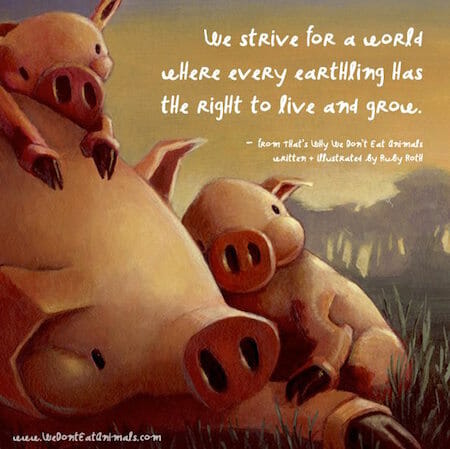
An illustrated page from That’s Why We Don’t Eat Animals.
I do, though, agree that kids are impressionable, which is exactly why they need information at an early age that will help them make educated choices. In my experience, when kids understand options, they choose wisely.
With constant media and technological stimulation, kids are being “impressed” upon by biased messaging up to hundreds of times a day—by whom? Follow the money. Seventy-five percent of government subsidies go to meat and dairy while less than half a percent goes to fruits and vegetables. The Milk Mustache campaign, driven by the National Milk Processor Board (administered by the USDA) spent $190 million in 1998. Colluding industry-led campaigns like these cause massive increases in demand, in this case, billions of pounds of fluid milk.
These profit-seeking systems are the ones we should be concerned about influencing our kids—not a picture book about choices. If we don’t intercept the all-pervasive, concerted efforts between Big Ag, Big Pharma, and federal nutrition programs, today’s youth will inevitably join in the animal cruelty and the dysfunctional cycle of disease and medication we are experiencing in this country at an all-time high. The most important message to teach kids is that we don’t have to fear anything we have the power to change.
Read More HERE
Order a FREE vegan kit: http://www.peta.org/living/food/free-vegan-starter-kit/
Take PETA’s Cruelty-Free Shopping Guide along with you next time you head to the store! The handy guide will help you find humane products at a glance. Order a FREE copy HERE
Want to do more than go vegan? Help others to do so! Click on the below for nominal, or no, fees to vegan literature that you can use to convince others that veganism is the only compassionate route to being an animal friend.
PETA: http://www.petacatalog.com/catalog/Literature-39-1.html
Looking for merchandise? Action for Animals has a very good sele : http://store.afa-online.org/home.php?cat=284
Have questions? Click HERE
Read more…
Mainstream Animal Advocacy Messages Framed By Those Doing The Harm

Wikimedia Commons
Source Vegan Publishers
By Dr. Casey Taft
I recently spoke with a highly respected activist connected to those who lead the largest animal advocacy organizations, discussing how these groups are now only asking others to “go vegetarian” and “cut down on” consuming animals (reducetarianism), rather than promoting veganism. He told me something that I intuitively knew but never fully digested: these organizations inform their advocacy decisions based on market research. In other words, when determining how best to encourage people to stop exploiting animals, they ask those doing the exploiting how we should craft our message to them.
Let that sink in for a moment and ask yourself how that would look with any other social justice movement. Do you think the Black Lives Matter folks conduct surveys with white racists in an effort to determine how we can end racial injustice? Do feminists conduct focus groups with sexist men about how we can best end patriarchy and violence against women? Of course not! It is absurd to ask those doing the oppressing how we should talk to them to encourage them to stop the oppression.
Of course, when we ask a non-vegan how we should engage in advocacy, they will tell us that we should only ask them to cut down on eating animal “products.” They would prefer that we never mentioned the word “vegan” at all because it makes them uncomfortable. This is why mainstream animal advocacy organizations are now calling for reducetarianism and vegetarianism rather than veganism. They can engage in their advocacy while not upsetting a very large potential donor base that funds their organizations and salaries.
We should not stop short of asking others to go vegan by suggesting that they go vegetarian or reducetarian instead because it makes them more comfortable. Being comfortable does not bring about the radical shift that we need for animals. We need to help the broader society step out of its comfort zone and ultimately reject the injustice we expose animals to in our use and abuse of them. Nonhuman animals deserve justice and an end to their use, not market researchers who are asking those engaging in the injustice how we can best talk to them.
Let’s do a thought experiment, just for the vegans. Think back to before you were vegan, when the plight of nonhuman animals wasn’t even on your radar. Maybe you willfully ignored what was happening to them or maybe you were just uninformed and unaware. Now imagine that a large animal advocacy group randomly contacts you, asking that you help lead a heavily funded campaign to end nonhuman animal exploitation. Do you think you are qualified to lead such an effort? Or do you think that your present self, as a vegan with a different perspective, might be more up to the task? Of course one is better positioned to know how to frame an animal rights message when we have some concept of the injustice that animals experience.
We have our greatest success in helping others go vegan if we discuss the implications of what we do to animals; the ethical argument is by far our strongest one. Large advocacy groups with access to considerable resources and large followings tell others that we should be asking people to reduce – rather than end – their exploitation, diluting our collective vegan message of social justice and undermining the ethical argument. Too many people are being taught that animal exploitation is okay in moderation, and that the best approach to having a vegan world is to not talk about veganism at all. Be aware of the source of this wrong-headed advocacy approach: pandering by large animal advocacy groups to those engaging in the exploitation.
Our movement should not be guided by the preferences of those who never want to see the end to exploitation of animals. It may help bring in donations to the large groups by those who are thankful that we don’t ask them to go vegan, but it is certainly not good for nonhuman animals. It’s time we as a movement collectively treat animal use as an issue of social justice.
Casey is co-owner of Vegan Publishers, Professor of Psychiatry at Boston University School of Medicine, and staff psychologist at the National Center for PTSD in the VA Boston Healthcare System. He’s an internationally recognized researcher in the area of violence prevention, winning prestigious awards for his work from the International Society for Traumatic Stress Studies, the Institute on Violence, Abuse and Trauma, and the Centers for Disease Control and Prevention. He has published over 100 journal articles, book chapters, and scientific reports, and has a book forthcoming on trauma-informed violence prevention, published by the American Psychological Association.
Order a FREE vegan kit: http://www.peta.org/living/food/free-vegan-starter-kit/
Take PETA’s Cruelty-Free Shopping Guide along with you next time you head to the store! The handy guide will help you find humane products at a glance. Order a FREE copy HERE
Want to do more than go vegan? Help others to do so! Click on the below for nominal, or no, fees to vegan literature that you can use to convince others that veganism is the only compassionate route to being an animal friend.
PETA: http://www.petacatalog.com/catalog/Literature-39-1.html
Looking for merchandise? Action for Animals has a very good sele : http://store.afa-online.org/home.php?cat=284
Have questions? Click HERE
Read more…
Europe’s First Abolitionist Vegan Advertising Campaign
Source Linkedin
By Sandra Higgins
Eden Farmed Animal Sanctuary & Matilda’s Promise, Animal Rights & Vegan Education Centre, have launched a Public Advertising Campaignon transport and street signage throughout Ireland.

The ads, which focus on abolition of animal use, and on the harm caused bydairy and egg consumption, will appear:
- on Buses throughout Ireland
- on Bus Shelters throughout Ireland
- in Dublin DART trains
- on Billboards throughout Ireland
- in newspapers/magazines
- in Third Level Colleges and Universities throughout Ireland
 The campaign will run throughout November in celebration of World Vegan Month.
 The campaign is designed to counteract speciesism at the levels of individual prejudice and the socio-cultural norm. The ads allow individual non-humans to use their voice to ask for empathic engagement, to awaken conscious awareness of the harm we cause by using them, and to ask for the justice to which they are entitled.
 This is an effective way of reaching a large population of non-vegans. The ads provide a direct link, through Free Text and a QR Scan Code to a Free Vegan Kit and to an educational website www.govegan.ie, both of which offer practical information to begin living vegan, as well as comprehensive information on the issues concerning our use of other animals. There is also a Facebook Page Go Vegan Ireland.
 Joanna Lucas, Peaceful Prairie, our Campaign Designer, has created ads that allow the featured animals to crack open the darkness of their world that has been hidden for too long. The ads shine light on something that is rotten and wrong to its core, and direct people into the brighter path of veganism.
 The campaign is inspired by the residents I work with at Eden Farmed Animal Sanctuary who have taught me everything I know about the personhood of the animals we harm. I have seen the light go out of too many eyes. Every one of them fights to the last breath to hold onto the only life they have. The least we owe them is a vegan world.
The Last Pig
Source The Last Pig
THE LAST PIG is a documentary feature currently in production. Principal photography has been underway since summer of 2014. We are presently seeking funds to complete the last phase of shooting and post production. Target completion is June 2016.
STORY
THE LAST PIG journeys into the life of a pig farmer as he grapples with death, searches for compassion, and finally finds the courage to change.
For over a decade, Bob Comis has provided a humane—even idyllic—life for the pigs he farms. But as he tends to his charges, he develops a closeness that begins to haunt him, and his weekly trips to the slaughterhouse become agonizing . With 250 pigs on the farm, Comis suddenly finds himself trapped by his past.
Through this personal journey, THE LAST PIG raises crucial questions about equality, the value of compassion and the sanctity of life. Comis’ soul-bearing narrative carries us through his final year of farming pigs, the struggle to reinvent his life, and the ghosts that will haunt him forever.
It is our hope that THE LAST PIG will help propel a shift in our society’s relationship to non-human beings and our capacity for compassion.
Order a FREE vegan kit: http://www.peta.org/living/food/free-vegan-starter-kit/
Take PETA’s Cruelty-Free Shopping Guide along with you next time you head to the store! The handy guide will help you find humane products at a glance. Order a FREE copy HERE
Want to do more than go vegan? Help others to do so! Click on the below for nominal, or no, fees to vegan literature that you can use to convince others that veganism is the only compassionate route to being an animal friend.
PETA: http://www.petacatalog.com/catalog/Literature-39-1.html
Looking for merchandise? Action for Animals has a very good sele : http://store.afa-online.org/home.php?cat=284
Have questions? Click HERE
The Vegan Way of Living – Free Telesummit
Find out how you can live a Compassionate, Healthy, Joyful, and a Sustainable Life! Enter your name and email address HERE to join this FREE event!
21 empowering speakers come together to teach a compassionate, sustainable, healthy, and happy way of living. Discover how to live a life free of animal products and suffering.
Hosted by Rupa Vadodaria, Certified Integrative Nutrition Health Coach
Order a FREE vegan kit: http://www.peta.org/living/food/free-vegan-starter-kit/
Take PETA’s Cruelty-Free Shopping Guide along with you next time you head to the store! The handy guide will help you find humane products at a glance. Order a FREE copy HERE
Want to do more than go vegan? Help others to do so! Click on the below for nominal, or no, fees to vegan literature that you can use to convince others that veganism is the only compassionate route to being an animal friend.
PETA: http://www.petacatalog.com/catalog/Literature-39-1.html
Looking for merchandise? Action for Animals has a very good sele : http://store.afa-online.org/home.php?cat=284
Have questions? Click HERE
Read more…
Compassion, Inc.
Source Compassion Incorporated
Compassion, Inc., is a nonprofit creating connections through our online vegan community with our Business Directory, Job Board, & Events Calendar. We’re your one-stop source for all things vegan! And, we’re expanding every day!
Members also receive discounts at participating businesses.

Compassion Incorporated
Order a FREE vegan kit: http://www.peta.org/living/food/free-vegan-starter-kit/
Take PETA’s Cruelty-Free Shopping Guide along with you next time you head to the store! The handy guide will help you find humane products at a glance. Order a FREE copy HERE
Want to do more than go vegan? Help others to do so! Click on the below for nominal, or no, fees to vegan literature that you can use to convince others that veganism is the only compassionate route to being an animal friend.
PETA: http://www.petacatalog.com/catalog/Literature-39-1.html
Looking for merchandise? Action for Animals has a very good sele : http://store.afa-online.org/home.php?cat=284
Have questions? Click HERE
Read more…
Why Plant Crops Don’t Kill More Wildlife than Pasture Raised Animals
FFH, Public domain
Source Free From Harm
By Anupam Katkar
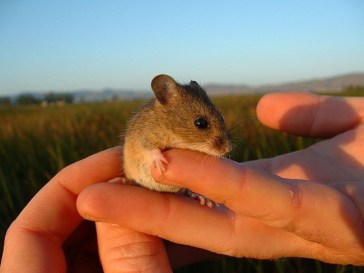
Picture this: You’re a harvest mouse who lives in a wheat field. Being a mouse, you have excellent hearing and can easily pick up sounds that a human cannot hear. Thanks to your sensitive whiskers and small size, you’re acutely attuned to vibrations caused by large machines. Although your eyesight isn’t the best in the world, your eyes are situated high on your head and offer an excellent all-round view. And to top that off, you have lightning reflexes and dash about at a top speed of 8 miles an hour.
Now imagine that you’re perched idly on a stalk of wheat, your tail curled around it like a fifth limb. You’re smelling the crisp morning air and feeling the sun shining on your face. But then, the ground starts to shudder as a 3 ton, 4-cylinder diesel-engined combine harvester ominously starts heading your way – which, by the way, you can see without even turning your head. What will you do?
Run like hell
Humbly await your fate on a Kentish plum
Mike Archer, a paleontologist, goes with Option 2, which makes me wonder if he should be spending more time with living animals instead of extinct ones.
But this article is not the rebuttal of any one person or article, but an exploration of a notion perpetuated repeatedly without a shred of scientific evidence: that more animals are killed cultivating food for vegans and vegetarians, and therefore eating meat is kinder because it kills fewer animals. I think that this is not a scientific debate, but a social power struggle, perhaps with the support of the meat industry. But before we debunk the “armchair experts”, let’s have a look at some actual studies conducted in the field.
Order a FREE vegan kit: http://www.peta.org/living/food/free-vegan-starter-kit/
Take PETA’s Cruelty-Free Shopping Guide along with you next time you head to the store! The handy guide will help you find humane products at a glance. Order a FREE copy HERE
Want to do more than go vegan? Help others to do so! Click on the below for nominal, or no, fees to vegan literature that you can use to convince others that veganism is the only compassionate route to being an animal friend.
PETA: http://www.petacatalog.com/catalog/Literature-39-1.html
Looking for merchandise? Action for Animals has a very good sele : http://store.afa-online.org/home.php?cat=284
Have questions? Click HERE
Read more…