HighestWelfare.Humane.Assured.GoodPractices.Vegetarian. Regenerative.Flexitarian.Lies...
What is the difference between No Welfare, High Welfare, and Highest Welfare when they all require animals to die? Only human comfort, NONE protect the actual animals. The most humane, ethical, and honest Webster-defined "welfare" is NOT exploiting animals - not using, not wearing, not eating, not killing - animals. The only meaningful position is vegan, everything else is just how humans euphemize animals' required suffering and violent deaths: no human exploits animals because they honestly believe that NOT exploiting animals is UNethical or INhumane.
Sustainability and Food Choice: Why Eating Local, “Less” Meat, and Taking Baby Steps Won’t Work
Source Vegan Outreach
The following findings were compiled from the executive summary of Livestock’s Long Shadow: Environmental Issues and Options* a 2006 report published by the United Nations Food and Agriculture Organization:
Climate change: With rising temperatures, rising sea levels, melting icecaps and glaciers, shifting ocean currents and weather patterns, climate change is the most serious challenge facing the human race. The livestock sector is a major player, responsible for 18 percent of greenhouse gas emissions measured in CO2 equivalent.… Livestock are also responsible for almost two-thirds (64 percent) of anthropogenic ammonia emissions, which contribute significantly to acid rain and acidification of ecosystems. [See also A Truly Inconvenient Truth.]
Water: The livestock sector is a key player in increasing water use, accounting for over 8 percent of global human water use, mostly for the irrigation of feedcrops. It is probably the largest sectoral source of water pollution, contributing to eutrophication, “dead” zones in coastal areas, degradation of coral reefs, human health problems, emergence of antibiotic resistance and many others. The major sources of pollution are from animal wastes, antibiotics and hormones, chemicals from tanneries, fertilizers and pesticides used for feedcrops, and sediments from eroded pastures.
Land degradation: Expansion of livestock production is a key factor in deforestation, especially in Latin America where the greatest amount of deforestation is occurring – 70 percent of previous forested land in the Amazon is occupied by pastures, and feedcrops cover a large part of the remainder.
Biodiversity: Indeed, the livestock sector may well be the leading player in the reduction of biodiversity, since it is the major driver of deforestation, as well as one of the leading drivers of land degradation, pollution, climate change, overfishing, sedimentation of coastal areas and facilitation of invasions by alien species.
*Note: The term “livestock” refers to all farmed animals, including pigs, birds raised for meat, egg-laying hens, and dairy cows.
For more information, see the media release and full report.
Read more…
Urge Philippine officials to stop horrific “crush” videos and hold the perverts who make them accountable
PETA
PETA Asia (helped by PETA affiliates around the world) has been working hard to shut down the production of cruel “crush” videos, disturbing films in which young girls in “sexy” outfits are videotaped tormenting, abusing, and killing animals—slowly and painfully.
Will you help stop the production of these ghastly videos by taking action online right now?
For more than two years, PETA Asia has been working to end the production, distribution, and sale of these videos, which exploit two of the most vulnerable members of any society—children and animals—and has focused its efforts in the region that may be “ground zero” for the crush-video industry, the Philippines.
These crush videos are made by filming girls stepping, standing, and stomping on and slowly crushing animals—from the smallest of mice to large dogs who are tied down and helpless. They appeal to a niche market of individuals from all over the world who derive sexual pleasure from watching animals being tortured to death.
One Philippine couple has been arrested on criminal charges related to making these graphic videos following a year-long PETA Asia investigation undertaken in cooperation with the Philippine National Bureau of Investigation.
The pair is being held in jail without bail as I write this. Now PETA Asia must follow through—at great financial cost—to pursue the case against these two alleged “crush” producers. Brace yourself: The videos associated with this case show girls skinning a live rabbit, burning a dog with a hot iron, and slowly crushing puppies to death.
Court testimony is well underway, but it’s a lot of hard work for the PETA Asia staff to keep the public’s attention focused on this case in a remote part of the Philippines. The PETA Asia legal team is confident that a judgment will be issued soon in this precedent-setting case. We hope PETA Asia’s pursuit of the case sends a clear message to people in the Philippines and around the world: If you make such videos, you will be caught and go to jail.
PETA Asia’s work on this case has also helped prompt a member of the Philippine Congress to introduce a bill prohibiting the sale, distribution, and exchange of these disgusting videos.
It’s difficult to imagine something as vile as animal crush videos, but you can help us move closer to the day when such sickening cruelty is stopped.
Please take a moment today to urge Philippine officials to ban crush videos.
Thank you for everything that you do for animals—both in your own neighborhood and around the world. Animals need friends like you, and we are proud to have your support.

Dissection choice signed into Connecticut law
Source: NEAVS
As the deadline approached, Connecticut’s Gov. Dannel Malloy signed a state dissection choice bill into law! Connecticut makes 16 states plus Washington D.C. that have laws or policies allowing students modern alternatives to traditional dissection.
Thank you, NEAVS’ Connecticut supporters, for contacting your state senators and representatives and helping to make this happen.
As we celebrate the victory in Connecticut for students, animals, and education, NEAVS and our educational affiliate, the Ethical Science Education Coalition (ESEC), continues to work to guarantee cruelty-free alternatives to dissection in every state. If your state does not protect a student’s right to dissection choice, contact us today to find out how, together, we can make this happen.
For more background, visit NEAVS/ESEC’s Objecting to Dissection and Dissection Alternatives.

Laws
- California
- Florida
- Illinois
- New Jersey
- New York
- Oregon
- Pennsylvania
- Rhode Island
- Vermont
- Virginia
- Connecticut
Policies
Update: U.S. Horse Slaughter on Hold…for Now

Wikimedia Commons
Urge your members of Congress to cosponsor the SAFE Act
Source ASPCA
We recently told you that the U.S. Department of Agriculture (USDA) approved applications for horse slaughter inspections at Valley Meat Company LLC in Roswell, New Mexico, and Responsible Transportation in Sigourney, Iowa. The USDA is likely to also grant horse slaughter inspections at Rains Natural Meats plant in Gallatin, Missouri, in the coming days.
This week we learned that no horse slaughter plants will be granted inspections until at least July 29 as a result of a lawsuit filed against the USDA by several animal welfare organizations.
This lawsuit buys critical time for our horses. The Agriculture Appropriations bills, which contain language that would prevent horse slaughter in the U.S., are expected to pass in the coming months. We are seeing building momentum for the Safeguard American Food Exports (SAFE) Act, which would prevent the slaughter of horses in the U.S., end the current export of American horses for slaughter abroad and protect consumers from unknowingly ingesting toxic horse meat.
Please be a voice for horses TODAY: Urge your members of Congress to cosponsor the SAFE Act to end this horrific threat to American horses and protect the public. This is a pivotal time for horses and they need your voice more than ever!
Wikimedia Commons
BACKGROUND | SOURCE PETA
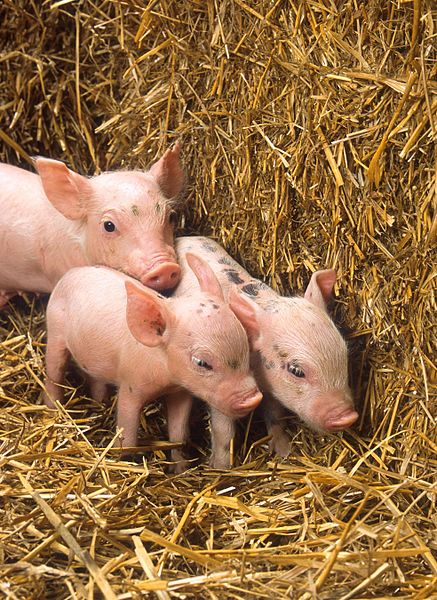
Social, intelligent, and loyal, pigs are highly sensitive animals who enjoy communicating with each other, making nests, and relaxing in the sun. But on July 20, the Empress Daze festival in the Canadian town of Empress, Alberta, has scheduled a “greased pig” contest, during which a young animal will be frantically chased, grabbed at, and tackled again and again in a pen lined with screaming crowds. Being trucked to and fro and subjected to the violence and general chaos of these events is a terrifying and hazardous ordeal for pigs, who often sustain severe injuries, such as broken limbs or backs. PETA has asked the festival’s organizer to replace the event with any number of humane alternatives, but to no avail. We need your help today!
Please urge Pat Donaldson, the organizer of the Empress Daze festival, to cancel the “greased pig” event. And please, spread this alert far and wide!
WHOM TO CONTACT
Call or send polite comments to:
Pat Donaldson
309 Centre St.
Empress, Alberta T0J 1E0
403-565-0009
pat@empressive.ca
SAMPLE LETTER
To Whom It Concerns,
I am disturbed to learn of your greased pig contest and am respectfully urging you cancel this unjustified and cruel event. Pigs are marvelously intelligent and sentient creatures, capable of love, pain, thought, and suffering; when you subject pigs to such indecent treatments, you not only condemn them to fear and agony, but you also demean yourself and establish that you are unsympathetic towards animal concerns.
Indeed, a young animal will be frantically chased, grabbed at, and tackled again and again in a pen lined with screaming crowds. Being trucked to and fro and subjected to the violence and general chaos of these events is a terrifying and hazardous ordeal for pigs, who often sustain severe injuries, such as broken limbs or backs.
Please consider humane alternatives instead.
Thank you for taking the time to consider this urgent appeal.
Read more…
Stop Virginia Running of the Bulls Event
PETA
BACKGROUND | SOURCE PETA
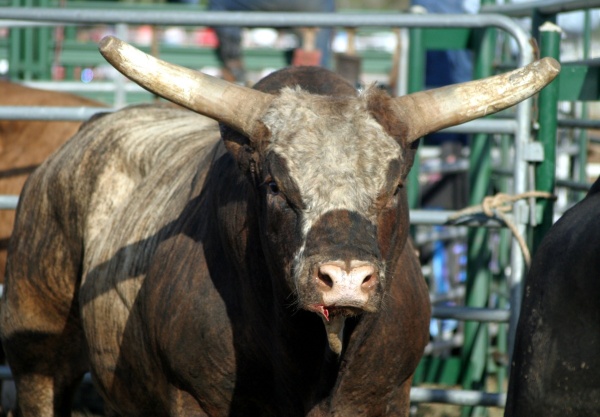
After having been loaded onto trucks, potentially driven hundreds or thousands of miles, and herded into an arena filled with hundreds of screaming people, bulls used for running events will bolt out of the pen in panic when the starting gate opens.
When running out of the pen, the animals risk crashing into barriers, falling and breaking their legs, or colliding with and injuring each other.
Despite receiving information from PETA about the cruelty inherent in the Running of the Bulls, Virginia Motorsports Park refuses to consider humane alternatives to its planned events, in which live bulls will be forced to participate in a bull run.
Please politely call or e-mail Bryan Pierce, the general manager at Virginia Motorsports Park, and politely ask him to drop this cruel, dangerous event.
WHOM TO CONTACT
Bryan Pierce
bryanp@virginiamotorsports.com
804-862-3174
SAMPLE COMMENT
Dear General Manager Pierce,
Please cancel the Running of the Bulls event in which live bulls will be forced to participate in a bull run. Allow me to elaborate on how dangerous and cruel this event is.
After having been loaded onto trucks, potentially driven hundreds or thousands of miles, and herded into an arena filled with hundreds of screaming people, bulls used for running events will bolt out of the pen in panic when the starting gate opens.
When running out of the pen, the animals risk crashing into barriers, falling and breaking their legs, or colliding with and injuring each other.
It is furthermore dangerous for humans; in a recent event, 23 people were injured, including goring injuries. Would there be liability issues?
Please drop this cruel, dangerous event and instead consider humane alternatives. Thank you.
Wikimedia Commons
Source Scoop World
Press Release: Greenpeace International
After Greenpeace Protest: Shipping Companies Committing Themselves to Send Whale Meat Back to Sender
German Environmental Minister Altmaier In Duty of Prohibit Transit of Whale Meat
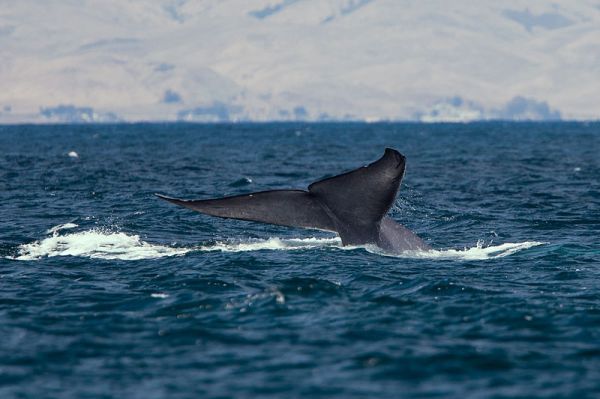
Hamburg / Germany, 11th July 2013 – The renewed protests by Greenpeace activists against the transit of whale meat via the harbour of Hamburg was successful: in the late evening the Taiwanese shipping company “Evergreen Line” announced to send the container with six fin whale meat back to Iceland. Few hours later, also the Icelandic shipping company “Samskip” promised in a public statement to stop transporting whale meat in future. “Among the shipping companies Samskip has dominated being involved in the bloody business with the whale meat. This boycott is a clear signal to Iceland’s whalers to finally stop the senseless hunting,” says Iris Menn, marine expert from Greenpeace Germany.
“Evergreen Line” handles the entire transport of the six containers and claims not have known that they were carrying whale meat as it was declared as “frozen fish”. Only because of the protest of Greenpeace activists they were aware of the real container content (please find the statement “Evergreen Line” here: http://bit.ly/12msGFT). Menn says: “We welcome the decision of Evergreen to send the whale meat back. Iceland’s whalehunters have to remember that trade with the world’s endangered animals is worldwide unwanted.” The “Evergreen Line” is going to transport the containers via the cargo ship “Ever Leading” on 11th July to the port Rotterdam.
From there, Icelandic company “Samskip” has promised to arrange the return transportation to Iceland and to refrain from whale meat transports in future. (Please find the statement of “Samskip” here: http://bit.ly/1aqHNTS) “The rapid response of the shipping companies on our protest clearly shows that nobody wants to have anything to do with whaling. Now German federal environment minister Peter Altmaier has finally to ensure that Germany will not longer support indirectly whaling neither the trade nor of whale meat. He has to drive for a long-term obligatory legal prohibition of the transit of whale meat via Germany”, says Menn.
The whale meat, about the amount of ten fin whales, arrived on 5th July in the port of Hamburg, carried by the container vessel “Cosco Pride”. Greenpeace activists in inflatable boats met the ship in the port with protest banner and informed the authorities. The Customs investigation services had seized the container due to lack of documents and false declarations, on 9 July, however, released. Thereupon Greenpeace activists climbed the cargo ship named “Eilbek” at Tollerort-Terminal in Hamburg as it was supposed to transport the whale meat via Rotterdam to Japan. Four activists tied themselves to the leashes, which tied the cargo ship to the land. Immediately, the charter “Unifeeder” refused to transport the whale meat, and canceled the order.
Iceland rejects alongside Norway and Japan both the international ban on commercial whaling (IWC) and international ban on trade of whale meat (CITES) . This season, Iceland whalers want to kill 184 endangered fin whales. Since there is no demand for meat in the country itself, it is exported exclusively to Japan. There, still unsellable frozen meat from the last whaling season is still being stored.
Read more…
Ask University of Texas Medical Branch at Galveston to End the Use of Goats in its ATLS Courses
 Please send an automatic e-mail
Source: PCRM
We need your help to stop the killing of goats by University of Texas Medical Branch at Galveston (UTMB). Please ask UTMB to end the use of animals in Advanced Trauma Life Support (ATLS) training today.
In ATLS courses at UTMB, each participant is required to perform numerous invasive procedures on live goats, and the goats are killed at the end of the training. Nonanimal training methods are widely used in nearly all other accredited ATLS programs, making this use of animals not only cruel but unnecessary and even substandard.
So far, the responsible UTMB faculty and administrators have refused pleas to change this practice. Please e-mail medical school dean Danny Jacobs, M.D., M.P.H., and ATLS course director William Mileski, M.D., and urge them to end this cruel and unnecessary practice.
Simulab’s TraumaMan System, a realistic anatomical human body simulator with lifelike human skin, fat, and muscle and approved by the American College of Surgeons, is used by the great majority of ATLS programs for this type of training. UTMB even owns a TraumaMan System but refuses to use it for ATLS training.
Ninety-eight percent of ATLS programs in the United States and Canada do not use animals. It is time for UTMB to join the majority. Please e-mail Drs. Jacobs and Mileski today and ask them to replace the use of animals in the University’s ATLS courses.
Thank you for your help.
Farm to Fridge – The Truth Behind Meat Production
Source: Mercy for Animals
Mercy For Animals presents Farm to Fridge. Narrated by Oscar-nominee James Cromwell, this powerful film takes viewers on an eye-opening exploration behind the closed doors of the nation’s largest industrial farms, hatcheries, and slaughter plants — revealing the often-unseen journey that animals make from Farm to Fridge.
Learn more at:
http://www.MeatVideo.com
http://www.ChooseVeg.com
http://www.MercyForAnimals.org
Order a FREE vegan kit HERE or see below
Free Vegan Guide
Read more…
They Will Be Set Free
Source: Cry of the Innocent
By Kathleen Lowson
When every single animal is released from imprisonment, torture, suffering and death inflicted upon them by an egocentric society, they will be set free.
When every single animal can live without bars in dignity and peace and take their rightful place on our planet, they will be set free.
When every single animal is treated with respect as a sentient being, capable of feeling pain and suffering, they will be set free.
When every single animal is revered as a loving creature of the earth and not a commodity, they will be set free.
When every single animal can walk this earth without fear of persecution and death, they will be set free.
When every single animal can speak their voice in their own language and be heard by a humane, empathetic and compassionate society, they will be set free.
Will you set them free? Not bemoan their fate but challenge the world as a sacred activist?
This is a “revolution of evolution” – not a battle with armor but a quest for spiritual epiphany, for the awakening of soul on our planet.
We can choose to turn a blind eye and remain prisoners in chains.
Or we can choose to confront the dark forces within and without, and foster the energy of love on our planet, sustained by courage of the heart and conviction of the soul.
We can set them free, set ourselves free, set the planet free. The animals, the earth, the human species are ONE inseparable soul energy.
Which choice will you make?
©Kathleen Lowson
Filmmaker
CRY OF THE INNOCENT: The Voices That Can’t Speak

“Choose if you would take your place among the saviors of the world, or would
Remain in hell, and hold your brothers there.”
– A Course in Miracles
Please take action for lab animals
Warning, Viewer Discretion is Advised
1. Please click HERE to sign and send letter
2. Please click HERE to sign petition
Background | Source BUAV’s Licensed to Kill
An undercover investigation carried out by the BUAV has exposed appalling suffering and wrong-doing inside one of the UK’s leading universities, Imperial College London, ranked as one of the best in the world. Despite Government and industry claims that the UK has strong regulations in place, the BUAV has uncovered a catalogue of suffering and wrongdoing.
Behind the closed doors of this ‘world-leading’ university, the BUAV investigator discovered a nightmare world for animals used in experiments: animals who suffered even more than was allowed by the experiment because of staff incompetence and neglect; a failure to provide adequate anaesthesia and pain relief; breaches and lack of knowledge of UK Home Office project licences and the shocking way in which animals were killed.
The harrowing experiments carried out at Imperial College during the investigation involved the deliberate infliction of major organ damage, surgical mutilation and invasive head surgery to implant cannulas (tubes) so that substances could be directly injected into the brain. Some animals were forced to run on treadmills to exhaustion to avoid electric shocks, others were restrained while a long tube was forced down their throats and substances injected directly into their stomachs.
This investigation has shed new light on the daily reality for animals in laboratories and the ordeal they are forced to endure. Their suffering was often severe and could include a high degree of pain, distress, weeping or bleeding head or abdomen wounds, diarrhoea, lethargy or hypothermia. Many animals died during or after the surgery; and others had to be killed because the level of their suffering was so great.
The BUAV is calling on the Home Secretary to revoke Imperial College’s Establishment Licence, stopping them from carrying out further animal research, and launch a full and independent inquiry in the concerns raised by the BUAV investigation.
Read more…
Viva
Please click HERE to sign and send petition
Source The Independent
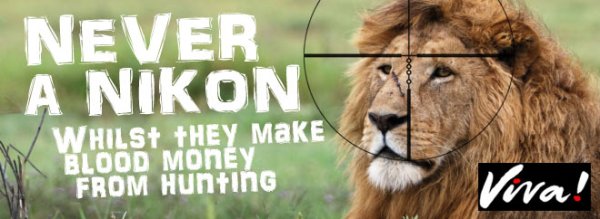
Camera company synonymous with wildlife photography accused of hypocrisy for making rifle sights
Nikon, one of photography’s most respected names, faces a backlash from within the industry for portraying itself as a friend of wildlife photography while making sights for rifles for big game trophy hunters in the US and Africa.
The Japanese camera manufacturer makes a rifle scope designed specifically for killing large game, the £170 “Monarch African”.
Nikon’s marketing literature boasts that the scope is perfect “for those seeking their dangerous game adventure on the dark continent” and is “the proven choice for dangerous big game hunting”, adding: “Africa has long been a continent of dreams for hunters around the world.”
In its latest catalogue for amateur and professional photographers, meanwhile, Nikon describes itself as being “at the heart of nature”. Next to a photograph of two polar bears, it states: “Nature is full of moments of timeless beauty, to be captured before they are gone forever.”
Many leading wildlife photographers use Nikon’s cameras to catch elegiac scenes of wild animals. Stefano Unterthiner, winner of the Wildlife Photographer of the Year in 2008, criticised Nikon’s connection to hunting.
“I’ve used Nikon since I was a young boy, fascinated by nature and wildlife. I always saw Nikon as a company close to nature, but I was wrong,” he said.
“I don’t understand and can’t agree with their support for trophy hunting, which sends out entirely the wrong message to global photographers who love nature. Wildlife needs protecting now more than ever, and I urge the company to end its support for trophy hunting.”
Nikon in the UK failed to respond to The Independent’s questions. Animal welfare campaigners criticised the stance of the company, part of Japan’s vast Mitsubishi conglomerate. Trophy hunting is highly controversial among wildlife campaigners. Wealthy western hunters typically pay tens of thousands of pounds to shoot big game. South Africa earns around $100m a year by sanctioning the hunting (which it classes as “eco tourism”), leading to the deaths of approximately 54,000 animals. Hunters typically target the biggest and strongest animals, who provide the more attractive trophies (stuffed animals and fur rugs etc). In the case of lions this is often the dominant male. In the absence of the dominant male, a rival lion will move in and kill any cubs fathered by the absent male, diminishing the lion population.
According to Scientific American magazine, trophy hunters have played a part in the halving of lion population in Africa over the past 30 years.
Most of Nikon’s hunting optics are produced for the US market, where it makes rifle scopes for turkey hunting and one called the Coyote Special – saying it is “…proud to introduce the first line of rifle scopes built specifically for predator hunters”.
Nikon previously marketed its rifle copes on a website called Nikon Hunting which has recently been renamed Nikon Sport Optics. Gruesome photos of grinning hunters have disappeared from the redesigned site, but the same rifle scopes are still for sale. Joe Duckworth, chief executive of The League Against Cruel Sports, said: “Big game hunters slaughter tens of thousands of animals, many of which are listed as endangered or bordering on extinction.”
BACKGROUND
Home to about a dozen miserable bears, the Cherokee Bear Zoo is a small remote tourist trap located off a highway in North Carolina—blink, and you’ll miss it. The dilapidated roadside attraction keeps these intelligent animals in grossly inhumane conditions. They are confined to virtually barren concrete pits, where they have no other option but to pace back and forth, walk in endless circles, and beg tourists to toss them a morsel of food.

Highly intelligent animals capable of empathy and a wide range of feelings, bears are active for up to 18 hours per day in their natural habitat and spend their time exploring diverse terrain. In the wild, bears forage for a wide variety of foods and dig in soft earth, brush, and leaves—but the concrete pits that the Cherokee bears are forced to call home deprive them of everything that is natural and important to them. Surrounded by four solid walls, the bears cannot scan the horizon, gain a perspective on their surroundings, or make much use of their acute sense of smell.
Cherokee’s roadside zoos have made no effort to simulate the animals’ natural habitat or provide them with stimulation. They have also been cited repeatedly by the U.S. Department of Agriculture for failing to meet minimal federal standards established in the Animal Welfare Act. Check out PETA’s investigation of a bear park in Cherokee similar to the Cherokee Bear Zoo here to see the filth, hunger, and misery that these captive bears are forced to endure.
You can help close this cruel animal prison by urging the owners of Cherokee Bear Zoo to release the bears to a reputable sanctuary. They are already feeling the heat from locals and thousands of others who have demanded that the bears be moved to a more natural environment at a reputable sanctuary—one that exists exclusively to benefit and rehabilitate animals.
WHOM TO CONTACT
Use the address coggins4@msn.com to e-mail Cherokee Bear Zoo owners Barry and Collette Coggins.
SAMPLE LETTER
Dear Mr. and Ms. Coggins:
Please close the Cherokee Bear Zoo bear exhibits immediately and agree to retire the bears to a reputable sanctuary, where they can roam vast acreage, forage for their own food, and act on their natural instincts. A concrete pit is no match for open terrain, and these intelligent animals deserve more than to live out the rest of their days entertaining bored tourists behind concrete walls.
No one wants to see animals suffer, and it’s shameful to continue to deny the frustrated bears the opportunity to thrive elsewhere. There is nothing for them to do but pace back and forth or walk around in circles. They are separated from everything that is natural and important to their species. As people continue to evolve and understand more about these animals’ unique needs, your revenue will continue to drop. It’s 2013, and there is no excuse for profiting from animal suffering in the name of entertainment.
Reputable sanctuaries stand ready to take in these bears so that they can live out the rest of their days in peace. Existing sanctuaries that have no corporate motives and employ experts in specialized care for exotic animals will provide these suffering bears with a much better home. Please take advantage of this opportunity without further delay and retire these bears so that they can finally truly be bears. They did not choose to be in the tourism business. Please don’t allow them to continue to suffer for your choice.
Thank you.
Source Animals Deserve To Live

Animals Deserve To Live
This is what they mean by “free range”. Equally disgusting as cages if you ask me.

Oregon Votes to Ban Horse Tripping at Rodeos
Source: Care2
(OC: all rodeo events are cruel; there is no justification for harming any animals regardless of type of “event”. All rodeos and rodeo “events” are equally barbaric and should be banned as a whole.)
Oregon lawmakers have voted to pass legislation that will ban the cruel rodeo event otherwise known as horse tripping.
The bill, SB 835, which was sponsored by Senators Mark Hass and Bill Hansell, and Representative David Gomberg, passed the Senate with the House’s amendments by a vote of 24-6 and now goes to Oregon Gov. John Kitzhaber for a signature.
The event in question is exactly what it sounds like and involves roping horses by the legs while they’re running and causing them to fall. For a fast-moving large animal, the crash is as violent as you can imagine and often leaves horses with serious injuries ranging from rope burns and internal damage to broken bones and death, never mind the psychological trauma it inflicts on them.
Advocacy organizations including Showing Animals Respect and Kindness (SHARK), the Humane Society of the United States (HSUS) and the Animal Law Coalition have been fighting to end this cruel event, along with caring members of the public — a Care2 petition supporting a ban gathered more than 20,000 signatures.
A previous attempt to ban it failed because rodeo supporters had legislators convinced this wasn’t going on and also argued that a ban on horse tripping could eventually lead to a ban on other roping events and may adversely affect what owners are allowed to do with their animals.
Last year, SHARK released footage from the Valley Big Loop Rodeo in southeastern Oregon that infuriated the public and reignited the call for a ban. This May, Adam Fahnestock, a member of SHARK, was arrested for videotaping one of these events in the state. (The above footage) is what he saw.
Clearly there’s evidence and this time around, legislators were presented with it at committee hearings by the Animal Law Coalition so they could see that even though it may not occur at events sanctioned by the Professional Rodeo Cowboys Association, it clearly still goes on.
Said Scott Beckstead, senior Oregon state director for The HSUS:
Horse tripping events are traumatizing for the animals and can cause catastrophic injuries such as broken legs, necks and backs. Watching a horse fall to the ground and suffer is not entertainment―it’s inhumane and has no place in Oregon. We are grateful to Senator Mark Hass and Representatives David Gomberg and Val Hoyle for their strong and principled leadership in moving this bill through the legislative process, and we urge Gov. Kitzhaber to swiftly sign this measure into law.
The bill will make horse tripping for entertainment or sport, or as practice for entertainment or sport, a Class B misdemeanor, leaving violators subject to up to six months in jail, a $2,500 fine, or both.










 Our Compass