HighestWelfare.Humane.Assured.GoodPractices.Vegetarian. Regenerative.Flexitarian.Lies...
What is the difference between No Welfare, High Welfare, and Highest Welfare when they all require animals to die? Only human comfort, NONE protect the actual animals. The most humane, ethical, and honest Webster-defined "welfare" is NOT exploiting animals - not using, not wearing, not eating, not killing - animals. The only meaningful position is vegan, everything else is just how humans euphemize animals' required suffering and violent deaths: no human exploits animals because they honestly believe that NOT exploiting animals is UNethical or INhumane.
Wikimedia Commons
BACKGROUND | SOURCE CARE2
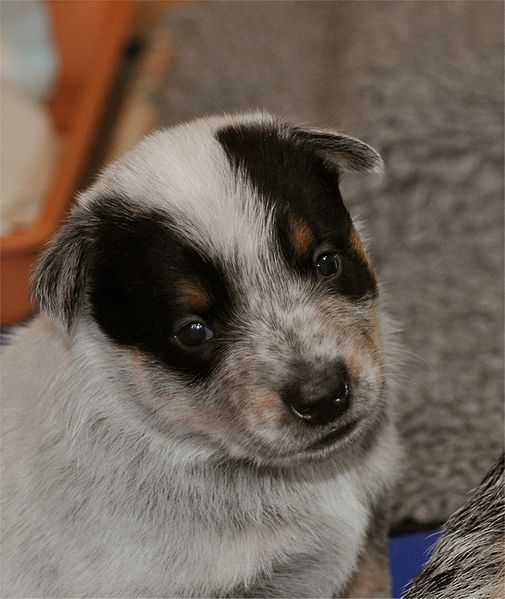
Instagram, used by 130 million people worldwide, is playing host to the buying and selling of unwanted animals for pets, slaughter and ritual sacrifice, and in doing so is encouraging and promoting widespread animal abuse.
The popular and trending hashtag #forsale throws up more than 1 million results, most of which are completely innocent such as clothes, shoes and other second hand goods, but riddled among the listings are thousands of live animals being offered for sale.
From household pets and exotic animals like snakes and turtles that require specialist care to sheep and goats intended to be sacrificially slaughtered for birthdays and events, Instagram is turning a blind eye to this atrocity when they clearly have full knowledge of its development.
What is supposed to be in Instagram’s own words “a beautiful and fun way to share your life with friends and family” has rapidly become a breeding ground for those looking to make a quick buck, with many users turning their personal accounts into streams of classified ads for animals.
Scarily, Instagram does not currently have any rules or guidelines on the advertisement of items for sale, and nowhere in the site’s terms and conditions do they mention the sale of animals. Conversly, other leading online marketplaces such as Amazon and eBay strictly prohibit the sale of live animals, and animal rights campaigners are imploring Instagram to follow suit and crack down on listings.
Leading the charge is the UK’s largest animal rights group Animal Aid, who are urging Instagram, which is owned by social media giant Facebook, to put an end to this careless and harmful trading of animals.
The charity’s director Andrew Tyler said, “Animals are being manufactured and traded as products and this will encourage people to breed carelessly. The easier you make it to buy and sell animals online, the more casual and callous an approach people will take…and this will only lead to more suffering.”
Animals are not mere commodities to be bought and sold. They are living, feeling, sentient beings, and when their welfare is put second to that of profit, they will always suffer as a result.
Millions of dogs and cats are killed every year because they have no prospects for a home, and it is facilitating sites like Instagram that are the worst offenders. By providing an easy way for irresponsible breeders and pet owners to offload their unwanted animals, the mentality of viewing animals as money making machines takes a hold and exploitative practices start to manifest.
As expected, Instagram has declined to comment on this controversy, but that doesn’t mean that their silence will go unnoticed. As an industry leader, Instagram has an obligation to lead by example and they need to recognize this thoughtless and careless trading and put a stop to it before any more harm is done.
WHOM TO CONTACT
Let Instagram know exactly what you think.
You can get in contact with them via Twitter, Facebook or you can shoot them an email at press@instagram.com
It only takes a few minutes to write an email and hit the send button so don’t wait, do it now and you can ensure that you are fighting towards creating a kinder and safer world for animals everywhere.
Another way you can help is to reject the buying and selling of live animals, and instead choose to adopt from a local shelter or rescue center.
SAMPLE COMMENT
To Whom It Concerns,
Like Amazon and Ebay, please change your business practices so that no animals are bought or sold on Instagram. Please keep Instagram an honest forum for everyone by rejecting the rampant cruelty that is inherent in live animal purchasing and selling for pets, slaughter, and ritual sacrifice. Unfortunately, until this practice ceases, I will be forwarding my business elsewhere.
Thank you.
Order a FREE vegan kit: http://www.peta.org/living/vegetarian-living/free-vegetarian-starter-kit.aspx
Want to do more than go vegan? Help others to do so! Click on the below for nominal, or no, fees to vegan literature that you can use to convince others that veganism is the only compassionate route to being an animal friend.
Vegan Outreach has a suggested donation: http://www.veganoutreach.org/catalog/index.html
PETA: http://www.petacatalog.com/catalog/Literature-39-1.html
Action for Animals has a very low price : http://store.afa-online.org/home.php?cat=284
Please vote HERE
Source CNN
Costa Rica, known for its biodiversity, has decided to close its zoos because cages are bad for animals. Costa Rica’s Minister of the Environment, Rene Castro says the decision was based on childhood experience.
“One day, we took the parrot out to the patio, and a flock of wild parrots passed, and the parrot went with them… We fed her with food and affection. … all these things that we as humans thought she liked. And when she had the chance, she left.” Castro said.
Erin Burnett says she always thought that zoos were important, inspiring children to respect and love animals.
But, after reading about Costa Rica’s closing its zoos, she wonders whether the United States should follow suit.
Is it time for America to close its zoos?
Order a FREE vegan kit: http://www.peta.org/living/vegetarian-living/free-vegetarian-starter-kit.aspx
Want to do more than go vegan? Help others to do so! Click on the below for nominal, or no, fees to vegan literature that you can use to convince others that veganism is the only compassionate route to being an animal friend.
Vegan Outreach has a suggested donation: http://www.veganoutreach.org/catalog/index.html
PETA: http://www.petacatalog.com/catalog/Literature-39-1.html
Action for Animals has a very low price : http://store.afa-online.org/home.php?cat=284
Ban Fur Trapping & Vicious Bloodsports in the US
Please click HERE to ban vicious blood sports in the US
Please click HERE to ban fur trapping on public lands in the US
Background | Source: Anti-Fur Society
Fur bearing animals are victims NOT only of the fur trade. The cruel attacks go from live skinning by the fur trade to being torn to pieces in bloodsports. The “buffets” of horrors are fair game for anyone who wishes to indulge in it.
There are virtually NO laws to protect fur bearing animals in fur farms or in the wild. Living in the compassionate AR community, we are constantly shocked by the violent acts of abhorrent cruelty inflicted on animals outside our cocoon. But we must face the reality in the rest of the world, and not only speak up but take actions for those who so suffer. The Anti-Fur Society has produced a series of action links to help people take action in a speedy way.
These links involved an immense amount of heart wrenching work to not only give you an idea of what happens in the animals’ world but also to make it easy for you to take action for them. The petitions have been programmed so that when you sign one, the second can be signed simply by adding your email. It is that easy! To learn about fur trapping, fox/coyote penning and bear baiting or baying, please check this web page BLOODSPORTS IN THE USA and videos (see above) PENNING VIDEO // TRAPPING VIDEO created specifically to bring an understanding about the importance of the petitions.
Order a FREE vegan kit: http://www.peta.org/living/vegetarian-living/free-vegetarian-starter-kit.aspx
Want to do more than go vegan? Help others to do so! Click on the below for nominal, or no, fees to vegan literature that you can use to convince others that veganism is the only compassionate route to being an animal friend.
Vegan Outreach has a suggested donation: http://www.veganoutreach.org/catalog/index.html
PETA: http://www.petacatalog.com/catalog/Literature-39-1.html
Action for Animals has a very low price : http://store.afa-online.org/home.php?cat=284

Wikimedia Commons
Please click HERE to sign and send message
The formula to protect wild animals from cruelty is simple: anything that the Safari Club International (SCI) supports MUST be opposed.
The SCI, an atrocious trophy hunter organization, is currently lobbying heavily for S 1335, sponsored by Sen. Lisa Murkowski (R-AK). If passed, the Act would make hunting and trapping a priority to be considered on federal lands-public lands that are owned and funded by us, the Public.
The bill would allow hunting and trapping in designated wilderness areas, allow “volunteers” to help in the killing of so-called “excess” animals on Federal land, including National Parks, increase the share of federal lands turned into shooting ranges, and legalize the transporting of bows through national parks and the importation of “trophies” from polar bears kills in Canada.
Please us the form HERE to contact your Senator immediately and tell her/him to vote “NO” on the Sportsmen’s Act 2013 (S. 1335). The threats our wildlife face come from many directions- loss of habitat, trophy hunters, poaching, conflicts with humans and or human-based activities, as well as the hardships of living in the wild as predator or prey. The last thing we need right now is to open our national parks or wilderness areas that currently do not allow hunting to more killing.
Order a FREE vegan kit: http://www.peta.org/living/vegetarian-living/free-vegetarian-starter-kit.aspx
Want to do more than go vegan? Help others to do so! Click on the below for nominal, or no, fees to vegan literature that you can use to convince others that veganism is the only compassionate route to being an animal friend.
Vegan Outreach has a suggested donation: http://www.veganoutreach.org/catalog/index.html
PETA: http://www.petacatalog.com/catalog/Literature-39-1.html
Action for Animals has a very low price : http://store.afa-online.org/home.php?cat=284
Wikimedia Commons
Source Grist.org
By Claire Thompson
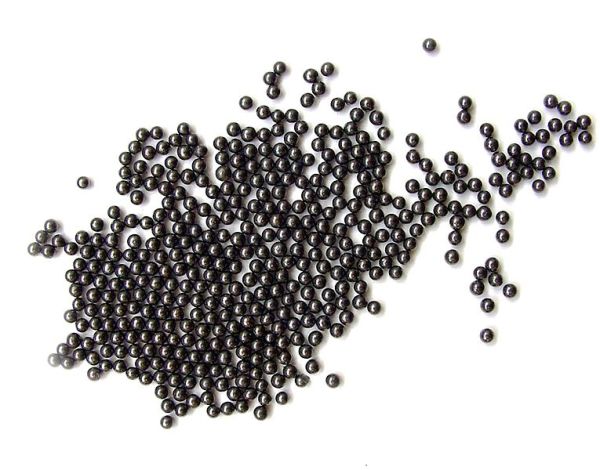
You might think the NRA would be busy enough fighting its current battles, fending off crazy ideas like expanded background checks for gun sales. But no. The group is now picking a whole new fight, this one against activists who want to ban lead bullets.
Studies have shown that as many as 20 million birds, including endangered California condors, die each year from lead poisoning after ingesting bullet fragments. Ammunition is likely the greatest unregulated source of lead released into the environment, according to a statement [PDF] from scientific experts in lead and environmental health. Some states, notably California, are now weighing regulations to outlaw the use of lead in bullets.
The NRA isn’t going to stand by and let that happen. The group has launched a campaign called Hunt for Truth to fight back against “the assault on traditional lead ammunition” by targeting the groups and individuals — mostly scientists, nonprofits, and government agencies — behind this unconscionable attack on American values.
But the thing is, requiring hunters to use lead-free bullets wouldn’t cause them any great hardship, the Huffington Post reports:
Lead-free bullets are widely available from top manufacturers, and have not been shown to function any differently than bullets containing the highly toxic element.
So this should be a no-brainer — an easy opportunity for the NRA to toss the bird-huggers a bone and get back to its more important mission of keeping guns less regulated than toys. But since when does the NRA cave that easily?
In order to rally its members to oppose the lead regulation, the NRA described a conspiracy theory involving crooked scientists, phony research, and a shadowy network of nonprofits, zoos and government agencies all conspiring to ban hunting.
According to the NRA, an “activist portion of the scientific community” has formed “a highly organized network of like minded researchers with an agenda to ban lead ammunition.” In order to thwart this looming threat, “Hunt for Truth will expose the researchers associated with ‘faulty science’ critical of lead ammunition,” the gun lobby says.
Scientists aren’t the NRA’s only new targets. Nonprofits like the San Diego Zoo and the California Condor Recovery Team are also on the enemies list. The NRA claims these groups “have considerable influence over many legislators and regulators,” which they use to “capture” the regulatory agencies and bureaucrats responsible for lead ammunition restrictions.
Now that’s rich: the NRA — perhaps the nation’s most powerful lobby, commanding mind-boggling subservience from Congress and other lawmakers — accusing nonprofit environmental groups of controlling the legislative process. The San Diego Zoo and the California Condor Recovery Team can only dream of having even the tiniest fraction of the “considerable influence” the NRA wields. But hey, these are people who think we’d all be safer with more guns, not fewer. I can only imagine the kind of paranoia that must go hand-in-hand with that mentality.
Although I am intrigued by the idea of an underground network of shady zoos; sounds spooky. Someone call M. Night Shyamalan. Or Scooby Doo.
Order a FREE vegan kit: http://www.peta.org/living/vegetarian-living/free-vegetarian-starter-kit.aspx
Want to do more than go vegan? Help others to do so! Click on the below for nominal, or no, fees to vegan literature that you can use to convince others that veganism is the only compassionate route to being an animal friend.
Vegan Outreach has a suggested donation: http://www.veganoutreach.org/catalog/index.html
PETA: http://www.petacatalog.com/catalog/Literature-39-1.html
Action for Animals has a very low price : http://store.afa-online.org/home.php?cat=284
Please Urge Michigan Track to Forgo Cruel Trapping
Wikimedia Commons
BACKGROUND
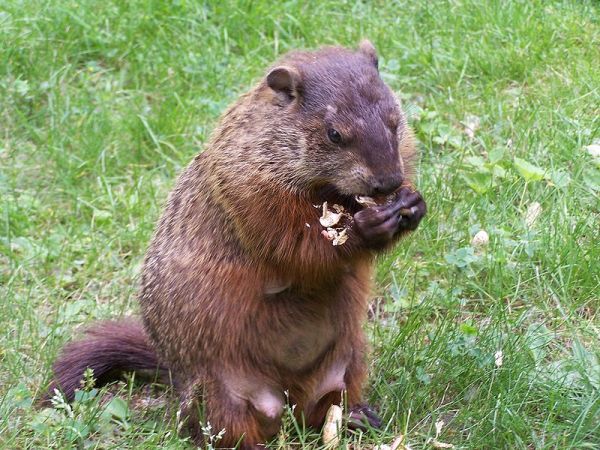
Hazel Park Harness Raceway in Hazel Park, Michigan, has reportedly set out body-gripping traps, apparently in an effort to kill groundhogs. These devices are exceptionally cruel, inflicting immense suffering while terrified victims die of slow suffocation. Such traps are also indiscriminate, posing risks to “nontarget” animals, including protected wildlife species and even companion animals. In fact, we’re told that a kitten was recently caught and gruesomely killed [graphic photo] in a trap at this facility. PETA urged Hazel Park Harness Raceway to remove all such traps that may be set on its property, but to no apparent avail. Your voice is needed!
Please contact raceway officials and urge them to forgo cruel trapping and instead employ humane and effective wildlife deterrent measures.
WHOM TO CONTACT
Please send polite comments to:
info@hazelparkraceway.com
SAMPLE LETTER
Dear Officials,
It has come to my attention that Hazel Park Harness Raceway in Hazel Park, Michigan, has reportedly set out body-gripping traps, apparently in an effort to kill groundhogs. Please remove these barbaric devices and instead employ humane and effective wildlife deterrent measures.
Body-gripping traps are exceptionally cruel, inflicting immense suffering while victims die of slow suffocation, all the while experiencing extreme terror and pain. Such traps are also indiscriminate, posing risks to “nontarget” animals, including protected wildlife species and even companion animals. In fact, I am told that a kitten was recently caught and gruesomely killed in a trap at this facility.
It would be unfortunate, but until this barbarism is appropriately addressed including a mandatory ban of such, I and others will collectively boycott resulting in the sacrifice of vital tourism and commerce profits. Please act responsibly and with compassion and choose to protect, rather than sanction harm, to animals.
Thank you for taking the time to consider this urgent appeal.
NAME
Order a FREE vegan kit: http://www.peta.org/living/vegetarian-living/free-vegetarian-starter-kit.aspx
Want to do more than go vegan? Help others to do so! Click on the below for nominal, or no, fees to vegan literature that you can use to convince others that veganism is the only compassionate route to being an animal friend.
Vegan Outreach has a suggested donation: http://www.veganoutreach.org/catalog/index.html
PETA: http://www.petacatalog.com/catalog/Literature-39-1.html
Action for Animals has a very low price : http://store.afa-online.org/home.php?cat=284

KATU: Cabella
According to Tuesday’s KOIN News, prosecutors have decided that the Stevenson, Wash., man, accused of blowing up his dog, will be charged with animal cruelty.
Initially, it appeared that 45-year-old Christopher Dillingham would face no animal cruelty charges because officials believed that his victim, a yellow Labrador retriever named “Cabella,” had not suffered when the bomb detonated.
On Tuesday, officials had a change of heart and decided that it may be possible to prove that Cabella suffered before dying.
Early Sunday morning, Skamania County Sheriff’s deputies arrived to Dillingham’s home and found the body of a dog who had been decapitated; a bomb had been strapped to her collar.
Dellingham is said to have told the authorities that he was preparing for “the rapture,” and that the dog had been killed because his ex-girlfriend had “put the devil in it.”
It is unclear if the officials’ change of heart, with regards to the animal cruelty charges, was the result of public pressure, or something else.
Prior story here.
Prior OC action alert here.
Order a FREE vegan kit: http://www.peta.org/living/vegetarian-living/free-vegetarian-starter-kit.aspx
Want to do more than go vegan? Help others to do so! Click on the below for nominal, or no, fees to vegan literature that you can use to convince others that veganism is the only compassionate route to being an animal friend.
Vegan Outreach has a suggested donation: http://www.veganoutreach.org/catalog/index.html
PETA: http://www.petacatalog.com/catalog/Literature-39-1.html
Action for Animals has a very low price : http://store.afa-online.org/home.php?cat=284

Wikimedia Commons
BACKGROUND | SOURCE EXAMINER.COM
A Stevenson, Wash., man is accused of blowing up his dog and amazingly, he is not facing any animal cruelty charges as a result, reported Monday’s KOMO News.
Skamania County Sheriff’s deputies arrived to the home of 45-year-old Christopher Dillingham after 911 calls came in about an explosion of some sort.
Responding deputies found the body of a dog who appeared to have been blown up on Dillingham’s property.
Amazingly, though the dog was killed in a decidedly heinous fashion, the man believed to be responsible is not facing animal cruelty charges because the Skamania County Sheriff’s Office does not feel that the dog suffered because he was killed instantly.
Dillingham was arrested on Sunday morning and taken to the Skamania County Jail.
He is due in court to face his charges of malicious mischief, reckless endangerment and possession of explosive devices, on Monday afternoon.
Individuals who are concerned over the lack of animal cruelty charges can direct their inquiries to the following:
WHOM TO CONTACT
Dave Cox
Undersheriff
Skamania County Sheriff’s Office
509-427-9490
Email: davec@co.skamania.wa.us
SAMPLE LETTER
Dear Undersheriff Cox,
I am gravely concerned that charges are not being filed against Mr. Christopher Dillingham for blowing up his dog; this decision was based on the lack of pain the dog may not have felt as a victim in such a barbaric crime. I am writing to respectfully remind people that a crime has been committed and that Mr. Dillingham should be charged accordingly. Furthermore, it is impossible for anyone to determine what the dog felt, and we are obligated to conclude that it was certain pain and fear, however brief.
Please allow me to validate my concerns: when I try to imagine what possible motive animal abusers entertain for subjecting their animal victims to such malicious, heinous acts of brutality, I fail, but I am thankful for a lack of cognitive understanding and rationalization. To engage in such malevolent behaviour absolutely suggests sociopathic and sadistic tendencies and demonstrates an incontrovertible lack of morality regarding other living beings and a gross disrespect for the law. In fact, a person who shows such a remarkable lack of compassion towards animals has, disturbingly enough, the ability to show such indifference towards humans. This link between animal and human abuse has been established, and if we excuse or ignore this dog’s violent killing, we would be serving an injustice to both animals and society: those responsible for such heinous acts against animals will many times escalate towards human animals.
Please respect the victim by penalizing the guilty and demonstrate your commitment to justice, responsibility, and integrity, attributes unquestionably necessary in an law enforcement setting: rejecting cruelty by maintaining an unyielding position towards it would be a model for all community members and would serve to characterize this type of behaviour as both impermissible and punishable.
Thank you for your attention to this urgent appeal.
NAME
Order a FREE vegan kit: http://www.peta.org/living/vegetarian-living/free-vegetarian-starter-kit.aspx
Want to do more than go vegan? Help others to do so! Click on the below for nominal, or no, fees to vegan literature that you can use to convince others that veganism is the only compassionate route to being an animal friend.
Vegan Outreach has a suggested donation: http://www.veganoutreach.org/catalog/index.html
PETA: http://www.petacatalog.com/catalog/Literature-39-1.html
Action for Animals has a very low price : http://store.afa-online.org/home.php?cat=284
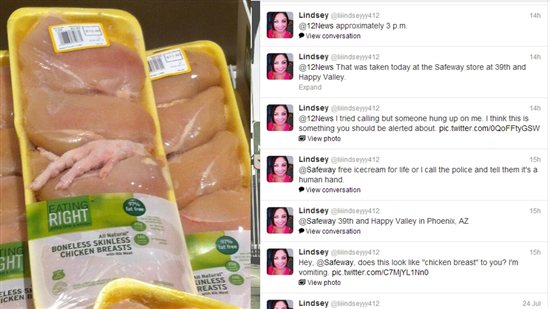
Woman Horrified to Find Chicken … in Her Chicken
PETA
An Arizona woman was so distraught after finding a chicken foot in a package of chicken breasts at Safeway that she contacted the media. It’s called a foot, but take a look at those appendages and those little nails—it resembles a human hand. Maybe the real horror is that we eat other living beings who have feelings and body parts just like ours.
Chickens are arguably the most abused animal on the planet. In the United States, more than 7 billion chickens are killed for their flesh each year. Oh, and there may be arsenic and feces in chicken. Now that’s something to be really upset about! The best way to make sure that no chicken feet—or any other animal body parts—are in your food is to go vegan. Here’s how in three easy steps!
Viva Vegan Basics
Order a FREE vegan kit: http://www.peta.org/living/vegetarian-living/free-vegetarian-starter-kit.aspx
Want to do more than go vegan? Help others to do so! Click on the below for nominal, or no, fees to vegan literature that you can use to convince others that veganism is the only compassionate route to being an animal friend.
Vegan Outreach has a suggested donation: http://www.veganoutreach.org/catalog/index.html
PETA: http://www.petacatalog.com/catalog/Literature-39-1.html
Action for Animals has a very low price : http://store.afa-online.org/home.php?cat=284
Source Gawker.com
A no-kill shelter in Kenosha, Wisconsin, is still reeling after nine Department of Natural Resources agents and four sheriff’s deputies suddenly descended on its barn and euthanized an abandoned baby deer that was one day away from being moved to a wildlife reserve.
“It was like a SWAT team,” shelter staffer Ray Schulze told WISN 12 News, noting that the DNR agents and the deputies were all “armed to the teeth.”
The Society of St. Francis Animal Shelter was being raided for temporarily housing a young fawn that was abandoned by her mother.
The shelter had named the animal “Giggles,” because “when it made a little noise, it sounded like it was laughing,” according to Schulze.
The shelter was on the verge of sending Giggles off to a wildlife reserve that specialized in rehabilitating deer.
Schulze informed the agents of this, but was ignored.
“I was thinking in my mind they were going to take the deer and take it to a wildlife shelter,” he recalled, “and here they come carrying the baby deer over their shoulder. She was in a body bag.”
When Schulze asked an agent why, he responded by saying it was a matter of policy. “That’s one hell of a policy,” Schulze replied.
Per Wisconsin law, DNR supervisor Jennifer Niemeyer explained to WISN, Giggles had to be put down “because of the potential for disease and danger to humans.”
She said the department was “empathetic” to the shelter’s distress, adding that “these are always very difficult situations for both parties involved.”
However, when asked why a phone call wasn’t made to the shelter prior to the raid, Niemeyer compared it to informing drug dealers of a bust ahead of schedule.
Shelter president Cindy Schultz, meanwhile, is planning to sue the DNR, and has also taken issue with the unnecessary taxpayer expense involved in removing a small harmless deer.
“They went way over the top for a little tiny baby deer,” she said.
Wikimedia Commons
Source Straight From the Horse’s Heart
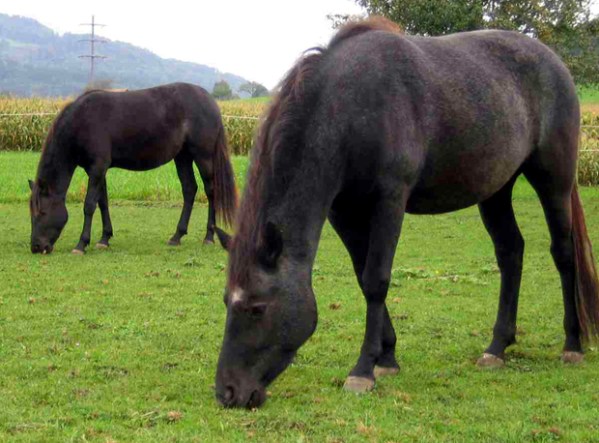
Horse Slaughter plants in New Mexico and Iowa lost their bid to begin killing American horses, next week, when a Federal Judge granted a Temporary Restraining Order against their operation this day.
Front Range Equine Rescue, HSUS and others had filed suit against the USDA and their arguments were deemed valid by a Federal Judge on August 2nd, 2013.
HSUS president and CEO Wayne Pacelle issued this statement: “We’ve won a temporary but life-saving reprieve for horses, and it’s good news indeed that the kill boxes in New Mexico and Iowa will be empty of horses in the weeks ahead. “<
“We’ve won a significant victory for the horses and we look forward to fighting on to end the slaughter of America’s horses once and for all.” stated Hilary Wood, plaintiff and President of Front Range Equine Rescue.
Further details to follow…
Order a FREE vegan kit: http://www.peta.org/living/vegetarian-living/free-vegetarian-starter-kit.aspx
Want to do more than go vegan? Help others to do so! Click on the below for nominal, or no, fees to vegan literature that you can use to convince others that veganism is the only compassionate route to being an animal friend.
Vegan Outreach has a suggested donation: http://www.veganoutreach.org/catalog/index.html
PETA: http://www.petacatalog.com/catalog/Literature-39-1.html
Action for Animals has a very low price : http://store.afa-online.org/home.php?cat=284
Stop koalas becoming industry casualties
Please click to sign and send letter HERE
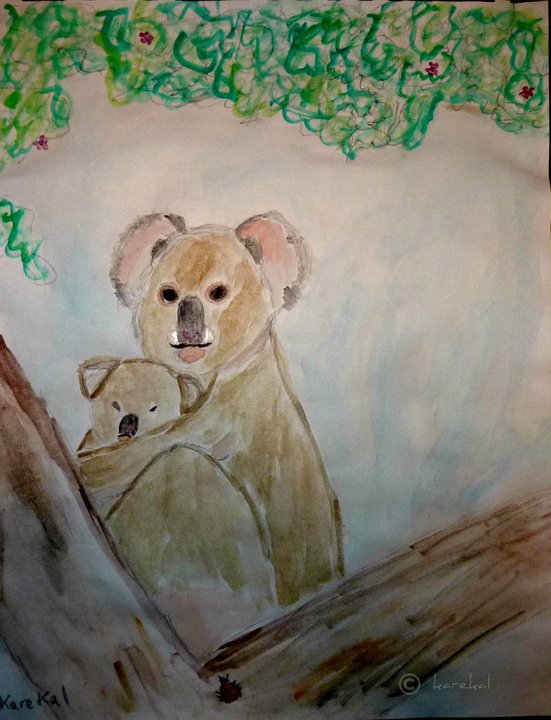
Koalas have become the silent victims of international paper production. ABC’s 7.30 has exposed the maiming and killing of countless koalas on plantations in Victoria and South Australia.
With dwindling natural habitats, some koalas have turned to Blue Gum plantations for refuge. But now, as these plantations are being cut down, an animal welfare disaster is unfolding.
With no apparent plan to relocate the local inhabitants, and without any government monitoring, trees are simply being cut down with animals still in them.
Volunteer wildlife carers are struggling to keep up with the number of casualties — koalas suffering from broken limbs and backs, severed arms and impact wounds. Many more don’t even survive the fall. Witnesses have even described injured koalas still on the felled trees as they are pulled through the shredders.
The Victorian Department for Environment & Primary Industries has admitted that they rely on timber companies to self-report wildlife issues. Yet the international companies that run the plantations continue to deny there’s any problem.
What’s clear is that self-regulation is failing, and stronger protection for wildlife is needed. At a minimum, the detection, capture and relocation of koalas (and other at risk wildlife) needs to occur under government supervision before forest areas are logged.
Koalas urgently need you to be their voice. Please call on the Ministers responsible in Victoria and South Australia to stop the tragic killing of koalas and introduce stronger protection for wildlife.
Karen Lyons Kalmenson
Order a FREE vegan kit: http://www.peta.org/living/vegetarian-living/free-vegetarian-starter-kit.aspx
Want to do more than go vegan? Help others to do so! Click on the below for nominal, or no, fees to vegan literature that you can use to convince others that veganism is the only compassionate route to being an animal friend.
Vegan Outreach has a suggested donation: http://www.veganoutreach.org/catalog/index.html
PETA: http://www.petacatalog.com/catalog/Literature-39-1.html
Action for Animals has a very low price : http://store.afa-online.org/home.php?cat=284
US friends, tigers and lions need you …
Wikimedia Commons
Please click HERE to sign and send letter
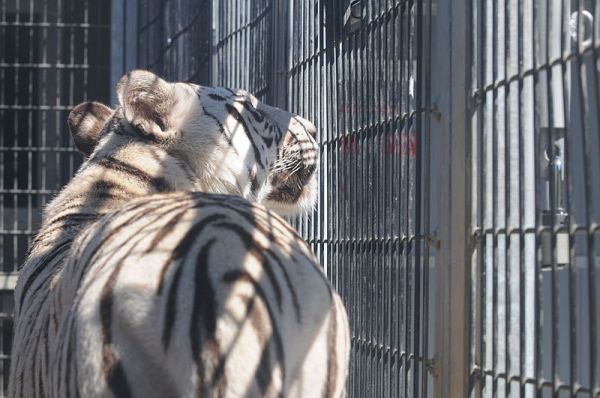
Did you know that there are at least 10,000 big cats kept in private hands in the U.S., but that no one knows exactly how many or where?
It’s a dangerous situation – for people and animals – when tigers, lions and other big cats are kept as backyard pets or in roadside zoos. When things go wrong, as they too often do, police officers, veterinarians, firefighters, EMTs and other first responders are forced to make life-or-death decisions.
We will never forget the Zanesville, Ohio tragedy, when a backyard exotic animal owner released 38 big cats and 18 other dangerous animals and then took his own life. To protect the surrounding community, law enforcement had no choice but to kill most of the animals. This type of situation happens time and time again.
Thankfully, today there is a solution.
U.S. Senator Richard Blumenthal (D-Conn) has introduced the Big Cats and Public Safety Protection Act (S.1381). Spearheaded by the International Fund for Animal Welfare, the bill aims at banning private possession and breeding of tigers, lions, and other captive big cats in the United States, while requiring current “owners” to register their big cats. The identical House version of the bill was introduced in May by U.S. Representatives Buck McKeon (R-CA) and Loretta Sanchez (D-CA).
First responders have to risk their lives when a person is killed or mauled by a big cat, or after a big cat escapes.
A few months ago, a young woman was attacked by an adult lion while she was cleaning his enclosure. Tragically, the young woman died, and the lion had to be killed by authorities.
The incident took place at a facility that breeds and frequently transports its big cats for public display.
IFAW’s big cats database shows that since 1997, incidents involving the animals have resulted in 22 human deaths including five children; and over 200 people have been mauled or injured.
And yet private ownership of big cats remains legal in many states.
Things need to change. You can help IFAW make it happen. Ask your U.S. senator to co-sponsor the Big Cats and Public Safety Protection Act today.
Order a FREE vegan kit: http://www.peta.org/living/vegetarian-living/free-vegetarian-starter-kit.aspx
Want to do more than go vegan? Help others to do so! Click on the below for nominal, or no, fees to vegan literature that you can use to convince others that veganism is the only compassionate route to being an animal friend.
Vegan Outreach has a suggested donation: http://www.veganoutreach.org/catalog/index.html
PETA: http://www.petacatalog.com/catalog/Literature-39-1.html
Action for Animals has a very low price : http://store.afa-online.org/home.php?cat=284
Shocking Animal Cruelty at Tyson Foods Supplier
Taking Ag Gag to Court
Source: ALDF
Take action! Sign the petition to stop ag gag
The Animal Legal Defense Fund, along with PETA, has filed the nation’s first lawsuit against ag gag legislation, taking Utah to court for infringing on the free speech rights of activists, investigators, and journalists by criminalizing undercover investigations at factory farms. Utah’s ag gag law aims to prevent animal advocates and law enforcement from collecting evidence of egregious and illegal abuse of animals on factory farms.
Factory farms want to keep their cruel practices hidden from the public, but the public deserves the truth about how the billions of animals suffering on industrial farms are treated and whether or not laws are being broken that jeopardize food safety, workers’ rights, and environmental standards.
Shocking exposés from undercover investigations have revealed severe animal abuse on factory farms, like animals beaten, kicked, maimed, and thrown by workers. Industrial agriculture has also brought us the unsavory likes of ammonia and pink slime in hamburgers, antibiotic-resistant “superbugs,” chickens abandoned by the thousands to starve to death, pregnant and nursing pigs held in gestation crates that never allow them to turn around, and sick and downed cows dragged on the ground to become lunchmeat. Corporate agriculture’s massive profit ratio and proven inclination to hide in a dark world of secrecy makes journalistic and investigative freedom imperative to the well-being of animals across the nation—and to our own health and safety.
Utah’s ag gag law criminalizes free speech. That is why the Animal Legal Defense Fund is joining with journalists Will Potter and Jesse Fruhwirth; Daniel Hauff, an undercover investigations consultant specializing in factory farms; the political journal CounterPunch; and professor James McWilliams, as plaintiffs in the lawsuit. “There’s a long history of investigative journalism in this country based on exactly the type of research and whistleblowing that these laws criminalize,” Will Potter explains. “Ag gag laws make it impossible to report stories that are vitally important to the public.”
Utah activist Amy Meyer is also a plaintiff in the case. In February, Amy made headlines by videotaping the operations at Dale Smith Meatpacking Company in Draper, Utah from the roadside. Amy was charged under Utah’s ag gag law—making her the first person in the nation to be prosecuted under an ag gag law–although the charges were dropped after public outcry.
Ag gag laws aim to control our behavior by instilling fear of prosecution. This is legally known as the “chilling effect” because it intimidates people from acting and gathering information—even in legally-protected ways. Tennessee Governor Bill Haslam recently vetoed a proposed ag gag law after the Tennessee Attorney General called the bill “constitutionally suspect.” Erwin Chemerinksy, a professor and dean of the law school at the University of California, Irvine, and a leading scholar of U.S. constitutional law, has weighed in in support of the lawsuit, explaining, “The Utah law is very much directed at restricting speech, and especially particular messages. This is exactly what the First Amendment prohibits.”
More Information
- Read a message from our executive director on the importance of fighting ag gag.
- Take action! Sign the petition to stop ag gag.
Share this!
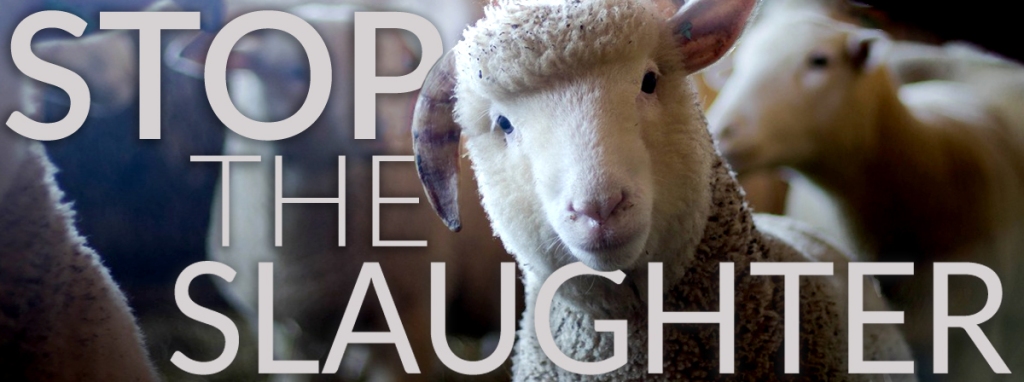
- Share this graphic with your friends on Facebook, click the image below:

Order a FREE vegan kit: http://www.peta.org/living/vegetarian-living/free-vegetarian-starter-kit.aspx
Want to do more than go vegan? Help others to do so! Click on the below for nominal, or no, fees to vegan literature that you can use to convince others that veganism is the only compassionate route to being an animal friend.
Vegan Outreach has a suggested donation: http://www.veganoutreach.org/catalog/index.html
PETA: http://www.petacatalog.com/catalog/Literature-39-1.html
Action for Animals has a very low price : http://store.afa-online.org/home.php?cat=284










 Our Compass