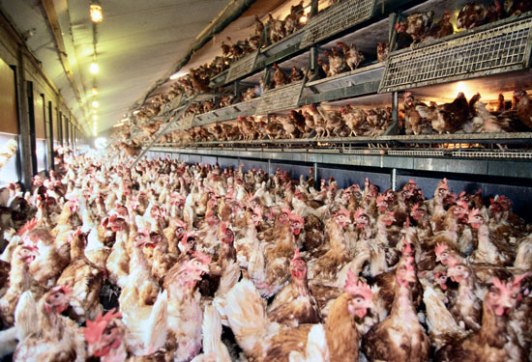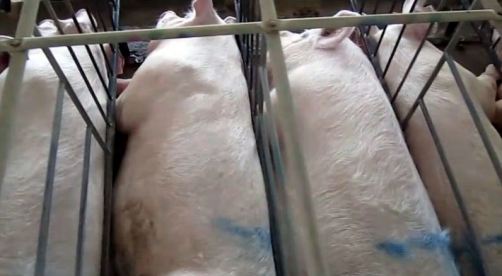
Gestation crate, Wikimedia Commons
I. A Child of Survivors
When I try to sum up my identity as a Jew, for purposes of determining whether and how that identity has affected my scholarship, a disturbing image comes to mind. The image I have is of a woman and a man in their 50’s: my paternal grandparents. They are in the process of being murdered simply for being Jewish. They are not being killed in death camps but, instead, standing face to face with their executioners, the Einsatzgruppen, the death squads that accounted for 1.5 million of the Jews killed in the Holocaust.[1] My brother, Abraham Mark Colb, M.D., has referred to this more “personal” killing as “Mommy’s Holocaust.”
In the image that continues to haunt me to this day, my paternal grandparents are first instructed by their killers to dig graves for themselves. My grandfather, a devout Jew, attempts to delay the digging until he can recite a prayer confessing his sins to God in his last moments, knowing he is about to die. For this failure to follow orders, he is kicked and forced to continue digging. Once both graves are complete, my grandfather and grandmother are each shot to death into those graves, thus sparing the men who killed them the trouble of burying them. I know of these deaths because an eyewitness who survived this action reported it to my family. The report was the closest thing to a funeral that my father had for his parents.
As if this is not enough, I stumble upon another image in my mind when contemplating my Jewish identity. This one is of my maternal grandmother, lying in her bed at home with a broken hip. While she is lying there, absolutely helpless, her home is invaded by Nazis and she is shot to death on her mattress. At that time, my mother is seventeen years old.
At the risk of further depressing my readers, I have yet another image to share. This image is one of my father’s brother, identified as one of the wealthier “Juden,” Jews, being taken outside of his parents’ home and being shot to death, while my mother (whose presence is undetected) hides, quaking with fear, under her mother-in-law’s blanket. The fate of my other four uncles, children at the time, remains unknown, although our best guess is that they met their end choking to death in a gas chamber, as did so many other Polish Jewish children. Images of those deaths haunt me to this day as well, images based on a combination of footage, film depictions, and the workings of my own fertile imagination.
I have held these pictures in my consciousness for as long as I can remember. My mother told me about my family’s fate when I was perhaps three or four years old. This was undoubtedly too early in a child’s life to be learning of extreme violence to her kin in such graphic detail, but my mother did not know that. She herself was traumatized, and she intended only to honestly answer my questions about why I had so few relatives.
As a child, I attended Orthodox Jewish schools for nursery, kindergarten, elementary, and high school. This education gave me the opportunity to learn a great deal more about Judaism than simply the nature of the Holocaust and the degree to which my family members were well-represented among its victims. However, the disturbing imagery stayed with me and became, for me, as it has been for many other children of Holocaust survivors, a defining feature of my Jewish identity, one that has outlasted my commitment to observing commandments.
II. A Daughter of a Rescuer
At the same time I acquired my identity as part of a catastrophically victimized group, I learned that my own father ran an underground operation during the War. My father rescued three thousand Jews from Eastern Europe, including hundreds of children, and arranged for their smuggling and safe passage to non-Jewish homes and other safer venues.[2] Because the Nazis had no use for Jewish children, they, along with the elderly and infirm, were the most likely to be killed immediately upon arrival at a death camp. This was a reality that made rescuing them prior to their transport to the death camps especially urgent. Knowing of my father’s rescue work was extremely redemptive for me, because it meant that I was an heir not only to the Holocaust but to heroism as well.
As a Jew himself, rescuing others exposed my father to grave risks that he could have easily avoided by simply hiding and taking care of “his own.” But like other people who rescued Jews at great risk and cost to their own safety, my father did not see how he could possibly have done otherwise, given that he had the opportunity, foresight, and means to do what he did.
My father died when I was six years old; he had been very sick with heart disease for several years before that so I never had the chance to get to know him. What I know about my father is mainly from other family members. From them, I know that my father was extremely generous and caring even though he had some flaws that made living with him a challenge.
One of his qualities that people liked to share with me, given my own sympathies, was that my father loved dogs. My mother showed me a photograph of my father standing next to a beautiful German Shepherd. She told me that when my father could no longer safely keep a dog with him, he drove this dog twenty miles away to a home where the dog could live. Later that night, however, the dog escaped from her new home and found her way back to my father, running across miles of unfamiliar terrain, so that my father found her the next morning waiting for him outside the house.
These were some of the bits and pieces that make up my sense of my father’s spirit. He was a man who suffered unimaginable tragedy in losing almost everyone he loved. But, despite all the pain, he stepped in and saved the lives of those he could. Lastly, my father was a man who had a place in his heart for animals. This is naturally an oversimplification of a complex person, but it is the spirit that I inherited, which has remained with me after twelve years of Jewish education, even as I became a secular Jew who doubted (but could never arrive at any certainty about) the existence of God. My mother, by contrast, was convinced of God’s existence and enraged at what she regarded as His callous indifference to suffering.
When I applied to college, I wrote an admissions essay about my father as the person with whom I would want to spend an afternoon if I could choose a stranger with whom to enjoy an extended conversation. My hypothetical conversation with my father consisted mainly of my telling him about everything of significance that had happened to me up until that point in my teen years. I would also let him know how much I admired him for what he did and how proud I felt of his rescue work. I would ask him for his approval of my life so far, and, finally, his forgiveness for the resentment that I recalled harboring towards him when I was five and six years old, when my mother had to split her caregiving attention between an ailing husband and a demanding daughter.
Once I left home for college and law school, and particularly when I began my career as a law professor, I thought I had left much of my Jewish identity as well as my internal connection with my father behind me. For a number of years, I wrote about issues in constitutional criminal procedure, evidence, and women’s equality, all of which continue to interest me as subjects of study and analysis. My sense of moral revulsion on behalf of women suffering rape and discrimination resonated with my view of my father as a person who pursued justice, as did my thinking about criminal procedure, but the resonance was tenuous, as anyone pursuing a vision of law and justice could plausibly characterize that pursuit as inspired by her father’s heroism. Until now, in fact, I rarely even considered the possibility that my legal scholarship interests in criminal procedure, feminist theory, or evidence law had anything at all to do with my identity as the child of a Holocaust survivor and savior.
III. A Journey of Discovering The Plight of Nonhuman Animals
This disconnection between my Jewish identity and my career began to change, however, early in my teaching years, when I “discovered” the plight of nonhuman animals. I first read a book called Next of Kin, by Roger Fouts, in which he described his work as a graduate student, teaching a captive chimpanzee, Washoe, how to communicate in American Sign Language.[3]After having learned of the memoir from a very positive review, I picked up the book mainly because I knew it would be a fascinating and riveting read, but it reached me on a level that I had not anticipated or planned. In the course of describing his work with Washoe, Fouts simultaneously conveyed his outrage on behalf of living beings whom he came to regard as “persons,” having to live as someone else’s property. He opened a chimpanzee sanctuary and used the sanctuary to exhibit for visitors the moral personhood of chimpanzees that Washoe had so ably taught him, person to person.
I had a profound emotional reaction to Fouts’s book. I came to love Washoe (as anyone who reads Next of Kin likely will) and to despise her tormentors. The book, however, was plainly about more than just one chimp, or even several chimps, or nonhuman primates. Fouts was clear about the broader change in his thinking that Washoe had initiated.
In the introduction to the book, Fouts tells a story about a dog named Brownie, with whom he shared his home as a child.[4] Fouts describes a faithful and intelligent family dog who one day uncharacteristically insisted on running alongside the family’s truck as he and his parents were returning home from a day of picking cucumbers in the field. The dog kept barking and running, and no one in the family could understand why she would not go back home. Then, suddenly, the dog leapt in front of the family vehicle. The truck screeched to a halt but not soon enough to avoid running over and killing the family’s beloved pet.[5]
Shocked and horrified, the car’s occupants emerged from the vehicle to discover that Roger’s older brother had been lying in the middle of the road, injured, and would have been the one run over by the car and killed if the dog had not leapt in front of it and blocked the car’s path.[6]
We have all heard stories of animals performing heroic deeds to rescue humans. Yet Fouts’s story of the dog, along with his story of Washoe, triggered my sense of kinship with animals in a new way. Fouts had introduced me to individual animals with distinctive personalities, and he connected that individuality with my existing love of dogs and a deep but somewhat buried suspicion that there was more to the story than dogs and chimpanzees. Though it is obvious in retrospect, Next of Kin led to my realization that all of the animals in our world are my kin and, more specifically, kin in whose suffering and oppression I should be taking an interest. I decided then to stop eating mammals, a class that includes both chimpanzees and dogs.
The next book in my awakening process was When Elephants Weep: The Emotional Lives of Animals, by Jeffrey Masson and Susan McCarthy. [7] This book provided narratives about animals’ emotions, and it was a revelation for me. Though I already understood and acknowledged that animals could feel pain, I did not fully apprehend until I read the book that animal emotions are quite similar to our own, that animals feel fear, rage, jealousy, hatred, anxiety, and other emotions that play such an important role in making a life good or bad for any one of us.
I was reading the book while visiting the Netherlands and had occasion to walk by a small animal farm each morning. Every day, a number of animals, including goats and chickens, would run over to the fence to greet my partner and me. Although we never brought any food along, they always seemed glad to see us. The sense I increasingly acquired from the book, and then from my daily interactions with the animals on the farm, was that nonhuman animals were here with us in this world and had independent internal experiences, both emotional and physical, that intersected with and potentially mirrored our own, but which did not require our existence to flourish. Indeed, it seemed that our existence might be positively inimical to their flourishing. It was at this point that I stopped eating birds.
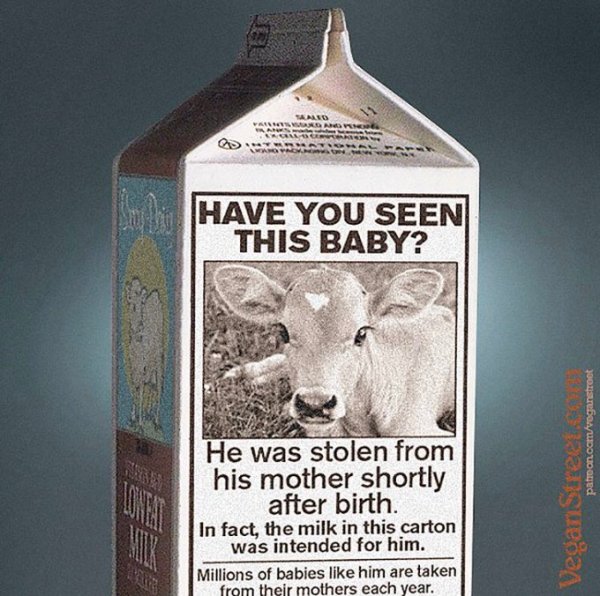
The journey continued, with me reading other books and encountering other animals, including fish, and gaining a newer and more informed perspective on the living beings whom I had previously dismissed as animate food. I then began reading more deliberately about animal rights and rapidly came to realize that if I hoped to spare cows and chickens from slaughter, I needed to stay away from dairy and eggs, not just meat. I was horrified to learn that the production of dairy and eggs not only required animal suffering and slaughter but specifically involved the extreme exploitation of female animals for their reproductive capacities, an exploitation that, as a matter of course, involved the mass killing of “useless” male babies—calves and baby chicks—who would not be able to lactate or lay eggs, respectively, and were thus economically worthless.
I now understood that what was happening to animals, and what I was participating in doing to animals, paralleled what I had long objected to men in patriarchal settings doing to women: treating females as reproductive machines, to be owned, violently used, sexually abused, and sometimes killed when they served no one’s purposes. The oppressions of women and female nonhuman animals are different from each other in many ways, but the parallels struck me, and I became ashamed of my prior belief that lacto-ovo vegetarianism[8] was an adequate (or even helpful) response to animal slaughter; it came to seem comparable to a decision a human rights advocate might make to ignore the persecution and oppression of women. But it was worse in my case, because consuming eggs and dairy products made me not just a bystander to oppression but an active participant in it.
Once I learned about dairy farming, both large- and small-scale, it became difficult for me to think about mother cows being forcibly separated from their calves (which is what happens so that the mothers can be “milked” for human consumption products) without remembering the innocent children whom my father rescued from Poland. When people said that Jews were taken on “cattle cars,” I began to find myself disturbed by the tacit implication that a car filled with living beings headed to slaughter is somehow an acceptable state of affairs if only the occupants are not of “my kind” but are instead “merely” nonhuman animals. I became vegan.[9]
Becoming vegan was at first largely a personal decision for me. It had taken me a long time to “get it” and to appreciate that the very least I could do for the animals whose plight so disturbed me was to stop using my money to order their suffering and slaughter. I was happy to combine my veganism with my Jewish identity by veganizing traditional Jewish foods, such as latkes (using oatmeal instead of eggs works beautifully),[10] vegan chopped liver (mushrooms and walnuts deliciously replace a bird’s organs)[11] vegan challah,[12] and enjoying my husband’s own special recipe for vegan matzoh ball soup, delicacies that we have shared with our children’s classmates on “U.N. Day” at their elementary school. Despite my positive feelings about being a vegan in general and a Jewish vegan in particular, I was ashamed at the realization that I had up until that point been so oblivious, and that shame prevented me from acting as a strong advocate.
I then began reading more about animal rights. I came to understand that the animal rights movement was a justice movement, similar to other such movements, in which members were calling for an end to the extreme violence, torture, and killing involved in the exploitation of nonhuman animals. While other justice movements were in more advanced stages, the animal rights movement was still struggling for people’s recognition of the most basic entitlement of sentient beings not to be slaughtered and consumed needlessly.
IV. Holocaust Analogies and People’s Offense
When I assert that my Holocaust background both inspired and feels very connected to my embrace of animal rights, I am cognizant of how triggering such analogies can be. I know that as a child of Holocaust survivors, I find offensive the cheap comparisons people draw between everything of which they disapprove and the Third Reich. Nonetheless, the analogy strikes me as valid here. I shall try to explain why most such analogies offend me but this one does not.
I was called a “sleep Nazi” when, in my sleep-deprived state as a parent of very young children, I let my toddlers cry themselves to sleep rather than pick them up on demand. I understand that many view the “cry it out”[13] method of sleep training children to be wrong, and I myself have come in retrospect to question the wisdom of my own decision to proceed in the way that I did. Nonetheless, there is, in my view, no reasonable comparison to be made between a parent who allows his child to cry herself to sleep, on the one hand, and a Nazi who murders a child in a death camp or in a field, on the other. The latter is not simply different in degree from the former; it is entirely different in kind.
The reason that analogies like this one are, in my view, offensive, is that they boil down what the Nazis did to their victims as simply doing something that was not very nice or doing something that caused some hurt feelings, rather than what the Nazis actually did, which was to take prisoners, employ them as slaves, torment those prisoners, and then murder millions of people. When Prince Charles compared Vladimir Putin to Adolf Hitler for annexing Crimea,[14]this was similarly an offensive comparison, because the bad things that Putin has done do not approach—in either malevolence, scale, or degree—the bad things that Hitler did (even recognizing that Putin’s actions may have been substantially worse than those of a parent who allowed her toddlers to cry themselves to sleep).
Beyond the trivialization involved in comparing relatively minor wrongdoing to something as extreme as the Holocaust, analogies between bad behavior and the Holocaust can be offensive to people for a different reason. Someone might, for example, compare a mass killing (in Rwanda or Darfur) to the Holocaust and still face criticism for the analogy. This time, the criticism is not about comparing something relatively benign to something deeply evil. In both cases, there is mass murder driven by ethnic hatred. Yet people may still be offended because the analogy may seem to imply that all atrocities are essentially identical and that all victims’ unique stories are interchangeable.
This implication of identity and interchangeability can offend those who feel particularly connected with one atrocity, by suggesting that the public knows all there is to know about “your” atrocity and is therefore well-situated to say that some other atrocity is truly no different. Those who were victimized in a particular atrocity, however, along with their loved ones, are amply capable of telling us stories of their circumstances that make them special and horrible in their own, unique ways. Just as rape victims are not all identical in their experiences, all of the horrible mass injustices visited upon other victims are not identical either.
PETA (People for the Ethical Treatment of Animals) drew one such distressing analogy, between the Holocaust and animal exploitation, in a campaign a number of years ago. The campaign, which was extremely controversial, was titled “Holocaust On Your Plate”[15] and included imagery from the Nazi death camps and from animal farming operations. Germany went so far as to ban the campaign, in a ruling that was upheld by the European Court of Human Rights.[16]
Though I maintain here that I find important parallels between the atrocities committed against my people and the atrocities committed against animals, I find the catchy phrase “Holocaust On Your Plate” very troubling. In my view, the phrase evidences little sensitivity for, or serious attention to, the nature of the Holocaust as something more than just an instrumental vehicle for making a point about a different injustice. Both the brevity of the phrase and the casual nature of PETA’s bare comparison could easily be understood as showing disrespect for the deep pain that grips survivors and their families when anyone invokes the Holocaust, and I found the campaign disturbing for that reason.[17]
I usually avoid the sorts of analogies that some animal rights advocates draw between atrocities such as the Holocaust or human slavery and animal breeding and slaughter. I do so mainly because drawing the analogy without elaboration can give an audience the impression that the speaker is actually indifferent to the Holocaust, to slavery, or to whatever other horror she has invoked. I have in fact heard people say “Holocaust” in connection with animal slaughter and myself wondered whether they had ever read or heard personal narratives about that historical event or whether they had any concept of what it meant and continues to mean to people, and the same can be said of analogies to slavery and other such profound injustices.
If one wishes to compare oppressions, one has a moral obligation, I think, to fully take into one’s consciousness the depth of the oppression to which one is drawing a comparison. PETA is an especially problematic purveyor of the analogy in this regard, because PETA habitually makes insensitive jokes as a means of either drawing attention to the issue of animal exploitation or, perhaps more cynically, as a means of drawing attention to itself. One example is a poster exhibiting a large woman and implying that the woman in the picture is a whale who needs to stop eating animals to lose her “blubber.”[18]
In this and other campaigns (such as “I’d Rather Go Naked Than Wear Fur”),[19] PETA routinely utilizes women’s bodies and sexualized imagery.[20] The organization thereby makes it difficult to assume either good faith or a true dedication to the seriousness of the crime to which it is drawing a comparison when it analogizes animal slaughter to the Holocaust. To say this differently, PETA (along with others who deploy analogies in a similarly cavalier fashion) seems as likely to be trivializing the Holocaust as to be elevating the cause of animal rights when it speaks of a “Holocaust on Your Plate.”
Yet once we move away from superficial invocations of the Holocaust for shock value, we can understand the analogy, offered in good faith, in a different way, one that focuses on the similarities in participants’ mindset rather than on the particular experiences of victims. In his book, Eternal Treblinka, Charles Patterson demonstrates some of the parallels in thinking that one can find between those who murdered Jews during World War II and those who participate in the slaughter of animals.[21] People in both of these categories share the moral assumption that their victims are an “other,” “only ____” and a sense of corresponding entitlement to kill and otherwise use “them.”
Another common feature is the banality of evil, the reality that the very same person who murdered innocent victims by day could go home and act as a warm and considerate husband and father in the evening. Similarly, people (including some of my own close friends and family) are warm, generous, and kind to many others (including companion animals) much of the time, but they (including me until July 2006) then pay money day after day to support the unspeakable violence of the slaughterhouse.
Some parallels are eerie. For example, Hitler inquired about how to kill Jews “humanely” and selected lethal gas with that purported objective in mind.[22] People and organizations (including, bizarrely, PETA) have in contemporary times praised Temple Grandin for developing allegedly “humane” slaughterhouses for cattle[23] and have advertised animal products as “humanely” produced.[24]
Most strikingly, Grandin’s serpentine ramp that leads cattle to their deaths, supposedly without alerting them to their fate, has a name, “Stairway to Heaven,”[25] that sounds quite a bit like the “Himmelstrasse”, translated from German as the “Road to Heaven,” the 150-foot tube that led to the gas chambers in the Sobibor death camp.[26] Jews were told before entering the “Tube” that they would be put to work but would first have to be washed and disinfected.[27]This lie was presumably offered to prevent resistance, much in the same way as Grandin’s ramp does in the case of the cows. Trying to do what is outrageously cruel in a manner that purports to be “humane” powerfully links the slaughter of animals and the extermination of Jews.
V. The Parallel Between the Holocaust and Animal Slaughter, For Me
For my own identity as a child of survivors and as a vegan, however, these parallels have represented a secondary aspect of what links the Holocaust to the slaughter of animals. My own experience of the link lies instead in the strong sense that something absolutely outrageous could be happening to millions (or billions) of innocent victims, in a systematic fashion, while most of the world remains largely indifferent and unwilling to make the most trivial of sacrifices to help bring it to an end.
Although President Roosevelt was a hero to many progressives, my parents, who lost virtually everyone they loved when they were in their 20’s and 30’s, respectively, regarded him as villainous for being unwilling to bomb the train tracks leading to Auschwitz. In similar ways, though many people either knew about or suspected the horrors that were going on in the death camps, the gas chambers and crematoria continued to operate, undisturbed, for years.[28] There were those individuals who resisted the injustice, of course, but they were few and far between.[29] And despite all of the documentation, there remain people in the world who choose to challenge the authenticity of the Holocaust, their indifference to the atrocity rising to the level of outright denial.[30]
By contrast, adults today generally acknowledge the fact that animal slaughter occurs, but they nonetheless prefer not to think about it as their problem. I cannot even count all of the conversations in which the following happened: someone would ask me why I choose not to consume dairy (since, in the popular imagination, dairy entails no violence or killing) and then, as I began to answer the question posed, the questioner would stop me and say “Please don’t tell me. I don’t want to know.”
People who are kind to their friends, colleagues, and families are nonetheless not only willing to be bystanders but are fully prepared to participate in the slaughter of billions of innocent beings, because they “like pork/steak/cheese/fish/eggs.” And I, prior to July of 2006, counted myself among their number. German Jewish philosopher Theodor W. Adorno said: “The possibility of pogroms is decided in the moment when the gaze of a fatally-wounded animal falls on a human being.”[31]
The notion that “those others” do not matter is very different from the idea that we should distinguish grave harms from trivial harms. Unlike sleep-training a toddler or refusing soup to restaurant customers who fail to follow the rules,[32] mutilating and slaughtering an animal is not a relatively minor harm, and it is also not a small-scale harm committed against only a few victims. People who say that the analogy, however drawn, inherently trivializes the Holocaust are therefore saying that the animal victims of our consumption habits are trivial beings whose terror, suffering, loss of loved ones and of life itself simply do not matter very much, because they are beings with DNA that is not human DNA.
There are two different things one might mean in objecting to an analogy as trivializing. One is that the analogy compares a relatively trivial injury to the Holocaust and thereby downgrades the injury of the Holocaust through that comparison. The analogy between sleep-training and death camps exemplifies this form of trivialization. A second meaning of trivialization through analogy acknowledges the gravity of the injury itself. It cannot, after all, be a trivial injury to someone to perform un-anesthetized mutilations on him, to take away his family members, to kill them, and then ultimately to slaughter him in a kill line. And it cannot be that the scale of this injury is trivial, given that it affects tens of billions of nonhuman animals every year.
What people mean, then, when they say that a comparison between animal agriculture and the Holocaust must be trivializing to the latter, since they cannot be referencing the magnitude or scale of the injury, must be instead the relative insignificance of the victims of animal agriculture. People who say that the analogy necessarily trivializes the Holocaust plainly regard the nonhuman victims of the injury as trivial individuals. The complaint is “how can you compare grave injuries to beings who matter—human beings—to grave injuries to beings—non-humans—whose lives do not matter and are trivial?” I see this second type of complaint in the notion that comparing animal slaughter with the Holocaust necessarily trivializes the Holocaust, and insofar as that is the complaint, I reject it. It betrays the very lessons that one needs to learn from the Holocaust’s construction of Jews.
What disturbs me about the attitude underlying this second kind of trivialization complaint is that it presumes that some living beings who are capable of joy and suffering and of emotions and social bonds are worth less than other sentient living beings simply in virtue of the category or classification in which we have placed them. “We” are humans, and “they” are not, and “we” are therefore immeasurably superior to “them.” Indeed, our superiority is so total and so patent, in many people’s view, that those offended by the analogy often feel no need to defend or explain what it is about nonhuman animals—and, in particular, the nonhuman animals who enter a slaughterhouse either before or after their remains and secretions have been consumed by the offended individuals—that makes their lives and their interests utterly subordinate to the desire of humans to eat one sort of food rather than another or to wear one sort of fiber rather than another. People imagine that it is enough to say that they are “only animals,” just as others were content to invoke the fact that my people were “only Jews.”[33]
No morally salient quality of “humans” is universally shared by all humans. Indeed, every one of us experienced a period in our lives, between our birth and our acquisition of “unique” human qualities, when we were—as a matter of cognitive capacity—“no better than animals.” Yet few people in modern moral discourse (with some notable exceptions, such as Peter Singer),[34]would suggest that human infants are therefore categorically “less than” adult humans. On the contrary, in the case of human infants, their inability to do various things makes them vulnerable in a way that elicits our compassion and our wish to protect them more vigilantly against anyone who would wish to do them violence.
In the words of Jeremy Bentham, “a full-grown horse or dog is beyond comparison a more rational, as well as a more conversable animal, than an infant of a day, or a week, or even a month, old.” [35] Yet many of us treat nonhuman animals as mere animated things whose lives we may take at will, and some of us are so confident of our supposed “right” to do so that we become offended when anyone proposes that the emperor—human supremacy—might have no clothes.
This presumption of human supremacy resonates for me in significant ways with the Anti-Semitism of the Nazis. First, when pushed to articulate distinctions between all humans and all animals, distinctions that do not fall prey to the reality of overlap, people tend ultimately to invoke our species’ DNA and to believe that in so doing, they have handily won the argument. Ronald Dworkin, for example, said (in a different context) that “human life has an intrinsic, innate value; that human life is sacred just in itself; and that the sacred nature of a human life begins when its biological life begins, even before the creature whose life it is has movement or sensation or interests or rights of its own.”[36] If a human life is “sacred” before it has any capacities or qualities of its own, then it would appear to be the mere possession of human DNA that—by stipulation and dramatic assertion—gives human life its value.
In similar terms, the late Supreme Court Justice, Byron R. White, dissenting in Thornburgh v. American College of Obstetricians & Gynecologists,[37] defended the protection of fetal life in the abortion context: “[O]ne must at least recognize . . . that the fetus is an entity that bears in its cells all the genetic information that characterizes a member of the species homo sapiensand distinguishes an individual member of that species from all others . . . .” In other words, Justice White accepts by stipulation—as do so many people—that members of our species, homo sapiens, in virtue of that genetic membership, matter morally, while “all others”—members of other species, whatever their characteristics, capacities, interests or needs—in virtue of their non-membership in our human club—do not.
We are not, moreover, talking simply about a marginal preference for human over non-human life. To be sure, we ethical vegans often hear the question “What would you do if you had to choose whether to save a human or a dog and could not save both?” as though this question gets to the heart of something important. In point of fact, this question gets to the heart of very little, because what ethical vegans urge in elevating nonhuman life is not a definitive approach to such triage conflicts but an approach to the far more banal conflict between a human’s desire to consume a chicken’s eggs rather than plant-based food, on the one hand, and an animal’s very life and freedom from extreme violence, on the other.
The view of Nazis toward Jews was correspondingly not that Jews are inherently valuable living beings who deserve to be free of violence but whose interests—when pitted against the interests of Aryans—might take second place. The view was, instead, that Jews are worth nothing or less than nothing and that their (our) homes, art, jewelry, and money rightly belong to Aryans, while their (our) lives could legitimately be taken from them.
Though I am certainly not proposing that Nazis would have been correct to demote Jewish life beneath Aryan life, even marginally, I am suggesting that a slight demotion of this sort is miles away from the reality of what Nazis did to Jews, just as a willingness to save a human rather than a dog from a burning building, when one must choose between the two, has very little to do with the reality of what most humans are currently willing to do to nonhuman animals. Nazis condemned our very DNA—as Jews—as rendering us inferior beings, and—most tellingly—manifested that supremacy by placing us into “cattle cars” that took us to be slaughtered.
When people say “Never Again” about the Holocaust, as I heard people say countless times while I was growing up and attending Jewish schools, I interpret the deep message of that plea to be that we must remember how ready people were to place the “other” outside their circle of compassion and moral concern and to demote that “other” to the status of a thing to be stripped of earthly possessions and then used and destroyed. It is this extreme degradation of “the other” that we see in such atrocities against humans as genocide and chattel slavery: these represent more than discrimination or second-class citizenship; they are the utter and complete abdication of any responsibility to refrain from violence. And we see this too, most dramatically, in our relationship with the “other” animals who, in virtue of their “other” DNA—regardless of what we learn about them (their use of tools, communication, maternal love, inter-species altruism, and the list goes on)—remain things for our use.
VI. Hatred Versus Exploitation
There is a potentially important difference between the sentiment of Nazis toward Jews evidenced during the Holocaust and the sentiment of humans toward nonhuman animals evidenced every day in meal after meal. The difference is between a view of the “other” as a despised enemy who must be vanquished and destroyed and a view of the “other” as a piece of property to be utilized and renewed (through forced reproduction) as a resource. In this sense, people’s sentiments toward nonhuman animals more closely mirror the white supremacists’ view of human slaves in the ante-bellum period than the Nazis’ view of Jews during the Holocaust.
Yet even this distinction in mindset is not as clear as it might seem. Though Nazis hated Jews, they were also happy to utilize them (us) and mine them (us) as resources, by experimenting upon the inmates in Auschwitz,[38] by taking the gold out of victims’ teeth,[39] by confiscating their property,[40] and by enslaving Jews in ghettos and in death camps[41] prior to taking their lives. This potential for use was, after all, the reason for the selection process, in which the “useless” elderly and infants were taken to be gassed immediately, and the more able-bodied captives were permitted to live in the death camp and “work” until they too were suitable only for death.
This use of—and selection among—the condemned “others” brings to my mind the fate of cows and chickens in the dairy and egg industries, respectively. The male babies of these farmed animals are killed soon after being born or hatched, because they are the least profitable of their breed and not “worth” feeding, while the “useful” females are kept alive and cruelly exploited for a number of years before they become “spent”—no longer profitable—when they too are then sent to slaughter, often so “useless” at that point as to be thrown into a “dead” pile or a garbage bag rather than sold.
VII. Hope From the Ashes: Rejecting “Might Makes Right”
At this point in the essay, I realize that my identity as a Jew sounds like a very depressing and sad one, and I wish to say that this is not entirely the case. I am heartened by the fact that, like me, people I know and people they know have become ethical vegans after taking seriously the weighty moral claims that nonhuman animals have, when we pay attention and stop allowing DNA supremacy to blind us. This movement gives me hope, as does the fact that the Holocaust against the Jews (and other despised groups) itself ended, with most of the world now both acknowledging the truth of what occurred during the War and condemning the deep injustice manifest in those indisputable facts.
I am hopeful too because some of the people who experienced the evil that was the Holocaust themselves came to recognize the parallels between that horror and the atrocity in which most of us have participated daily and continue to participate. One prominent example was Isaac Bashevis Singer, a Nobel-Prize-winning Yiddish writer who lost several members of his immediate family to Hitler’s War against the Jews.[42] He chose, after giving the matter a great deal of thought, to stop consuming animal flesh (this was a time before most people knew of the unavoidable connection between dairy and eggs, on the one hand, and animal slaughter and torture, on the other). Singer’s choice subjected him to ridicule and ostracism, not in spite of, but because of the fact that he had made the decision to become vegetarian as a protest against the ongoing violence committed against animals.[43]
In response to the notion that he was perhaps elevating himself above God, (on the premise that God accepts or invites the consumption of animals), Singer stated: “I can never accept inconsistency or injustice. Even if it comes from God. If there would come a voice from God saying, “I’m against vegetarianism!” I would say, “Well, I am for it!” This is how strongly I feel in this regard.” [44] Singer might instead have invoked the Torah itself as authority for rejecting the exploitation of animals. In Genesis, for example, only three short sentences after announcing that people have “dominion” (or, perhaps more accurately, “stewardship”) over other animals, God tells Adam and Eve what to eat, and he includes only vegan items on that list: “And God said, Behold, I have given you every herb bearing seed, which is upon the face of all the earth, and every tree, in the which is a fruit of a tree yielding seed; to you it shall be for meat[sic].”[45]
In describing his choice to stop consuming animal flesh, Singer continued: “This is my protest against the conduct of the world. To be a vegetarian is to disagree—to disagree with the course of things today. Nuclear power, starvation, cruelty—we must make a statement against these things. Vegetarianism is my statement. And I think it’s a strong one.”[46] Singer’s analogy between the Holocaust and what is done to animals appears most clearly in a short story titledThe Letter Writer.[47] Here is what he said, in the mouth of a man speaking to a mouse:
What do they know—all those scholars, all those philosophers, all the leaders of the world—about such as you? They have convinced themselves that man, the worst transgressor of all the species, is the crown of creation. All other creatures were created merely to provide him with food, pelts, to be tormented, exterminated. In relation to them, all people are Nazis; for the animals it is an eternal Treblinka.[48]
In Enemies, A Love Story,[49] Singer said the following:
As often as Herman had witnessed the slaughter of animals and fish, he always had the same thought: in their behavior toward creatures, all men were Nazis. The smugness with which man could do with other species as he pleased exemplified the most extreme racist theories, the principle that might is right.[50]
This quotation, stark and powerful, ironically gives me great hope. Singer lost so much as a result of what the Nazis did to the Jews during the Holocaust, but he was nonetheless prepared to understand the inescapable parallel between what drove the Nazis’ behavior and what drives the behavior of humans who do as they please to the members of other species, as people who consume animal products do. What unites these activities, both horrifically violent in substance and in scale, reflects an often-unconscious arrogance and a commitment to the proposition that “might makes right.”
That is what it means to say that “our” DNA is sacred, while “their” DNA designates them as disposable commodities or despised enemies. Rather than invoking a morally relevant distinction, those who rely on “might makes right” morality simply point out that “they” are not “us” and believe they have thereby fully defended the demotion of “them” to fit subjects for violence, slaughter, and exploitation.
Alex Hershaft, a Holocaust survivor himself and the Founder and President of the Farm Animal Rights Movement, was inspired by the words of I.B. Singer. In a speech entitled “From the Warsaw Ghetto to the Fight for Animal Rights,” Hershaft described his reaction when he visited a slaughterhouse in the early 1970’s: . . . “I saw piles of hooves and skins and hearts, livers and skulls bearing silent testimony to the living, sentient, feeling beings who were no more . . . the parallels [to] my memories of Treblinka were overwhelming.”[51]
Hershaft went on to explain what he understood to be the lesson of “Never Again”:
My friends, the oppressive mindset is not about the victims, be they animals, Bosnians, Tutsis, Cambodian victims of Pol Pot, or European Jews. It’s about us. ‘Never again’ should not be about what others shouldn’t do to us. It should be about what we should not do to others. ‘Never again’ means that we must never again perpetrate mass atrocities against other living, sentient beings.[52]
That Singer and Hershaft were able to take in these truths gives me great hope. As children, they were undoubtedly taught the same prejudices that were taught to me and to most other ethical vegans in religious and secular settings, notwithstanding the contrary messages available in our religious texts.[53] We heard that God chose us, that animals are here on this earth to be subject to our supremacy, and that killing them and consuming them is morally just and proper.
Yet through their words and their actions, Singer and Hershaft have helped the people around them to confront the fact that victims can quite easily become perpetrators and that one individual can simultaneously be both a victim and a perpetrator. The solution to “might makes right,” then, is not for victims to become perpetrators. Instead of protecting ourselves by identifying with the oppressor, we serve justice when victims instead identify with other victims and extend the compassion and justice that should rightly have been extended to them, to the rest of sentient creation.
Originally published in volume 16 of the Rutgers Journal of Law & Religion as part of a symposium entitled People of the Book: Judaism’s Influence on American Legal Scholarship
 Sherry F. Colb is Professor of Law and Charles Evans Hughes Scholar at Cornell University School of Law. She earned an A.B. from Columbia College (Valedictorian) and a J.D. from Harvard Law School (magna cum laude) and clerked for Associate Justice Harry A. Blackmun of the United States Supreme Court. Her research and teaching interests center on issues of constitutional criminal procedure (especially the Fourth Amendment), animal rights, sexual equality, and evidence. She composes a bi-weekly column on Verdict.Justia.com as well as regular posts on the blog, Dorf on Law. Her recently published book about veganism and animal rights is entitled “Mind If I Order the Cheeseburger?” and Other Questions People Ask Vegans (Lantern 2013).
* Professor of Law & Charles Evans Hughes Scholar, Cornell Law School. The author is enormously grateful to Yuliya Neverova (Cornell Law Class of 2015) for her outstanding research assistance on this essay, to Michael C. Dorf for his invaluable feedback and encouragement, and to Cornell Law School for supporting this work, including through summer research funding.
[1] See Richard Rhodes, Masters of Death: The SS-Einsatzgruppen and the Invention of the Holocaust (1st ed., 2002) (“The first plan, initiated in July 1941, condemned the Jews of eastern Europe to slaughter by the Einsatzgruppen, who went on to execute 1.5 million men, women and children between 1941 and 1943 by shooting them into killing pits, as at Babi Yar—massive crimes that have been underestimated or overlooked by Holocaust historians.”).
[2] See The Book of Strzyzow and Vicinity (Poland), Translation of Sefer Strzyzow ve-ha-seviva 289 (Itzhok Berglass & Shlomo Yahalomi-Diamond eds., Harry Langsam trans., 1990); United States Holocaust Memorial Museum Archives, USHMM.org, http://collections.ushmm.org/search/catalog?action= index&controller=catalog&q=KALB+RESCUE+MISSION&results_view=true (last visited Apr. 19, 2015) (documenting the rescue work of Ben Zion Kalb).
[3] Roger Fouts with Stephen Tukel Mills, Next of Kin: What Chimpanzees Have Taught Me About Who We Are 14 (1st ed. 1997) (“As Dr. Gardner and I strolled across the campus—which ironically was where the Ronald Reagan chimp movie, Bedtime for Bonzo, was filmed—he explained the two main parts of the job. First, to help raise Washoe by taking care of her day-to-day feeding, clothing, and play. Second, to expose her to American Sign Language.”).
[4] Id. at 5.
[5] Id. at 6 (“After going along for a while, we suddenly heard Brownie barking very loudly and very persistently. We looked down and we could just make her out next to the front fender. She was sniping at the right front tire. This was very strange behavior. Brownie had come to the fields hundreds of times and had never once barked at the truck. But now she was practically attacking it. My brother Bob thought this was off but didn’t give Brownie much thought as he plowed ahead even as her barking became more frenzied. Then, without further warning, Brownie dove in front of the truck’s front tire. I heard her shriek and felt a thump as we drove over her body. Bob hit the brakes and we all got out. Brownie was dead.”).
[6] Id. (“And right there in front of the truck, not ten feet away, was Ed, stuck on his bike in the deep tire rut, unable to escape. Another two seconds and we would have run him down.”).
[7] Jeffry Moussaieff Masson & Susan McCarthy, When Elephants Weep: The Emotional Lives of Animals (1996).
[8] Lacto-Ovo Vegetarian, Merriam-Webster.com, http://www.merriam-webster.com/dictionary/lacto-ovo%20vegetarian (last visited Jul. 17, 2014) (“a vegetarian whose diet includes dairy products, eggs . . . .”).
[9] As defined by Donald Watson, who first coined the term in 1944, “the word ‘veganism’ denotes a philosophy and way of living which seeks to exclude—as far as is possible and practical—all forms of exploitation of, and cruelty to, animals for food, clothing or any other purpose; and by extension, promotes the development and use of animal-free alternatives for the benefit of humans, animals and the environment. In dietary terms it denotes the practice of dispensing with all products derived wholly or partly from animals.” Memorandum of Association of the Vegan Society, The Vegan Society, http://www.vegansociety.com/sites/default/files/VS_Articles%20Association2013.pdf (last visited Jul. 26, 2014).
[10] Nava Atlas, Vegan Latkes, Humane Society, http://www.humanesociety.org/issues/eating/recipes/breakfast/vegan_latkes.html (last visited Dec. 22, 2014).
[11] Chopped “Liver” Spread, PETA, http://www.peta.org/recipes/chopped-liver-spread/ (last visited Dec. 22, 2014).
[12] Shuli Gutmann, Vegan Challah II (P, TNT), The Jewish Food Mailing List Archive, http://www.jewishfood-list.com/recipes/bread/challot/veganchallah 02.html (last visited Dec. 22, 2014).
[13] See Amanda Enayati, Should Babies be Allowed to ‘Cry it Out’?, CNN (Jan. 14, 2013), http://www.cnn.com/2013/01/24/health/child-sleep-debate-enayati (“Cry-it-out is a sleep training method that advocates letting your baby cry (or the more innocuous-sounding ‘self-soothe’) for varying periods of time before offering comfort.”).
[14] See Guy Faulconbridge & Alissa de Carbonnel, Prince Charles Provokes Diplomatic Row by Comparing Putin to Hitler, Reuters (,May 22, 2014, 6:28 PM), http://uk.reuters.com/article/2014/05/22/uk-britain-putin-prince-idUKKBN0E20P920140522.
[15] See Amanda Schinke, PETA Germany’s Holocaust Display Banned, PETA Blog (Mar. 27, 2009), http://www.peta.org/blog/peta-germanys-holocaust-display-banned.
[16] PETA Deutschland v. Germany, HUDOC European Court of Human Rights (last visited Mar. 5, 2015), available at http://hudoc.echr.coe.int/sites/ eng/pages/search.aspx?i=001-114273.
[17] For my more detailed analysis of the PETA case, see Sherry F. Colb, The European Court of Human Rights Upholds German Ban on PETA’s “Holocaust on Your Plate” Campaign: Lessons For Animal Activists and for Animal Product Consumers, Verdict (Nov. 28, 2012),http://verdict.justia.com/2012/11/28/the-european-court-of-human-rights-upholds-german-ban-on-petas-holocaust-on-your-plate-campaign.
[18] Liz Graffeo, Lose the Blubber: Go Vegetarian, PETA Blog (Aug. 17, 2009), http://www.peta.org/blog/lose-blubber-go-vegetarian.
[19] I’d Rather Go Naked Than Wear Fur, PETA Blog (July 16, 2008), http://www.peta.org/videos/id-rather-go-naked-than-wear-fur.
[20] See, e.g., Tara Kelly, PETA.xxx Site Launches, Features Sexy Photos and Animal Abuse, The Huffington Post (Jun. 5, 2012, 6:58PM), http://www.huffingtonpost.com/2012/06/05/peta-porn-site-launches-petaxxx-photos_n_1571941.html.
[21] Charles Patterson, Eternal Treblinka: Our Treatment of Animals and the Holocaust (2002).
[22] See id. at 132 (“As Nazi Germany began implementing its eugenic policies, both Hitler and Himmler wanted the policies to be ‘more humane’ . . . . During his 1939 meeting with Karl Brandt, who he appointed head of the T4 program, Hitler used the expression again when they talked about the best way to kill mentally ill Germans. When Brandt told him about the various options under consideration, including the use of carbon monoxide gas, Hitler asked him, ‘Which is the more humane way?’ Brandt recommended gas, and Hitler gave his authorization. In the Political Testament Hitler wrote in his bunker in Berlin the day before he committed suicide, he spoke about the ‘humane’ method that had been used to exterminate the Jews.”).
[23] See 2004 PETA Proggy Award, “Visionary,” http://www.abolitionist approach.com/animal-rights-debate/endnotes/176.pdf (last visited Jul. 6, 2014). See also Temple Grandin: The World Needs All Kinds of Minds, The Huffington Post (Feb. 24, 2010, 11:04 AM), http://www.huffingtonpost.com/tedtalks/temple-grandin-the-world_b_474799.html (“An expert on animal behavior, Temple Grandin has designed humane handling systems for half the cattle-processing facilities in the US, and consults with the meat industry to develop animal welfare guidelines. As PETA wrote when awarding her a 2004 Proggy: ‘Dr. Grandin’s improvements to animal-handling systems found in slaughterhouses have decreased the amount of fear and pain that animals experience in their final hours, and she is widely considered the world’s leading expert on the welfare of cattle and pigs.’ ”). See also Ingrid E. Newkirk, Temple Grandin: Helping the Animals We Can’t Save, PETA Blog (Feb. 10, 2010), http://www.peta.org/ blog/temple-grandin-helping-animals-cant-save/ (“But I applaud Dr. Grandin for another reason, one that has angered some people who work in animal protection: I admire her work in the field of humane animal slaughter.”).
[24] See, e.g., Animal Welfare Standards, Whole Foods, http://www.whole foodsmarket.com/about-our-products/quality-standards/animal-welfare-standards (last visited Jul. 5, 2014) (“We believe the humane treatment of animals should be guided by an attitude of care, responsibility and respect. We work closely with our farmers and ranchers to focus on raising animals for high quality, great-tasting meat.”).
[25] See Daniel Zwerdling, Kill Them With Kindness, American RadioWorks, (Apr. 2002), http://americanradioworks.publicradio.org/ features/ mcdonalds/grandin5.html (“When Grandin designed the ramp that takes the cattle to their deaths, she gave it a nickname, and now people all over the industry use it—‘the stairway to heaven.’ ”). See Patterson, supra note 21, at 113 (“Dr. Temple Grandin, an animal scientist employed by the meat industry, calls the ramp and double-rail conveyor she designed to funnel cattle to their deaths the ‘Stairway to Heaven.’ ”).
[26] Patterson, supra note 21, at 112−13 (“At Belzec, Sobibor, and Treblinka, the ‘tube’ was the final passage that led to the gas chambers . . . . At Treblinka and Sobibor the SS called the tube the ‘Road to Heaven.’ (Himmelfahrtsstrasse).”) (emphasis in the original). See also Rhodes,supra note 1, at 264 (describing the exhibition of sexualized cruelty at Sobibor when Jewesses were “herded up the ‘Himmelfahrtstrasse’ [the “road to heaven”]”).
[27] See, e.g., 5 Adolf Eichmann, The Trial of Adolf Eichmann: Record of Proceedings in the District Court of Jerusalem 2149 (1994), available athttp://www.nizkor.org/ftp.cgi/people/e/eichmann.adolf/ftp.cgi?people/e/eichmann.adolf//transcripts/Judgment/Judgment-038 (“Like Chelmno in the Warthe area, three camps were set up . . . . Their only function was the extermination of Jews. They were: Treblinka, near the railway line from Warsaw to Bialystok; Sobibor, to the east of Lublin; and Belzec, in Eastern Galicia. In each of these camps hundreds of thousands of Jews were put to death, asphyxiated by gas. We heard witnesses, survivors of these camps (except Belzec), and official reports were submitted to us from Polish Government Main Commission for the Investigation of Nazi Crimes, which examined the facts and reached reliable conclusions. From the evidence about Treblinka, this seems to have been the extermination process: The Jews destined for extermination were brought in overcrowded freight trains which entered the camp gate. To mislead the Jews to the very last minute, the place was given the form of a sham railway station, with a timetable, and arrows pointing in various directions to indicate trains to various towns. When the train doors were opened, the victims were ordered off the train, were beaten with rifles and whips, and made to run to the camp courtyard. Those who could not run as fast as the guards wished were shot immediately. In the courtyard, the people were told that, since they were going to wash and would be disinfected, all their documents, valuables and money must be deposited in the “camp safe” in a hut in the yard. They were also told that, after the shower, their belongings would be returned, and they would go out to work. They all had to undress. The men undressed in the courtyard, and the women were taken to another hut where their hair was shorn. In this naked state, the victims were led along a narrow path called by the Germans ‘the path to heaven’ (Himmelstrasse), to a building partitioned into cells measuring seven by seven metres and 1.90 metres high.”).
[28] See, e.g., The Implementation of the Final Solution: The Death Camps, Yad Vashem, http://www.yadvashem.org/yv/en/holocaust/about/05/death_camps. asp (last visited Jul. 5, 2014) (“Chelmno was the first extermination camp that the Germans established on Polish soil. Murder operations began there on December 8, 1941, and continued intermittently until January 1945 . . . . Majdanek was established in late 1941, for Soviet prisoners of war and as a concentration camp for Poles. The gas chambers and crematoria were built in 1942 . . . . The camp operated until the Soviet army liberated the Lublin area in July 1944.”).
[29] See The Righteous Among the Nations, Yad Vashem, http://www. yadvashem.org/yv/en/righteous/about.asp (last visited Jul. 5, 2014) (“In a world of total moral collapse there was a small minority who mustered extraordinary courage to uphold human values. These were the Righteous Among the Nations. They stand in stark contrast to the mainstream of indifference and hostility that prevailed during the Holocaust. Contrary to the general trend, these rescuers regarded the Jews as fellow human beings who came within the bounds of their universe of obligation.”).
[30] See Nazila Fathi, Holocaust Deniers and Skeptics Gather in Iran, N.Y. Times (Dec. 11, 2006), http://www.nytimes.com/2006/12/11/world/middleeast/ 11cnd-iran.html (“The conference is being held at the behest of Iran’s president, Mahmoud Ahmadinejad, who likewise called the Holocaust a myth last year, and repeated a well-known slogan from the early days of the 1979 revolution in Iran, ‘Israel must be wiped off the map.’ He has spoken several times since then about a need to establish whether the Holocaust actually happened.”).
[31] See Theodor W. Adorno, Minima Moralia:Reflections From Damaged Life 105 (E.F.N. Jephcott trans., NLB ed. 1974) (1951) (“Indignation over cruelty diminishes in proportion as the victims are less like normal readers, the more they are swarthy, ‘dirty’, dago-like. This throws as much light on the crimes as on the spectators. Perhaps the social schematization of perception in anti-Semites is such that they do not see Jews as human beings at all. The constantly encountered assertion that savages, blacks, Japanese are like animals, monkeys for example, is the key to the pogrom. The possibility of pogroms is decided in the moment when the gaze of a fatally-wounded animal falls on a human being. The defiance with which he repels this gaze—‘after all, it’s only an animal’—reappears irresistibly in cruelties done to human beings, the perpetrators having again and again to reassure themselves that it is ‘only an animal’, because they could never fully believe this even of animals.”).
[32] See Seinfeld: The Soup Nazi (NBC television broadcast Nov. 2, 1995), available athttp://www.tbs.com/videos/seinfeld/season-7/episode-6/the-soup-nazi.html; http://www.imdb.com/title/tt0697782/. See also Colb, supra note 17 (“In the episode, a soup vendor rigidly insists on customers’ following the proper procedure for receiving soup; if they do not do so, he refuses to serve them. The soup is so delicious, however, that customers tolerate the mistreatment. As Wikipedia describes the episode, “the term “Nazi” is used as an exaggeration of the excessively strict regimentation the vendor constantly demands of his patrons.” ”).
[33] Rhodes, supra note 1, at 247 (“In a psychiatric interview before his trial in Israel in 1961, Eichmann described his response to the [Purim] massacre: ‘Then I encapsulated myself and carried out my work. I told myself: “Up till now [sic] I never killed anybody.” I created a situation for myself in which I could find a spark of inner calm. The main medicament was: I have nothing to do with it all personally. They are not my people. But my nervousness got worse. I had no rest at night.’ ”) (emphasis added).
[34] See Peter Singer, Practical Ethics 160−61 (3rd ed. 2011) (“In Chapter 4, we saw that the fact that a being is a human being, in the sense of a member of the species Homo sapiens, is not relevant to the wrongness of killing it; instead, characteristics like rationality, autonomy and self-awareness make a difference. Infants lack these characteristics. Killing them, therefore, cannot be equated with killing normal human beings or any other self-aware beings… . No infant−disabled or not−has as strong an intrinsic claim to life as beings capable of seeing themselves as distinct entities existing over time… . Parents may, with good reason, regret that a disabled child was ever born. In those circumstances, the effect that the death of the child will have on its parents can be a reason for, rather than against, killing it.”).
[35] Jeremy Bentham, The Principles of Morals and Legislation 310−11 n.1 (Prometheus Books 1988) (1789).
[36] Ronald Dworkin, Life’s Dominion: An Argument About Abortion, Euthanasia, and Individual Freedom 11 (1st ed. 1993).
[37] 476 U.S. 747, 792 (1986) (White, J., dissenting).
[38] See Jonathan Broder, Survivor Put Mengele on ‘Trial’: Dozens to Testify Against Nazi ‘Angel of Death,’ The Chicago Tribune, Feb. 4, 1985, at 2, available athttp://articles.chicagotribune.com/1985-02-04/news/8501070490_1_auschwitz-jewish-twins-dr-josef-mengele (“Yona Laks remembers how Dr. Josef Mengele plucked her from the gas chambers of Auschwitz and gave her chocolate—to keep her alive for his hideous medical experiments on Jewish twins…. Details of Mengele`s research, which employed electric shock, freezing, sterilization, disembowelment and other experiments performed without anesthetic, are known through the Nazi doctor`s own meticulous medical records and films, which were captured after the war.”).
[39] See Susan Sachs, Holocaust Survivors Tell of Horrors at Trial of Accused Guard, N.Y. Times, Aug. 11, 1998, at B4, available at http://www.nytimes.com/ 1998/08/11/nyregion/holocaust-survivors-tell-of-horrors-at-trial-of-accused-guard.html (“The men in their group were assigned to feed the dead bodies onto bonfires after removing any gold teeth or jewelry they found ….”).
[40] See Isabel Kershner, Property Lost in Holocaust is Cataloged Online, N.Y. Times (May 2, 2011), http://www.nytimes.com/2011/05/03/world/ middleeast/03holocaust.html (“This is the first worldwide list of property confiscated, looted or forcibly sold during the Holocaust era to be made available to survivors and their heirs. Compiled from hundreds of European archives, including tax records and voter registries, it includes real estate and land, movable property like art and jewelry, and intangible personal property like stocks, bonds and savings accounts.”).
[41] See Eric Lichtblau, The Holocaust Just Got More Shocking, N.Y. Times (Mar. 1, 2013), http://www.nytimes.com/2013/03/03/sunday-review/the-holocaust-just-got-more-shocking.html (“The researchers have cataloged some 42,500 Nazi ghettos and camps throughout Europe, spanning German-controlled areas from France to Russia and Germany itself, during Hitler’s reign of brutality from 1933 to 1945 . . . . The documented camps include not only “killing centers” but also thousands of forced labor camps, where prisoners manufactured war supplies; prisoner-of-war camps; sites euphemistically named “care” centers, where pregnant women were forced to have abortions or their babies were killed after birth; and brothels, where women were coerced into having sex with German military personnel.”). See generally Stuart E. Eizenstat, Imperfect Justice: Looted Assets, Slave Labor, and the Unfinished Business of World War II (2004).
[42] See Eric Pace, Isaac Bashevis Singer, Nobel Laureate for His Yiddish Stories, Is Dead at 87,N.Y. Times, Jul. 26, 1991, at B5, available at http://www.nytimes.com/1991/07/26/obituaries/isaac-bashevis-singer-nobel-laureate-for-his-yiddish-stories-is-dead-at-87.html (“Mr. Singer’s stories and novels, written in Yiddish, often dealt with his upbringing as a rabbi’s son in Warsaw and in a small town in eastern Poland and were redolent of the mysticism of Jewish folklore . . . . But Mr. Singer’s writing reached a large international public through translations into English and many other languages. Its worldwide appeal was noted in the citation that accompanied his Nobel Prize in 1978.”). See also Florence Noiville, Isaac B. Singer: A Life 78 (Catherine Temerson trans., 2006) (2003) (“May 1943. After four weeks of fighting, the ghetto resistance ended. The few remaining survivors tried to escape through the sewers. General Stroop of the S.S. let it be known that his units had exterminated 56,065 Jews, including those who had chosen to burn with their houses. All that was left of the old Jewish city of Warsaw was rubble. Singer was shattered by the news. But the final blow came in 1944 when he learned of the death of his mother and younger brother. Bathsheba and Moishe were deported in a cattle car and taken from Dzikow to Russia. They died in Kazakhstan, under unknown circumstances, possibly simply of hunger and thirst. For Isaac, the pain was hard to bear. To make matters far worse, he hadn’t written to them once since his departure from Warsaw.”).
[43] See Book Review, A Storyteller’s Story, N.Y. Times (Jun. 21, 1981),http://www.nytimes.com/1981/06/21/books/a-storyteller-s-story.html (“He recalls the number of his cabin as ‘suddenly’ as he had forgotten it, but in the dining room a new problem arises. Once more his strangeness, his ‘confusion,’ is apparent to everyone else: He is assigned the only table for one in the room. ‘Abruptly now, I blurted, “I am very sorry, but I’m a vegetarian,” ’ for he has decided now to ‘act according to my convictions.’ And this of course spells trouble. ‘Immediately questions came at me from the tables among which I was squeezed . . . . What was the reason for my vegetarianism? Was it on account of my health? On doctors’ orders? Did it have to do with religion? The men appeared insulted that I had introduced a sort of controversy into their presence. They had come here to enjoy themselves, not to philosophize about the anguish of animals and fish. I tried in my mangled German to explain to them that my vegetarianism was based on no religion but simply on the feeling that creature [sic] laced [sic] the right to rob another creature of its life and devour it. I turned, momentarily and against my will, propagandist.’ ”).
[44] Isaac Bashevis Singer, Preface to Steven Rosen, Food for the Spirit: Vegetarianism and the World Religions i (1986).
[45] Genesis 1:29 (King James). The Hebrew word translated as “for meat” in the King James Bible literally signifies “for food” or “for eating it.”
[46] Singer, supra note 44, at ii.
[47] Isaac Bashevis Singer, The Letter Writer, in The Séance and Other Stories, 239 (2d ed. 1968).
[48] Id. at 270 (“In his thoughts, Herman spoke a eulogy for the mouse who had shared a portion of her life with him and who, because of him, had left this earth.”).
[49] Isaac Bashevis Singer, Enemies, A Love Story (1972).
[50] Id. at 257.
[51] Jewish Vegetarians of North America (JVNA), Alex Hershaft: From the Warsaw Ghetto to the Fight for Animal Rights, YouTube (Sept. 9, 2014), https://www.youtube.com/watch?v=18mZrDujOm0, at 33:10−33:58.
[52] Id. at 37:35−38:15.
[53] See, e.g., Sherry F. Colb, Doesn’t God Value Us More Than the Other Animals?, in Mind If I Order the Cheeseburger? And Other Questions People Ask Vegans 112−29 (2013) (discussing how religion generally and Judaism in particular offer lessons that ultimately support rather than undermine ethical veganism).
we have a history
which too many ignore
atrocities go on
even more and more.
how many lessons
can we ignore…
before our earthmother
closes the final door.
Karen Lyons Kalmenson
Read more…