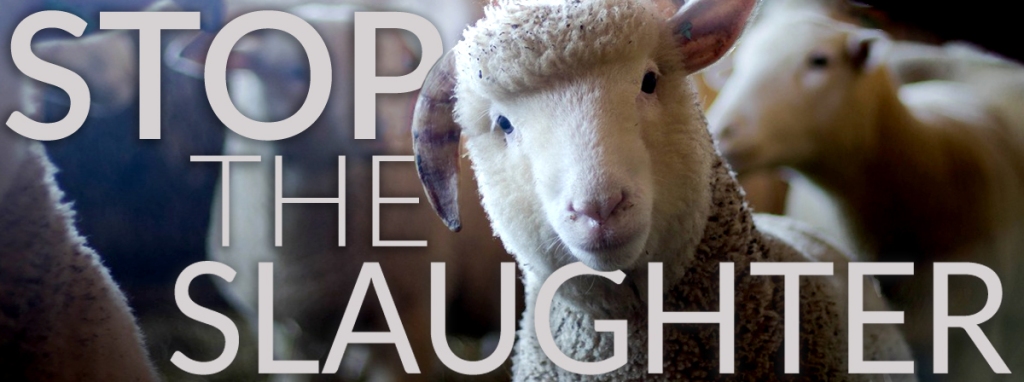
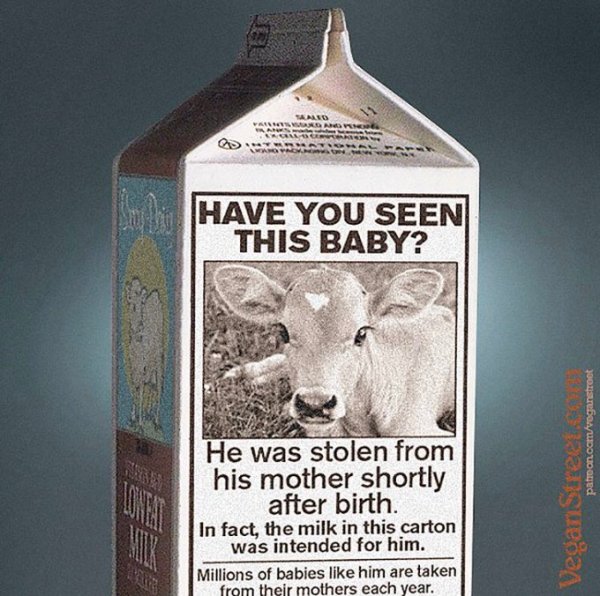
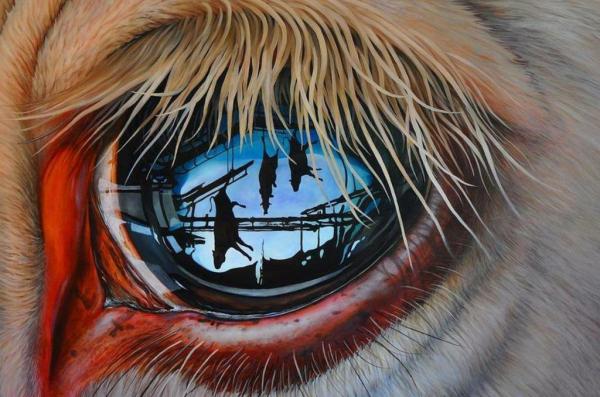
HighestWelfare.Humane.Assured.GoodPractices.Vegetarian. Regenerative.Flexitarian.Lies...
What is the difference between No Welfare, High Welfare, and Highest Welfare when they all require animals to die? Only human comfort, NONE protect the actual animals. The most humane, ethical, and honest Webster-defined "welfare" is NOT exploiting animals - not using, not wearing, not eating, not killing - animals. The only meaningful position is vegan, everything else is just how humans euphemize animals' required suffering and violent deaths: no human exploits animals because they honestly believe that NOT exploiting animals is UNethical or INhumane.
If Not Now, When? If Not You, Who?
December 11, 2017
Wikimedia Commons, by Serenity
Source Gentle World, for the Vegan in Everyone
By Light, Co-Founder of Gentle World
Have you ever been driving on a highway and come alongside a cattle truck? Or perhaps you’ve had the experience of going fishing and feeling a pang of sympathy for both the worms wriggling on the hooks and the fish flapping their bodies, in a desperate struggle to return to life-giving water.
Were you saddened when you first found out how many animals in the wild face extinction? Do you remember going to the zoo and watching big cats and other wild animals pacing back and forth in their cages, resorting to insane behavior due to the unnatural limitations of their surroundings? When was the last time you were at a circus, or a rodeo? Did you realize then that the animals had been driven, through cruelty and confinement, to a state of abject terror?
Have you ever experienced the slaughter of an animal, on screen or in reality? Or maybe you’ve seen a documentary on the unbelievably horrific reality that is the life of laboratory animals, tortured by lab-coated sadists. Maybe you grew up on a farm and as a child befriended a cow, or a lamb, or a goat and then witnessed your friend being led to his or her death.
If you’ve ever come across someone abusing a dog, were you tempted to intervene on the dog’s behalf? Perhaps you have experienced the inside of a so-called ‘humane’ pound, and felt tears well up upon seeing the pitiful eyes of the condemned individuals who knew instinctively that they were on death row, awaiting execution by lethal injection.
If you’ve ever eaten lobsters after they were put in a pot of boiling water, can you recall the sound their claws made on the metal, in their frantic and vain attempt to escape? How ‘bout a pig roast? Have you ever been to one of those? If so, I’ll bet your stomach and your heart ached to see the animal recognizably whole.
…
From a different perspective: Have you looked into the eyes of an animal, and seen feelings like your own reflected in them? I imagine you’ve seen movies such as Bambi, Babe, or Charlotte’s Web, and felt a kinship, a siding, with the animals in the film. What have you done with the feelings of compassion elicited from these experiences? What have you done to end the abuse of both wild and domestic animals you loved when you were a child?
Have you forgotten or are you trying to ignore the irrefutable truth that cruelty should be abolished wherever it is found? Are you trying to smother that truth so as not to have to deal with the obvious ethical, morally justifiable course of action? And have you been finding out that the truth cannot be smothered? Truth lives in your conscience, and will remain there until you make the decision to live that truth.
If you’ve seen Earthlings or heard a powerful animal activist speak, or watched any one of countless documentaries that enlighten as well as horrify your conscience, there are only two ways to deal with such information: by ignoring the reality you just became aware of, or by resolving to do what you can to remove your own complicity, which means to stop eating, wearing, and using animals in your own daily life. In other words, to become vegan, and to live with a respect for all life: the animals, and your own.
If they could, every animal in the world would rise up, and with one pleading voice, say to you:
“What on earth are you waiting for?”
Order a FREE vegan kit: http://www.peta.org/living/food/free-vegan-starter-kit/
Take PETA’s Cruelty-Free Shopping Guide along with you next time you head to the store! The handy guide will help you find humane products at a glance. Order a FREE copy HERE
Want to do more than go vegan? Help others to do so! Click on the below for nominal, or no, fees to vegan literature that you can use to convince others that veganism is the only compassionate route to being an animal friend.
PETA: http://www.petacatalog.com/catalog/Literature-39-1.html
Looking for merchandise? Action for Animals has a very good selection : http://store.afa-online.org/home.php?cat=284
Have questions? Click HERE
Order a FREE vegan kit: http://www.peta.org/living/food/free-vegan-starter-kit/
be not by time
your heart to make
be not by time
a heart to break
be not by time,
broken
take time in hand
a word, softly
spoken
the kindness we
all understand.
Karen Lyons Kalmenson
VEGAN INTEGRITY by 12-Year-Old Vegan Journalist: Marc Bernstein
December 4, 2017

Marc Bernstein, Veganism: A Truth Whose Time Has Come
Source Veganism: A Truth Whose Time Has Come
By Marc Bernstein
(Marc can be followed on Facebook at www.TheKidSays.com
While being vegan is healthier for us, that’s not what I think being vegan is really about. Being vegan is about doing what’s right. A part of doing what’s right is having integrity. But some people who say they’re vegan may not really be vegan and might be lacking integrity. Maybe they’re doing it just for an image and not integrity? It’s upsetting but I suppose in a way it’s also kind of cool that some people want the image of being vegan even when they’re not.
It’s amazing that some celebrities want the image of being vegan. There are some stars who really are vegan, but some of them just seem to want the image. There have been different celebrities who say they’re vegan, and then later the truth comes out that they are not what they said they were. I don’t think we should be focusing on celebrities. Even if they’re good in one way, they can be bad role models in other ways. We should not look outside ourselves to them but look inside ourselves at who we can be and then actually just become those role models. I think we should all do what we know is right. Still, people do look at celebrities. But, people shouldn’t lie. Maybe some of them said they were vegan but didn’t even know what it really meant. How can someone know what vegan really means and go against it? I don’t understand that.
What I really don’t understand is when a restaurant says it is vegan but it’s not. Recently here in Los Angeles there’s been a scandal about some vegan restaurants owned by a certain family. This family doesn’t serve meat at their restaurants, but it was just found out that they have a farm where they are raising animals for slaughter! That is so wrong. Now, I should tell you that their restaurants were never on the listing of totally vegan restaurants in L.A. (www.VeganDay.info/Restaurants.html) because they did use some honey there. Many people ignored that and still called their restaurants vegan, but finding out about the actual animals being raised for slaughter has now sent vegans raging. There have been protests at these restaurants and boycotts online. But, these restaurants were never vegan. One of them just held a massive vegan grilled cheese party to try and win back the support of vegans. But the people who run them were never really vegan and are not vegan now. When the Vegan Society contacted them about their use of dairy and honey, the restaurant owners claimed that their honey was vegan because they raised their own bees and treated them nicely and their dairy was vegan because they raised their cows and treated them nicely. Now they’re saying they treat the animals nicely that they are going to slaughter too.
There was another restaurant in L.A. that had a big sign in the window that just said “Vegan” and their menu said “Vegan” and so did their website. They sure tried to make it seem that they were vegan. One of my vegan friends and his parents were driving down the main street when he saw the big sign saying vegan and was excited. Like mine, his parents aren’t vegan, but they were willing to stop for him to get something he wanted to eat. He thought the menu looked great. He ordered a sandwich and a smoothie. Later that day, he started getting sick. He knew that he was allergic to honey and bee pollen, and those were the symptoms he was getting. His dad contacted the restaurant and found out that they did actually use those bee products in their bread, in their sauce, and in their smoothies. His dad, who’s not even vegan, was furious with this restaurant for not being honest. His dad told them that he didn’t want to sue them, but he would if they did not either change their signs to “Vegan Friendly” or “Vegan Options” or something like that or even better to just change their ingredients and really go vegan. Really sad, this restaurant got rid of the signs that said “Vegan” and even moved more away from being vegan. They added organic eggs and chicken to their menu too. But, that’s what we keep getting from places that aren’t going to be truly vegan in the first place. They’re not vegan in their hearts, they don’t really get it, and they’re not going to really commit to it.
I’m not saying I don’t eat at places sometimes that aren’t vegan. I’ll support a place for having vegan options, and I’ll try to get them to go more and more vegan. I’ve been glad to help some places with that. With Veg Kids I’ve helped restaurants add vegan options. We’ve even helped some of the big amusement parks add vegan food stands! I’m glad to help people move in the right direction, but I sure don’t want to support places that move in the wrong direction or even worse; lie! I won’t support places that lie and say they’re vegan when they’re not. I think we should have higher standards for places that say they’re vegan.
I’m too young and only got to hear about the Quarry expose years after it happened, but that’s another good example. As I understand it, a blogger took food samples from a bunch of different vegan restaurants. They had them sent to a science lab to test the food for traces of non-vegan ingredients. They found that some of the supposedly vegan meats at some of the restaurants had animal products in them. Some restaurants reacted by getting rid of those products and ordering instead from more reliable suppliers. At least one of those restaurants didn’t care and didn’t change, but they still claim to be vegan. This is the same place whose supposedly vegan cheese tested to have some casein (a dairy product) still in it. So some restaurants were lied to, but they fixed it right away because they were really vegan. Others never really were vegan and just wanted the image. That’s not integrity.
Restaurants you expect to be out to make money, but some can do it with integrity and that’s so much better. Celebrities you expect to be out for image, but some can do it with integrity and that’s so much better. But what about vegan celebrities? I don’t mean people who are famous who maybe choose to be vegan, but I mean people who are leaders in the vegan world and that makes them kind of famous in our world. Some of them bother me more than any of the above. If someone is going to be a true leader in the vegan world, then they should really be vegan. But there are some who aren’t. And then some of them might really be vegan, but they’re not truthful about other things. Why can’t people just be honest, and vegans I think should be more ethical and therefore more honest!
There’s someone who claims to be a vegan expert and says she’s been vegan for so many years. She even wrote a book, and in it she claims to be vegan for longer than she really has! I’ve met a couple of people separately who’ve known her for a lot of years, and they both have stories about how she wasn’t vegan back when she said she first was. She may really be vegan now, but she’s still lacking integrity because she wants the image of being vegan ahead of others who were really ahead of her. But, they’re not trying to be the vegan celebrities that she is. Still, it’s wrong to pretend to be what you’re not. Then, there’s the vegan leader who is trying to tell everyone how to not compromise and how important it is to just be vegan. That could be a good message, but she doesn’t follow it herself. She has her own kids who aren’t even vegan. If she can’t raise her own kids vegan, then how can she be taken seriously when she tells other people what to do? It’s just not right to not do what you know is right. If she really believes in how important it is to be vegan, then she should be raising her own kids vegan. She puts out a vegan image she wants everyone to believe and gets loads of vegan celebrity attention for it, but she doesn’t have the integrity to really live like she says!
Then there’s the Hollywood celebrity-run school that has been claiming it’s vegan. It’s even claimed to be the first ever vegan school. This school is not the first; there have been others way before it, and it’s not even a vegan school at all. They are plant-based with their foods, but they still serve honey which isn’t vegan. One of the celebrities that runs the school still wears her fur coats which aren’t vegan. They still do things like dissection, which surely isn’t vegan. They keep a pet hawk that they claim is the school’s mascot and bind it up in little leather straps and blindfold the bird, and that’s far from vegan. So they’re lying and aren’t vegan. But, they’re glad to get the attention for it. They like the image but lack integrity. All the posting about this school being the first vegan school is being done by loads of bloggers, but if the celebrities running this school had integrity then they’d correct what people are saying that’s incorrect. And even if they do go vegan, which I hope they really do, they can never say they’re the first when there are others ahead of them. Loads of vegans believe it because they read it. We need to stop looking at image and look at integrity.
The one that bothers me the most is a kid who says she’s vegan but really isn’t. So many people think she is because she and her mom are trying to create that image. She’s trying to be a celebrity. At vegan events, she tells people she’s vegan. But, my friend heard her mom once say that she wants her daughter to be a star and this is just a way to get her attention. She sees that being vegan is the future, and she’s trying to make it seem that she’s ahead and leading the way. But at a major vegan event I saw her in the parking lot and she was, get this, eating McDonald’s! I couldn’t believe it, but I know what I saw. It was the McDonald’s paper on the outside with a bun and a brown patty on the inside. I checked after that to see if McDonald’s started selling vegan burgers, but that wasn’t it. That is so wrong. It’s another case of someone wanting an image but not having integrity. When I was talking about this to someone, they said that maybe she got a bun with just lettuce and tomato in it, but I know the difference between a tomato and a burger. Even if it was something vegan from McDonald’s, why eat that when you’re about to go into a vegan event that was going to have some great vegan food? I wrote another essay recently on being prepared. That’s a really valuable lesson I’ve learned. Always be prepared! There are plenty of times when I’m in places where I’m not going to have a bunch of good vegan options. That wasn’t the case in this girl’s situation, but if it was then she could have been prepared. That’s why I always have plenty of vegan snacks in my backpack.
Some people say that being vegan is hard. I really don’t think it’s hard if you have vegan integrity. Being vegan is only hard if you let it be hard, but it can be easy if you let it be easy. It’s about integrity. It also helps to have confidence and be secure with what you know is right. The vegan celebrities and the celebrity vegans and the restaurant owners that are more concerned with image than integrity – do more harm than good. When they’re not being consistent, they set bad examples for us. I’m 12 years old. I went vegan when I was 8. While I try to get my parents to go vegan, I’m sorry that hasn’t happened yet. I can help other kids more than I can help my parents. I depend on my parents, and if I pushed it too hard on them then it could backfire and they could stop supporting what I’m doing. So I’ve learned to not push too much on them but to stand strong and do what I know is right. From 8 to 12 years old, that’s a third of my life so far that I’ve been able to have my own integrity and be vegan. If I can do it then others can too. The most important thing I hope people get from this article is that we’re better when we focus on integrity and not image. Let’s have integrity, and let’s live by it. Thank-you to all of you vegans who are really trying with integrity and not just trying to put out some fake image.
child is father to the great man he shall become.
Karen Lyons Kalmenson
A Hurricane of Distortions Surrounding Animals and Veganism
November 27, 2017

A cowboy leads “rescued” animals down a city street after hurricane Harvey hits Texas. (Free From Harm)
Source Free From Harm
By
As we all know, hurricanes Harvey, Irma, and Maria have brought devastation upon so many. As someone with family in Florida, including my Mom, I anxiously followed Irma’s path and was immensely relieved when she only lost a couple of shingles along with power for several days. Many others, as we know, were not so lucky.
Yet even during such nail-biting times and now the tremendous destruction left behind, I couldn’t help but notice that, somehow, a perfect storm had been created for glorifying animal exploitation and ridiculing veganism (of all things).
Although I really wish we didn’t have to talk about this right now, unfortunately, letting these distortions go unchallenged would be a great injustice, both to the animals and those who truly defend them.
Are farmed animals really “rescued?”
A disturbing trend is exemplified by the viral video the above image was taken from, as well as by articles like The New York Times’ “A Flying Cowboy Arises to Rescue Cattle Stranded in Harvey’s Floods” and CNN’s “Texas Ranchers Battle to Save Cattle From Harvey’s Wrath,” all depicting the moving of cattle to dryer ground as some sort of compassionate intervention to save these animals for their own sakes.
But despite appearances and claims – unless, of course, they are being rescued by a vegan sanctuary – farmed animals in situations such as this are NOT being rescued or saved from weather events or fires; sadly, it’s just being made sure they don’t die before they can be further exploited and killed for profit.
Positioning this profit-protecting as “rescuing” or “saving” those you are going to restrain and kill at a later date is obtuse and deceptive if not downright diabolical, and the media and public’s uncritical acceptance of that framing reveals a glaring disconnect. It’s all part of the ludicrous charade required for people to support animal exploitation and slaughter in the total absence of necessity.
The farmers, of course, are all too happy to use the confusion to their advantage. In an Orwellian piece for Farm and Dairy, editor Susan Cromwell has sunk so low as to claim that the fact that so many so-called “livestock” (that word alone speaks volumes) were “rescued” by farmers from the hurricanes not only proves that commodifying and killing sentient individuals is an act of “compassion” rather than exploitation (they give them bedding and hay, tho!), but that animal activists are the true dangerous hurricane, metaphorically speaking.
I kid you not.
Not surprisingly, this spot-on comment left by Free From Harm’s founder Robert Grillo has since been deleted/censored from the article’s comments section:
Are we really to believe your assertion about farmers “rescuing” their animals from Harvey and Irma, that the real “victims” are those who artificially breed, exploit and kill baby animals for profit? Are we to hail exploiters as heroes for rescuing their “livestock” because they view them as nothing more than valuable commodities they can’t afford to lose? Are we to conflate real compassion, altruism and empathy with financial self-interest? Everyone knows that these animals have a price tag on their heads and will soon be sent off to slaughter by these same “compassionate rescuers” where they will be shot point blank in the head, have their throats slashed and then have their bodies hacked up into “edible” body parts. You are shamefully and dishonestly propping up an industry built upon violence and killing as some kind of rescue mission.
When we trust the ones doing the direct exploiting on our behalf, it’s the desensitized leading the disassociated. It’s a very convenient dynamic, allowing them to profit while consumers enjoy the results and absolve ourselves of responsibility and moral consequence. When it comes to justifying needless exploitation and killing, apparently nothing is too ridiculous and absurd for otherwise savvy people (including reputable journalists) to believe.
And where is the journalistic integrity and responsibility in accurately covering such stories? Journalists hold the power in either informing or deceiving the public about news stories. Rather than getting at the truth and the facts, they’ve conflated rescue with financial self-interest. It flies in the face of the Society of Professional Journalists Code of Ethics, particularly these two principles:
- Provide context. Take special care not to misrepresent or oversimplify in promoting, previewing or summarizing a story.
- Never deliberately distort facts or context, including visual information.
If they were truly being rescued, these animals would be destined for sanctuaries, not slaughterhouses.
Please read rest HERE
first one needs to save ones soul
to see all as equal
part of the greater whole
to no longer use, exploit
or abuse..
this would be
the greatest news!!!
Karen Lyons Kalmenson
Reflections on Impact and Activism presentation at ARNC 2017
November 20, 2017
Source Free From Harm Blog, YouTube
A live recording from Free from Harm’s director and founder, Robert Grillo, at the Animal Rights National Conference in Washington D.C. on Sunday August 6th, 2017, as part of a panel of three other presenters. His focus is on a non-linear, non-qualitative approach to looking at our impact and drawing inspiration and lessons from other successful activism efforts.
how far we are from
where we should be
but keeping on going
is our reality.
so stand in our way
so no and such
we will rule the day
thank you
very much!!!
Karen Lyons Kalmenson
5000 Vegans MARCH in London for Animal Rights 2017
November 13, 2017
Source YouTube, Plant Based News
Animal Rights March London 2017: On the 2nd of September 2017, 5000 #vegans marched through the streets of #london calling for an END to all animal exploitation.
The March was conducted by uk activist group Surge Activism, HeartCure Clothing and supported by groups all over the country. The march culminated with motivational and inspirational speeches from Earthling Ed Joey Carbstrong among others. This march is the biggest of its kind in recent years.
Part 1 Intro & Ed (Earthling Winters) Speech more to follow.
More speeches and other coverage to follow…
Thanks to Jeff Knecht for his bus footage give him some love here https://www.youtube.com/watch?v=7Egce…
Filmed at the Animal Rights March London by Calin Wynn & Robbie Lockie | Edited by Robbie Lockie
Follow Earthling Ed here : https://www.youtube.com/channel/UCVRr…
Support Heart Cure Collective here: https://www.heartcureclothing.com
The vegans in the march where around 5000 people. In London the vegans marched for the animals. The activists where marching in London the numbers of vegan activists there where was considerable. Earthling Ed, Joey Carbstrong and a number of other people spoke at the Animal Rights March in London 2017. The day vegan activists where marching for the animals in London.
—
⬇ SUPPORT OUR CHANNEL ⬇
★ HELP TRANSLATE OUR VIDEOS: http://bit.ly/translatePBN
★ SIGN UP TO RECEIVE OUR WEEKLY HEADLINES IN YOUR INBOX: http://www.plantbasednews.org/signup
★ GOT A NEWS STORY WE SHOULD KNOW ABOUT? Please email press@plantbasednews.org or leave a message on our hotline UK landline: +44 207 0960 175, US landline: +1 818 963 5411
★ CHECK OUT OUR WEBSITE: http://www.plantbasednews.org/
★ SUPPORT OUR WORK BY MAKING A DONATION: https://actionsprout.io/0B2DF1/initial
★ SUPPORT OUR WORK ON PATREON: https://www.patreon.com/plantbasednews
SOCIAL MEDIA
★ TWITTER: https://www.twitter.com/plantbasednews
★ FACEBOOK: https://www.facebook.com/plantbasednews
★ YOUTUBE: https://www.youtube.com/plantbasednews
★ INSTAGRAM: https://www.instagram.com/plantbasednews
LEARN ABOUT VEGANISM
★ Cowspiracy ➞ https://youtu.be/nV04zyfLyN4
★ NutritionFacts.Org ➞ https://goo.gl/BdNbiU
★ Veganuary ➞ http://www.veganuary.com/
Order a FREE vegan kit: http://www.peta.org/living/food/free-vegan-starter-kit/
Take PETA’s Cruelty-Free Shopping Guide along with you next time you head to the store! The handy guide will help you find humane products at a glance. Order a FREE copy HERE
Want to do more than go vegan? Help others to do so! Click on the below for nominal, or no, fees to vegan literature that you can use to convince others that veganism is the only compassionate route to being an animal friend.
PETA: http://www.petacatalog.com/catalog/Literature-39-1.html
Looking for merchandise? Action for Animals has a very good selection : http://store.afa-online.org/home.php?cat=284
Have questions? Click HERE
we are challenged by
what is new
something different
perhaps hard to do
but changing for
the better
is the test
being kind
is the
best!
Karen Lyons Kalmenson
Combating speciesism in a time of racism
November 6, 2017

Wikimedia Commons
Source NY Daily News
By Ingrid Newkirk
I’m an animal rights advocate, stuck with the problem of how to discuss discrimination based on species at a time when the news is dominated by stories of discrimination based on skin color.
When human rights hang in the balance, we who speak for animals are always told to zip it. We don’t have time to worry about other species, the argument goes, until we handle homo sapiens’ problems.
But we can’t put animal rights on the back burner when racism is on the front burner. In fact, the conversation becomes only more urgent now. Not just because the vast majority of the hate mail that animal rights groups like PETA receive is from self-identified sexists, homophobes, grinning trophy and “varmint” hunters, and people who spell out hateful messages with the bodies of rabbits and coyotes they’ve shot.
We know so much nowadays about animal intelligence and the cruelty hidden in the slaughterhouse, the circus and trophy hunting that it can’t be right to put that aside. In fact, by recognizing that obligation, we may even learn something about how to treat those who are closest to us.
Henry Bergh, founder of the ASPCA, who also brought and won the first court case about child abuse, said that if you teach a child to care for a caterpillar, you do as much for the child as you do for the caterpillar. And Dr. Martin Luther King Jr. taught, “Injustice anywhere is a threat to justice everywhere,” when he was criticized for objecting to the Vietnam war by those who thought he should restrict his activism to fighting racial discrimination.
Bullying and violence don’t stop at the human door any more than they stop at the race or gender door.
If ever there were a time to examine the principle behind our objections to the practices and beliefs that result in disrespect toward and discrimination against anyone — women, people with disabilities, people of various races and religions, and other living beings — it is now.
Watch old films like “The Thin Man,” and you will shake your head at scene after scene of all-male decisionmakers, women treated like and referred to as “dolls” and “cutie pies,” black men visible only as subservient shoe shiners and waiters, black women appearing only as maids, stereotypes of Asians directed to use phrases like “No tickee, no laundry.”
Most of us are ashamed of those earlier times of limited understanding of “others,” and are glad they are behind us. So how, then, can we justify treating other sentient, thinking, feeling, living beings, as meals on the hoof, future handbags, cheap burglar alarms and slaves as many do today? We can’t, and that demands a broader discussion about prejudice.
Longtime PETA supporter Russell Simmons says, “I went vegan more than 15 years ago because cruelty is cruelty, whether it’s to blacks, whites, children, the elderly, dogs, cats, pigs or chickens.” He echoes the words of Nobel laureate Isaac Bashevis Singer, whose family fled the Holocaust and who said, “I didn’t become a vegetarian for my health. I did it for the health of the chickens.”
And of Alice Walker, who wrote, “The animals of the world exist for their own reasons. They were not made for humans any more than black people were made for white, or women created for men.”
It has been a few years now since over a dozen prominent scientists and philosophers issued the Cambridge Declaration on Consciousness, calling on humanity to recognize the rights of other species, with the words: “The weight of evidence indicates that humans are not unique in possessing then neurological substrates that generate consciousness. Nonhuman animals, including all mammals and birds, and many other creatures, including octopuses, also possess (them).”
Animal rights proponents embrace the words of civil rights activist and feminist Audre Lorde, who believed, “There is no such thing as a single-issue struggle, because we do not live single-issue lives.”
Those of us working to break down the prejudices against animals are the same people who are advocating for human rights and challenging hate groups. Because we know that prejudice in all its ugly forms is wrong. It doesn’t matter who the victim is, but when we witness oppression, we should never let it go unchallenged.
Newkirk is president of People for the Ethical Treatment of Animals.
Order a FREE vegan kit: http://www.peta.org/living/food/free-vegan-starter-kit/
Take PETA’s Cruelty-Free Shopping Guide along with you next time you head to the store! The handy guide will help you find humane products at a glance. Order a FREE copy HERE
Want to do more than go vegan? Help others to do so! Click on the below for nominal, or no, fees to vegan literature that you can use to convince others that veganism is the only compassionate route to being an animal friend.
PETA: http://www.petacatalog.com/catalog/Literature-39-1.html
Looking for merchandise? Action for Animals has a very good selection : http://store.afa-online.org/home.php?cat=284
Have questions? Click HERE
why do some choose to pursue
a false hierarchy view
when we are all equal
in the heart and eyes
of the one
who created us,
true!
Karen Lyons Kalmenson
I Became a ‘Humane Farmer’ to Help Animals; I Should Have Gone Vegan
October 30, 2017

Gustaf Soderfeldt on his vegetable farm. Source Free From Harm
Source Free From Harm
By
I started out as a small scale “humane farmer” back in 2006. Farming grew out of my involvement with, and passion for, the whole “back-to-the-land,” “grow your own,” sustainable food movement.
I raised free range pigs, sheep, goats and chickens, and I opened a shop for local, organic foods that sold meat and vegetables from my farm, as well as from others nearby.
But while running the shop, my ideas around, and options for, “ethical meat” began to crumble. I soon realized that, because producing meat is as unnecessary as it is violent, ethical meat is an impossibility whenever it is possible to grow plentiful plant-based foods.
Too, more than anything, I believe my customers saw the local, organic, “ethical meat” and dairy labels as an excuse to continue eating all types of meat and animal products generally. And that is because, more than anything, humane labels still designate animal lives as so inherently inferior and existentially worthless that breeding, exploiting and killing them for completely unnecessary reasons can still be embraced, celebrated even, as “ethical” and “humane.”
It may sound funny to say, but I discovered veganism through YouTube, and it was there that I learned it was a healthy, viable option. My world as a small-scale, ethical meat producer was totally turned upside down. I closed the shop, stopped raising animals, and became active in the vegan community. Now, together with my spouse Caroline, I run the farm totally veganically [without animal manure, blood or bones, or any other animal inputs].
Please read more HERE
every little tip toe
every step
every way
our ranks are
swelling with
kindness,
every day!
Karen Lyons Kalmenson
Adele – Hello [Official Vegan Parody]
October 23, 2017
Source YouTube
Light Twins
Adele – Hello [Official Vegan Parody} – We thought that music would be a great way spread the vegan message! This is our first song and really we hope you like it! This song is for all the animals out there and to the dream of a world vegan! Preformed : Treena Strong Written : Treena Strong and Light Twins Recorded & edited : Nytmare (Lel brothas / lel nation on Facebook & Twitter) LELNation.com & Wei Kei Thapilot beatemirates.com (@ ykthepilot on twitter) Big thanks to our friends (check them out!) Directed & edited : Light Twins Produced : Light Twins
Lyrics – Adele – Hello [Vegan Parody] * Say no, to meat * It’s a wonder how you’ll fall in love with what you use to eat * They’re not fowl, pork or beef * If you’re disassociating, then you are just not seeing * Outgrown alone and hungry * they are captive living out their short lives in a factory * since they were young they dreamed * To escape and find a place to feel the grass beneath their feet * There’s no difference between us * We all feel pain * now I’m on the vegan side * so I can save a thousand lives * don’t be sorry for, everything we’ve done wrong * it’s a journey, this path lead, to where we belong * changing from the inside * can make a difference worldwide * it’s time to, think more, about everyone else * we can’t be just thinking, of only ourselves * Anymore * it shows, the devastation * clear-cutting all the forest for the cattle population * it’s not sustainable * using animals as A resource is unexplainable * It’s no secret that all of us * Are running out of time * now I’m on the vegan side * so I can save a thousand lives * don’t be sorry for everything we’ve done wrong * it’s a journey, this path lead, to where we belong * changing from the inside * can make a difference worldwide * it’s time to think more about everyone else * we can’t be just thinking of only ourselves * Anymore, ooooohh * Anymore, ooooohh * Anymore, ooooohh * Anymore, Anymore * hard to tell what’s wrong from right * We’ve been told a thousand lies * I’ll tell you the truth about what can be done * be apart of the, big changes to come * Allow your heart to open wide * connecting to your humane side * It’s time, to be, the change you want to see * it’s not too late to change, from who you don’t want to be *
Anymore Social Links: YouTube Channel – http://www.youtube.com/user/lighttwins11 Facebook Page – https://www.facebook.com/LightTwins Instagram – https://instagram.com/light_twins_henry Instagram – Instagram – https://instagram.com/lighttwins Extro Music – Jim Yosef – Lights [NCS Release] https://www.youtube.com/watch?v=vb3ks…
Order a FREE vegan kit: http://www.peta.org/living/food/free-vegan-starter-kit/
Take PETA’s Cruelty-Free Shopping Guide along with you next time you head to the store! The handy guide will help you find humane products at a glance. Order a FREE copy HERE
Want to do more than go vegan? Help others to do so! Click on the below for nominal, or no, fees to vegan literature that you can use to convince others that veganism is the only compassionate route to being an animal friend.
PETA: http://www.petacatalog.com/catalog/Literature-39-1.html
Looking for merchandise? Action for Animals has a very good selection : http://store.afa-online.org/home.php?cat=284
Have questions? Click HERE
in tune with where our hearts
reside.
a word a note
can turn the tide
Karen Lyons Kalmenson
The Normalization of Nonhuman Oppression in Education
October 16, 2017
Source Free From Harm
By

One of the greatest challenges faced by the animal liberation community is the normalization of violence against, and captivity of, nonhumans that is imposed upon human children. This is widely discussed as problematic with respect to events in a child’s life, such as visiting a zoo or a circus, or attending a Fourth of July barbecue. As I recently became a literacy tutor specializing in elementary school students, I find that this is also prevalent in the materials one is expected to use as well as those provided by both public and private elementary schools.
Reading Skills Grade 3, published by Flash Kids, is one of many widely available workbooks used by tutors to provide support to elementary school students who are not reading at grade level. (The number of such students in New York City is astounding; as of 2013, a staggering seventy-four percent of students in grades 3-8 in New York City were reading below grade level. In 2015, nationally, nearly one-third of 4th-, 8th-, and 12th-grade students read below “basic” level, while just over one-third read at or above “proficiency.”) This workbook includes a number of exercising regarding paragraphs. One section pertains to finding the main idea— students are given a brief paragraph and then asked to choose from four options which best states the main idea of what they have just read.
I was disappointed to find when I first began working with this book that a significant number of the passages related to some form of animal exploitation. One passage had to do with the responsibilities of being a zookeeper, with no regard whatsoever for the victim’s perspective— what it’s like to be a “zoo animal.” The passage, of course, glorified the role of zookeeper and depicted it as a nonhuman animal’s friend and caretaker. In short, it described zookeepers as they might describe themselves, glorifying the captor while ignoring the captive. Another passage described a young boy’s dedication to fishing in such a way that it appeared almost admirable. The focus of said passage was on his patience and determination, not on the act of murder to which he was so devoted. Indeed, in the passage, the boy never actually caught a fish; but we are supposed to admire him for waiting all day and all night, not making a sound, determined to reach his goal.
Please read rest HERE
until we recognize our own “animal” state
our fellow beings will still suffer terrible fates.
we must learn and teach that in the eyes of the
creator,
whatever his/her name
we are all his/her children…
one and the same!!!
Karen Lyons Kalmenson
Vegan Hero
October 9, 2017
Source Veganism A Truth Whose Time Has Come
By M. (known as) “Butterflies” Katz
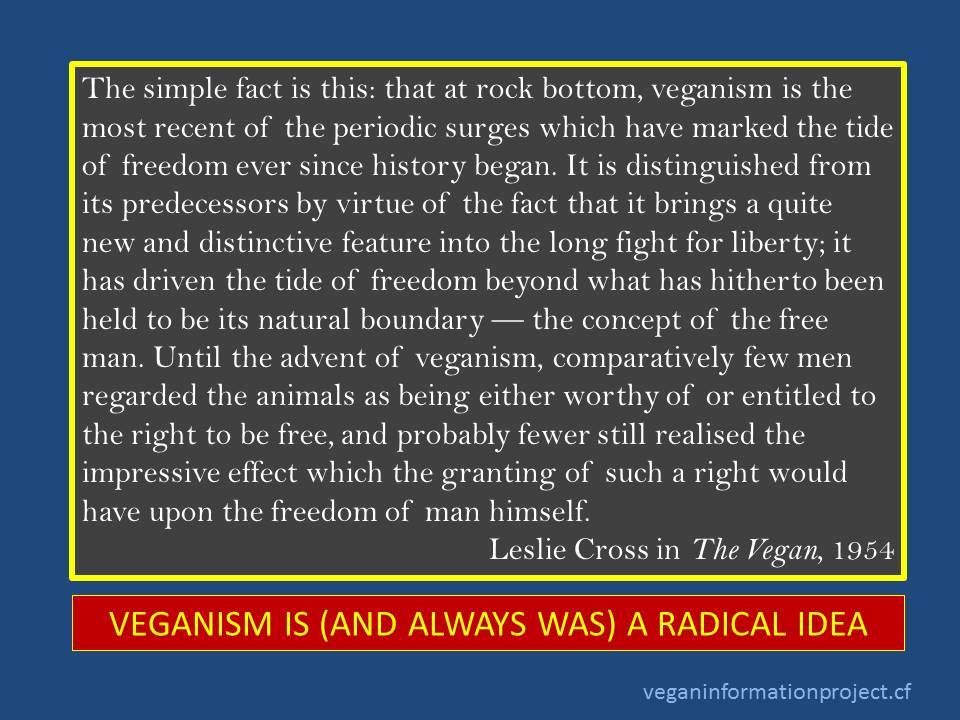
My vegan hero is Leslie Cross; an early pioneer of the vegan movement and the man who is responsible for bringing about a literal definition of veganism that equated it with animal rights. Although the first Vegan Society was formed by Donald Watson and 5 members in 1944, it was not until 1949 that Leslie J. Cross pointed out that the society lacked an official definition. He then suggested: “the principle of the emancipation of animals from exploitation by man”. This was later clarified to “seek an end to the use of animals by man for food, commodities, work, hunting, vivisection, and by all other uses involving exploitation of animal life by man”. The definition was again changed in 1979.
In spring of 1951, Leslie Cross wrote an essay in the early vegan publication which concluded with the following quote: “A great and historic wrong, whose effect upon the course of evolution must have been stupendous, would be righted. The idea that his fellow creatures might be used by man for self-interested purposes would be so alien to human thought as to be almost unthinkable. In this light, veganism is not so much welfare as liberation, for the creatures and for the mind and heart of man; not so much an effort to make the present relationship bearable, as an uncompromising recognition that because it is in the main one of master and slave, it has to be abolished before something better and finer can be built. ~~ Veganism is in truth an affirmation that where love is, exploitation vanishes. It possesses historical continuity with the movement that set free the human slaves. Were it put into effect, every basic wrong done to animals by man would automatically disappear. At its heart is the healing power of compassion, the highest expression of love of which man is capable. For it is a giving without hope of a getting. And yet, because he would free himself from many of the demands made by his own lower nature, the benefit to man himself would be incalculable.”
~Leslie Cross, (Vice-President, The Vegan Society)
39, Willow Crescent East, Uxbridge, Middx.
39, Willow Crescent East, Uxbridge, Middx.
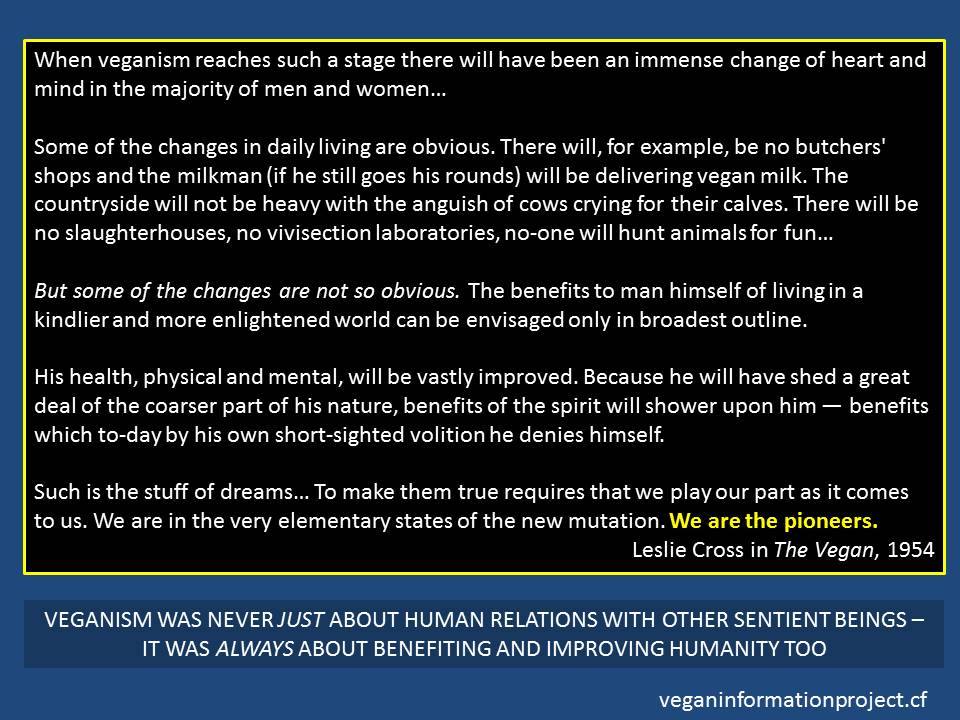
I saw a SILK commercial on television last night and thought of Leslie Cross and how happy he would be to see this mainstream advertisement of a plant-milk, as well as all the many vegan milks on the market today. In June of 1956, Leslie Cross founded the Plantmilk Society, which in 1972 became Plamil Foods, in the United Kingdom. He became a vegan in 1942, and at that time argued that dairy-milk production was cruel and exploitative. The first plant milk was fortified with calcium, vitamins B2, B12 and D2. In 1965 Plantmilk Ltd had Cross as its first full-time employee.
An obituary by early vegan pioneer; Kathleen Jannaway appeared in the spring 1980 issue that read:
“Leslie Cross, vegan for 35 years, founder member of the Vegan Society, and of the Plantmilk Society, died peacefully in his sleep on 2nd December, 1979. Inspired by his deep love of all life he looked forward to the day when plant milks would be generally used and a great burden thus lifted from the gentle cow. He was managing director of Plantmilk Ltd when it was at Langley, Bucks, was Secretary of the Plantmilk Society until his death, and often used his skill as a journalist to write on behalf of animals. We offer our sympathy to his wife, Constance, who worked so hard with him to forward the cause of animal compassion, and to his son and daughter, who were fine examples of vegan children.”

Thank-you Vegan Information Project (Ireland) for the posters with his quotes.
Order a FREE vegan kit: http://www.peta.org/living/food/free-vegan-starter-kit/
Take PETA’s Cruelty-Free Shopping Guide along with you next time you head to the store! The handy guide will help you find humane products at a glance. Order a FREE copy HERE
Want to do more than go vegan? Help others to do so! Click on the below for nominal, or no, fees to vegan literature that you can use to convince others that veganism is the only compassionate route to being an animal friend.
PETA: http://www.petacatalog.com/catalog/Literature-39-1.html
Looking for merchandise? Action for Animals has a very good selection : http://store.afa-online.org/home.php?cat=284
Have questions? Click HERE
this man was love personified
he found his truth
and he always tried
to share that love
he felt so strong.
it takes a world of compassion
to make this world
get along.
Karen Lyons Kalmenson
SHARK Exposes Animal Charity Evaluators (ACE)
October 2, 2017
Source YouTube SHARK
Animal Charity Evaluators (ACE) claims to do science-based evaluations of animal protection organizations, however, SHARK is exposing that as being false. The problem is that ACE reviews – which are important because those who receive “top Charity” status can potential make millions in donations – appear to be biased in favor of one particular person, an activist named Nick Cooney. How is it possible that with over 20,000 animal organizations in the US alone, only organizations connected to Nick Cooney receive “Top Charity” status? Harrison Nathan’s essays about ACE: https://medium.com/@harrisonnathan/re-evaluating-animal-charity-evaluators-c164231406f7
SHARK’S letters to ACE:
http://www.sharkonline.org/index.php/charity-cops/1731-ACE-Letter1
http://www.sharkonline.org/index.php/charity-cops/1734-ACE-Letter2
http://www.sharkonline.org/index.php/charity-cops/1732-ACE-Letter3
http://www.sharkonline.org/index.php/charity-cops/1733-ACE-Letter4
http://www.sharkonline.org/index.php/charity-cops/1735-ACE-Letter5
http://www.sharkonline.org/index.php/charity-cops/1730-merritt-clifton-on-animal-charity-evaluators
For more information about waste, incompetence, laziness and fraud in the animal protection movement, please go to CharityCops.com *We have been alerted that Vegan Outreach was once, at the very start of ACE, briefly listed as a Top Charity. What’s interesting is that we could find no mention of this on ACE’s website, but it was found on an internet archive website with ACE’s old website. Apparently ACE was caught in a controversy about a study on leafletting involving VO (see Mr. Nathan’s essays) and we have been told that information was removed from the ACE site because of this. We must also note that Vegan Outreach had ties to Mr. Cooney as well, including him having his own page on the VO website, so this only adds to our claims about his relations to Top Charities. We will have more on this in a future video. On August 9, 2017, the blog Animals 24-7 posted an article about SHARK’s efforts to expose ACE. You can review the article at: http://www.animals24-7.org/2017/08/09/new-shark-charitycops-site-exposes-animal-charity-evaluators/
Order a FREE vegan kit: http://www.peta.org/living/food/free-vegan-starter-kit/
Take PETA’s Cruelty-Free Shopping Guide along with you next time you head to the store! The handy guide will help you find humane products at a glance. Order a FREE copy HERE
Want to do more than go vegan? Help others to do so! Click on the below for nominal, or no, fees to vegan literature that you can use to convince others that veganism is the only compassionate route to being an animal friend.
PETA: http://www.petacatalog.com/catalog/Literature-39-1.html
Looking for merchandise? Action for Animals has a very good selection : http://store.afa-online.org/home.php?cat=284
Have questions? Click HERE
is there no place where the corrupt
and greedy
do not take away from
the kind and needy.
Karen Lyons Kalmenson
Lauren Gazzola – Human Supremacy: What Does the Animal Rights Movement Mean?
September 25, 2017
Source YouTube: Direct Action Everywhere
SHAC 7 defendant Lauren Gazzola delivered a keynote address at the 2017 National Animal Rights Conference, urging conference attendees to think about the meaning of the animal rights movement. Help us caption & translate this video! http://amara.org/v/9MU0/
human supremacy
a joke that failed
and we will make sure
that cruel ship
has sailed
and in its place
a kinder face!!!
Karen Lyons Kalmenson
Source JoAnn Farb
When I heard that a new group, Voices for Animals Kansas City (VFAKC) was planning to host Kansas City’s first VegFest, I was thrilled. Although it seemed odd that they didn’t reach out to the longest running animal right’s group in the area, Animal Outreach of Kansas, and invite them to participate, I didn’t start to have concerns until AOK’s founder, Judy Carman inquired about tabling at the Vegfest and was informed that to have a table would cost her 300.00 dollars — the same as for food vendors, even though she wasn’t selling anything, and didn’t have that kind of budget. My concerns grew when I found out HSUS and Whole Foods (one of the largest meat retailers in the US.) were both sponsors.
How would messaging at the vegfest be impacted by its sponsors?
Sponsors provide money expecting to get something. Non-profits typically sponsor expecting to expand membership and increase revenue. In the case of VFAKC’s Vegfest — HSUS wasn’t just a sponsor, but also provided one of the speakers — Paul Shapiro.
KC’s first VegFest was free and open to the public, and my family went and mingled with other attendees. Our intent was to support and promote veganism by talking with others. When we talked with non-vegans, we shared literature that encouraged veganism. When attendees told us that they were already vegan, we discussed the issue of co-option within the movement and provided them the flyer pictured above (front) and below (back).

Overwhelmingly the people we met expressed gratitude that we were raising awareness of this issue. At no point were we loud or disruptive in any way. We simply spoke respectfully one on one with individuals, and heard no objections.
But in weeks following the Vegfest we heard from a number of people that the Vegfest’s main organizer, Dave Swarts, was upset when he learned after the fact that we had been providing this literature to people and he was seeking to block us from attending next year’s Vegfest. Dave told others (incorrectly) that we were distributing “Humane Watch” literature. Humane Watch is a well-known front group for animal exploiting industries, that also is very critical of HSUS. Mischaracterizing our hand-out and the website it linked to in this way, may cause those supportive of HSUS to not even look into the substance of what we were saying. After hearing how upset Dave was and that our actions were being misconstrued, my daughter reached out with an email to Dave asking to set up a phone call to discuss what happened, hoping that they could better understand each other’s perspective.
12 days later, Dave Swarts replied to my daughter with the following emailed statement and he copied me too:

It is ironic that Dave used the words, “conflict with our brand” in his statement. If we are both working to help animals, why would his biggest expressed concern be his “brand”? Perhaps this definition of co-option HERE can shed some light:

When the vegan movement began in 1944 with the coining of the word, “vegan,” it was clearly defined as the exclusion of all forms of exploitation of animals. Keep in mind — factory farms were not yet known. Nearly all animals were raised on family farms like those being promoted as “humane” by organizations like HSUS.
I’ve been vegan over 25 years and have witnessed messaging from large animal advocacy groups changing in a disturbing way. Groups, that once advocated for justice for animals, are suddenly steering the conversation away from promoting veganism to endorsing meat, dairy and eggs from farms they now refer to as, “humane,” in some cases even giving their stamp of approval as with the infamous Whole Foods Letter, or when Peta gave an award to Temple Grandin for designing a “humane” slaughterhouse. To put that in perspective, consider what would be the public’s reaction if Amnesty International gave an award to a dictator for jailing dissidents in more comfortable jails and feeding them a great meal before killing them by lethal injection, instead of a firing squad? Should animal advocates publicly applaud baby steps that still perpetrate violent injustice against animals? How would you feel if Amnesty International suggested that the less terrible dictators were our allies in the struggle against the most horrific dictators?
Now juxtapose that scenario with a real conversation that occurred on a vegan Kansas City Facebook group, when a new vegan, expressed interest in holding a vigil in front of a small local slaughterhouse to raise awareness. The new vegan asked if anyone knew where local slaughterhouses were, and Dave tried to dissuade this individual by suggesting that these slaughterhouses were, “allies” with vegans who work to raise awareness about the injustice of exploiting animals:

What does it mean if we begin to ally with those who are profiting off of the exploitation and killing of animals? What is left of our movement, if we are no longer clearly opposed to exploitation and killing of other beings? What does that make our movement a movement for?
Does messaging matter?One of the speakers at KC’s VegFest was Paul Shapiro, a VP at HSUS. As a segue to his endorsement of cultured meat, (Which I have raised concerns about in my post, Cultured Meat, Yellow Rice, Cage Free Eggs, Have YOU Been Duped?) Paul told the audience a tall-tale about how whales benefitted from the transition from whale oil lamps popular in the 1800s to kerosene lamps — a tale that I have deconstructed in my post, Dangerous Myths that Threaten Animals. Paul used that tale as a metaphor for why people who care about animals should now endorse cultured meat.Paul also made the following Orwellian statement while on stage:
“We should accept that not all animal raising is the same…In fact if all animals were raised that way [on small farms] we might go do something else with our lives…because there’d be maybe bigger problems.”
–Paul Shapiro HSUS VP
Why is VFAKC providing a platform for sentiments contrary to real justice for animals? I shudder to think how this messaging (which also included suggesting that ethically, its better to eat beef than chicken) might have influenced attendees. How many people on the verge of considering veganism — because a vegan spokesperson/leader suggested that embracing or working for “humane” meat/dairy/eggs is a morally acceptable alternative to veganism, will now become consumers of, “happy meat?” instead of embracing veganism? Might this translate into economic benefits for sponsors like Whole Foods and HSUS?
IF you are involved with the group Voices for Animals — or for that matter, ANY group that is partnering with entities which might present a conflict of interest, I urge you to speak up and raise awareness. Go to their events and dialogue with others who attend. If you are not sure what constitutes a conflict of interest, Tribe of Heart Defined it Here:

Who is VFAKC advocating for — the animals or their sponsors?
PLEASE do all you can to keep the conversation about industry co-option of grass-roots animal advocacy alive! If you attend VFAKC events, make sure others there know what is taking place and share information. Share this post on your social media, email it to friends who may not be on FB. Print out some of the articles that I have linked to and share them with others. The animals need us to speak up!
If you’d like to know more about how conflicts-of-interest are undermining grass-roots activism and decades of work by sincere activists on behalf of other beings, read Invasion of the Movement Snatchers and When Animal Groups Promote Happy Meat, and watch the video, Happy Meatopia. I would also encourage you to read this excellent post by Gary Francione explaining how the Vegan Society of the UK — THE very first vegan society ever — founded in 1944 by Donald Watson has also been, coopted/rebranded.
Something else just bought to my attention is this 2012 article:
Justice For Animals, Respect for Advocates — Ideas too Dangerous for Corporatized Animal Advocacy?
if they could speak
what would they say.
now all they can
do is pray…
and hope some kindness
comes their
way!
Karen Lyons Kalmenson
Planet of the Apes: Speciesism Exposed
September 11, 2017

Free From Harm
Source Free From Harm
The third installment of the epic prequel to the original Planet of the Apes movies came out recently and I was captivated along with everyone else in the theatre. Cheering for the mass extinction of your own species is an peculiar feeling — a little unnerving when you pause to think about it — but so easy to get on board when the human species’ litany of destructive, vicious, and callous actions are on full display as they so expertly were in this trilogy.
These three films are a startling illustration of speciesism, the assumption of human superiority resulting in the exploitation of animals. Many doomsday scenario films fill us with dread of asteroids and trepidation of severe weather events, but this apocalypse — or ape-ocalypse as graffiti on a wall suggests in the third film — is more subtle, emerging from our arrogance, greed, and disregard for other species. I am not the only one to perceive the speciesist themes of the movie that this writer also points out in her article where she explains that “War for the Planet of the Apes” inspired her to go vegetarian.
Starting with the first installment of the trilogy, Rise of the Planet of the Apes in 2011, we meet young Caser, who was born in a laboratory experimenting on apes for a potential Alzheimer’s drug. The death of his mother is one of the most tragic scenes in all three films. Laboratory workers are trying to forcefully take her out of her cage, not knowing that she has just given birth. She was hiding her infant from them and gets violent when she feels she had no other way of protecting him from the humans. After escaping through the building, she is dramatically shot dead on a board room table where the drug company executives were plotting to make billions on the drug that had been tested on her. The symbolism was not subtle.
Please read the rest HERE
if we choose to see
with “blinded” eyes
who will hear
the wounded’s cries
who will reach out
who will go that
one step, far
so we can be better
than
we
are.
Karen Lyons Kalmenson
United Poultry Concerns and the Alliance to End Chickens as Kaporos
September 5, 2017

Wikimedia Commons
Please sign HERE
United Poultry Concerns and the Alliance to End Chickens as Kaporos would like to invite you to participate in our campaign exposing the cruelty of Kaporos. Kaporos is a ritual preceding Yom Kippur, the Jewish Day of Atonement, occurring in late September this year, in which thousands of chickens are “swung” and then slaughtered by certain ultra-orthodox Jewish communities. Practitioners wave the chickens over their heads by the legs or by pinning the bird’s wings painfully backward while reciting a chant about transferring their sins and punishment symbolically onto the bird.
Our campaign seeks to end this horrific cruelty to chickens at Kaporos sites year after year in New York City, Los Angeles, New Jersey, and everywhere the ritual is performed. Prior to the ritual, thousands of chickens are crammed into transport crates without food or water for as long as four days. They are deprived of shelter from rain, heat, and cold. Many die in the crates of starvation, dehydration, heat stress, and fear. More and more rabbis are publicly condemning Kaporos for violating the Jewish values of mercy and compassion for animals.
We would like to encourage you to join our campaign by taking this simple action:
Please send an alert to your members informing them of the inhumane practice of using chickens in Kaporos and encourage them to sign our Change.org petition. This petition urges major Orthodox Rabbinical Organizations to oppose the use of chickens for Kaporos and encourage practitioners to perform the ritual with money instead of chickens, an accepted method of atonement. Please feel free to pull copy, text, or images directly from our site to create your own post based on the content of our petition.
Please share our petition on your social media sites and/or website and urge people to sign. Here is the full link to our Change.org petition: https://www.change.org/p/urge-jewish-community-to-do-kaporos-with-money-not-chickens
Thank you for your collaboration to help end this cruel practice. Let me know if you have any questions and please provide me with a link to any alert or post you create.
With compassion,
Hope Bohanec
Projects Manager, United Poultry Concerns
Office: 707-540-1760
Email: Hope@UPC-online.org
until we see ourselves and animals
on an even par,
we as a species will
not go far!!!
Karen Lyons Kalmenson