Three Issues: Chimpanzees, Orca
Please click on and sign the following:
1. Send the Alamogordo Chimpanzees Home
2. Tell CareerBuilder to Stop Exploiting Chimpanzees!
3. Free Morgan! Ask Dolfinarium in Harderwijk to Release an Orca
1. BACKGROUND | From PCRM
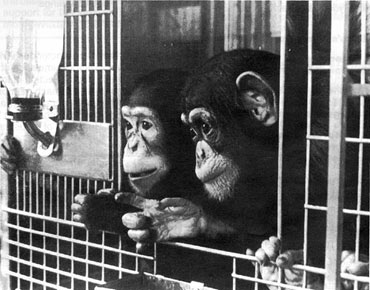
Please urge Francis Collins, M.D., Ph.D., director of the National Institutes of Health, to have a heart and return the 14 Alamogordo chimpanzees to New Mexico.
MESSAGE TEXT
I am writing to ask that you return the 14 chimpanzees recently moved to the Southwest National Primate Research Center in San Antonio, Texas, back to Alamogordo, N.M., where they belong.
Since arriving at the federally funded Alamogordo Primate Facility in 2001, none of these chimpanzees have been used in experiments. Prior to that, they were used for years in cruel experiments. The psychological trauma experience by chimpanzees in laboratories is similar to human symptoms. They exhibit signs of anxiety, depression, and post-traumatic stress disorder.
Significant genetic and physiological differences between great apes and humans make chimpanzees a poor research model for human diseases. As you know, we still have no vaccine for HIV or hepatitis C, although tens of millions of dollars have been spent over many decades on chimpanzee-based research for these diseases. Please have a heart this Valentine’s Day and return Levi, Rosie, Randy, and the 11 other chimpanzees back to Alamogordo, N.M. Now is the time to join the rest of the world and stop experimenting on chimpanzees–please start by returning the 14 chimpanzees to Alamogordo.
2. BACKGROUND | From PETA
During the 2011 Super Bowl, CareerBuilder debuted a new commercial featuring chimpanzees, despite hearing from tens of thousands of concerned consumers who are offended by the company’s ongoing exploitation of chimpanzee “actors.” CareerBuilder first began airing ads that portrayed chimpanzees as misbehaving office workers in 2005, but the company announced that it was permanently retiring the campaign in 2008. So PETA was shocked to learn that CareerBuilder had created a new ad featuring chimpanzees, especially since a 2008 study published in the journal Science revealed that using this endangered species for advertising seriously hinders conservation efforts by misleading the public into believing that the animals are not in jeopardy.
Chimpanzees used in the entertainment and advertising industries are typically very young animals who are prematurely removed from their mothers—often just days or weeks after birth. Trainers use physical abuse in order to ensure that chimpanzees know “who’s boss” and to force the animals to perform confusing, unnatural behaviors on cue. By the time chimpanzees reach approximately 8 years of age, they are too strong to be safely handled and are often discarded at unaccredited roadside zoos or otherwise warehoused in appalling conditions.
The chimpanzees used in CareerBuilder’s new commercial were provided by Steve Martin’s Working Wildlife, a company with a long history of cruelty to animals. Martin has routinely dumped unwanted chimpanzees and other wild animals at poorly run roadside zoos, and he’s posted ads in dubious animal trade publications that advertise to breeders, dealers, and the pet trade. During 2004 and 2006 undercover investigations, PETA found three chimpanzees who had come from Steve Martin’s Working Wildlife living in seedy roadside zoos. One of the chimpanzees, Walter, was living in squalor in a dark, concrete pit littered with feces and rotting food. As a recent article published in Advertising Age points out, 10 of the top 15 advertising agencies in the U.S.—including BBDO, Young & Rubicam, McCann Erickson, Grey, Ogilvy & Mather, and JWT—now have policies in place that prohibit the use of chimpanzees in their ads. Earlier this year, Dodge, Pfizer, Heartland Payment Systems, and Europcar all pulled or modified ads that featured apes after learning about the ethical problems associated with exploiting these highly intelligent and sensitive animals.
MESSAGE TEXT
I was extremely disappointed to see CareerBuilder’s new commercial that features chimpanzees. By now you know that chimpanzees who are used for advertising are torn away from their mothers as infants, trained through physical abuse, and discarded when they become too strong to be managed. There is no excuse for supporting this cruel industry, especially considering the many alternatives available to the use of live apes.
Please make the responsible and compassionate decision to end this offensive ad campaign and agree never to exploit chimpanzees in future CareerBuilder ads and promotions. Thank you for your time.
RELATED | Orcas
Vodpod videos no longer available.
3. BACKGROUND | From PETA
This past June, a very young orca was found separated from her pod and swimming alone in the shallow Wadden Sea off the coast of the Netherlands. She appeared thin, weak and distressed. According to Reuters, she was the first orca to be found alive in Dutch coastal waters in more than 60 years.
Dutch marine mammal rescue group SOS Dolfijn captured the orca and transported her to the marine park “Dolfinarium” in Harderwijk, the Netherlands. According to original statements from the Dolfinarium, the marine park’s initial plan was to release the orca (named Morgan) back into the wild as soon as she had recovered.
But now it appears that the marine park might keep Morgan in captivity and possibly ship her to a SeaWorld theme park in the US or another foreign facility, where she would suffer a lifetime of misery in a small, concrete tank. Information requests from PETA Germany on the status of Morgan’s release have gone unanswered, and Dolfinarium’s website states that scientists around the world are considering what the best option would be for Morgan.
The more time that passes, the more difficult it will be to release Morgan back into the open ocean – her rightful home.
Please help spare Morgan from a lifetime of captivity!
Orcas in the wild swim up to 100 miles each day. They live in large social groups and communicate among themselves. Orcas in aquariums suffer from loneliness, illness and distress. These animals can only swim endless circles in enclosures that to them are like bathtubs. They are unable to engage in natural behaviours and are forced to entertain paying customers by performing silly tricks for food.
MESSAGE TEXT
Please ensure that the young orca named Morgan, who was captured in the Wadden Sea and taken to the Dolfinarium in Harderwijk, is released back into the ocean as soon as possible.
The longer that Morgan lives in captivity, the more difficult it will be for her to become accustomed again to life in the wild. Nothing is sadder for an orca than to live in a small basin away from his or her family and to perform tricks for humans rather than roaming the vast ocean.
In the ocean, whales and dolphins live in large social groups and communicate among themselves.
In marine parks–such as SeaWorld locations in the US and Loro Parque in Tenerife, Spain–captive orcas sometimes become so desperate that they attack and kill trainers.
Please free Morgan!
Thank you.
See More …
these 3 actions take but the smallest
amount of time, but that may be all
these innocent animals have left
please sign and save
Karen Lyons Kalmenson













 Our Compass
these 3 actions take but the smallest
amount of time, but that may be all
these innocent animals have left
please sign and save
LikeLike
Animals being exploited by “man(evil)kind” , has become a plague in the world…
LikeLike
Action Taken and Shared here: http://animalconnectionblog.blogspot.com/2011/02/three-issues-chimpanzees-orca.html
LikeLike