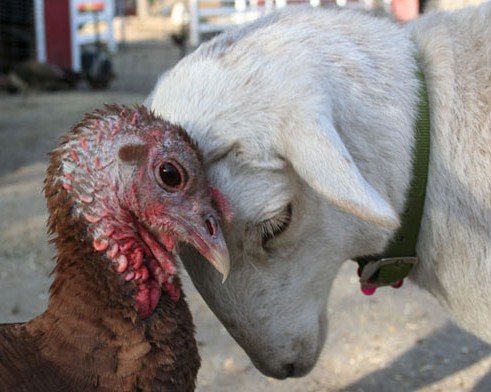
HighestWelfare.Humane.Assured.GoodPractices.Vegetarian. Regenerative.Flexitarian.Lies...
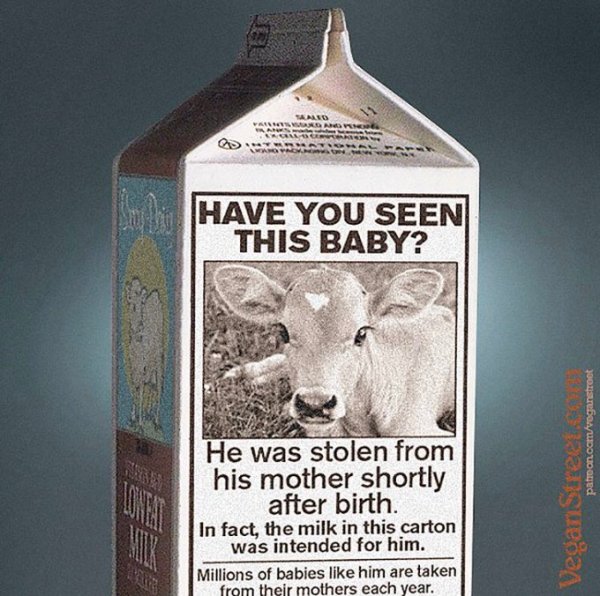
What is the difference between No Welfare, High Welfare, and Highest Welfare when they all require animals to die? Only human comfort, NONE protect the actual animals. The most humane, ethical, and honest Webster-defined "welfare" is NOT exploiting animals - not using, not wearing, not eating, not killing - animals. The only meaningful position is vegan, everything else is just how humans euphemize animals' required suffering and violent deaths: no human exploits animals because they honestly believe that NOT exploiting animals is UNethical or INhumane.
KTLA Special Report: Hatchery Hell

From KTLA News
Shocking new video from California hatchery
Undercover video Tuesday reveals what one animal rights group calls clear evidence of animal abuse inside a California chicken breeding farm.
The group, Compassion Over Killing, shot video of chicks being mutilated by hatchery machinery, drowning in the filthy water of a waste bucket and being stuffed alive down a drain.
The video was shot at the Cal-Cruz Hatcheries in Santa Cruz over a one month period in 2009. Compassion Over Killing then brought the video to KTLA.
KTLA spoke by phone to the owner of Cal-Cruz Hatcheries. He told KTLA that he buys equipment from established poultry equipment suppliers who look at the compassion of their design.
He also said it was not their goal to do harm to any of their ‘product.’
Vodpod videos no longer available.
RELATED:
Dog Meat Promoted at UK Farmers Markets: Labrador steaks, Beagle chops, leg of Greyhound …
From Animal Aid
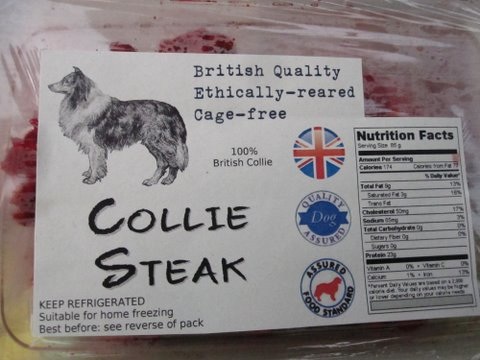
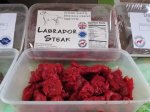
Labrador steaks, leg of Greyhound, Afghan burgers, Dachshund sausages, Beagle chops, Chihuahua poppers…these are just some of the exotic meats being promoted at the new organic and free-range dog meat catering trailer that will set up shop at the edge of farmers markets across the UK.
Featuring pictures of happy healthy dogs running through fields, chasing balls and swimming in streams, and the words ‘organic’ and ‘free-range’, the trailer will be offering dog meat to the public, with the assurance that all the animals were loved and well cared for before being butchered.
Please click on each picture to enlarge.



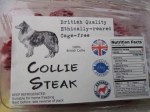
…And that’s when the unpleasant truth lying behind Animal Aid’s initiative is spelt out.
Whether organic, free-range, corn-fed or rested on the finest mattresses, at the end of the day it’s all the same for animals farmed for their flesh. They all end up in the same slaughterhouses; they are all alone and terrified; they are all hung upside down by their hind legs and all end up bleeding to death.
Animal Aid has documented routine abuse at slaughterhouses throughout the country, with animals being kicked, stamped on and improperly stunned before having their throats slit.* Our ‘dog meat’ stall will attempt to engage the public in a discussion about the way animals raised for food are killed and why certain animals are deemed unworthy of our compassion while others are treated as part of the family. Stall visitors will also be given free background literature.
Says Campaigner Andrew Butler, who will be manning the dog meat stall:
Most people eat different parts of various animals every day, without thinking too deeply about what those animals’ last moments were like. We hope that this will get people to confront the fact that, at the end of the line, all of these animals died with the smell of blood and fear in their nostrils and terror in their eyes, and yet they are no different from the millions of dogs who we, as a nation, dote on.
The dog meat trailer is making its way around the country, stopping at markets in 12 cities, as part of Animal Aid’s annual Vegan Month promotion. **
- Tuesday 2nd November – Nottingham Market, 12 noon
- Wednesday 3rd November – Birmingham Farmers Market, 12 noon.
- Thursday 4th November – Norwich Market, 12 noon.
- Friday 5th November – Borough Market, London, 12 noon.
- Saturday 6th November – Southampton Bargate Market, 12 noon.
- Tuesday 9th November – Plymouth City Market, 12 noon.
- Wednesday 10th November – Bristol Farmers Market, 12 noon.
- Thursday 11th November – Cardiff Market, 12 noon.
- Friday 12th November – Manchester Real Food Market, 12 noon.
- Saturday 13th November – Mansfield Park Farmers Market, Glasgow, 12 noon.
- Monday 15th November – Grainger Market, Newcastle, 12 noon.
- Tuesday 16th November – Kirkgate Market, Leeds, 12 noon.
*Animal Aid has conducted an investigation into seven randomly chosen slaughterhouses throughout the UK. The secret filming revealed animals being kicked, slapped, stamped on, and picked up by fleeces and ears and thrown into stunning pens. Animals were also recorded being improperly stunned and going to the knife while still conscious.
View the undercover investigation here.
Illegal tiger trade ‘killing 100 big cats each year’
From BBC
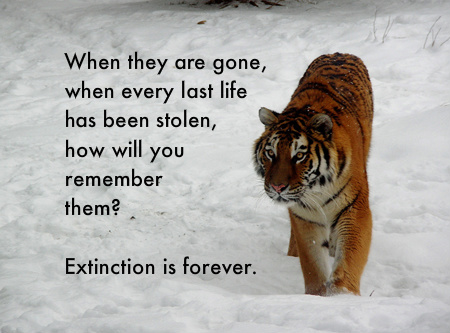
The illegal trade in tiger parts has led to more than 1,000 wild tigers being killed over the past decade, a report suggests.
Traffic International, a wildlife trade monitoring network, found that skins, bones and claws were among the most common items seized by officials.
The trade continues unabated despite efforts to protect the cats, it warns.
Over the past century, tiger numbers have fallen from about 100,000 individuals to just an estimated 3,500.
The study, which used data from 11 of the 13 countries that are home to populations of Panthera tigris, estimated that between 1,069 and 1,220 tigers were killed to supply the illicit demand for tiger parts.
‘Poaching pressures’
Since October 1987, tigers have been listed as an Appendix I species (threatened with extinction) under the Convention on International Trade in Endangered Species of Wild Fauna and Flora (Cites), which means all commercial trade in the animals or their parts is banned.
They have lost nearly 90 percent of their wild habitat. They have been placed on every ‘near extinction’ list in the world. They have become a symbol of mankind’s overreach in the wild. Yet somehow, the number of wild tigers continues to decline at an alarming rate, reports Traffic International, a British non-profit wildlife trade monitoring agency. CBS News
The figure was based on analysis of 481 seizures. More than 275 of the seizures were in India, which – the report’s authors said – represented between 469 and 533 tigers.
China, with 40, had the second highest number of seizures, accounting for up to 124 animals, while Nepal reported 39 seizures, or 113-130 tigers, they added.
“Given half the world’s Tigers live in India, it’s no real surprise the country has the highest number of seizures,” explained co-author Pauline Verheij, joint TRAFFIC and WWF tiger trade programme manager.
“While a high number of seizures could indicate high levels of trade or effective enforcement work, or a combination of both, it does highlight the nation’s tigers are facing severe poaching pressure,” she added.
“With parts of potentially more than 100 wild tigers actually seized each year, one can only speculate what the true numbers of animals are being plundered.”
Drugs, weapons, wildlife
The authors said the data showed that the trade continued “unabated despite considerable and repeated efforts to curtail it on the part of tiger range and consumer countries, intergovernmental organisations and NGOs”.
Commenting on the findings, leader of WWF’s Tigers Alive initiative Mike Baltzer said: “Clearly enforcement efforts to date are either ineffective or an insufficient deterrent.
Tiger Trade Slashes Big Cat Numbers
Saving Big Cats, Stopping the Trade
EIA Tiger Campaign
“Not only must the risk of getting caught increase significantly, but seizures and arrests must also be followed up by swift prosecution and adequate sentencing, reflecting the seriousness of crimes against tigers,” he added.
In March 2010, during the most recent high level meeting of Cites, nations agreed to increase intelligence sharing against criminal networks that smuggled big cat parts.
Speaking in 2009, World Bank chief Robert Zoellick said the global black market in wildlife products was worth about $10bn (£6bn) per year, making wildlife the third most valuable illicit commodity after drugs and weapons.
Conservationists also point to China’s “tiger farms” as a threat to the wild animals because, they say, it perpetuates a market into which wild tiger parts can be sold, often commanding a higher value as products made from wild animals are perceived to be more “potent”.
Although China does not officially permit the sale of goods from these farms, in practice several investigations have revealed tiger parts are being sold.
Afghan Wives Set Themselves On Fire

From Care2
By Amelia Thomson-DeVeaux
For some Afghan women, the only way out of lives of poverty and abuse is to set themselves on fire. This form of suicide is common partially because the tools are so readily available: even for the most impoverished of families, matches and cooking fluid are easy to access. In a medical center specifically designated for burn victims, about 75 women came in with mostly self-inflicted burns through early October, numbers up about 30 percent from last year.
The reasons for this particularly desperate and horrifying form of suicide are simple: women, as Alyssa Rubin points out in the NYT,
“There is little chance for education, little choice about whom a woman marries, no choice at all about her role in her own house. Her primary job is to serve her husband’s family. Outside that world, she is an outcast.”
Women who run away from home may be raped or put in jail; women and girls are still stoned to death. Other burn victims arrive with wounds that seem to be self-inflicted but were actually attempted homicides. Rubin writes,
“Doctors cited two recent cases where women were beaten by their husbands or in-laws, lost consciousness and awoke in the hospital to find themselves burned because they had been shoved in an oven or set on fire.”
Afghan women marry extremely young, and some girls are given as payment for debts. The tendency toward this brutal form of suicide or homicide clearly reflects a wider cultural norm of misogyny that needs to be addressed, or more women will suffer severe consequences. There isn’t a clear political solution, but the U.S. government should take a clearer stand in demanding rights for women.
~~~
A New York Times video details the increasing practice of Afghan women setting themselves on fire to escape the troubles of the war-torn country. It’s called self-immolation. Content WARNING: The images contained in the report are disturbing:
Vodpod videos no longer available.
Burning Desperation
Self-immolation has become a common form of suicide for Afghan women. Photographer Lynsey Addario speaks with women who survived their suicide attempts
A Gentle Thanksgiving

From FARM
Gentle Thanksgiving is an opportunity each year to encourage friends, family and neighbors to adopt compassionate alternatives to cruel turkey dinners. Caring people across the country will screen videos, distribute information, and, most importantly, host free vegan meals.
GentleThanksgiving.org provides a national events directory and includes tips for arranging special events such as public vegan dinners. You can also help spread the message of compassion by distributing our colorful handouts in your community.
The best thing you can do for turkeys and other farmed animals is to stop eating them and other animal products (meat, eggs, & dairy). Find out more.
Beyond that, you can encourage other people to stop eating animals.
Check out our food donors if you’re hosting a dinner or feed-in!
Here are ways you can get active (click on the links for details):
- Distribute handouts (below as well)
- Coordinate a public Gentle Thanksgiving dinner
- Host a private Gentle Thanksgiving dinner
- Host a workplace feed-in
- Distribute Vegan Food Samples
- Donate vegan food to a homeless shelter
- Get our message out on the air
- Show a video
- Write a letter to the editor
- Post a Gentle Thanksgiving web banner on your website
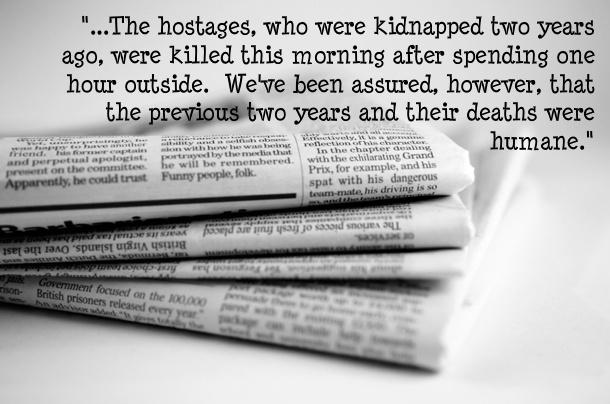
THE ONLY HUMANE IS VEGAN
From Care2
By Mac McDaniel
Whole Foods Introduces “Animal Welfare” Rating System
Whole Foods supermarkets will be implementing a new “animal welfare” rating system in their stores starting next year.
Beginning in January, the company plans to introduce signs in stores that will allegedly give customers specific information about how food animals were raised prior to slaughter. The company says this will give customers the ability to make “more educated” choices about food.
This venture works on the premise that there are certain methods of raising animals which rate as “humane” and others that rate as “cruel” and that there is a delineation between the two. Customers would, in theory, prefer to buy meat they believe comes from animals who were treated “humanely”.
But why?
Related, Shannon Keith on Corporate Deception
Vodpod videos no longer available.
As animal-related issues become more and more a part of the mainstream, many companies that produce animal products have attempted to co-opt the conscience of customers by creating arbitrary labels for animal products such as “cage-free” eggs, “free range” meats, etc. The goal is to capitalize on a growing consciousness without having to really change the methods of production.
As people start to question the morality of eating animals, they are faced with choice: to change their lifestyle in a meaningful way by refusing to eat animal products, or to buy into marketing by companies that claim their products are nicer, kinder, more compassionate.
If you want to benefit the welfare and well-being of animals, go Vegan. Set the standard that animal life is worth preserving under all circumstances.
Veganism is an easy lifestyle, but people are creatures of habit and would prefer not to change their lifestyles if they don’t have to. These supposedly “humane” animal products don’t serve to benefit animals, they serve to benefit people who want to feel better about their diet without having to change their diet.
Update, November 10: The petition has been closed after getting 6000 signatures and will be given to the target. I’ll update when I have more information regarding the current status of the case. Thank you so much to everyone who participated and cared!
Immediate, please sign:
Justice for dog who’s back legs were chopped off for “stealing” food and left in critical condition
- Target: Ms. Angie Serote, Prosecutor, Magestrate Court, Sabie, South Africa
- Sponsored by: South African Animal Rights Activists Community
SABIE, South Africa – A defenseless dog was subjected to merciless mutilation when her supposed “best friend” chopped off her back legs and cruelly left her in that critically injured state for more than a week.
“She was stealing; now that she can’t walk so she can’t steal anymore,” said the owner. He simply shrugged his shoulders when he was confronted. According to the remorseless man, he wanted to teach his dog a lesson so he cut her back legs off with a blunt axe.
When help finally arrived after a concerned neighbour in the informal settlement of “Fok-Fok” stating they had seen an injured dog, the poor skeleton-of-a-dog was in severe pain and shock, and displayed absolutely no reaction when she was approached. The black Africanis female dog was lying outside when the disorientated animal was removed from the premises.
When questioned why the owner chopped off her legs, his response was “ask the dog”. It is an absolute horrific act of animal cruelty as the dog was lying and whimpering in pain for more than a week with her owner ignoring her. The owner also commented “see, now, I have no more problems with her”. He also helped loading his other dog into the official vehicle himself which was taken to a temporary shelter.
The injured dog was taken to a veterinarian who was appalled at what he saw. “She was totally dehydrated and in shock and septicemia was already taking place – one could smell the flesh rotting.” He said she was in severe pain and it was decided mercifully to put her out of her misery.
“But the worst was that she was totally dejected and had simply resigned herself to the fact that she was going to die, that this was her lot in life,” The veterinarian was clearly emotional as he added that the dog “simply stared at him”.
In search of intelligence … just not finding much.

I am, admittedly, stymied. Not one to usually falter under the inanity of pro-exploitation validations, I find myself lacking words at this moment, in response to the “gadgeting” of non-human animals. Internet hunting, vending machines, pet spas … Humans have the capacity for greatness yet instead choose to whittle away decency and time designing faddish contraptions that serve zero benefit except to the ones profiting off money and chuckles. These are utterly revolting, the contrived creations of childish sense gleefully characterizing and accepting fault as gift and cruelty as necessity but are nothing but the patsy of immature, indoctrinated minds soliciting approval using convenient tchotchke as excuse. Speciesism has many faces, including the ones showing up online, at hardware stores, and in subways, but as long as cattle and sows are killed for food, as long as mink and foxes are killed for fur, and as long as rats and monkeys are tested for pharmaceutical bombs, expect to see more animal appliance novelties for kicks and giggles. SR
Lobster Zone
The Lobster Zone is a cruel “game” that’s found in some bars and restaurants. The arcade-style contraption allows patrons to pluck a lobster out of a machine using a joystick-controlled crane with an attached claw. Once caught, the lobster is dropped down a chute, boiled or cut up while still alive, and then eaten. But like all animals, lobsters can feel pain, and they suffer when they are injured, cut, or boiled alive.
Luckily, there are plenty of caring individuals who wish to end the use of these lobster-torture machines. If you happen to come across the Lobster Zone, you can help lobsters by doing the following:
- Call and write the owner of the restaurant. Politely, but firmly, let him or her know that games are supposed to involve skill, fun, and prizes, not suffering—then ask that the contraption be removed.
- If the tank is excessively crowded or if it looks as if there are dead lobsters inside it, complain to the local health department.
- Write a letter to the editor of your local paper letting people in your area know that all animals, including lobsters, deserve our consideration. To determine local media and how you can contact up to five with one message, please click HERE.
- Report the use of these “games” to PETA by sending a quick e-mail to LobsterZone@peta.org. Include the name of the restaurant, bar, or resort as well as the location’s address and phone number. Please also include your personal contact information so that we can get in touch with you should we need more details.
Several dining establishments continue to feature the Lobster Zone “game” despite outrage from local patrons. Please take a minute to contact each of the following locations and request that they remove the Lobster Zone machine immediately.
Please visit PETA at the following to send automatic messages to restaurants using Lobster Zone (I have removed the alerts that were no longer active):
- Tell Los Angeles Restaurant to Ditch Its Lobster-Tormenting ‘Game’
- Tell Illinois Restaurant to Ditch Its Lobster-Tormenting ‘Game’
- Tell Ohio Restaurant to Ditch Its Lobster-Tormenting ‘Game’
- Tell San Pedro Fish Market to Ditch Its Lobster-Tormenting ‘Game’
- Tell Wisconsin Bar to Ditch Its Lobster-Tormenting ‘Game’
- Tell Pennsylvania Restaurant to Ditch Its Lobster-Tormenting ‘Game’(via postal, sample letter provided)
Living in a Vending Machine
Vodpod videos no longer available.
Please sign Live Crab Vending Machines in China
Subway stations in Nanjing, China, are offering live crabs in automated vending machines. The Dazha hairy crabs, apparently a delicacy in the region, are packed into custom-fitted plastic boxes and chilled to 5C, leaving them sedated but still very much alive. The retailer has a sign displayed near the machine saying that customers are offered three free crabs if they happen to receive a dead one.
http://www.dailymail.co.uk/news/article-1326157/Live-crab-vending-machines-commuters-China.html
Wu Zhendi, general manager of Twin Lake Crab Company, says they found a way to conveniently and cheaply sell the crab, while also keeping them pretty much as fresh as possible, by keeping them alive and supplying them through a vending machine. They are selling hundreds by the day. It took them a while to manage to keep the crabs fresh and alive, but now they plan to expand the area where they are offering these vending machines.
Kitten’s horrid tale contains conundrum
From New Haven Register
By Joel Marks
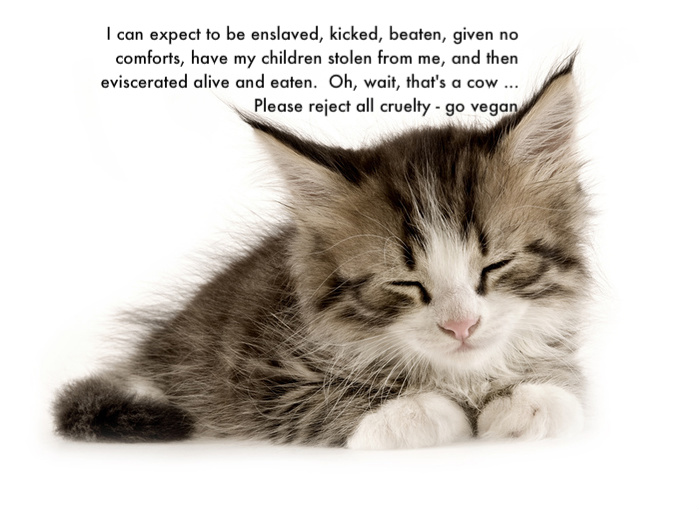
A news story that was both horrible and heartwarming appeared on Saturday’s front page: “Woman saves kitten tossed from car.” Somebody threw a kitten out of a moving car, injuring her severely.
No fewer than four other drivers stopped to render assistance, with one of them whisking the kitten off to a nearby animal hospital. Apparently, the kitten will survive and then thrive under the loving care of an adoptive owner.
But the witnesses and the folks at the hospital remain traumatized and outraged by what they saw. Sample quotations include: “The person has to be sick. Anybody who would do this is a dangerous person. There should be a police investigation;” “so sick to my stomach I could have thrown up;” and “I can’t believe someone would do that.”
The reporter referred to the “cruelty” to which the kitten had been subjected. And isn’t that the word that best sums up our natural human feelings toward the abusive treatment of other animals? One of the largest animal organizations has that word in its very name.
Both our emotions and our pocketbooks are wide open when it comes to cruel treatment of cats and dogs, and even pet gerbils and chicks, but shut tight when it comes to their animal cousins in factory farms and slaughterhouses…Mental eyes closed, physical mouth open.
Yet, there is something distinctly odd about how we apply, and especially how we do not apply, the word “cruelty” to other animals. Look at some numbers.
According to one survey, there are approximately 68 million dogs and 73 million cats owned in the United States. Let’s suppose that every one of them is treated cruelly: That’s 141 million animals.
Of course, the actual number is a fraction of this. But even if we assumed the higher number, it would be only a fraction of the number of animals we eat in the United States: 10 billion, and that does not include marine animals. That is every year. So, if you consider the average life expectancy of a cat or a dog to be, say, 10 years, then the true comparison is between 141 million pets versus 100 billion food animals.
Now consider two other facts: The animals we eat are no less sentient, intelligent or even adorable than our pets. The standard treatment of animals we eat would be considered cruel, indeed criminal, if done to pets. It includes the manner in which they are housed, the actual things done to them and killing them at a young age even though healthy.
The conclusion would seem to be that our attitude toward the cruel treatment of other animals is contradictory. Both our emotions and our pocketbooks are wide open when it comes to cruel treatment of cats and dogs, and even pet gerbils and chicks, but shut tight when it comes to their animal cousins in factory farms and slaughterhouses.
Out of sight, out of mind. Or more precisely, since we do see the slab of meat in front of us: Mental eyes closed, physical mouth open.
And they carry deadly weapons …
From The Denver Channel
Posted by Wayne Harrison
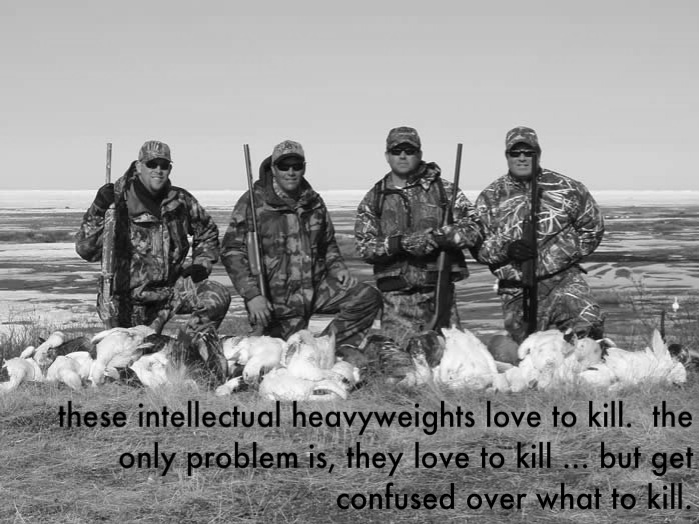
Colorado Hunters Killing Moose By Mistake
Hunters in Colorado are being urged to be sure they have the right animal in their rifle sights before pulling the trigger, after the illegal killing of 10 moose.
…attendees did identify certain traits common to some serial murderers, including sensation seeking, a lack of remorse or guilt, impulsivity, the need for control, and predatory behavior. These traits and behaviors are consistent with the psychopathic personality disorder.
FBI
The state Wildlife Division tells The Daily Sentinel that moose have been killed in north-central and central Colorado this big-game season.
Wildlife officials say a hunter who didn’t report shooting a moose right away is facing charges that could carry a penalty of more than $14,000 in fines.
Regardless of the motive, serial murderers commit their crimes because they want to…Power/thrill is a motivation in which the offender feels empowered and/or excited when he kills his victims.
FBI
Wildlife Division Randy Hampton said information is sent to hunters on the differences between elk and moose, which are bigger with different antlers. There’s a limited moose season.
The division started restoring moose to Colorado in the 1970s. It’s believed they were previously wiped out by hunting.
Psychopaths are not sensitive to altruistic interview themes, such as sympathy for their victims or remorse/guilt over their crimes. They do possess certain personality traits that can be exploited, particularly their inherent narcissism, selfishness, and vanity.
FBI
United Bowhunters of New Jersey leave carnage and bloodshed in 09’s season
Cat severely abused by teens
From NBC Philadelphia
By Dan Stamm
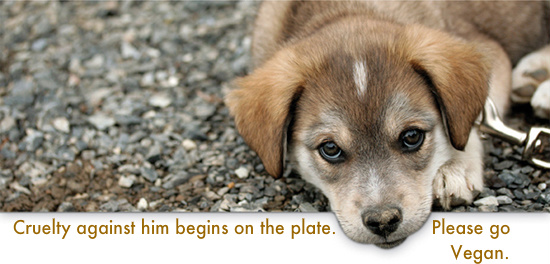
A cat was stuffed in a microwave oven and thrown out of a third-story window by two teens who videotaped the whole thing Wednesday afternoon, according to the Pennsylvania SPCA.
On Thursday one of the boys accused spoke exclusively to NBC Philadelphia.
“I Don’t Know What I Was Thinking,” said the 15-year-old who along with his 16-year-old friend allegedly committed the cruel act from the window of a home on the 4500 block of G Street in the Juniata section of Philadelphia.
“It’s bizarre I don’t know what these kids are thinking,” said Pennsylvania SPCA Director George Bengal.
FBI Supervisory Special Agent Allen Brantley was quoted as saying “Animal cruelty… is not a harmless venting of emotion in a healthy individual; this is a warning sign…” It should be looked at as exactly that. Its a clear indicator of psychological issues that can and often DO lead to more violent human crimes.
The male cat, named Tostino by SPCA staff, luckily survived the ordeal but he was in pretty bad shape and required treatment for cuts, bruises and a concussion. He was doing better and moving about at an SPCA shelter Thursday morning.
Cat Put in Microwave, Thrown Out Window: SPCA
Vodpod videos no longer available.
Tostino Improves After Being Dropped Out a Window
Vodpod videos no longer available.
The 15-year-old acknowledged that he was the one who tossed the cat out the window while his friend recorded the whole thing on a cell phone camera.
“It went flat, door opened up and the cat walked out,” the boy, who didn’t want to have his face shown, said. “I didn’t know it was that serious.”
The boy had found the 2- to 6-month-old stray kitten a few days earlier and decided he didn’t want it any more so he tossed Tostino, SPCA officials said.
A neighbor saw the microwave fly out the back alley window and called authorities. When officials went to the home the boys jumped out the same window that they allegedly threw the cat out of and ran away. SPCA officers caught the kids and arrested them.
“They put me on house arrest, on GPS,” the teen said. “They charged me with animal cruelty and conspiracy.”
He and his friend are both charged with one charge misdemeanor animal cruelty and could face no less than $1,000 in fines and possibly serve up to two years in jail or probation, according to the SPCA.
Those who abuse animals for no obvious reason, Lockwood said, are “budding psychopaths.” They have no empathy and only see the world as what it’s going to do for them.
The boys said he was “sorry… for abusing animals” but he had another message for anyone thinking about hurting animals.
“Don’t be stupid! Just don’t do it!”
There was no timetable as of Thursday afternoon for Tostino finding a permanent home. He won’t be up for adoption until he is fully healed and well enough to leave the shelter.
Tostino might not be up for adoption but that doesn’t mean you can’t help. For information about adopting other animals, donating or volunteering at the PSPCA call 215.426.6300 or visit www.pspca.org.
Tony has been kidnapped and abused so why won’t Louisiana help set him free? Will you?

Immediate, please sign these two petitions if you have not already, thank you:
- A Chance to Free the Real Tony the Tiger From His Box
- Urge The LDWF Not To Renew Tiger Truck Stop Permit
From Change
By Stephanie Feldstein
Between the heat, the cement-floored cage, the noise, bright lights and diesel fumes, Tony the tiger’s life at Tiger Truck Stop in Grosse Tete, Louisiana, is everything that’s wrong with allowing people to keep exotic animals in captivity. Carole Baskin, from Big Cat Rescue in Florida, says they’ve received more complaints about the conditions where Tony is forced to live than any other abusive situation out there.
Morally speaking, he doesn’t belong there … but technically, he shouldn’t be there either. As Martin Matheny explained, a county ordinance banned private ownership of exotic animals in 1993. It was never enforced, and Michael Sandlin, Tiger Truck Stop’s owner, played local politics to get an official exemption written into the ordinance last year. Sandlin then had to get a permit to keep Tony from the Louisiana Department of Wildlife and Fisheries.
Despite a statement from LDWF’s Large Carnivore Manager, Maria Davidson, that tiger ownership “poses a significant hazard to pubic safety and is detrimental to the health of the animal,” a permit was granted on December 14, 2009.
From Free Tony the Tiger

Reposted from Facebook / Catherine Ritlaw:
Please contact Marriott executives to request they cancel their contract with American College of Toxicology Annual Meeting. The two people who can cancel the American College of Toxicology 31st Annual Meeting, which is sponsored by Huntingdon Life Sciences (HLS) among other nefarious animal testing laboratories, are:
- Julie Codus, Director of Sales and Marketing
Direct Phone line: 410-895-1807
Email: julie.codus@marriott.com
Note: Julie has been working as the Director of Sales and Marketing for a few weeks.
- Ed Rudzinski, General Manager
Direct phone line: 410-895-1842
Email: ed.rudzinski@marriott.com
General Number to Baltimore Marriot Waterfront Hotel: 410-385-3000
Please call and email Julie and Ed. Let them know that animal experiments are cruel and unreliable. Ask that the Marriott Waterfront Hotel make the ethical decision to not let Huntingdon Life Sciences and all of their animal abusing cohorts meet at their hotel. Remember that every drug or product that is withdrawn because of serious side effects, every pesticide that proves to be carcinogenic, every “new and improved” household product that we don’t need, Huntingdon (et al) will have forced that product down the throats of thousands of animals and then passed them as “safe” only to go on to maim, harm and kill humans. At least 50 drugs currently on the market cause cancer in lab animals. These “failed” drugs are allowed on the market because it is admitted that animal tests are not relevant to humans.
—————————————–
Sample Letter (Please write your own, as it will carry more weight):
Dear Julie Codus,
It has come to our attention that the Baltimore Marriott is hosting the American College of Toxicology 31st Annual Meeting. I ask that you and the Baltimore Marriot Waterfront Hotel make the responsible and ethical decision to cancel your contract with the American College of Toxicology. The American College of Toxicology is being sponsored, in part, byHuntingdon Life Sciences (HLS) among other laboratories that kill approximately 180 million animals every year in the US alone in cruel and obsolete tests.
Would you want to safeguard a notoriously cruel and unprofessional animal testing facility? Huntingdon Life Sciences (HLS), also known as LifeSciences Research, has been the object of an international protest campaign to end their cruel tests on animals. Seven undercover investigations of Huntingdon Life Sciences have revealed an unabated trend of blatant and gratuitous cruelty to animals and unprofessional behavior. As a result of documentation from a 1996-1997 investigation, HuntingdonLife Sciences’ United States facility was fined $50,000 by the USDA for violations of the Animal Welfare Act. To put this in perspective, more than 90 percent of animals used in experimentation are not even included under the minimal protections of the AWA.
The most recent investigation of HLS’s primate supplier documented tiny, collapsing cages, each holding a solitary shaking monkey. In the course of the ADI investigation, 217 of these feeling, sensitive animals were killed in the course of five studies.
Tests performed on animals by Huntingdon Life Sciences involve restraining animals and forcing them to ingest and inhale substances – any substance a company pays HLS to test, from Viagra to Olestra (both tested at HLS) to incontinence drugs. The animals observed during the 2006-2008 investigation were observed suffering from vomiting, nosebleeds, severe diarrhea, rectal prolapse, and stress responses such as self-mutilation and dragging their teeth along the bars of the cage.
The everyday business of Huntingdon Life Sciences is a crime against nature and human decency. No one would wish to see their dogs and cats treated in this manner, but every day at Huntingdon Life Sciences is a living nightmare for the animals trapped inside its walls. These animals feel pain and want to have a good life, just like the dogs and cats with whom we share our homes and lives.
I am asking you to withdraw your services from the American College of Toxicology Annual Meeting and Huntingdon Life Sciences. This is an important issue and a decision that you have the power to make. I appreciate your ethical stance and look forward to hearing back from you.
Sincerely,
(Your Name Here)
Additional Contact information:
Baltimore Marriott Waterfront
700 Aliceanna Street
Baltimore, Maryland 21202
USA Phone: 1-410-385-3000
Fax: 1-410-895-1900
Toll-free: 1-800-228-9290
Sales: 1-410-385-3000 ext. 6998
Sales Fax: 1-410-385-0330
*Legal Disclaimer: Please keep all correspondence polite and informative.The above information is not meant to incite any illegal activity. DARTT is an independent group, not affiliated with SHAC, SHAC USA or any other organization and does not conduct illegal activity.
Defending Animal Rights Today & Tomorrow (DARTT)http://www.dartt-online.org
For more info contact Win Animal Rights at: winanimalrights@optonline.net
Call: 646.267.9934 or visit the WAR website at: http://war-online.org/
If You Knew The Truth, Would It Make A Difference? It Would To Them …
Vodpod videos no longer available.
Read More … DISSECTION / TESTING & ANIMAL WRONGS
The Gross Truth About Natural Flavors

From Care2
By Angel Flinn
Natural Flavors…
The name sounds innocent enough, but these mild-sounding words are used by the food industry as an umbrella term for some pretty horrible stuff, including certain ingredients that come from extreme animal abuse.
The exact definition of natural flavors from the Code of Federal Regulations is as follows:
The term natural flavor or natural flavoring means the essential oil, oleoresin, essence or extractive, protein hydrolysate, distillate, or any product of roasting, heating or enzymolysis, which contains the flavoring constituents derived from a spice, fruit or fruit juice, vegetable or vegetable juice, edible yeast, herb, bark, bud, root, leaf or similar plant material, meat, seafood, poultry, eggs, dairy products, or fermentation products thereof, whose significant function in food is flavoring rather than nutritional.
When the phrase ‘natural flavors’ appears on a package, the best move is to call the company and find out what the flavors are actually made from. Of course, I say this assuming that we’re all the kind of people who would be horrified to find out that we might have come close to ingesting fluid from the sex glands of beavers.
Think that sounds absurd? Then you must not have heard of castoreum, which is “used extensively in perfumery and has been added to food as a flavor ingredient for at least 80 years.”
Castoreum is a bitter, orange-brown, odoriferous, oily secretion, found in two sacs between the anus and the external genitals of beavers. The discharge of the castor sac is combined with the beaver’s urine, and used during scent marking of territory. Both male and female beavers possess a pair of castor sacs and a pair of anal glands located in two cavities under the skin between the pelvis and the base of the tail.
Castoreum is a product of the trapping industry. When beavers are skinned for their fur, these glands are taken out, and are sold after being smoked or sun-dried to prevent putrefaction…
Well, that’s a relief.
Related, Cruelty Free Resources : LeapingBunny.org
(Verify for vegan, LB does not provide info on vegan products.)
Vodpod videos no longer available.
An URGENT alert from GREY2K USA: Kennel Abandoned, Dogs Left to Die at Ebro Greyhound Park

From GREY2K USA
Dear Friends,
Today we bring the terrible news that nearly forty greyhounds have been found abandoned and many starved to death at Ebro Greyhound Park in Florida. Their “trainer,” Ronald John Williams was charged with 37 counts of felony animal cruelty over the weekend. Since then, more dead dogs may have been found at his home.
Please read the stories posted below and join us in demanding justice for the Ebro dogs. Ask Washington County prosecutor Erin Oliver to pursue the strongest penalties available under the law. Click here to read a sample letter (below) and then please send your own thoughts (samples below to use).
 It is shocking that innocent greyhounds are made to suffer like this. Join us in demanding punishment for this latest example of greyhound abuse, and please donate to our campaigns to end dog racing in Florida and nationwide. It’s time to stop this cruelty once and for all.
BACKGROUND ARTICLES
- Dozens of dead Greyhounds discovered at Florida Greyhound park
- More greyhounds found dead near suspect’s home; trainer’s license suspended
WHERE TO SEND YOUR LETTERS
Ms. Erin Oliver
Washington County State Attorney’s Office
P.O. Box 590
Chipley, FL 32428
(850) 638-6039 (fax)
(no e-mail address available)
SAMPLE LETTERS : THREE OPTIONS
- ONE
Dear {District Attorney, Honorable, Officer}
I have learned of an extremely disturbing and malicious case of animal cruelty in which {person} deliberately caused the suffering and death of {a dog named). This alleged incident occurred on {Friday, April 23}, in the city of {Fox Island}.
Please allow me to elaborate. Our global communities share laws, moral and written, and when one person demonstrates such a gross lack of respect for both, our societies must react with concern for the innocent and potential victims, who include both non-human and human animals. It is our obligation to protect them from both manufactured and intrinsic cruelty, and although the distinction is often difficult to identify, the effect is not, and our priority is the innocent, in this case {the dog}. Nobody possesses such heightened intuitive ability to determine the thoughts of another, but past behaviours are potentially indicative of future actions, and his callous disregard, so easily adopted as demonstrated by his unprovoked and (potentially) lethal behaviour, needs to be regarded rather than dismissed.
Please respect the victims by penalizing the guilty and demonstrate your commitment to justice, responsibility, and integrity, attributes unquestionably necessary in an {academic/law enforcement} setting: rejecting cruelty by maintaining an unyielding position towards it would be a model for all community members and would serve to characterize this type of behaviour as both impermissible and punishable.
Thank you for your attention to this urgent issue.
NAME
ADDRESS













 Our Compass