For The Turkeys
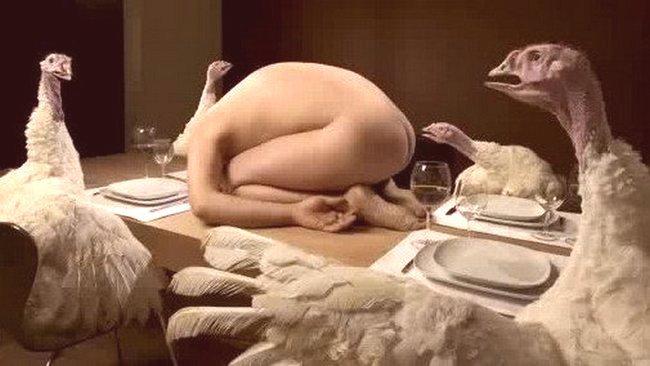
What if? Indeed, though, they look stunned … this doesn’t make much sense either.
Abusing and killing an innocent bird betrays the life-affirming spirit of giving thanks for our life, health, and happiness.
The nearly 300 million turkeys killed each year in the U.S. spend their entire lives crammed in large sheds with little room to move. Artificially inseminated and selectively bred to gain enormous amounts of weight, they suffer heart attacks, broken limbs, lameness, and death from their genetically-induced accelerated growth rate.
Factory farm conditions are so harsh that the turkeys must be pumped full of antibiotics just to stay alive. Shortly after birth, they have their snoods and parts of their toes and beaks cut off with hot blades, without the use of anesthetic, to reduce damage from from stress-induced aggression. They are then delivered by conveyer belt to a carousel where they get a power injection, usually of an antibiotic, whacked into the back of their necks.
The rest of their lives they are forced to endure crowding, living in their own waste, and ravaging diseases. As many as 25,000 birds may be housed in a single shed. Their eyes and lungs are burned by toxic fumes emanating from their excrement. Conditions are so severe that about 9% of turkeys raised for food (or over 26 million) didn’t survive long enough to make it to the slaughterhouse.
After 16 weeks of misery, they are hung on a conveyer belt, their throats are cut, and they are dumped — sometimes still fully conscious — into scalding water to strip their feathers.
Watch this amazing video! Thanksgiving – Let’s Talk Turkey
Vodpod videos no longer available.
What About “Free-Range”?
According to the United States Department of Agriculture, the single condition for the term “free-range” is that birds have access to the outdoors. All other facets of a free-range turkey’s life can be indistinguishable from the living conditions of a conventionally raised bird.
Like all other turkeys raised for food, free-range turkeys receive no protection under the law. Turkeys – all birds, in fact – are excluded from coverage under the federal Humane Methods of Slaughter Act. All animals raised for food are excluded from the Animal Welfare Act.
Free-range turkeys suffer the same inhumane transportation and slaughter processes as factory-farmed turkeys. Their flesh is also subject to many of the same contamination issues as factory-farmed turkey flesh because free-range turkeys are taken to the same slaughterhouses as factory-farmed turkeys. As line speeds in slaughterhouses increase, so does the frequency of fecal contamination. For additional information, please visit Cage-Free Eggs, Behind the Myth.
House of Raeford
Slaughterhouse Investigation Butterball Undercover Investigation
Vodpod videos no longer available. Vodpod videos no longer available.
For Your Health
Turkey flesh is loaded with cholesterol and saturated fats, which have been linked conclusively with an elevated risk of heart disease, stroke, cancer, diabetes, and other chronic diseases that kill 1.3 million Americans annually.
Turkey flesh is also contaminated with deadly pathogens and antibiotics. The antibiotics are passed on to the consumer, disrupting normal growth and development. The pathogens, including Salmonella and Campylobacter, are introduced by eviscerating equipment that spills fecal matter into the cavities of the bird’s bodies.
Careful adherence to U.S. Department of Agriculture warning labels and Poultry Hotline directions are required to avoid severe food poisoning, as the antibiotics administered to the birds build up the pathogens’ immunity to these powerful remedies.
For the Globe
In addition to threatening personal health, factory farming is a global problem. Much of the 10 billion pounds of manure generated by 7,300 turkey farms in 33 states ends up in our drinking water. Grain fed to turkeys is denied to millions of starving people in the world’s most impoverished nations.
Livestock farming contributes carbon dioxide from deforestation and from the fossil fuels used in operations and slaughterhouses. More importantly, animals raised for food are responsible for immense amounts of methane (23x GHG) and nitrous oxide (296x GHG).
According to the United Nations, the livestock sector generates more greenhouse gas emissions than all transport combined. Says Henning Steinfeld, Chief of FAO’s Livestock Information & Policy Branch and senior author of the report: “Livestock are one of the most significant contributors to today’s most serious environmental problems. Urgent action is required to remedy the situation.”
Globally, people are consuming more meat and dairy every year (projected to double by 2050). The United States is by far the largest per capita consumer. Reducing/eliminating meat and other animal products from our diet will have the largest impact in our efforts to reduce global warming.
Related:
A Gentle Thanksgiving
Gentle Thanksgiving Vegan Recipes
Vegan food, recipes, and more … Click on the upper right arrow to view the full tab names, scroll down to see all entries.
Vodpod videos no longer available.















 Our Compass
STOP au massacre des dindes
LikeLike
birds were NOT born
to be basted, stuffed
or roasted
or tasted!!!!
LikeLike