HighestWelfare.Humane.Assured.GoodPractices.Vegetarian. Regenerative.Flexitarian.Lies...
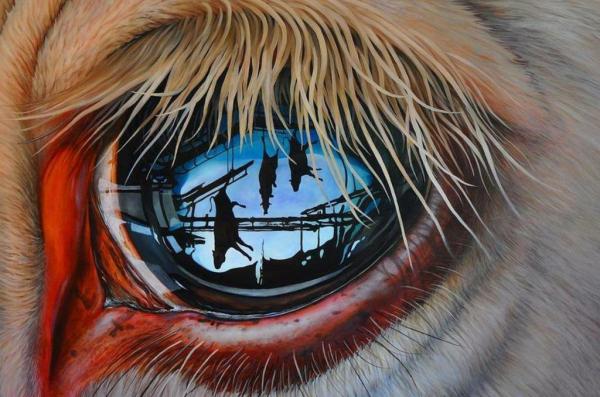
What is the difference between No Welfare, High Welfare, and Highest Welfare when they all require animals to die? Only human comfort, NONE protect the actual animals. The most humane, ethical, and honest Webster-defined "welfare" is NOT exploiting animals - not using, not wearing, not eating, not killing - animals. The only meaningful position is vegan, everything else is just how humans euphemize animals' required suffering and violent deaths: no human exploits animals because they honestly believe that NOT exploiting animals is UNethical or INhumane.
Surge: Why Vegan
Land of Hope and Glory Trailer, Source YouTube
What compels people to argue against veganism, or try to debate issues ad nauseam, with vegans? I have never seen such cowardly and belligerent behaviour than from antivegans. To wake up daily with the soul purpose of trying to debunk vegansim is sad and pathetic: you literally defend animal abuse rather than defend animals, which is particularly bizarre considering we live in a world where, since >90% of the global population effortlessly condones animal suffering, nobody is being forced to NOT abuse animals and nobody needs further motivation.
I’ve said it 1000 times: the deception and lies that people embrace is fam.iliar manipulation and a horrific embarrassment, fortifying an-already cruel foundation of normalized violence, causing suffering based on what YOU as a human consider tolerable but will NEVER be forced to experience as an animal.
I honestly believe that humans, via their anthropocentric filter, consider animals as mere commodities or dead objects, meant to only benefit humans, so that any “life” they have been “given”, no matter how violent, brief, painful, or miserable, is a “gift” … because they’re supposed to be dead.
You mock them as bad mothers, even while reproductively exploiting them & denying the maternal bond you facilitated; you consider them as violent, validating your grocery store shopping by reflecting on obligate carnivores in the wild and then pretending that you’re somehow superior to animals you just compared yourself to; you say they’re necessary to be environmentally responsible while denying that killing them is contrary to your position; you like to ignore that their blood, bones, disease, gore, feces, rot, bacteria, decomp, and confinement are causing environmental destruction and pandemics; you enjoy your human supremacy to define their suffering in terms that makes you feel comfortable causing it. Wretched and selfish.
You don’t care, you don’t love SL
Source Surge
Ethics
We consider ourselves a nation of animal lovers, they are our friends, companions and even members of our families. However, as a nation we also slaughter one billion land animals every year as well as billions of marine animals, for no necessary reason.
We are born into societies and cultures that condition us from birth into believing that animal products are normal, natural and necessary. Our societies dictate many philosophies and ideologies that we carry with us through life and in the case of animals, we are told to love some – and eat others. We have normalised behaviour that we would normally consider to be horrific, using excuses and ingrained justifications to hide behind the reality of our immoral actions.
We are indoctrinated with advertising and marketing, further reinforcing the idea of separation and segregation between species, with decades of devaluing and reducing the lives of farm animals to nothing more than commodities for human disposal. In many respects we are vulnerable to the power society holds over us, but at what point do we choose to look past what we are told and seek the truth?
Animals suffer, just like us. They feel a vast spectrum of emotions including love, joy, grief, fear and pain. The fact that animals experience pain means that they have an innate preference to avoid it. Therefore it is our moral obligation to protect them from unnecessary suffering – however we have normalised exploiting them in the trillions, profiting from their gentleness and their innocence.
The suffering that occurs in order to produce animal products is immense – and it is all unnecessary. The consumption of animal products has no necessity in the human diet and is in fact massively detrimental to our health and life longevity. Moving from an animal-based diet to a vegan diet is directly opposing animal cruelty and oppression. Every purchase we make is a vote for the type of world that we want to live in, therefore when we buy animal products, or products tested on them – we are saying that we are comfortable living in a world that inflicts violence upon animals. However when we choose the vegan option, we are stating that we oppose animal cruelty and wish to live in a compassionate, non-violent world.
Environment
Livestock systems currently cover 45% of the total land on earth, with this in mind it is not surprising that animal agriculture is the leading cause of the destruction of the planet. Raising animals for meat, dairy and eggs requires a huge amount of energy, in fact more greenhouse gas emissions are produced from just animal agriculture than all of the transportation industry combined.
Animal agriculture is also responsible for causing the largest mass species extinction of the past 65 million years (which we are currently in) – and by the year 2048 we could see fishless oceans. Although eating meat, dairy and eggs is deemed an acceptable choice by society’s standards, by doing so we are paying for one of the leading causes of ocean dead zones, water pollution, habitat destruction, top soil erosion, species extinction and greenhouse gas emissions.
Due to all of these contributing factors we are fast approaching a vast shift in our planet’s climate, something that will impact every living being on earth. It doesn’t have to be this way, one person CAN make a difference. Each day, a person who eats a vegan diet saves 1,100 gallons of water, 45 pounds of grain, 30 sq ft of forested land and 20 lbs CO2 equivalent.
Health
There are many common misconceptions surrounding the necessity of animal products for a healthy diet, many coming from animal agriculture propaganda. But do we really need animal products to be healthy, or do they inhibit a healthy body and mind?
One of the biggest health concerns of consuming animal products is the extensively documented associations that they have with a myriad of unnecessary and preventable diseases including heart disease, cancer, strokes, hypertension, type 2 diabetes, kidney failure, high cholesterol, autoimmune disease and osteoporosis. In fact consuming animal products has been linked to 15 of the top 16 killers of people in the west, however by consuming a plant-based diet not only are you able to prevent these diseases but in many cases reverse them as well.
Although the meat, dairy and egg industries tell us that animal products contain essential nutrients that we cannot find elsewhere, this simply isn’t true as every nutrient that the human body needs to survive and thrive, can be found in abundance in the plant kingdom.
Download Your FREE Vegan PDF HERE
Order a FREE vegan kit HERE
Dairy-Free Info HERE
Take the Dairy-Free Challenge HERE
Click HERE for more Dairy-Free
Fish alternatives can be found HERE
Learn about eggs HERE
Find bacon alternatives HERE and HERE
Take PETA’s Cruelty-Free Shopping Guide along with you next time you head to the store! The handy guide will help you find humane products at a glance. Order a FREE copy HERE
Searching for Cruelty-Free Cosmetics, Personal-Care Products, Vegan Products, or more?
Click HERE to search.
Free PDF of Vegan & Cruelty-Free Products/Companies HERE
Click HERE to find out How to Wear Vegan!
Want to do more than go vegan? Help others to do so! Click below for nominal, or no, fees to vegan literature that you can use to convince others that veganism is the only compassionate route to being an animal friend:
PETA HERE
Vegan Outreach HERE
Get your FREE Activist Kit from PETA, including stickers, leaflets, and guide HERE
Have questions? Click HERE
Better question…why not
First-Ever Cruelty Investigation into an Organic (“Humane/High-Welfare/Certified/LIELIELIE”) Dairy Farm
If animal agriculture was so humane and ethical, the actual industry would be offering information and documentation of the slaughter “process”, not undercover investigators/employees; as it is, the industry execs and supporters relentlessly pursue ag-gag and attempt to criminalize the people who expose them.
Needing to continually update it’s PR, anag floats “organic”, “high welfare”, “certified humane”, etcetcetc., human-centric words to define animals’ required suffering and violent death, just so YOU can take their flesh and the calves’ naturally-intended milk instead … as an aging human with teeth…If being “humane” to animals is important, NOT killing/consuming/breastfeeding-from animals is MORE IMPORTANT.
Their repeated violations, fear, pain, and premature and infant violent death are what YOU PAY FOR. If you have to label a violent “process” as “humane” and that still requires violent death, that means it is inherently NOT, just like my plant-based food requires no HUMANE labels.
This is an industry that values DEATH, which makes animal lives cost-prohibitive: animals are products, bred-to-be-dead, and as such, NO concern to their care/comfort/emotions/safety is regarded or even necessary as all are precluded by animals’ “worth” as mere products.
And no, animals aren’t treated like trash, they’re treated WORSE than trash since trash lacks the capacity for pain, suffering, fear, and misery. SL
Source Sentient Media
Animal Recovery Mission’s (ARM) investigation at Natural Prairie Dairy stands as the first-ever cruelty investigation into an organic dairy farm in the United States, and the third installment of the largest dairy investigation of all time into Fairlife and Select Milk Producers, Inc. The first two investigations released by ARM were Operation Fair Oaks Farms and Operation Fairlife.
Natural Prairie Dairy is located in Channing, TX, and houses over 25,000 cows between its four locations. Over four months, an ARM investigator documented cows stabbed with screwdrivers, kicked and dragged when unable to stand due to illness and fatigue. Cows were repeatedly and violently inseminated and mother cows were witnessed being chased while giving birth, and the babies immediately ripped away from their mothers.
The following video footage was compiled by the ARM investigative team between March and July 2019. The farm is still open for business today.
People concerned with buying organic dairy products are being deceived by the animal agriculture industry about the realities of how their food is being produced and the companies they support, which ARM documented and exposed during its latest four-month investigation.
Organic dairies, such as Natural Prairie Dairy, are often viewed by consumers and the public as naturally more humane and ethical than non-organic farms. But just because a farm calls itself “organic” does not mean it’s cruelty-free. In most cases, the term “organic” serves a very different purpose, one that has nothing to do with the humane and ethical treatment of animals.
Consumers pay top dollar for organic milk and dairy products, compared to conventional products, and they justify making such expensive purchases because the products are supposedly better for their health, the environment, and for the animals.
On organic milk labels, dairy companies reinforce this message, showing images of cows smiling and grazing in green pastures. That could not be further from the truth. Do these cows look happy to you?
The following evidence was compiled by undercover ARM investigators at Natural Prairie Dairy over four months. Investigators who return to the farm – or any farm like it – will witness similar acts of cruelty.
Cows are removed from their holding barns every eight hours to be milked, day and night. It is important to note that Natural Prairie Dairy is equipped with camera surveillance and that the actions of employees are recorded and overseen by management. As the company states on its website, all Natural Prairie Dairy employees receive training in “animal welfare and handling before they begin work on the farm.”
“Unfortunately, [Natural Prairie] failed to deter and/or stop the systemic cruelty, torment, and squalid living conditions suffered by the cows,” ARM stated in the Operation Natural Prairie report.
Natural Prairie Dairy promises to “take care of the cow” on its website. “A sustainable farm ecosystem means giving our cows the very best care.” In light of the farm’s commitment to animal welfare, the ARM investigator witnessed extreme and violent animal cruelty within the first few hours of employment.
Daily, cows were tormented, kicked, hit with shovels, and stabbed with screwdrivers by the farm’s so-called animal caregivers.
During its grueling investigation, ARM concluded with the same abhorrent conditions – abuse and cruelty towards the dairy cows – that was evident in ARM’s conventional dairy farm investigations. Amongst these criminal acts upon animals, the investigator documented dairy cows being tormented.
Downer cows were repeatedly beaten to get up. Cows that couldn’t prop themselves back up were stabbed with screwdrivers, pulled by the head by front loaders, dragged, picked up by the bucket and driven to a holding area where they awaited transport to be sold for slaughter.
Other cows were left to die slowly in barns, some cows taking a whole day or longer to die, all under the supervision of management. Cows were seen falling into cesspools and almost drowning.
Many of the cows suffer from infection and lameness and were reluctant to eat, so they were force-fed with metal tubes by untrained employees. The ARM investigator also documented dead calves and cows in a dumpsite.
In 2008, Organic Valley terminated its contract with Natural Prairie Dairy for suspected violations of the USDA’s Guidelines for Organic Certification of Dairy Livestock, among other organic labeling standards.
The average size Organic Valley member farm has approximately 65-70 cows, according to an investigation conducted by the Cornucopia Institute at Natural Prairie Dairy in 2008. Satellite imagery indicated that unlike legitimate organic farms, that commonly have one cow per acre, Natural Prairie had as many as 7.2 cows per acre.
Natural Prairie’s website states: “During the warmer months, we graze our cows on acres and acres of beautiful green pastures. When it gets cold, they stay in spacious, open-air, free-stall barns that protect them from the elements.” This could not be further from the truth. According to the ARM investigator, if a cow isn’t being milked, they spend their lives in illegally overcrowded barns where they are forced to lay on cement covered in feces. Many develop footrot and cannot walk.
The farm’s gross violations of the USDA’s organic dairy certification guidelines is a crucial component of this investigation. According to the guidelines, continuous total confinement of any ruminant animal over six months of age indoors is strictly prohibited.
Throughout his time on the farm, the ARM investigator found that Natural Prairie Dairy cows well enough and willing to graze only did so for about an hour a day during the grazing months. Many others never left the barn.
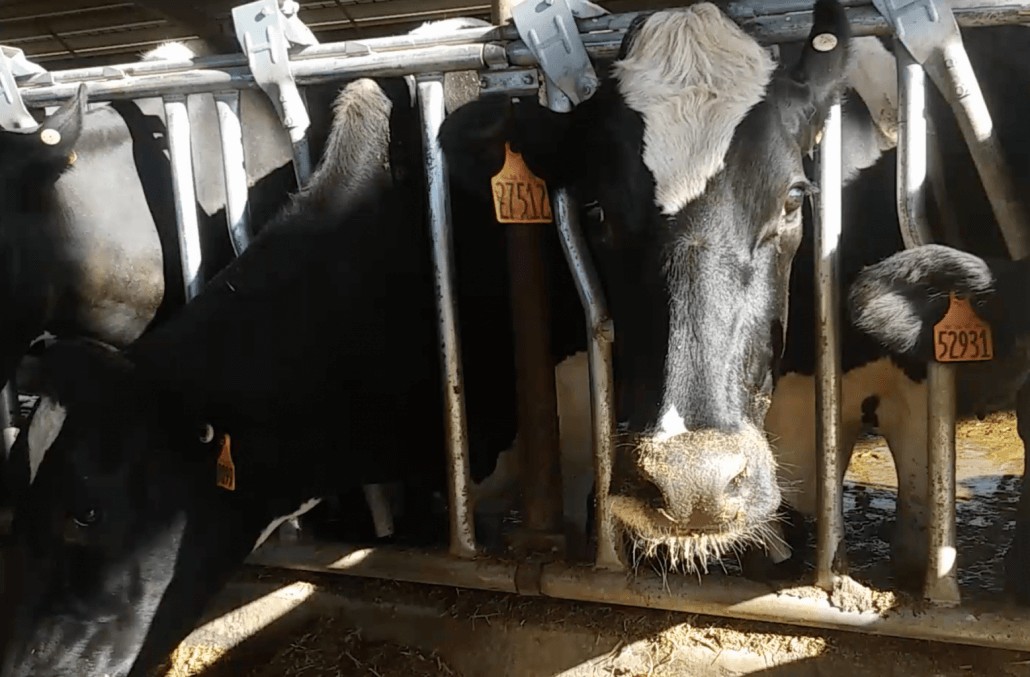
Donald DeJong is the owner and CEO of Natural Prairie Dairy. Soon after ARM began this investigation, it also discovered that DeJong is the vice chairman of Select Milk Producers, and a Board of Directors member of Fairlife and he has strong personal and business associations with Mike McCloskey of Fair Oaks Farms and Fairlife.
Natural Prairie Dairy currently supplies raw dairy to Kroger, Costco, and Publix through Aurora Organic Dairy’s bottling plant in Denver, Colorado. The company is in the process of expanding its operations with construction underway in Newton County, Indiana, that will supply dairy to Meijer Grocer, the Midwest, and East Coast.
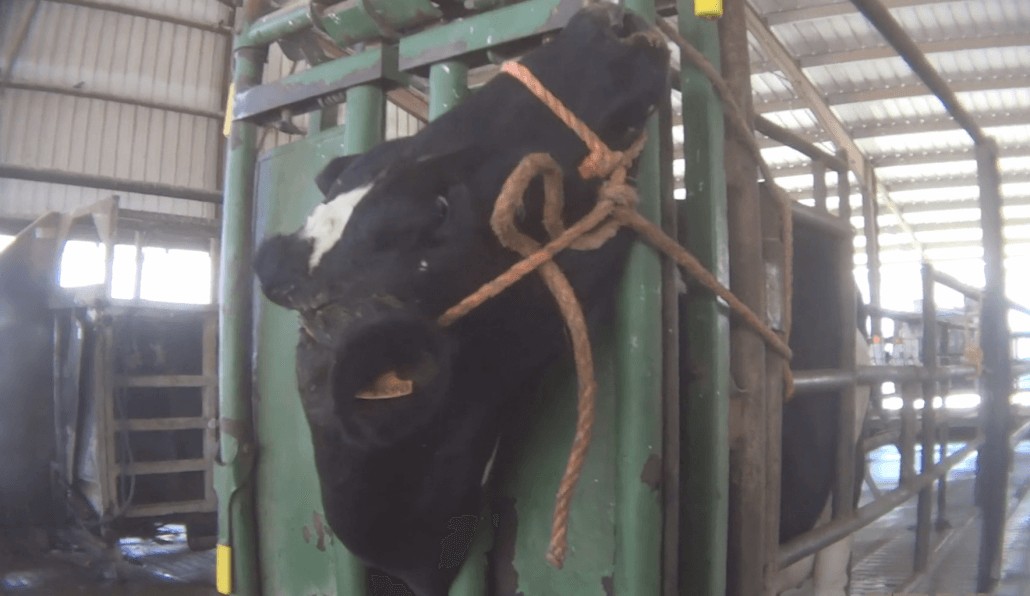
The undercover investigator was fired after management found photos of animal abuse on his cell phone. They quickly deleted the photos – to no avail. ARM investigators submitted a substantial body of evidence to the Hartley County Sheriff’s Office for review.
“Consumer power is the most effective vehicle towards creating change by raising awareness of these criminal findings,” ARM said in a statement. “Leave dairy products out of your cart.”
Download Your FREE Vegan PDF HERE
Order a FREE vegan kit HERE
Dairy-Free Info HERE
Take the Dairy-Free Challenge HERE
Click HERE for more Dairy-Free
Fish alternatives can be found HERE
Learn about eggs HERE
Find bacon alternatives HERE and HERE
Take PETA’s Cruelty-Free Shopping Guide along with you next time you head to the store! The handy guide will help you find humane products at a glance. Order a FREE copy HERE
Searching for Cruelty-Free Cosmetics, Personal-Care Products, Vegan Products, or more?
Click HERE to search.
Free PDF of Vegan & Cruelty-Free Products/Companies HERE
Click HERE to find out How to Wear Vegan!
Want to do more than go vegan? Help others to do so! Click below for nominal, or no, fees to vegan literature that you can use to convince others that veganism is the only compassionate route to being an animal friend:
PETA HERE
Vegan Outreach HERE
Get your FREE Activist Kit from PETA, including stickers, leaflets, and guide HERE
Have questions? Click HERE
We are animals first last and only hope.
Prop 12 cheerleaders: why do you support laws that REQUIRE animal suffering & violent death?
The people who care about animals and the people who don’t care about animals all know about Prop 12, hailed as the USA’s “strongest farm animal protection measure … EVER … mandating bigger cages, etcetcetc.”, passed by California voters in 2018 and that is now being challenged – ofcourseofcourseofcourse – by those ever-so cowardly “pork industry execs” as being too costly, blahblahblah, and onward to SCOTUS.
Here’s the thing: if you care about animals, and even if don’t care because your opinion regarding others’ bodies, families, and lives, all of what and whom are important to THEM regardless of how meaningless they are to YOU, REQUIRES YOU LEAVE THEM TF ALONE. You don’t eat them, use them, entertain with them, or wear them, and you sure as hell DON’T celebrate laws that STILL REQUIRE THEIR SUFFERING AND VIOLENT DEATHS.
(There is no way to “humanely” kill a being who doesn’t willingly volunteer to die, and the USDA recently released 1000s of pages of “slaughter violations” – used with apostrophes because, come on, ALL slaughter is an inherent violation of a being – of torturous, neglectful, abject cruelty inflicted on animals in just the death part of the death industry.)
It’s absolutely astounding that so many of the prop 12 promoters are literally NOT waiting for this measure to be implemented (ie, enforced), the will of the voters is obviously enough because they are STILL PARTICIPATING IN ANIMAL SUFFERING AND VIOLENT DEATH, which is actually required pre and post prop 12: the absolute violent irony of people who spend 2 seconds marking a ballot in favor of a proposition that STILL REQUIRES ANIMAL SUFFERING AND VIOLENT DEATH.
So congrats! You’re still an animal abuser but now you can wear the badge of “care” because it cost you all of nothing to mark a ballot. The suffering and killed animals would be proud, but they’re all dead, still being violated and violently killed to satisfy your UNethical behaviour, prop 12 or no prop 12.
Here’s another thing: YOU CAN BE VEGAN RIGHT NOW. Why do people wait for laws to define their ethics surrounding others’ lives? The whiny, petulant voters who are screaming, “I’m happy to spend more money to ensure animals are humanely treated………………………………………………but I’m not stopping using animals in the meantime, it’s the politician’s fault, the pork people’s fault, everybody but my own fault………………………nor will I actually do the MOST humane action and be vegan.” … are relevant only in their cruel hypocrisy.
Because, really, if a larger prison is important, NOT BEING USED AND KILLED IS MORE IMPORTANT. You cannot honestly preach “protections” that still demand animals are relentlessly violated and violently killed. I mean, I’m no Webster scholar, but “protection” pretty much would be the OPPOSITE: NOT BEING FORCED TO BE EXPLOITATIVELY USED AND KILLED.
And ffs, Prop 12 doesn’t prevent cruelty, why do people keep screaming that it does? A prison is a prison no matter the size, and the ULTIMATE cruelty – violent death – is still REQUIRED for the Prop 12 animal victims.
So, yes, shake your head, swear at the tv, demand political retribution, whatever, but know this: it IS YOUR fault. You gladly support the mass suffering and unimaginable terror and pain YOU force on animals, you just stand behind postponed mandates to excuse your actions, but the “pork people” are providing cheap flesh in response to YOUR cheap flesh demand. But I’d like to know, where’s your indignation about the animals who are forced to endure YOUR verbal welfare? Where’s your anger regarding the subjugation and loss of body autonomy, separation of families, the repeated violation and required violent deaths of all animals?
If you honestly care about the passage – or rather, the implementation – of Prop 12, you’d just be vegan. Now. For the ANIMALS because the animals are denied the luxury of just leisurely hanging out, waiting for the end of the slow, ponderous march of “justice” to decide their (always violently cruel and bloody) fate. And if you’re really pissed off at the “pork people” for trying to quash your vote, you’d be vegan – or plant-based at the least, the diet portion of veganism – because THAT will piss THEM off the most giving them essentially a big fu for being bastards no matter what to humans and animals because, really, who else gets to sue and head to SCOTUS to try and overturn a legal vote??? Yup, they are one and the same. Hmmmmm.
One last note, if you’re angry that abolitionist vegans don’t support welfarist issues that only serve to comfort the species causing violent suffering, ask yourself this: what’s the difference between a nonvegan who supports prop 12 and a nonvegan who doesn’t support prop 12? SL
Five things to know about the SCOTUS challenge to California’s ban on extreme farm animal confinement
Source The Counter
The U.S. Supreme Court on Monday agreed to hear the pork industry’s challenge to California’s Proposition 12, a law that restricts certain confinement practices in industrial animal agriculture.
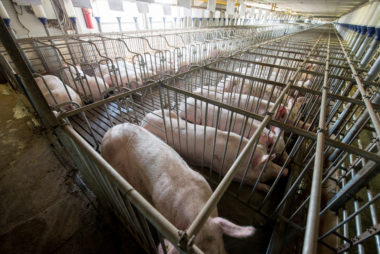
The law, passed by nearly 63 percent of voters in a 2018 ballot measure, effectively bans “gestation crates”—narrow, metal enclosures with slatted floors that confine pregnant sows to only sitting and standing, and restrict them from turning around. The industry argues the crates, which have been used in large-scale hog farming for more than 30 years, minimize aggression and prevent competition for food. But growing consumer concern about the wellbeing of animals we raise for food, coupled with strong opposition from animal welfare groups, has made the crates increasingly controversial.
Gestation crates have so far been banned in nine states, plus Ohio, which is slated to phase them out by 2026. In addition, California and Massachusetts have passed restrictions on the retail sale of pork that originated from animals kept in gestation-crate systems.
It’s that additional restriction on retail sales that’s at heart of the current challenge. When SCOTUS rules on Prop 12 in its next term—sometime between December of this year and June of 2023—it will not be ruling on whether the crates themselves are inhumane, but rather on whether the costs of complying with California’s law put an unfair burden on out-of-state farmers and have a “dramatic economic effect,” according to the petition, on non-California transactions.
Here are five things you need to know about the case:
1.) We’ve been here before.
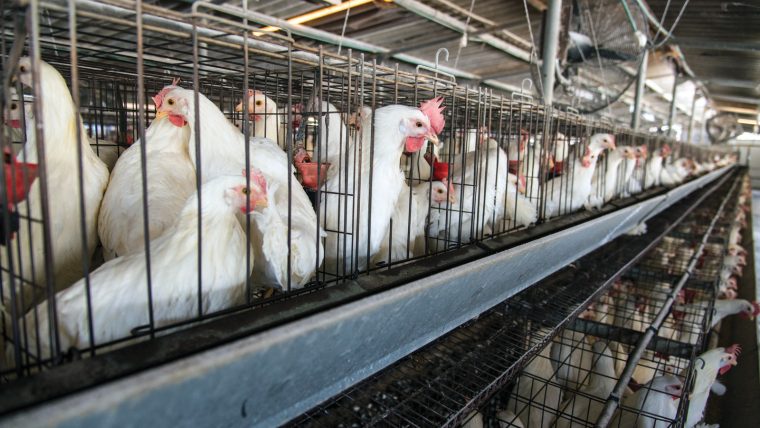
Prop 12 requires sows to have at least 24 square feet of living space; in industrial-scale operations they currently have about 14. The law also requires egg-laying hens to be housed in at least 144 square inches of living space, and veal calves to have at least 43 square feet. These standards ban industry practices that confine egg-laying hens in “battery cages” so small they can’t spread their wings and male calves raised for veal in similarly restrictive spaces.
Because Prop 12 bans not only gestation crates, veal crates, and battery cages on California farms, but also imports of animal products raised in these conditions anywhere in the world, it’s considered one of the strongest farm animal protection laws in the U.S. and is perhaps the most frequently challenged. The pork industry has been fighting like hell to overturn it, and so far, all of its challenges have failed.
In a case before the Ninth Circuit Court of Appeals last year, the National Pork Producers Council (NPPC), a pork industry lobby group, and the American Farm Bureau Federation unsuccessfully argued that Prop 12 violates the “dormant Commerce Clause” of the Constitution—a legal doctrine that bars states from enacting protectionist laws that discriminate against out-of-state businesses.
After that loss, the National Pork Producers Council took its challenge to the Supreme Court, claiming that Prop 12 would “upend an entire nationwide industry” to cater to the ethical preferences of Californians. It also argues that gestation crates don’t allow pigs to turn around “for hygiene, safety, and animal-welfare and husbandry reasons.”
2.) The outcome isn’t a foregone conclusion.
The Supreme Court’s decision to take up a case on which there wasn’t any disagreement among lower courts likely signals a desire among some justices to strike down Prop 12. That the court decided to weigh in on the case at all was surprising to some observers. “It is something that would have been unimaginable not that long ago,” Justin Marceau, an animal law scholar at the University of Denver, said in an email. “This court seems hungry to get involved with every divisive political issue.”
But it only takes four of the justices—not a majority—to agree to hear a case, and the pork industry’s legal argument is considered weak by many legal scholars because Prop 12 applies the same standard to products raised in California as it does to those in any other state. “I think the odds are not great for Prop 12, but I wouldn’t give up at all,” said Harvard constitutional law professor Laurence Tribe. “The Supreme Court’s decisions in this area—going all the way back to the 1920s—I think strongly support California.”
The dormant Commerce Clause on which the case hinges is complex and confusing. It isn’t explicitly written into the Constitution, but instead has been inferred in case law as a limit on states’ ability to interfere with interstate trade. The country’s top pork-producing states are Iowa, Minnesota, and North Carolina, which together make up most of the industry.
The NPPC argues that California’s share of the U.S. pork industry (.12 percent, according to USDA) is extremely small, and Prop 12 would unfairly impact states from which it imports its pork.
Tribe said this doesn’t mean Prop 12 imposes an unconstitutional burden on interstate commerce. “It’s undoubtedly true that it will have most of its impact outside California, but they’re not exempting California,” he said. “Even though the industry is smaller in California, it’s not insignificant, and it has to comply with these rules just as fully as [producers] in Iowa and elsewhere do.”
The Ninth Circuit Court’s ruling in favor of Prop 12 similarly reasoned: “A state law may require out-of-state producers to meet burdensome requirements in order to sell their products in the state without violating the dormant Commerce Clause.”
Clarence Thomas, one of the court’s Republican-appointed justices, has expressed skepticism that the dormant Commerce Clause even exists, Tribe said. “That’s, in a sense, the most conservative originalist view. And it may be that on the current court, only Justice Thomas has that view, but it will certainly influence at least to some extent the way the other conservatives look at this, so that there could be a very powerful conservative as well as liberal argument in support of Prop 12.”
3.) You should look up the definition of “extraterritoriality.”
Yes, it’s a mouthful. But whether or not the court decides that Prop 12 passes muster will likely come down to the value of that one word, and whether the justices believe that ethical concerns of a state outweigh, as the petition puts it, “the wrenching effect of the law on interstate commerce.”
“There’s very little basis for invalidating California’s Prop 12 unless one takes the view that the state’s moral concerns for the abuse of animals somehow count less than the kinds of economic concerns that in the past have been used to justify state regulations with nationwide impact like this one,” Tribe said. “Pigs are at least as smart as dogs, and anyway smartness shouldn’t have anything to do with it. They can suffer.”
“If California decides that intelligent mammals like pigs that can suffer are worthy of moral concern, then California should be allowed to protect their interests. But at least some justices might be insensitive to that and might say, ‘who cares about animals?’ And if they do, that would be an example of a form of judicial activism that conservatives and liberals alike ought to find inappropriate.”
“Given that a strong case can (and will through amicus briefs) be made that animal welfare is an extremely substantial interest, it would seem under existing law that the law would be upheld,” Marceau from the University of Denver said. But that’s if the court adheres to the established doctrine on interstate commerce, which he called “a big if.”
4.) Big interests will be represented by Big Law.
One underexamined dimension of the Prop 12 litigation is legal institutions’ (including the Supreme Court’s) ongoing bias toward business interests. The NPPC’s case is being argued by attorneys from the corporate law firm Mayer Brown, which has represented clients like the tobacco conglomerate Altria Group and Cargill, Inc. in a lawsuit alleging child-labor abuses in the global food company’s cocoa supply chain.
The attorney of record in the Prop 12 case, Timothy Bishop, “is advertised by Mayer Brown as being a top appellate lawyer in environmental law,” said Oren Nimni, litigation director at Rights Behind Bars and a well-known critic of big law. “When you see someone who’s an expert in environmental law at a firm like Mayer Brown, a giant corporate firm, that means that they are an expert in destroying the environment.” Bishop didn’t return a request for comment for this story.
“There’s essentially universal neoliberal consensus in the legal field that there can be no judgment for that type of representation,” Nimni said, and the Supreme Court likewise favors commercial interests. Whatever the merits of the pork industry’s lawsuit, or lack thereof, he added, “it really doesn’t matter because there’s universal consensus in favor of corporate rights on the Supreme Court.”
The Cato Institute, a libertarian think tank, also filed a friend-of-the-court brief in favor of NPPC, arguing that “there is already ample evidence of Prop 12’s onerous economic burdens on the pork industry” and that “preventing animal cruelty nationwide is not a legitimate state interest.”
5.) SCOTUS heat could chill local efforts.
Invalidating Prop 12 “would cast quite a shadow on perfectly reasonable state regulations, both in favor of animal welfare and various environmental concerns,” Tribe said. “It’s very hard to come up with a principle that would make the burden on interstate commerce in this case excessive but that wouldn’t invalidate all kinds of other rules as well.”
The environmental impact of Prop 12 itself would likely be minor because its additional space requirements are minimal, so it wouldn’t impose enough additional costs on pork production to substantially scale down industrial animal agriculture, said Silvia Secchi, a natural resource economist at the University of Iowa, in an email. But the Supreme Court’s decision could have indirect implications for state environmental regulations. “California leads the nation on climate change via, for example, the CAFE standards carve-out,” Secchi said. “This might signal a willingness to re-litigate these issues.”
The only way to mitigate agriculture’s environmental footprint, Secchi added, is to reduce overall meat consumption with policies stronger than Prop 12. “Prices of livestock WOULD be higher and more in line with their environmental impacts, but we would have plenty of other food available and affordable,” she said. “If all this squealing (sorry could not resist) about pretty minor changes to livestock production practices causes all this legal chaos, you can see how hard to do more is going to be.”
Ultimately, especially with so much recent turnover on the Supreme Court, all bets on Prop 12’s fate are off. “It is beyond tea leaf reading to guess how this case comes out,” Marceau said. “The idea that one can accurately predict how these new justices will respond to a set of technical commerce clause issues would be the height of legal-prediction hubris.”
Marina Bolotnikova is a journalist in Madison, Wisconsin.
Download Your FREE Vegan PDF HERE
Order a FREE vegan kit HERE
Dairy-Free Info HERE
Take the Dairy-Free Challenge HERE
Click HERE for more Dairy-Free
Fish alternatives can be found HERE
Learn about eggs HERE
Find bacon alternatives HERE and HERE
Take PETA’s Cruelty-Free Shopping Guide along with you next time you head to the store! The handy guide will help you find humane products at a glance. Order a FREE copy HERE
Searching for Cruelty-Free Cosmetics, Personal-Care Products, Vegan Products, or more?
Click HERE to search.
Free PDF of Vegan & Cruelty-Free Products/Companies HERE
Click HERE to find out How to Wear Vegan!
Want to do more than go vegan? Help others to do so! Click below for nominal, or no, fees to vegan literature that you can use to convince others that veganism is the only compassionate route to being an animal friend:
PETA HERE
Vegan Outreach HERE
Get your FREE Activist Kit from PETA, including stickers, leaflets, and guide HERE
Have questions? Click HERE
We need more sane and sensible
Instead of cruel and incomprehensible
Source NowThis YouTube , Jan Dutkiewicz
It was my pleasure to guide @nowthisnews through the animal agriculture industry’s playbook for addressing footage of animal abuse.
If anag execs and farmers weren’t so deceptively abusive and inherently unethical, they’d just be laughable. To them, one “militant” vegan, as defined because a vegan provides industry data from anag sources, is representive of all vegans, but one (or-two-or-fifty-or-onemillion) abusive animal farmer or employee is an anomaly, a rare exception to the rule (ah, the willfully ignorant masses always forget the animals they use and consume are … dead. They’re all … dead, not certain how anyone can pretend that being violently killed after a brief existence of suffering and forced body intrusion, DOESN’T represent the ENTIRE anag industry).
And by the way, even if there is just ONE case (not trillions), it would still be proof that the industry is flawed, there’s no way around that, it’s evil, masked as happy-dancy cows going to school. SL
Download Your FREE Vegan PDF HERE
Order a FREE vegan kit HERE
Dairy-Free Info HERE
Take the Dairy-Free Challenge HERE
Click HERE for more Dairy-Free
Fish alternatives can be found HERE
Learn about eggs HERE
Find bacon alternatives HERE and HERE
Take PETA’s Cruelty-Free Shopping Guide along with you next time you head to the store! The handy guide will help you find humane products at a glance. Order a FREE copy HERE
Searching for Cruelty-Free Cosmetics, Personal-Care Products, Vegan Products, or more?
Click HERE to search.
Free PDF of Vegan & Cruelty-Free Products/Companies HERE
Click HERE to find out How to Wear Vegan!
Want to do more than go vegan? Help others to do so! Click below for nominal, or no, fees to vegan literature that you can use to convince others that veganism is the only compassionate route to being an animal friend:
PETA HERE
Vegan Outreach HERE
Get your FREE Activist Kit from PETA, including stickers, leaflets, and guide HERE
Have questions? Click HERE
The lavender lizard
the lavender lizard was once dull,sad and grey
but then he chased the nasties
away
… he decided to like just
who he pleased
no matter what he was taught
at his elders knees
and with his new friendships
he walked towards the sun
sharing his kindness
with most everyone
be kind, practice tolerance, embrace difference…the world will be a much better, happier place
 ☻
☻

Mental health awareness month
Mental illness is not an indictment. Mental illness is neither judgement nor judgement call. Mental illness is pain…crippling, life altering, life stealing pain. Mental illness takes no prisoners but those who suffer are its prisoners.
Mental illness is illness.
Please see it as such.
Help if you can.

The original title, which I took liberty to “modify”, was Victory for Animals and Free Speech as U.S. Supreme Court Declines to Review Kansas Ag-Gag Law
I changed it because, no, this isn’t a “victory” for animals as it doesn’t benefit animals who all suffer on farms (and labs, entertainment, fur farms, zoos, etcetcetc) regardless of a human court decision. A “victory” for animals would be a vegan world.
And it really wasn’t a “victory” for free speech either as ag-gag should NEVER have been considered much less implemented.
And to be fair, it really wasn’t a victory for “transparency” either, as “transparency” would be the actual anag industry publicizing the torture they inflict on animals versus aggressively trying to illegalize OTHER NON-ANAG PEOPLE from sharing undercover footage of the torture the anag industry effortlessly inflicts on animals.
(I’m not criticizing ALDF, they do excellent work, but many in the tiny minority of vegans who actually care about animals, often view even the meager crumbs of a SCOTUS decision upholding an already-legal-and-required constitutional right, as an “animal victory” in the face of global socially-accepted and celebrated normalized violence and suffering.)
But it’s pathetic how anag cheerleaders can’t get their stories straight, always inviting people to, “COME SEE THE FARMS!!!”, or, “HAVE YOU EVER EVEN VISITED A FARM???” while simultaneously relentlessly pursuing ag-gag to criminalize exposure of THEIR criminally inhuman, abusive acts perpetrated on defenseless, vulnerable animals. So much for “transparency”! (And by the way, I’ve never personally witnessed FGM, seeing someone mutilate a child in person, though, is not going to inspire me to change my mind and support FGM.)
But I wanted to share it anyway as it’s worth noting that a conservative SCOTUS has refused to reconsider a lower court’s decision that ag-gag is INDEED unconstitutional (while of course acknowledging that SCOTUS, along with billions of other humans, still don’t care about animals whatsoever; this wasn’t about animal “rights” or animal “freedoms”, this was about privileged human supremacists who don’t care about human animals OR non-human animals and want to hide their animal cruelty while infringing on the rights of humans).
Oh, and the excuse dejour of – it goes something like – maintaining a disease-free perimeter/area due to “biohazard risks” is based on YOUR actions of confining literally tens/hundreds-of-thousands of animals, not people who are exposing your deviant, shameful behaviour. And your track record sucks as diseases – pandemics – are in the news practically daily. But do pretend that you care about all animals while creating hellishly-zoonotic conditions where suffering, death, and disease thrive….
I won’t be holding my breath waiting for SCOTUS to determine that socially-accepted slavery, rape, and murder inflicted on billions of animals yearly in just the USA, should also be abolished based on the inhuman acts of violently exploiting and destroying animals. In the meantime, however, you can be vegan TODAY rather than wait for others to judicially enforce YOUR ethics.
Oh, and for those who experience moral outrage at my word choices of “slavery, rape, murder”, I don’t like your literal actions – condemning animals to such horrific fates – that inspired my words. You should be more concerned with the violent consequences of your choices versus how I accurately describe them with my word choices.
But people love to define the suffering of others in manners that makes them comfortable causing the suffering of others. SRL
Source Animal Legal Defense Fund/ALDF
In a major victory for animals, workers, and transparency In the animal agriculture industry, the U.S. Supreme Court declined to review a decision by the U.S. Court of Appeals for the Tenth Circuit that struck down Kansas’s “Ag-Gag” law for violating the First Amendment. The decision follows a lawsuit filed in 2018 by an Animal Legal Defense Fund-led coalition of animal, environmental, and food safety advocacy groups challenging the law’s constitutionality.
The Kansas law in question made it a crime to engage in activities that are essential to conducting undercover investigations that have in the past revealed horrific treatment of farmed animals and food workers to the public. The appeals court held that Kansas may not silence views critical of industrial animal agriculture. The court’s decision affirmed that videos, articles, advocacy, and public dialogue generated by whistleblowing and undercover investigations of factory farms and slaughterhouses relate to a matter of public concern: The treatment of animals and workers on factory farms and slaughterhouses, and manner in which food is produced. Such speech lies at the core of the First Amendment. The Supreme Court’s decision leaves that important ruling in place.
The 2021 U.S. Court of Appeals for the Tenth Circuit’s decision notes: “[T]he text and legislative history of the Act evince Kansas’s desire to limit the ability of [the Animal Legal Defense Fund] and like organizations to engage in true speech critical of animal facilities.. . .. We reject this approach because it elevates form over substance and permits Kansas to do just what the First Amendment prohibits: ‘license one side of a debate to fight freestyle, while requiring the other to follow Marquis of Queensberry rules.’”
“The U.S. Supreme Court’s decision not to disturb the lower court decisions is a victory for farmed animals, factory farm and slaughterhouse workers, and food and public safety — as it leaves intact the public’s constitutional rights over protecting corporate interests and profits. Until there are cameras publicly broadcasting the conditions within factory farms and slaughterhouses, investigations are the country’s only opportunity to see the horrific ‘industry standard’ conditions under which food is made,” says Animal Legal Defense Fund Executive Director Stephen Wells. “The industry works hard to keep its practices secret, knowing consumers won’t accept the intense confinement and other inhumane treatment of animals, as evidenced by the passing of California’s Proposition 12 and other proposed state legislation.”
Earlier this year, the Supreme Court agreed to hear a challenge to California’s Proposition 12 ballot initiative, which outlaws the sale of animal products from pigs held in gestation crates, calves held in veal crates, and eggs from hens kept in battery cages. The measure passed after undercover investigation footage exposed the cramped and cruel conditions in which pigs, calves, and chickens spend their lives at industrial animal agricultural facilities.
“The Supreme Court’s refusal to review the Tenth Circuit’s decision leaves in place important constitutional protections for investigators working with animal rights groups to expose misconduct in the industrial animal agriculture industry,” says Alan Chen, a University of Denver law professor who helped lead the lawsuit against Kansas. “This is a big win for the national campaign against Ag-Gag laws.” Enacted in 1990, the Kansas Ag-Gag law was the oldest in the United States. Kansas is a major agricultural producer with the third-most cows of any state, and until being struck down, its Ag-Gag law had successfully prevented whistleblowers from investigating the conditions that millions of pigs, cows, chickens, and other animals endure.
There have been nine lawsuits challenging state Ag-Gag laws around the country. Earlier lawsuits have resulted in courts striking down similar laws or portions of laws in Iowa, North Carolina, Idaho, Utah, and Wyoming. The Eighth Circuit Court of Appeals will soon consider the constitutionality of Iowa’s second law, after striking down Iowa’s first law and recently clearing the way for an Animal Legal Defense Fund-led coalition’s lawsuit challenging Arkansas’ law to proceed. A decision concerning North Carolina’s law is pending in the Fourth Circuit Court of Appeals. The Animal Legal Defense Fund is also currently challenging a third Iowa law in the U.S. District Court for the Southern District of Iowa.
The Kansas coalition is comprised of the Animal Legal Defense Fund, the Center for Food Safety, and state farmed animal organizations Shy 38, Inc. and Hope Sanctuary. The coalition is represented by Public Justice, leading First Amendment scholars, the law firm Foley & Mansfield, and attorneys with the plaintiff organizations, with assistance from Joshua Rosenkranz and the Supreme Court & Appellate practice at Orrick Herrington & Sutcliffe.
Download Your FREE Vegan PDF HERE
Order a FREE vegan kit HERE
Dairy-Free Info HERE
Take the Dairy-Free Challenge HERE
Click HERE for more Dairy-Free
Fish alternatives can be found HERE
Learn about eggs HERE
Find bacon alternatives HERE and HERE
Take PETA’s Cruelty-Free Shopping Guide along with you next time you head to the store! The handy guide will help you find humane products at a glance. Order a FREE copy HERE
Searching for Cruelty-Free Cosmetics, Personal-Care Products, Vegan Products, or more?
Click HERE to search.
Free PDF of Vegan & Cruelty-Free Products/Companies HERE
Click HERE to find out How to Wear Vegan!
Want to do more than go vegan? Help others to do so! Click below for nominal, or no, fees to vegan literature that you can use to convince others that veganism is the only compassionate route to being an animal friend:
PETA HERE
Vegan Outreach HERE
Get your FREE Activist Kit from PETA, including stickers, leaflets, and guide HERE
Have questions? Click HERE
Until all voices are heard
Until all beings are protected
We will speak for those of voices silent
We will never be silenced
In freedom
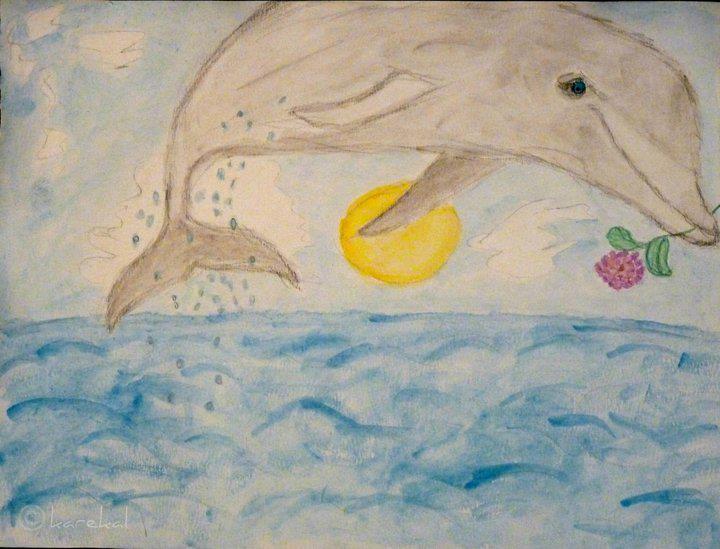
My eyes reflect the blue of the sea
When they are in freedom, naturally
I can jump up so high
Chase and play
Catch my food
This is the dolphin way
But when in a small space
Entrapped and alone
Or even with others
All I can do is moan
The blue sea reflection
Flickers then dies
Lost in man’s deception
Why bother to try
“Happy” Earth Day – ??? Guess what? Earth is NOT happy, nor healthy, and neither are its inhabitants…
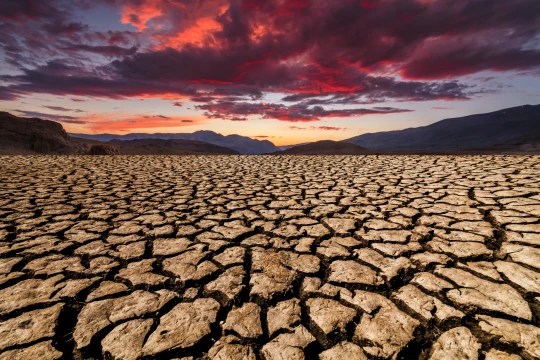
I recently emailed an “environmentally-focused” organization in response to a newsletter I received from them regarding Earth Day and the “Top Three Things YOU Can Do Right Now to Stabilize the Climate!!!” including “cutting global methane production”, which is caused by “oil, gas, coal mines and … livestock”. I replied asking why they’re not encouraging veganism, or at the very least, plant based diets, and in response I got nonsense, that while they do “encourage decreasing beef consumption, we’re primarily focused on other things ………………………………………….”
I replied and said that since they acknowledge that decreasing animal consumption is important to decrease negative environmental impacts, then they’re also claiming – while not actually claiming – that THEREFORE, eliminating animal consumption is MORE IMPORTANT.
But, hahaha, nobody actually wants to do anything that would require personal commitment to defending vulnerable, defenseless beings who are denied all opportunities to defend their bodies, their families, their lives, and THEIR environment by, you know, NOT being bred to be dead.
IF YOU’RE NOT VEGAN – or plant based at the very least – YOU’RE NOT CONCERNED ABOUT ANIMALS, THE ENVIRONMENT, WATER, DIRT, OXYGEN or the APOCALYPTIC LEGACY YOU’RE LEAVING FOR YOUR AND OTHERS’ KIDDOS …………
This isn’t difficult, NOT consuming animals, their flesh and secretions, is as easy as reaching for a different item, like plant-based milk vs cow’s milk (by the way, the USDA has added plant based milk as nutritionally equivalent to required-fortified cow’s milk), or beans and nuts vs hotdogs: veganism is literally a nonaction.
If you want to skip the reading, though, you can get a free PDF guide right now:
To help mobilize the shift to more sustainable plant-based diets, A Well-Fed World created the free EcoFood Guide.
SL
Source A Well-Fed World
In their most dire climate report to date, the UN’s Intergovernmental Panel on Climate Change (IPCC) has urged a switch to plant-based diets as the single most important shift individuals can make to halt the course of climate warming and prevent the most catastrophic impacts.
For the first time in 34 years since the United Nations convened the body of global climate experts, the IPCC’s new report focuses on the importance of demand-side mitigation potential; that is, the crucial role individual choices can play in urgently needed emissions reductions. They group these choices into three categories of action: Avoid, Improve, and Shift.
The report notes that “The greatest Avoid potential comes from reducing long-haul aviation and providing short-distance low-carbon urban infrastructures,” while “The greatest Improve potential comes from within the building sector, in particular increased use of energy-efficient end-use technologies and passive housing.” And “The greatest Shift potential would come from switching to plant-based diets.”
Transforming the Food System Is Key
While emissions from the energy sector have long received the bulk of attention in both the media and in policy recommendations, emissions from the food system are a major contributor that scientists say we can no longer ignore. A 2021 study published in Science warned that if global fossil fuel use were halted immediately and all other emissions were eliminated, greenhouse gas emissions from food production alone would make it impossible to limit warming to 1.5°C, overshooting the carbon budget by the middle of this century. Even keeping warming below 2°C would be difficult if not impossible without major dietary shifts, the scientists urged.
IPCC scientists agree. They note that since the Industrial Revolution, global greenhouse gas emissions have reached a cataclysmic 2,400 billion tons, with a whopping 42% of those emissions occurring after 1990, and 17% in the ten years between 2010 and 2020. At current emission rates, in less than a decade we will surpass the remaining carbon budget that would keep global warming to 1.5°C, the level at which scientists say we’ll have a mere 50-50 chance of averting the worst impacts of the climate crisis.
To keep 1.5°C within any scope of feasibility, global emissions must peak by 2025, the IPCC report says. If current emission levels persist, we are on a trajectory toward an apocalyptic 3.2°C by 2100.
While half a degree, or even a difference of two degrees, may sound small, scientists say each increment of warming spells fundamental– and irreversible– disaster for life on our planet, from increasingly lethal and widespread heat waves, unprecedented global crop failure and resulting famine from more intense drought and flooding, ecosystem collapse from the Amazon rainforest to the Arctic, and entire cities and coastal regions disappearing under rising seas.
“I don’t have words to explain,” former UN climate secretary Christiana Figueres commented. ‘Concerning’ is not enough. This is frankly a terrifying report.”
Making the Shift
Unsurprisingly, the meat and dairy industries continue to ramp up efforts to greenwash the most climate-disastrous foods. Proponents of so-called “regenerative” grazing, for example, say all that is needed is better production methods, but this flies in the face of actual climate science. Global methane emissions reached their highest levels in the past year, according to the National Oceanic and Atmospheric Administration. Animal agriculture is the largest human-caused source of methane in the United States, with grazing cattle and other farmed ruminants contributing the vast majority of these emissions.
Methane traps significantly more heat— 86 times more than CO2— in the atmosphere over a 20-year time frame, which is why products from grazing animals, such as beef, dairy, and lamb, are ranked as the worst foods for climate. At the same time, it stays in the atmosphere for a much shorter time, leading experts to say that slashing methane is now our single greatest and quickest strategy for slowing down warming by 2040.
The UN has previously noted, “Improving production methods and reducing methane emissions from livestock could reduce emissions by up to 1.44 Gt CO2e per year, but much greater reductions could be achieved by shifting to healthier and more sustainable diets with a higher proportion of plant-based than animal-based foods, which could avoid emissions of up to 8 Gt CO2e each year.”
The new IPCC report reiterates this, stating: ‘In addition to climate mitigation gains, a transition towards more plant-based consumption and reduced consumption of animal-based foods, particularly from ruminant animals, could reduce pressure on forests and land used for feed, support the preservation of biodiversity and planetary health, and contribute to preventing forms of malnutrition (i.e. undernutrition, micronutrient deficiency, and obesity) in developing countries. Other co-benefits include lowering the risk of cardiovascular disease, type 2 diabetes, and reducing mortality from diet-related non-communicable diseases.”
To help mobilize the shift to more sustainable plant-based diets, A Well-Fed World created the free EcoFood Guide.
This colorful, user-friendly resource explains the immense climate benefits of plant-based food choices, the harms of even the so-called “greenest” forms of animal-based food production, and includes helpful tips, recipes, statistics, food swaps, and more.
Visit EcoFoodGuide.org to download your PDF and/or pre-order a free printed copy. You can also read it in a fun, reader-friendly flip-book form.
And learn much more about the greenwashing of grazing at our new companion website, GrazingFacts.com.
Download Your FREE Vegan PDF HERE
Order a FREE vegan kit HERE
Dairy-Free Info HERE
Take the Dairy-Free Challenge HERE
Click HERE for more Dairy-Free
Fish alternatives can be found HERE
Learn about eggs HERE
Find bacon alternatives HERE and HERE
Take PETA’s Cruelty-Free Shopping Guide along with you next time you head to the store! The handy guide will help you find humane products at a glance. Order a FREE copy HERE
Searching for Cruelty-Free Cosmetics, Personal-Care Products, Vegan Products, or more?
Click HERE to search.
Free PDF of Vegan & Cruelty-Free Products/Companies HERE
Click HERE to find out How to Wear Vegan!
Want to do more than go vegan? Help others to do so! Click below for nominal, or no, fees to vegan literature that you can use to convince others that veganism is the only compassionate route to being an animal friend:
PETA HERE
Vegan Outreach HERE
Get your FREE Activist Kit from PETA, including stickers, leaflets, and guide HERE
Have questions? Click HERE
We are our earth mother’s last and first hope.
Compassion cake
I would like to bake
a compassionate cake
to create a world of giving
and less of take
where loving kindness
is the norm
not one where cruelty
attacks in swarms

Source Direct Action Everywhere (DxE):
This Iowa farm just killed 5 million birds during an outbreak of avian flu, and we documented the horrific aftermath of the mass killing, including birds left behind after surviving “ventilation shutdown.”
Taxpayer dollars paid for the farm’s last mass killing after infectious disease ran rampant in 2015. Now, the farm’s billionaire owner, former Senator Glen Taylor, who also owns the Minnesota Timberwolves and Star Tribune, may be getting bailed out once again despite posing a public health threat.
(Because billionaires have a lot of money, you’ll support them having more money to reward their putrid, disgusting actions causing unimaginable suffering? Would you trust Glen with your cat? I don’t trust Glen with dirt – look at the abysmal mess he’s made out of it already, but he’s old so he doesn’t care that his legacy is cesspools of bacteria, pus, and decomp poisoning a world – much less a live being capable of pain and misery. Just because the Timberwolves team sucks is no reason to take it out on vulnerable, defenseless animals, who, by their very nature of vulnerability and as acceptably abused by humans, deserve the MOST care and empathy, which excludes exploiting them in any way. SL)
Learn more about Direct Action Everywhere: https://www.directactioneverywhere.com/
(Because not caring about animal suffering doesn’t preclude the effects your abusive behaviour has on Planet Earth, which affects everyone. SL)
Support the right to rescue animals from harm: https://righttorescue.com/
(Because if someone stole your dog, intent on killing and eating her, what would you do to save her? SL)
Download Your FREE Vegan PDF HERE
Order a FREE vegan kit HERE
Dairy-Free Info HERE
Take the Dairy-Free Challenge HERE
Click HERE for more Dairy-Free
Fish alternatives can be found HERE
Learn about eggs HERE
Find bacon alternatives HERE and HERE
Take PETA’s Cruelty-Free Shopping Guide along with you next time you head to the store! The handy guide will help you find humane products at a glance. Order a FREE copy HERE
Searching for Cruelty-Free Cosmetics, Personal-Care Products, Vegan Products, or more?
Click HERE to search.
Free PDF of Vegan & Cruelty-Free Products/Companies HERE
Click HERE to find out How to Wear Vegan!
Want to do more than go vegan? Help others to do so! Click below for nominal, or no, fees to vegan literature that you can use to convince others that veganism is the only compassionate route to being an animal friend:
PETA HERE
Vegan Outreach HERE
Get your FREE Activist Kit from PETA, including stickers, leaflets, and guide HERE
Have questions? Click HERE
Human ignorance is the most dangerous pandemic
Today is save the elephant day
What goes on inside an elephant’s head
Do they look at their world with fear and dread?
Do they see each day as another chance to live
Are they short on grudges, and long on forgive?
Do they revel in their planet and its natural wealth
Do they understand the importance of their homeland’s health
Do they go about their lives, day by day
In quiet reverence, with not much to say
We can barely understand each other
Perhaps we can learn from our
Elephant sisters and brothers
If we open our hearts and eyes
We might just be pleasantly surprised.

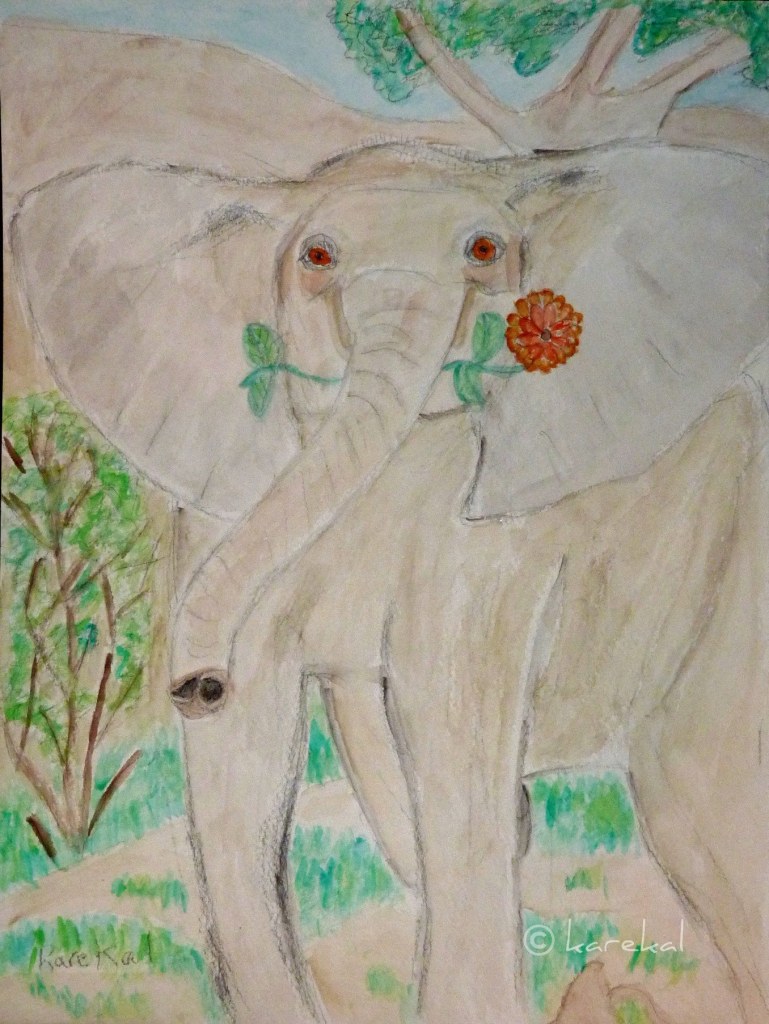

A world without elephants, isnt
A county with ONE MILLION COWS …
Don’t come at vegans with your, “bUt sMaLL fArMS …” First, satisfying a 7+ billion human populations’ addiction to animal products could NEVER be met with the amount of land required to “revert back to small-farm animal exploitation”, it’s not sustainable, it’s not a solution; all factory farms were birthed from the small-farm model, which has devolved into >90% global animal bodies “produced” on CAFOs, FFs, ILOs. Second, tell me about how factory farms are “cruel” because they confine animals, but small farms are “kind” because they kill animals … How anyone can honestly praise killing animals as a solution to confining animals, is bizarre and a grammatical manipulation of others’ bodies and lives, animals who do not volunteer their bodies, lives, or children for human snacks, amusement, products, etc.
ALL animal farming, ALL animal exploitation is unethical, it’s a system based on inherent brutality and injustice, how anyone can knowingly participate is based on the inability to reconcile being a “kind” animal killer with kind vegans who don’t kill, it’s not vegans’ behaviour that bothers you, it’s YOURS.
Watch the brief documentary above, see the absolute Hell devil-humans create for the most vulnerable, defenseless beings. Why support such violence inflicted on animals, you don’t have to. And remember: all animals sold in the USA require FSIS inspections in slaughterhouses, there are NOT two doors into slaughterhouses, ALL animals, regardless of “operation size” they came from, face the EXACT SAME torture, cruelty, and violence.
Stop defining others’ required suffering in terms that brings YOU comfort causing it. SL
Source Direct Action Everywhere / DxE
Directed by Raven Deerbrook
All pictures from DxE
Sign to support AB 2764 and help put a moratorium on factory farming in California HERE
California is the highest-producing agricultural state in the nation. California’s farms and ranches received $49.1 billion in cash receipts for their output in 2020, with cattle, calves, and dairy products as some of the top agricultural commodities. Animal agriculture is well-known as one of the largest contributors to climate change, making up more than a third of methane emissions in the US and using so much water that it is significantly diminishing the flow of major US rivers. And yet, instead of working to address the harms caused by this industry, the Governor’s Office of Business and Economic Development is actively funding the construction and expansion of factory farms and slaughterhouses throughout the state.
A new investigation into a major Costco beef supplier in California’s Imperial Valley is showing the true cost of this government-subsidized expansion — for animals and all of us who rely on the same precious natural resources.
The One World Beef company, also operating as Brandt Beef, has one of the largest cow feedlots on the West Coast, spanning 730 acres and confining as many as 150,000 cows at a time. Two-thirds of these cows are slaughtered by Brandt to supply Costco’s “Kirkland Signature” product line – around 86 million pounds of beef each year, making up an estimated 25% of all beef sold by the retail giant.
Over the course of a 6-month investigation at the Brandt Beef slaughterhouse in Brawley, California, anonymous whistleblowers recorded criminal animal cruelty, including improper stunning, cutting into the necks of conscious cows, pulling cows with rope, the use of cattle prods to shock “downed” cows, as well as prodding cows who were too crowded to move and countless numbers of animals with unexplained bleeding injuries and lameness.
During each step in the process of a Brandt cow’s life and death, water is wasted, land is degraded and polluted, dangerous emissions are generated, workers are exploited and traumatized, and the cows themselves are subjected to abuse.
State-Funded Criminal Animal Cruelty at One World Beef
Facility background
One World Beef opened the Brandt Beef slaughterhouse in Brawley, California in 2016, with the assistance of over $6 million from the state of California. Killing over 300,000 cows per year, it is one of the largest slaughterhouses in the state. The facility had operated in the past under two different companies, and the 2016 reopening faced considerable opposition from the local community, which is over 85% latino. In December 2020, Cal/OSHA fined One World Beef Packers for inadequate safety precautions and failing to report a COVID-19-related worker fatality. The $23,000 fine was a small fraction of the amount OWB received in state funding that same year.
Investigation Methodology

Over the course of a multi-month investigation, anonymous whistleblowers collected data and footage using hidden cameras throughout the Brawley slaughterhouse. From loading ramps to the kill floor, investigators documented the entire process to which Brandt cows are subjected.
Findings

Hidden camera footage recorded inside One World Beef in Brawley, California shows improperly-stunned, still-conscious cows raised onto the slaughter line upside down via chains shackled to their legs, before shaking loose and falling to the floor, highlighting what investigators say is a climate of lax enforcement in an industry rife with criminal abuse.
The footage shows company and/or USDA inspectors watching over a worker, who rightfully checks the animals for signs of sensibility after stunning them, in accordance with the Humane Methods of Slaughter Act. But once the inspectors step away, the worker immediately stops checking the animals for sensibility after the bolt-gun shot, resulting in still-conscious cows proceeding through the slaughter process.

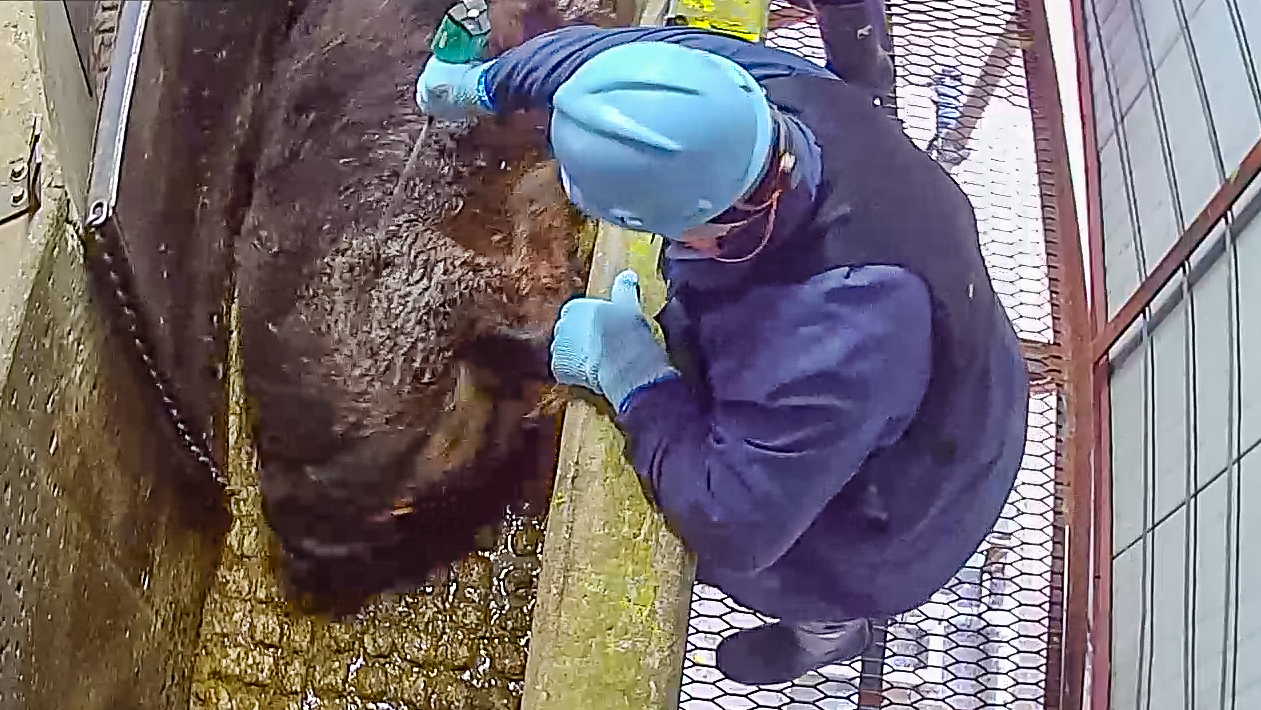
Other footage inside the facility shows additional violations of the Humane Methods of Slaughter Act via the routine misuse of an electric prod, including on “downed” cows (animals physically immobilized due to illness and/or injury) as well as cows waiting in a line to slaughter, with no physical space available to move forward. These violations constitute criminal animal cruelty under federal law.
Environmental Impact
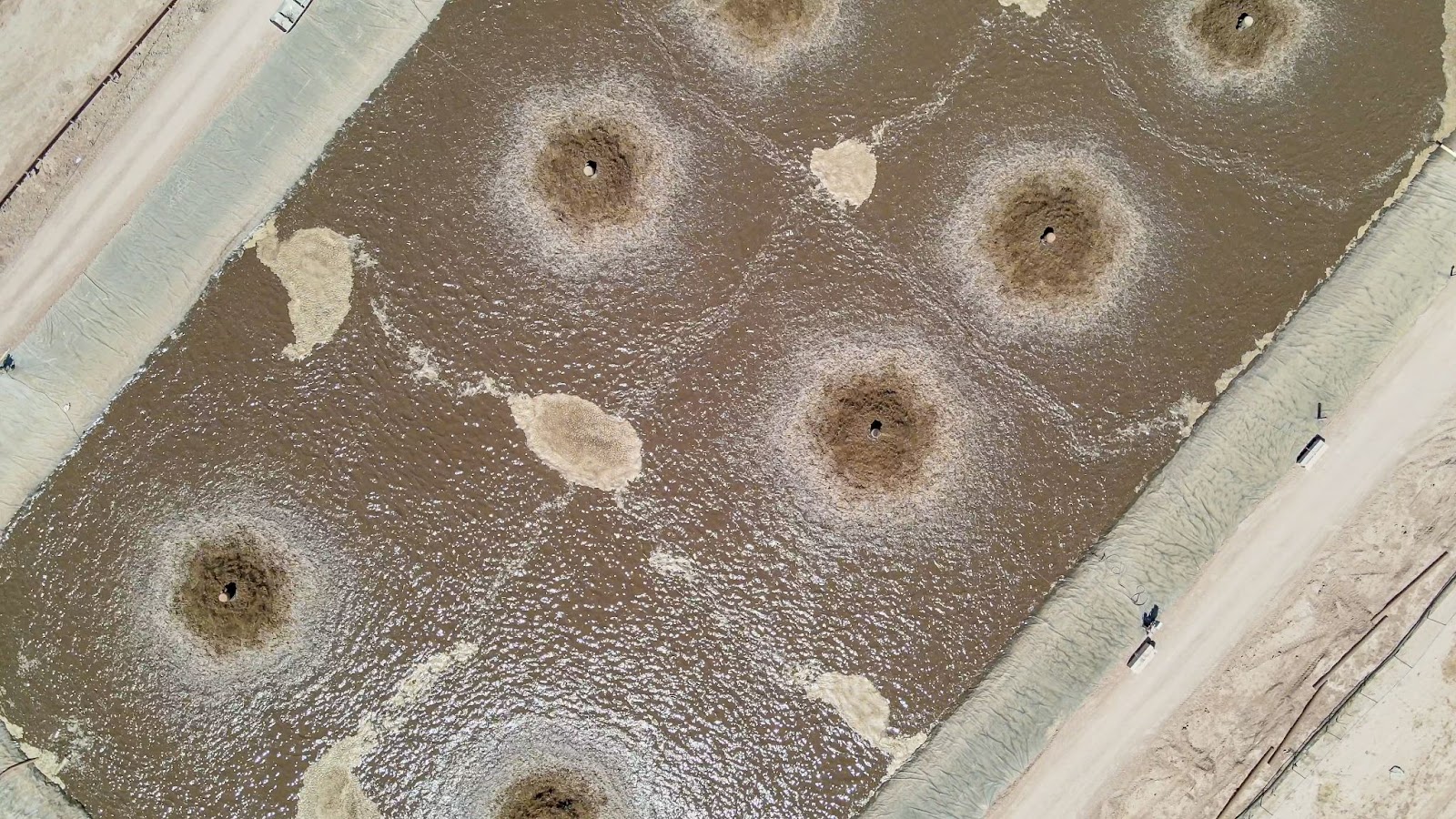
238,000 gallons of water per day is consumed and polluted by Brandt’s slaughterhouse alone. The Alamo river, one of only two major waterways in Imperial County, runs directly beside the Brandt Cattle feedlot northwest of Calipatria, and it is polluted by manure dust from the feedlot. The company uses an estimated 2 million gallons of water just to control the amount of dust in the air at its feedlot. In the Imperial Valley, the rate of asthma-related emergency room visits and hospitalizations for children is double the California state average.
The Lives of Brandt Cows

Calf Raising
Brandt uses exclusively male holstein calves, considered a byproduct of the dairy industry because they don’t produce milk. Male calves from dairy farms across the state are separated from their mothers and sisters at birth, and trucked to massive industrial calf raising operations like Grimmius Cattle in Tulare County.
At Grimmus, as is standard in calf raising operations, the typical crate stall is 2.5 x 4.5 ft. As calves approach 6 weeks old, they are barely able to turn around and lay down. Hutches are constructed side-by-side in long rows on top of concrete latrines which funnel into manure lagoons. This means, instead of bedding, the bottom of calf crates are made of open slats, often covered in diarrhea. The calves are crated for at least 6 weeks, drinking 2 gallons of “waste” milk or formula per day while being weaned onto a “calf starter” (a bucket full of flaked corn and soybean meal) before being moved to the “grow yard.”
Feedlots

On the Brandt feedlot, cows are kept in stationary pens, never allowed to leave or see pasture. The concentration of cows in a confined environment leads to the trampling and compaction of manure and dirt, creating immense amounts of dust. This dust is remediated by the use of sprinklers, consuming an estimated 2.3 million gallons of water per day. The average Brandt cow drinks over 7,000 gallons of water over their lifetime, averaging around 3 million more gallons consumed per day at the feedlot.
But the largest amount of water consumed by Brandt is the water used to grow their feed. Imperial Valley’s alfalfa growers, such as Brandt, consume more water than any other crop, even though much of Imperial Valley alfalfa is exported overseas and the United States relies on the Imperial Valley to grow 80% of its vegetables during winter. Each steer eats over 6,000 pounds of feed per year. Even at only 10% alfalfa (a minimum amount of forage necessary for rumen health in cattle), across 150,000 individuals, Brandt consumes another 43 million gallons of Imperial Valley water via alfalfa irrigation every day.
This means the Brandt operation is responsible for consuming at least 48.5 million gallons of California’s allotment of Colorado River water every day. Meanwhile, Californians are being asked to change their personal habits to use only 55 gallons per day.
Along with the immense amount of water used to grow the animals’ food, there are other negative effects of this unnatural diet. Cows who eat an industrial, grain-based diet often suffer from acidosis, a painful buildup of acid in their bodily fluids.
What Must Be Done
Instead of funding the expansion of factory farms and slaughterhouses, California should be halting this destructive expansion.
Californians overwhelmingly supported trailblazing animal welfare reforms in 2008 and 2018, but animal welfare legislation isn’t enough.
Bold, decisive action is needed to address the routine abuses of the animal agriculture industry. That’s why DxE launched the No More Factory Farms campaign, calling on California leaders to enact a moratorium prohibiting the construction and expansion of factory farms and slaughterhouses in the state.
In response to the No More Factory Farms coalition campaign, in February 2022, California Assemblymember Adrin Nazarian introduced Assembly Bill 2764 to enact a moratorium on the construction and expansion of commercial animal feeding operations and slaughterhouses in California, along with joint author Assemblymember Alex Lee.
California has passed moratoriums on evictions, debt repayments, offshore drilling, and even on the death penalty. Now is the right time for a moratorium on factory farms.
Download Your FREE Vegan PDF HERE
Order a FREE vegan kit HERE
Dairy-Free Info HERE
Take the Dairy-Free Challenge HERE
Click HERE for more Dairy-Free
Fish alternatives can be found HERE
Learn about eggs HERE
Find bacon alternatives HERE and HERE
Take PETA’s Cruelty-Free Shopping Guide along with you next time you head to the store! The handy guide will help you find humane products at a glance. Order a FREE copy HERE
Searching for Cruelty-Free Cosmetics, Personal-Care Products, Vegan Products, or more?
Click HERE to search.
Free PDF of Vegan & Cruelty-Free Products/Companies HERE
Click HERE to find out How to Wear Vegan!
Want to do more than go vegan? Help others to do so! Click below for nominal, or no, fees to vegan literature that you can use to convince others that veganism is the only compassionate route to being an animal friend:
PETA HERE
Vegan Outreach HERE
Get your FREE Activist Kit from PETA, including stickers, leaflets, and guide HERE
Have questions? Click HERE
A cow bleeds
A cow has needs
A cow is real
Like we humans
They feel
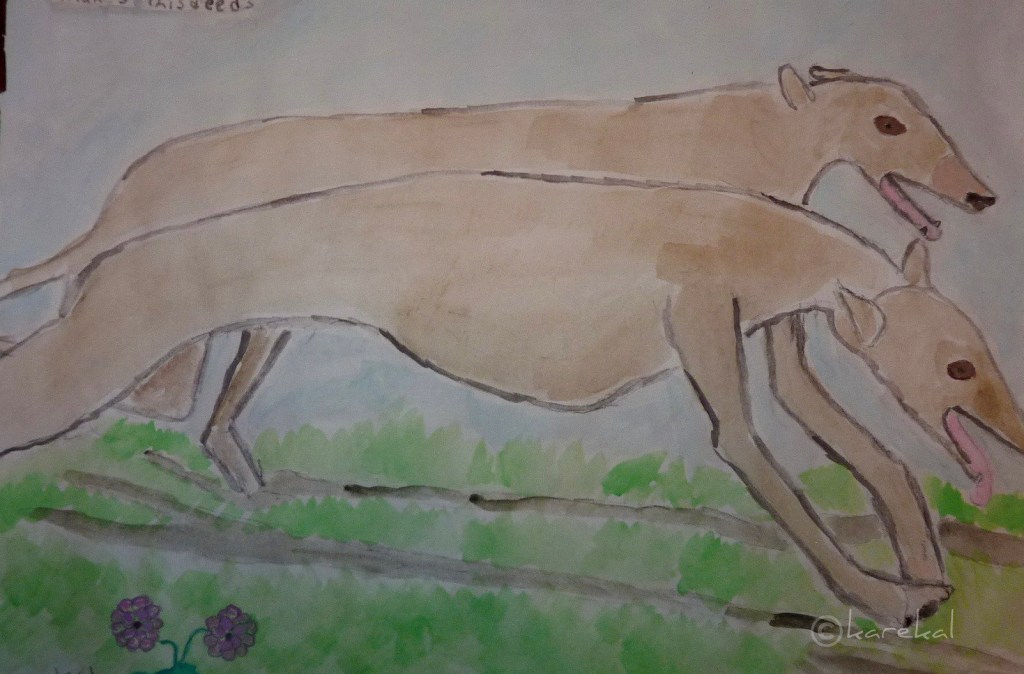
April is adopt a greyhound month
We are fast built for speed
Now we run from man’s misdeeds
We do not want to race
We want to sit beside you
And kiss your face
OMG, the moral outrage!!!
Source PETA UK
When these Londoners were asked to try a new milk, they were more than happy to offer praise for the creamy drink, but when a disturbing “fact” about the milk was revealed, everything changed. People were disgusted when they were told that the drink (which was actually soya milk) came from a dog. But if the thought of drinking dogs’ milk makes you feel ill, why drink the milk from any other animal?
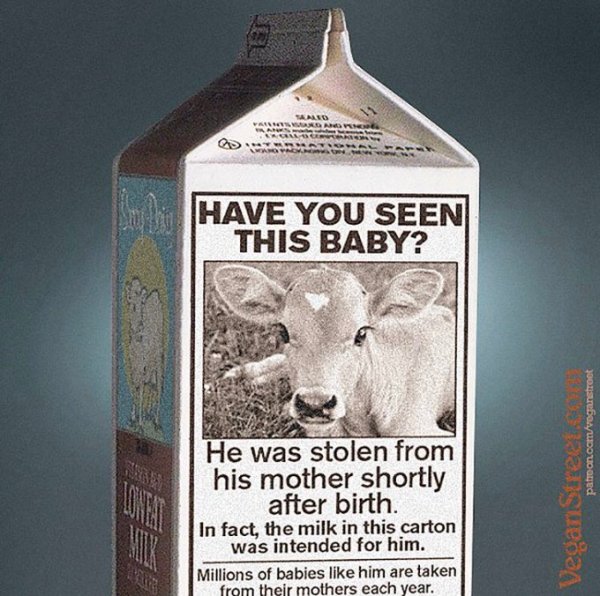
After all, there is nothing “normal” about artificially inseminating a cow and forcing her to give birth, only to tear her beloved calf away from her so that the milk that nature intended for her baby can be consumed by humans instead. Humans are the only species on the planet to drink another animal’s milk, and cows’ milk is no more natural for us than dogs’ or rats’ milk would be.
____________________________
So, if you “accidentally” drank dog’s milk, or cat’s milk, would you be angry? Pissed off? Morally outraged? You’re not the victim who’s forcibly impregnated, separated from her infants, and then violently killed.
Right?
Did you know there are actual industry video shorts on how to “safely” steal a calf from her mother, to protect the kidnapper from an angry and fearful mother trying to SAVE HER CHILD? Yeah, it’s all about how violent cows can be and how the farmer is just the innocent bystander risking bodily injury to nobly take an infant SO HUMANS CAN DRINK THE CALVES’ NATURALLY-INTENDED MILK INSTEAD.
What would YOU do if someone tried to take your child?
But what if, say, dogs were farmed for their flesh and for their breastmilk? Would that be ok? I mean, people say ALL THE TIME how much they love animals, but eat them, and farmers always say they care for the animals better than their own kiddos and then kill them. Right? Effing yikes.
So what about love for Fido or Fluffy or Lassie or Benji? Can you show THEM how much you care?
Find out more about this unique and dog-lover owned business venture at Elwood’s Organic Dog Meat
I bet you can also hear Sam Elliot proclaiming, “Dog. He’s what’s for dinner………………..”
(Be aware that due to some negative feedback they’ve received, ie., angry messages, hostile tweets, violent phone calls, death threats … they are monitoring their feedback more frequently, but want to let you know how important dogs are to them, and how much they love dogs like you love pigs, chickens, cows, lambs, so please keep an open mind and remember this is all for the love of animals.)
SL
Download Your FREE Vegan PDF HERE
Order a FREE vegan kit HERE
Dairy-Free Info HERE
Take the Dairy-Free Challenge HERE
Click HERE for more Dairy-Free
Fish alternatives can be found HERE
Learn about eggs HERE
Find bacon alternatives HERE and HERE
Take PETA’s Cruelty-Free Shopping Guide along with you next time you head to the store! The handy guide will help you find humane products at a glance. Order a FREE copy HERE
Searching for Cruelty-Free Cosmetics, Personal-Care Products, Vegan Products, or more?
Click HERE to search.
Free PDF of Vegan & Cruelty-Free Products/Companies HERE
Click HERE to find out How to Wear Vegan!
Want to do more than go vegan? Help others to do so! Click below for nominal, or no, fees to vegan literature that you can use to convince others that veganism is the only compassionate route to being an animal friend:
PETA HERE
Vegan Outreach HERE
Get your FREE Activist Kit from PETA, including stickers, leaflets, and guide HERE
Have questions? Click HERE
The lies we tell
So we believe
Cruelties ignored
Who do we really
Deceive










 Our Compass