HighestWelfare.Humane.Assured.GoodPractices.Vegetarian. Regenerative.Flexitarian.Lies...
What is the difference between No Welfare, High Welfare, and Highest Welfare when they all require animals to die? Only human comfort, NONE protect the actual animals. The most humane, ethical, and honest Webster-defined "welfare" is NOT exploiting animals - not using, not wearing, not eating, not killing - animals. The only meaningful position is vegan, everything else is just how humans euphemize animals' required suffering and violent deaths: no human exploits animals because they honestly believe that NOT exploiting animals is UNethical or INhumane.
Vegan Kindergarten
Published on Jul 10, 2014: A story by Israel’s Vegan News: Bar Sharon tells what motivated her to make her kindergarten vegan.
Source: GaryTV
See Gary Yourofsky’s full talk here:
Order a FREE vegan kit: http://www.peta.org/living/vegetarian-living/free-vegetarian-starter-kit.aspx
Take PETA’s Cruelty-Free Shopping Guide along with you next time you head to the store! The handy guide will help you find humane products at a glance. Order a FREE copy HERE
Want to do more than go vegan? Help others to do so! Click on the below for nominal, or no, fees to vegan literature that you can use to convince others that veganism is the only compassionate route to being an animal friend.
PETA: http://www.petacatalog.com/catalog/Literature-39-1.html
Action for Animals has a very low price : http://store.afa-online.org/home.php?cat=284
Have questions? Click HERE
Read more…
Inspiring action
Source Sunshine and Slaughter
I recently watched an interesting Ted Talk by Simon Sinek called How Great Leaders Inspire Action. The talk focused on such diverse leaders as the Apple computer company, Martin Luther King Jr., and aviation pioneers the Wright Brothers.
In the talk, Sinek said all great inspiring leaders–from business to social justice–think and act the same way. That is, the opposite to everyone else.
Sinek described what he calls The Golden Circle: Why, How, and what.

We all know what we do. Some people know how they do it, and very few people or organizations know why they do something.
Why is the purpose, cause or beliefs that we have. It’s the reason we get up in the morning and do what we do. Most people work from the outside in. But the inspired leaders work from the inside–from the why.
Working from the inside out also means we work using feelings and emotions first rather than analytical thinking.
As I listened, I couldn’t help think of the parallels between being a great leader and being a vegan. If you act based on what your soul tells you, you’re probably working from the inside out. If the stories of factory farmed animals tug at your heartstrings more than stats about the number of animals who suffer, you’re operating from the why.
Like leaders, vegans pursue something we believe in. And by doing so we can help others buy into the why and believe what we believe.
Sinek spoke about the Law of Diffusion of Innovation. A new term, perhaps, but you’ll recognize the concept.
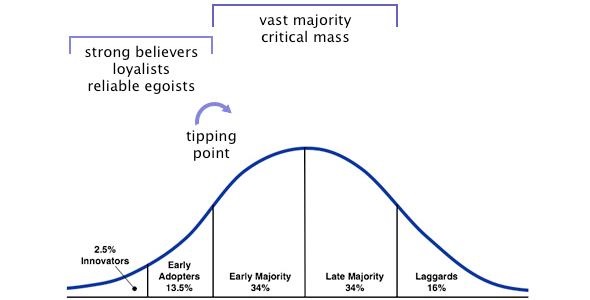
2.5% of people are innovators; 13.5% are early adopters; 34% are the early majority; 34% are the late majority; 16% are laggards.
If you want mass market success or acceptance of an idea, you can’t reach it until you reach the tipping point–between 15% and 18% market penetration. The early majority won’t try something until someone else has tried it first.
If you’re a vegan, you’re an innovator. You go against the grain and are comfortable making gut decisions and you’re driven by what you believe about the world.
Numbers vary, but about 2.5% of Americans are vegan (innovators). In our daily lives, we reach many people with our message–whether it’s overt leafleting and tabling or subtler ways of leading by example.
The vegan population is growing. What’s exciting to me is that as soon as the early adopters are on board and we reach the tipping point, the early majority will join in as well. From that point, veganism will snowball. This model applies to business models as well as social justice movements like civil rights.
People don’t buy what you do, they buy why you do it. What vegans do is the proof of why we believe. And if others learn about veganism and believe being vegan is the best way to stop cruelty, feed the world, stay healthy, and save the environment, they’ll be vegan too. But they won’t do it because you are vegan. They’ll do it because they believe it’s right. They’ll do it for themselves.
You don’t need to be a leader to lead. You don’t need to hold a position of authority to inspire others. Others will follow those who lead because they want to, not because they have to. Those who start with why will inspire others and find others who inspire them.
The talk wasn’t about veganism but it’s a perfect fit. To listen to the presentation (it’s a quick 18 minutes), check out the Ted Talk link (or see above).
Order a FREE vegan kit: http://www.peta.org/living/vegetarian-living/free-vegetarian-starter-kit.aspx
Take PETA’s Cruelty-Free Shopping Guide along with you next time you head to the store! The handy guide will help you find humane products at a glance. Order a FREE copy HERE
Want to do more than go vegan? Help others to do so! Click on the below for nominal, or no, fees to vegan literature that you can use to convince others that veganism is the only compassionate route to being an animal friend.
PETA: http://www.petacatalog.com/catalog/Literature-39-1.html
Action for Animals has a very low price : http://store.afa-online.org/home.php?cat=284
Have questions? Click HERE
Read more…
Cat And Lynx Become Inseparable Friends
OC: I don’t support zoos; they deprive animals of their natural environments and cause them to disintegrate into boredom, loneliness, and lack of physical interaction. However, I wanted to share this video in the hopes that people can realize that humans need to look to animals to learn how to act: animals teach US and not the other way around. And yet we still deprive them of what they so deserve and should have above all: their freedom.
Source Love Meow
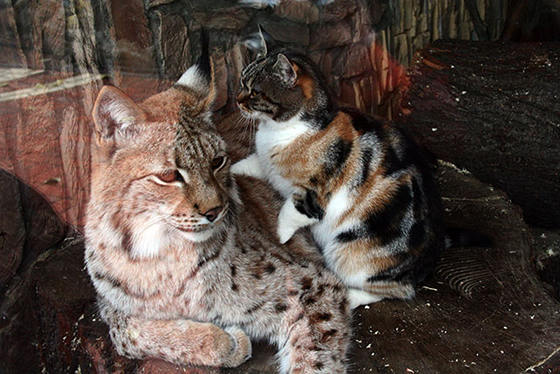
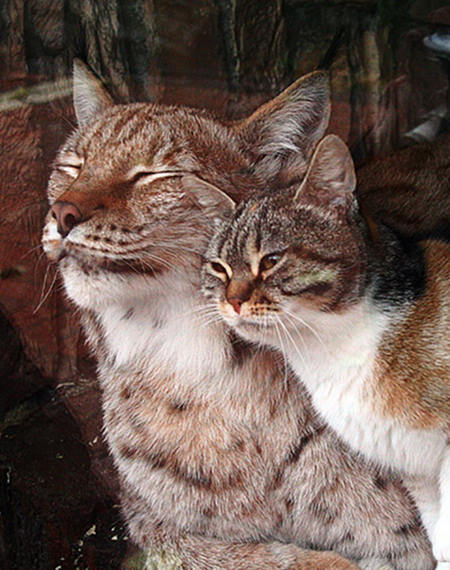
An European Lynx had a feline friend who came to visit her everyday at the Leningrad (St Petersburg) Zoo, the oldest zoo in Russia. The calico cat bonded with the Lynx on the first day they met. They have been inseparable since. Now they are living together at the Zoo.
According to the local people, the calico was homeless and happened to find food in the lynx’s enclosure. The lynx did not reject her, rather she became her best friend. It seems as if the cat needs the lynx as much as she needs her. The zoo adopted the cat so that she and her lynx friend could live together.


Order a FREE vegan kit: http://www.peta.org/living/vegetarian-living/free-vegetarian-starter-kit.aspx
Take PETA’s Cruelty-Free Shopping Guide along with you next time you head to the store! The handy guide will help you find humane products at a glance. Order a FREE copy HERE
Want to do more than go vegan? Help others to do so! Click on the below for nominal, or no, fees to vegan literature that you can use to convince others that veganism is the only compassionate route to being an animal friend.
PETA: http://www.petacatalog.com/catalog/Literature-39-1.html
Action for Animals has a very low price : http://store.afa-online.org/home.php?cat=284
Have questions? Click HERE
Read more…
Humane Meat: Taste the Happy
OC: If you substituted human animals for non-human animals, would you still categorize it as humane? I didn’t think so. So why is it okay to exploit, traumatize, cause suffering and extreme pain for non-human animals? Watch below and determine just WHAT the definition of “humane” really entails, and remember that the only “humane” is veganism.
Source PETA
So, as you’ve probably figured out, there is no such thing as “humane meat.” On “humane,” “grass-fed,” and “organic” farms, animals are still subject to cruel industry standards: severe crowding, physical mutilation, and a terrifying death. The only “humane meat” is no meat at all. Try vegan!
Order a FREE vegan kit: http://www.peta.org/living/vegetarian-living/free-vegetarian-starter-kit.aspx
Take PETA’s Cruelty-Free Shopping Guide along with you next time you head to the store! The handy guide will help you find humane products at a glance. Order a FREE copy HERE
Want to do more than go vegan? Help others to do so! Click on the below for nominal, or no, fees to vegan literature that you can use to convince others that veganism is the only compassionate route to being an animal friend.
PETA: http://www.petacatalog.com/catalog/Literature-39-1.html
Action for Animals has a very low price : http://store.afa-online.org/home.php?cat=284
Have questions? Click HERE
Read more…
On Speciesism and Token Gestures
Wikimedia Commons
Source My Face Is On Fire
The bottom line is that for any animal advocacy to bring about meaningful long-term change for the billions killed each and every year for human pleasure, it needs to address speciesism. Convincing someone to give up beef for climate change, fishes to save the oceans, or meat on one day a week for personal health? It merely persuades people to make token gestures for themselves — often just temporarily — rather than to initiate meaningful permanent change for other animals. People are left feeling better about choosing the other animal products they’ll invariably choose to replace the ones they may omit or use less often. They become convinced that those other options are better or more ethical choices. They’re left feeling good that they’ve done “enough” – and hey, if animal advocates are patting them on the back for it, then surely they’re doing enough, right?
Some animal advocates argue that “something is better than nothing”, assuming that getting non-vegans to shuffle animal products around is actually “something” in the first place. How is it “something” if instead of having a burger for lunch on Meatless Monday, someone instead has an omelet? How is it “something” if someone decides to stop consuming beef, but instead chooses to eat chickens or fishes? And why this false dichotomy, as if the only two options available in animal advocacy result in varying degrees of the continued deliberate exploitation of others? Is it not incredibly arrogant for us to think that although a message got through to us and we went vegan that the same could not possibly occur with others?
Those advocates insist that getting non-vegans to “lower” their animal consumption is some sort of “step in the right direction”, when the truth is that unless that direction is towards veganism, there are no actual “steps” being taken. When we try to persuade non-vegans to make small token gestures for themselves – for their health, their environment – rather than attempt to persuade them to make meaningful changes for the sake of those billions of others whose lives we steal each and every year, we are bargaining away the lives of innocents. Without addressing the underlying problem of speciesism and turning people’s focus to those others, we have no hope of seriously shifting the status quo.
Worse is that when animal advocates convey to the public that veganism is “too hard” and applaud token gestures, they actually leave the general public less willing to hear and weigh animal rights advocacy and an actual vegan message. After all, why would they listen when they’ve been told that they’ve already done enough? This is the horrible damage caused by groups like Vegan Outreach and all of the other large welfarist groups who pump their fists in the air over false victories. This is the horrible damage which we’re left to undo.
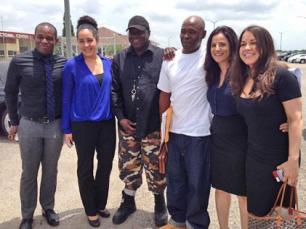
Photo: Nathan Brown (white shirt) with exoneree Michael Williams (black hat) and his legal team. – Innocence Project
Source Innocent Project
Nathan Brown walked out of a Louisiana state prison a free man last week after a Jefferson Parish judge overturned his conviction for attempted rape and the District Attorney agreed that he was factually innocent. DNA testing of crime scene evidence proved that he is innocent and matched to an alternative suspect, a man who is currently serving a sentence for a felony in Mississippi and who, at the time, lived only a few blocks away from the crime scene.
In August 1997, a woman was attacked from behind in the courtyard of her apartment building. The perpetrator bit the victim’s neck, ripped off her dress and took her purse before she was able to fend him off, at which point he fled, leaving the complex on a bike. The victim told police, who had been summoned by neighbors that heard the victim’s screams, that she had been attacked by a black man who was wearing black shorts and no shirt.
Police knocked on Nate’s door just minutes after the crime. He was in his bedroom wearing pajamas, rocking his young daughter to sleep. The officers had him change into black shorts and remove his shirt and then conducted what is called a one-on-one “show-up,” a highly-suggestive identification procedure in which a single suspect is presented to the eyewitness at either the site of the arrest or near the site of the crime. The victim identified Nate as the man who attacked her.
Nate’s mother retained a private attorney to represent him who provided a less than effective defense and didn’t even meet with Nate until the day his trial was set to start. Despite having four alibi witnesses who placed him at home with his daughter when the crime was occurring, Nate was convicted based on the victim’s identification and sentenced to 25 years for the crime.
Nate, who has always maintained his innocence, contacted the Innocence Project, which, with the cooperation of the Jefferson Parish District Attorney’s office, conducted DNA testing of the victim’s dress. Male DNA found in four different locations on the dress excluded Nate and matched to another man, currently in prison in Mississippi on a felony conviction but who lived just blocks away from the victim’s apartment complex at the time.
By the time of his exoneration last week, Nate had served nearly 17 years for a crime that he did not commit. Read more.
Frogs and Turtles in Maryland Need Your Voice
Wikimedia Commons
BACKGROUND | SOURCE PETA
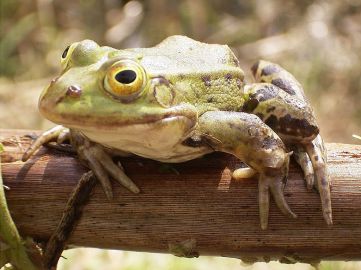
Each year, frogs and turtles are taken from their natural habitats and cruelly subjected to “Frog Jumping” and “Turtle Derby” games at Bel Air Independence Day. They are surrounded by screaming crowds, roughly handled, and relentlessly goaded into making their way across a dry, dusty slab of concrete. This chaotic ordeal would obviously be terrifying for both frogs and turtles, who view humans as predators, and it is potentially harmful. Frogs can have respiratory problems since they breathe through their skin and therefore must remain clean and moist—one local conservationist even stated that “a lot of frogs get injured in the jump.” And because of their slow metabolism, turtles can take weeks or even months to heal from injuries. Your voice is needed!
Please urge the Bel Air Independence Day Committee to cancel these cruel events permanently and replace them with activities that don’t involve live animals. And please forward this alert widely!
WHOM TO CONTACT
Individual:
Don Stewart, President and Chair
Bel Air Independence Day Committee
Info@BelAirLions.org
Michael Blum, Vice President and CEO
Bel Air Independence Day Committee
michaelblum@martinoblum.com
Block:
Info@BelAirLions.org ; michaelblum@martinoblum.com
Please email the following in a separate online contact, and only include Dear President Conway:
Althes Conway, President
Bel Air Kiwanis Club
To send an e-mail, please click here.
SAMPLE LETTER
Dear President and Chair Stewart and Vice President and CEO Blum:
Or
Dear President Conway:
Each year, frogs and turtles are taken from their natural habitats and cruelly subjected to “Frog Jumping” and “Turtle Derby” games at Bel Air Independence Day, and I respectfully request that these cruel games cease. Please allow me this opportunity to explain.
Frogs and turtles are surrounded by screaming crowds, roughly handled, and relentlessly goaded into making their way across a dry, dusty slab of concrete. This chaotic ordeal would obviously be terrifying for both frogs and turtles, who view humans as predators, and it is potentially harmful. Frogs can have respiratory problems since they breathe through their skin and therefore must remain clean and moist—one local conservationist even stated that “a lot of frogs get injured in the jump.” And because of their slow metabolism, turtles can take weeks or even months to heal from injuries.
Please cancel these cruel events permanently and replace them with activities that don’t involve live animals.
Thank you for taking the time to consider this urgent appeal.
Order a FREE vegan kit: http://www.peta.org/living/vegetarian-living/free-vegetarian-starter-kit.aspx
Take PETA’s Cruelty-Free Shopping Guide along with you next time you head to the store! The handy guide will help you find humane products at a glance. Order a FREE copy HERE
Want to do more than go vegan? Help others to do so! Click on the below for nominal, or no, fees to vegan literature that you can use to convince others that veganism is the only compassionate route to being an animal friend.
PETA: http://www.petacatalog.com/catalog/Literature-39-1.html
Action for Animals has a very low price : http://store.afa-online.org/home.php?cat=284
Have questions? Click HERE
James Cameron-Backed School To Terminate Meat And Dairy

Wikimedia Commons: vegan sandwich
Source NPR
By Eliza Barclay
As we’ve been reporting, the quest to get more fruits, vegetables and whole grains into public schools has once again gotten political.
But in spite of the new federal standards for school nutrition, “changing a school lunch cafeteria, especially those that participate in the National School Lunch Program, it is like turning around the Titanic,” says Susan Levin, director of nutrition for the Physicians Committee for Responsible Education.
However, if you happen to have performed in the movie Titanic, such as Suzy Amis Cameron did, and you happen to have founded a private school that you and your world-famous director husband support, as Amis Cameron also has, then maybe revamping a school cafeteria isn’t such a tall task. You might even be able to eliminate meat and dairy altogether, and create the first plant-based school in the U.S.
A lot of schools lately have been making incremental changes toward more plant-based options, says Levin. Take the Meatless Monday program, which is now in hundreds of K-12 public and private schools. One public school, P.S. 24, in Flushing, N.Y., even went completely vegetarian.
But Amis Cameron’s plan for MUSE School CA, the environmentally focused school in Calabasas, Calif., that she founded with her sister, Rebecca Amis, in 2006, is even more ambitious.
“We are gradually moving toward a plant-based menu because we do call ourselves an environmental school,” Amis Cameron tells The Salt. “Within the next year and a half, we will be plant-based.”
Private schools like MUSE School CA, of course, have a lot more flexibility when it comes to deciding what goes on, and what comes off, the menu.
Already, the school has a strong seed-to-table program that’s producing fresh fruits and vegetables grown by its 140 students. They’re guided by the school’s full-time, year-round gardener and educator, Paul Hudak.
He and students at the school’s two campuses in Malibu Canyon have built 28 raised beds to grow peppers, greens, tomatoes, herbs and other edibles, plus flowers. The older students will also be selling some of the food grown over the summer to local restaurants.
Hudak says now that the schools are growing produce year-round, they can supply up to 20 percent of the food consumed in the cafeterias, depending on the season. “Once we really get cranking, I think we’ll be up to 40 or 50 percent,” Hudak says.
The Origins Of MUSE School CA
Food played a role in sparking Amis Cameron’s motivation to start the school in the first place. She and her husband, James Cameron, one of the world’s most successful directors (yes, Avatar, the Terminator films and Titantic), have five children, including one from her previous marriage. The family splits its time between their home in Malibu, their ranch in Santa Barbara and their 3,500-acre farm in New Zealand.
As she phased out modeling and acting in the late ’90s, Amis Cameron focused on her children and their education. And as she did, she says, she became increasingly frustrated with the schools they were in: “They were really wanting to put our children in a box.”
Then, in 2005, Amis Cameron was driving her 4-year-old daughter home from school and heard her daughter describe a math lesson with candy.
“The school she was going to — that touted itself as an environmental school — was teaching my child to count with M&M’s,” Amis Cameron says. “And everything in my life came to a screeching halt.”
She and James started talking about the possibility of starting their own school for their children and other kids whose parents were looking for an alternative to the schools in Malibu.
“Jim was trying to decide between doing more deep-ocean exploration, or make a little film called Avatar,” says Amis Cameron. “He decided to make Avatar, and I decided to start MUSE. And off we went in our different ventures. Now, nine to 10 years later, it’s all coming full circle, dovetailing.”
While MUSE School CA has grown to 140 students — two are Camerons, and half receive financial aid — it’s still not an accredited school, though Amis Cameron says they’re working on that.
She and her sister, Rebecca, have tried to walk the sustainability talk on campus, using recycled materials to build the classrooms, installing solar “flowers” designed and donated by James to power the school with renewable energy, and by hiring a resident falconer whose hawks eat rodents and eliminate the need for pesticides.
The Camerons Go Vegan
Over time, the Camerons’ environmentalism — which features heavily in the ecological destruction narrative of Avatar — has become more and more centered around food.
The turn happened, Amis Cameron says, when the couple went vegan in 2012 after watching the documentary Forks Over Knives. The film emphasizes the health benefits of a plant-based diet, and that initially compelled them to empty the cupboards and fridges of all dairy and meat products.
“But what has really been a major eye opener is the connection between food and the environment,” says Amis Cameron. “Now, we’re benefiting greatly from eating plant-based, as are our children, but the environmental piece has become really our sole focus.”
Specifically, Amis Cameron says, she’s appalled by all of the water and grain it takes to produce meat and dairy, and all of the greenhouse gas emissions, waste and pollution that production generates. And everything she’s learned lately about animal products and the environment has coalesced into a singular conviction: “You can’t really call yourself an environmentalist if you’re still consuming animals. You just can’t.”
While there is a consensus that the meat industry has taken a heavy toll on the environment, few people agree on what to do about it.
And many environmental scientists are not convinced the solution is for everyone to give up animal products — especially people in the developing world who haven’t had ready access to them.
One recent study we reported on argued that to prevent more greenhouse gas emissions from the livestock sector, we’ll get the biggest bang for the buck by helping producers become more efficient and keeping land from being converted for grazing. The researchers say that while consumers in rich countries could stand to eat less meat, it’s not realistic to expect us to give it up entirely.
“It’s not a matter of giving up meat. It’s a matter of shifting to other kinds that have less climate impacts,” one scientist told us. So, not as much beef and pork, and maybe more farmed fish and insects.
But Amis Cameron, like a lot of other activists we’ve interviewed, argues that avoiding animal products is still the most powerful decision a consumer can make — more significant than buying a hybrid car or LED light bulbs.
In addition to transforming MUSE School CA into a vegan school, Amis Cameron is writing books on the environmental impacts of meat production for different demographics — moms, teens, children and thought leaders, she says. The Camerons also regularly give speeches where they talk about their newfound veganism and why they’re primarily motivated by concern for the planet.
“Any extra bandwidth that we have is spent on that piece and … bringing that message out into the world,” she says. “We have an amazing platform.”
But even with all their influence, Amis Cameron admits that it hasn’t been easy to convince other parents at MUSE School CA that the chicken, turkey and cheese currently served at the school have to go.
“Food is a very sensitive subject for so many people,” she says. “People have their cultural reasons for eating meat, their traditional reasons, their likes and dislikes. But slowly we are offering educational programs through MUSE, for not only the children, mainly for the grownups, because the children, they live and breath [the environmental way] already.”
Is Vegan Healthy For Kids?
Levin of PCRM says that a vegan diet can be healthy for kids — even the Academy of Nutrition and Dietetics has ruled that kids can get everything they need from plants alone.
“Most people assume it’s so hard to make kids eat vegan — that it’s easier to give them the chicken nuggets and the milk, and the cheese,” says Levin. “But I don’t think anyone could defend that they would be less healthy by not consuming animal products.”
And while Levin sees MUSE School CA’s move toward a vegan menu as an anomaly, she says she applauds what Amis Cameron is doing.
“They might be in a privileged position to advocate for dietary choice, but it ultimately shows other people how effective it is,” says Levin.
And, Levin adds, many plant-based foods, like rice and beans, aren’t prohibitively expensive for schools. “It shouldn’t be an entitled program. You don’t have to be rich to be plant-based.”
The Camerons were the initial MUSE School CA donors, and continue to supply startup funds as the school has expanded from elementary to middle to a high school slated to open this fall. But Amis Cameron says the plan is for the school to become self-sustaining.
“We’ve capped what we give, and we decrease the amount every year,” she says. “But, gosh, it’s a great place to be a philanthropist.”
Order a FREE vegan kit: http://www.peta.org/living/vegetarian-living/free-vegetarian-starter-kit.aspx
Take PETA’s Cruelty-Free Shopping Guide along with you next time you head to the store! The handy guide will help you find humane products at a glance. Order a FREE copy HERE
Want to do more than go vegan? Help others to do so! Click on the below for nominal, or no, fees to vegan literature that you can use to convince others that veganism is the only compassionate route to being an animal friend.
PETA: http://www.petacatalog.com/catalog/Literature-39-1.html
Action for Animals has a very low price : http://store.afa-online.org/home.php?cat=284
Have questions? Click HERE
Read more…
Morrissey New Song ‘The Bullfighter Dies’
“The Bullfighter Dies” is one song from Morrissey’s upcoming album World Peace Is None Of Your Business. The album is due to hit stores on July 15. (Music Times)
Order a FREE vegan kit: http://www.peta.org/living/vegetarian-living/free-vegetarian-starter-kit.aspx
Take PETA’s Cruelty-Free Shopping Guide along with you next time you head to the store! The handy guide will help you find humane products at a glance. Order a FREE copy HERE
Want to do more than go vegan? Help others to do so! Click on the below for nominal, or no, fees to vegan literature that you can use to convince others that veganism is the only compassionate route to being an animal friend.
PETA: http://www.petacatalog.com/catalog/Literature-39-1.html
Action for Animals has a very low price : http://store.afa-online.org/home.php?cat=284
Have questions? Click HERE
Wikimedia Commons
Source Grist
By Sarah Miller
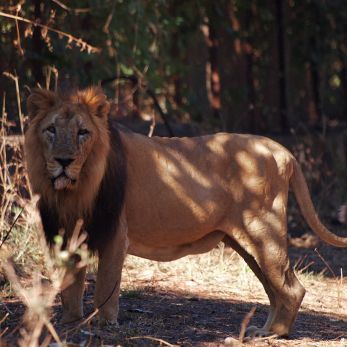
A 12-year-old girl kidnapped by a group of seven men in the Ethiopian city of Bita Genet was found several days after her abduction, safe under the watchful eyes of three lions. Not only were the lions guarding her, they allegedly chased off her captors.
The girl was reportedly abducted by the seven men with the idea that she would be forced into marrying one of the them. According to the United Nations, about 70 percent of the marriages taking place in Ethiopia are the result of similar kidnappings. And nearly 100 percent of those abduction-marriages are not thwarted by kindly wildlife.
While it is certainly within reason to consider this a miracle, a wildlife official did point out that the lions — who guarded the girl for about a half day — may have heard her crying and mistaken her for a cub. Interesting theory, but don’t lions know the difference between a Person and a Furry Thing that Looks Just Like Them? Although who wants to complain? It’s such a great story.
It’s so great, in fact, that Twitter is going nuts about it today even though this event took place and was reported on in 2005. Possibly because there’s been so much rape in the news lately, and it’s nice to hear a story with a happy ending. Or maybe we just like stories where animals behave in the noble, humane way we wish people would.
Order a FREE vegan kit: http://www.peta.org/living/vegetarian-living/free-vegetarian-starter-kit.aspx
Take PETA’s Cruelty-Free Shopping Guide along with you next time you head to the store! The handy guide will help you find humane products at a glance. Order a FREE copy HERE
Want to do more than go vegan? Help others to do so! Click on the below for nominal, or no, fees to vegan literature that you can use to convince others that veganism is the only compassionate route to being an animal friend.
PETA: http://www.petacatalog.com/catalog/Literature-39-1.html
Action for Animals has a very low price : http://store.afa-online.org/home.php?cat=284
Have questions? Click HERE
Read more…
How I Found My Way To Veganism

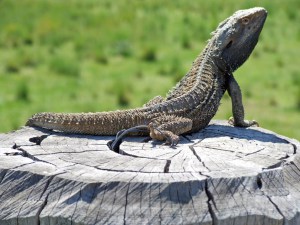
From early childhood, I’ve always had an interest in other animals. When I was a child in the ’60s, small frill-necked lizards dotted our old wooden fence. I loved to watch them and on occasion I would pick them up to look closer. Occasionally there would be a very large Bearded Dragon in our yard. My interest in our nonhuman residents was more than a superficial fascination with their appearance. I would find solace in their company. I’ve always felt different to others and I wonder if perhaps it was because I was adopted. I think in some odd way, I identified with my nonhuman friends and their obvious difference. Even at that early age, as I observed them, I remember wondering what they might be experiencing, what they might be feeling, what they thought of me, and so on.
 As with most Australian families, my parents bought us “pets”…
View original post 3,406 more words
URGENT: Ask New York Officials to Stop Massacring Geese
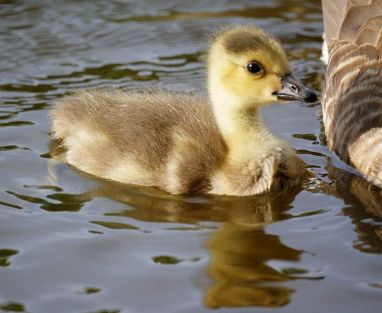
Wikimedia Commons
BACKGROUND
U.S. Department of Agriculture (USDA) documents reveal that more than 3,650 geese in the vicinity of New York City airports were rounded up and killed by the agency in the past five years alone, yet it has not recommended humane controls to prevent more birds from flying in and taking up residence. Consequently, the city is caught in a vicious, expensive, and endless killing cycle (which guarantees continued funding for the USDA), and despite an intense public outcry, another annual massacre is apparently proceeding. Helpless molting and flightless birds will again be snatched up, forced into crates, and trucked to slaughter—a terrifying ordeal for any wild animal but especially for a sensitive “prey” species. Such measures also tear families apart and leave orphaned young at great risk. Your voice is desperately needed!
Please urge New York City officials to stop contracting with the USDA to have geese killed and instead employ tried-and-true humane control measures. And then forward this e-mail widely!
WHOM TO CONTACT
Polite comments can be directed to:
Block:
mtarlow@cityhall.nyc.gov; pfoye@panynj.gov
Individual:
Mindy Tarlow
Director, Mayor’s Office of Operations
New York City
mtarlow@cityhall.nyc.gov
Patrick J. Foye
Executive Director
Port Authority of New York & New Jersey
pfoye@panynj.gov
SAMPLE LETTER
Dear Director Tarlow and Executive Director Foye:
I am extremely alarmed to learn of New York City’s decision to cruelly massacre geese via USDA agents. I respectfully request suspension of this violent strategy.
Please allow me to elaborate. First, killing geese does nothing to modify landscapes and waterways that attract them in the first place. I encourage officials to work with avian experts on population stabilization and site aversion.
Second, sweeping eradication does not reduce long-term growth. Killing geese artificially increases food supplies to the remaining geese, the consequence of which is increased reproduction and an ensuing greater population. In fact, studies have demonstrated that the continual cycle of seasonal eradication is responsible for a rebound, or larger gaggle populations, in subsequent years.
Third, using such barbaric strategies in such visible locations will most certainly affect visitation: agents typically enter the pond area during early morning, roughly separating goslings from parents, and then stuff the bound, panicked geese and babies into crates. Next, the geese are gassed or shot to death. In fact, although I do not currently reside in New York, I would be unwilling to consider it, or a nearby location, for tourist purposes if this cull ensues.
Please practice compassion and integrity: let the geese live and institute responsible policies that promote respect and tolerance of wildlife, and commit to habitat/landscape modification as outlined in Friends of Animals’ Canada Goose Habitat Modification Manual, https://friendsofanimals.org/sites/default/files/Goose%20Habitat.pdf in addition to instituting humane control measures.
Thank you for taking the time to consider this urgent appeal.
NAME
Order a FREE vegan kit: http://www.peta.org/living/vegetarian-living/free-vegetarian-starter-kit.aspx
Take PETA’s Cruelty-Free Shopping Guide along with you next time you head to the store! The handy guide will help you find humane products at a glance. Order a FREE copy HERE
Want to do more than go vegan? Help others to do so! Click on the below for nominal, or no, fees to vegan literature that you can use to convince others that veganism is the only compassionate route to being an animal friend.
PETA: http://www.petacatalog.com/catalog/Literature-39-1.html
Action for Animals has a very low price : http://store.afa-online.org/home.php?cat=284
Have questions? Click HERE
![HEALTH: Neil became a veggie at 13 for ethical reasons [PH]](https://our-compass.org/wp-content/uploads/2014/06/114836.jpg?w=360&h=498)
HEALTH: Neil became a veggie at 13 for ethical reasons [PH]
By Sarah Barns
During the 2010 World Cup England footballers were put on a sex ban to improve their performance. Now vegan former player Neil Robinson thinks they should be put on a meat-free diet to help up their game.
“I think that the World Cup team would get great benefit from adopting this kind of diet.”
Rooney, Gerrard and co currently follow a diet rich in chicken, fish and pasta.
After moving to Swansea City FC in 1980, Neil extended his moral stance for animals by becoming vegan.
Neil was the first player to demonstrate that a vegan diet could be highly beneficial for professional football players at all levels.
He retired from professional football in 1990 and stayed vegetarian and then vegan throughout his entire professional playing career.
Neil will be appearing at VegfestUK London. See london.vegfest.co.uk.
Order a FREE vegan kit: http://www.peta.org/living/vegetarian-living/free-vegetarian-starter-kit.aspx
Take PETA’s Cruelty-Free Shopping Guide along with you next time you head to the store! The handy guide will help you find humane products at a glance. Order a FREE copy HERE
Want to do more than go vegan? Help others to do so! Click on the below for nominal, or no, fees to vegan literature that you can use to convince others that veganism is the only compassionate route to being an animal friend.
PETA: http://www.petacatalog.com/catalog/Literature-39-1.html
Action for Animals has a very low price : http://store.afa-online.org/home.php?cat=284
Have questions? Click HERE
Read more…
SeaWorld to Its Critics: ‘OK, Let’s Talk’
Whatever words,
Whatever their
Spin,
We all know the truth
Beneath their lies
And din
Karen Lyons Kalmenson
Oh, how they lie and deceive!

Vegan Publishers: Christopher-Sebastian McJetters
Source Vegan Publishers
By Christopher-Sebastian McJetters
For this week’s blog we are thrilled to post an excerpt from our upcoming book: “Circles of Compassion.” (Please visit https://www.indiegogo.com/projects/circles-of-compassion-connecting-issues-of-justice to donate to this amazing cause and even get a copy of the book!) The author, Christopher-Sebastian McJetters, is a talented up-and-coming vegan writer who sheds light on a difficult and uncomfortable topic- the connection between human and animal slavery.
Slavery. It’s Still a Thing.
By Christopher-Sebastian McJetters
Hey, everyone. I’m a black guy! I know it’s probably obvious to some of you when you look at me. But some people don’t see race. So I have to make it clear. Otherwise, this fact will escape them entirely.
Very recently, I rounded up a group of people and asked them a simple question: “Why do we consume animals?” The responses were as simple and concise as the question itself:
“Because I like it.”
“They’re not like us.”
“We’re just superior.”
“We have higher intelligence.”
“It’s perfectly natural.”
“God put them here for us.”
“We’re more important.”
“They don’t feel pain the same way we do.”
“It’s just an animal.”
“They don’t reason or have complex emotions.”
“Because we can.”
“I NEED to.”
“I was raised on a farm. Nothing wrong with it. We’ve done it for generations.”
Okay, great! Second question then: “Why don’t we reinstitute slavery in the United States?”
SLAVERY?!
I always want to have a camera to record the expressions when I ask that question. Let’s think about it though. Are not all of these justifications the same ones that pre-Civil War Americans used to justify keeping African slaves?
Uh oh. Battle stations, everyone. I could almost see the mental wagons starting to circle. More than half of these people were Afro-American, and they were having none of my foolishness. Not even a little bit of it. But it wasn’t just the blacks. The white people in the group were looking uncomfortable too. The expression on their faces was priceless. Hoodwinked! I’d drawn these two disparate groups into a subject that dare not speak its name.
There was so much fidgeting in the room that I could no longer tell if we were having a discussion or if we had declared an impromptu interpretive dance.
This response is not uncommon. I’m used to it; American slavery is the elephant in the room. However, constructive dialogue is the only way we can ever heal systemic injustice. Ignoring it only serves to perpetuate the oppression. But this goes deeper than American slavery. It’s about the mindset that allowed American slavery to take root at all. At least everyone in the room could agree upon the fact that white folks should no longer be making black folks pick their cotton. Unfortunately, we seem to be perfectly comfortable with the captive breeding, torture, forced labor, and killing of others right now. But why?
If I were having this conversation 200 years ago with a white person about owning black people, I would be met with the same level of skepticism. Actually, no … this conversation would not have happened at all 200 years ago because I would be far too busy singing negro spirituals and shucking corn to articulate a position. But you get the picture. Why does one form of slavery get a pass, while we recognize the obvious violation of the other? And why do we get so doggone angry and uncomfortable when we identify these parallels?
Let’s take a moment to unpack some of our prejudices against others. Let’s look at some of the common visceral reactions experienced by people of color when discussing oppression. Let’s push past our current perceptions, and put ourselves in the place of the victims rather than the established system that advantages us.
How dare you compare black people and animals? Those two groups are nothing alike!
Allow me to make a point of clarification. Humans are animals. Whether or not you believe that we are conceived from a common ancestor with bonobos, we don’t exist outside of the animal kingdom. So it’s important to deconstruct the narrative that pits “us” against “them.” Also, let’s listen to the correct part of the conversation. This is not a comparison of human animals to non-human animals. This is a comparison of like systems of oppression. Whether talking about white humans and brown ones or horses and pigs, slavery is an abuse of power. That’s what we’re here to examine.
I wish you would stop saying slavery. It’s not the same thing.
Language is important. The very definition of slavery is the treatment of one group as property to be bought, sold, and forced into work by another group. If non-human animals are not slaves, are they then free? There are not many animals I know of that exist within human society who voluntarily engaged in this system. Cows do not clock in and clock out. They don’t go home to their families. They don’t have conversations in the lunchroom. And the only retirement package available to them at the end of their painful lives is a violent death when their usefulness to us has run out.
Of course, coming to terms with the sobering reality of slavery is probably the most difficult mental hurdle to overcome when having these discussions. Because if we are forced to acknowledge that slavery is wrong and that non-humans are slaves, then we have a moral obligation to talk about abolition. The repercussions for our economic structure and, indeed, our way of life could be devastating. But I imagine it wasn’t easy for pre-Civil War Americans either.
I’m not a bad person. Are you calling me a slave owner?
In America’s historic narrative, it’s easy to paint slave owners as villains, and abolitionists as heroes. But slave owners were not all bad people. Likewise, racists are not all bad people. Racism and slavery are constructs that make otherwise good people engage in really bad behavior. Unfortunately, we were all born into this construct that privileges some of us over others. The key is to unlearn the conditioning that teaches us that any form of oppression is okay.
But comparing black ancestors to pigs is insulting and degrading, and it trivializes the oppression they went through.
Say it with me now—a comparison between like systems of oppression is not a comparison between two species of animal. But even if we were comparing marginalized groups of humans and non-humans, why do we find that offensive? At the root, most of us are insulted because we feel like we’re better than another group based on physical distinctions. This is discrimination. When one group of humans does it to another group of humans, we call it racism. When humans do it to non-humans, this is called speciesism.
Any criteria we use to establish dominance over or to except another group is discriminatory. See, the yardstick used to measure differences between “us and them” is always going to start “us” off at one-and-a-half inches. And a house built with false measurements is destined to fall down. The very act of seeking to point out our differences in a society is a rigged system designed by its very nature to determine who is better. Throughout American history, blacks have always found themselves the victims of a hierarchy that inherently favors whites. To that end, non-humans throughout the whole of history have suffered the same fate, and still do today with no end in sight.
Well what black people have suffered is far worse.
This is all a matter of perspective, isn’t it? From the standpoint of the victim, one could argue that what is happening to non-humans is actually much worse. During the 18th and 19th centuries, approximately 12.5 million Africans were shipped to the New World. Nearly 10 billion land animals alone are killed each year to produce meat, dairy, and eggs. And that’s just in the United States. That number increases to 65 billion globally (or 6 million every hour)[1]. So strictly by numbers, non-humans have Africans beat. It could also be argued that since this exploitation existed prior to the African slave trade and still exists now, it’s an aggression that deserves strong consideration.
But where is the value in tallying up who has suffered the greater injustice? Why should we choose to take on the narrative that one group has been more deeply aggrieved than another? Establishing a hierarchy of oppression only serves to help the oppressor. The better narrative—the stronger narrative—is in choosing to seek freedom for everyone. Otherwise, we’re only fighting for the right to oppress someone else. Solidarity is the key to establishing equality. Division only perpetuates more tyranny.
This is all well and good, but consuming animals is a personal choice. You’re forcing your beliefs on me.
Again, this is a matter of perspective. We should take a sober look at the kind of aggressions that are being perpetrated against non-humans. Their exploitation is so complete that it’s nearly invisible. Yes, they are our food. But they are also our wool sweaters, our leather shoes, our shampoo, our streets, our electronics, and even our home décor. Can we honestly say that it is our personal choice to take away the agency and sovereignty of someone else while simultaneously saying that American slavery was wrong? If holding up a mirror to expose our complicity in structural inequality toward non-humans is forcing beliefs, then so too did abolitionists force their beliefs on Americans to end the exploitation of black people.
I’m scared.
So am I. It takes a lot of work to unlearn a lifetime of conditioning that privileges certain groups. It’s equally scary when black people have discussions with white people involving race. But even though it makes us uncomfortable, it’s necessary. When we can adequately understand the space occupied by both those who benefit from privilege and those who are oppressed by it, we build a bridge that can liberate us from such inequality altogether. That’s why slavery matters to all of us. Regardless of our racial background, everyone is complicit in this system of persecution against non-human animals. And until we are truly present to the impact of harming the most vulnerable among us, we won’t be able to deconstruct how to stop doing harm to one another.
So how did this exchange end with all these nervous people desperate to distance themselves from their participation in slavery? Same as it always does. We got angry. We got sad. We placed blame. And then something amazing happened. We took responsibility. Did all of these people walk away choosing instantly to let go of their speciesism? No. But every one of them is now more aware. And raising awareness is where it all begins.
Racism hasn’t entirely been eradicated either. Fortunately, far fewer people exercise that choice. So we have these conversations. And we don’t give up.
Longtime vegan and social justice advocate Christopher-Sebastian McJetters lives in New York City with his rescue dog Orion. A copyeditor by profession, Sebastian is currently a staff writer at Vegan Publishers. In his spare time, he organizes events and discussions relative to exploring the intersectionality of veganism and other movements for social justice including women, the LGBT community, and people of color. He also bakes vegan cookies that are guaranteed to end wars, lower taxes, save marriages, and raise consciousness.
[1] http://farmusa.org/statistics11.html
Please also remember Circles of Compassion: Connecting Issues of Justice. To donate to this amazing cause, please visit https://www.indiegogo.com/projects/circles-of-compassion-connecting-issues-of-justice













 Our Compass