HighestWelfare.Humane.Assured.GoodPractices.Vegetarian. Regenerative.Flexitarian.Lies...
What is the difference between No Welfare, High Welfare, and Highest Welfare when they all require animals to die? Only human comfort, NONE protect the actual animals. The most humane, ethical, and honest Webster-defined "welfare" is NOT exploiting animals - not using, not wearing, not eating, not killing - animals. The only meaningful position is vegan, everything else is just how humans euphemize animals' required suffering and violent deaths: no human exploits animals because they honestly believe that NOT exploiting animals is UNethical or INhumane.
Source Bite Size Vegan
By Emily Moran Barwick
YouTube is trying to silence me! Help me fight social media censorship of the vegan message with one simple action. Censorship of the truth and bias against vegan accounts is yet another extension of our global society’s willful denial of what we are doing to animals and our planet. I refuse to buy the lie. I will never stop speaking up. In this video I discuss the disturbing undercurrent of social media censorship as a whole. Will you help me fight for truth?
▶︎➤ SHARE The Relaunch! (more resources below!)
➤➤PRE-MADE TWEETS:
➣ YouTube Trying to Silence Me: http://ctt.ec/zN1Be
➣ Call YouTube On Their Hypocrisy: http://ctt.ec/5c007
▶︎➤ FEATURED VIDEOS & RESOURCES:
➤➤SPEECH LINKS:
➣ The Original Speech Post (must be age-verified to view): http://bit.ly/VeganExtreme
➣ The Speech Re-Post: COMING June 15, 2016
➤➤ADDITIONAL RESOURCES:
➣ The Lie They’re Trying To Protect: http://bit.ly/GreatestLie
➣ All of My Recorded Speeches: http://bit.ly/1V66Pi0
➣ The Power of Propaganda: http://bit.ly/PropagandaPlaylist
➣ Criminalizing Activism & The AETA: http://bit.ly/HeroismOrTerrorism
➣ How We Justify This Abuse: http://bit.ly/25jRSyk
➣ OPEN YOUR EYES [My First Vigil With Toronto Pig Save]: http://bit.ly/OpenYourEyesToSee
➣ The Lie of “The Nicest Way To Die”: http://bit.ly/TheNicestWayToDie
➣ Do Animals Want To Be Eaten?: http://bit.ly/1VpPxMd
➣ The Food That’s Killing Us: http://bit.ly/RealKillers
➣ The Lies Doctors Tell: http://bit.ly/YourDoctorLies
⠀⠀⠀⠀⠀⠀⠀⠀⠀⠀⠀★★SUPPORT THIS ACTIVISM★★
⠀⠀⠀⠀⠀⠀(help keep the effective vegan education coming!)
⠀⠀⠀⠀⠀⠀⠀★★SUPPORT THE EDUCATION & Get Rewards!★★
⠀⠀Join the Nugget Army On Patreon: http://bit.ly/TheNuggetArmy
⠀⠀⠀⠀⠀⠀⠀⠀⠀⠀⠀⠀⠀⠀⠀⠀⠀⠀⠀⠀OR
⠀⠀⠀★ ★SUPPORT With A One-Time Donation★★
⠀⠀⠀⠀⠀⠀⠀⠀⠀⠀Info here: http://bit.ly/1MsskkA
Bite Size Vegan is veganism [simplified]. subscribe for fun, friendly, and fast fact-based information on how and why to live vegan!
★FREE eBook: http://bit.ly/Ebook4Free
★Subscribe: http://bit.ly/BiteSizeSubscribe
★Work With Me!: http://bit.ly/1vPNWQg
★Vegan Message T-Shirts!: http://bit.ly/1MP8aB9
★★Lost? Browse the Vegan Library of Awesome★★: http://bit.ly/1pzt2I5
Follow Me:
★Instagram: http://instagram.com/bitesizevegan/
★Twitter: https://twitter.com/BiteSizeVegan
★Facebook: https://www.facebook.com/BiteSizeVegan
★Tumblr: http://bitesizevegan.tumblr.com
★Google Plus: http://bit.ly/16BQDP7
★The Vegan Nugget Playlist!: http://goo.gl/x6RzBX
★Blog Post for This Video: http://www.BiteSizeVegan.com/YouTubeC…
▶︎Snail Mail◀︎(no snails used, cause that ain’t vegan!)
351 Pleasant St
Suite B #108
Northampton, MA,
01060, USA
[always confirm with the address in my channel’s “About” section (http://bit.ly/1Y2Fhsm) in case I’ve moved since this video!]
Copyright Disclaimer Under Section 107 of the Copyright Act 1976, allowance is made for “fair use” for purposes such as criticism, comment, news reporting, teaching, scholarship, parody, and research. Fair use is a use permitted by copyright statute that might otherwise be infringing. Non-profit, educational or personal use tips the balance in favor of fair use.
★★HELP TRANSLATE THIS VIDEO TO SPREAD THE VEGAN MESSAGE★★
This video’s captioning link:
http://bit.ly/21h6A2X
FOR INSTRUCTIONS & MORE PLEASE VISIT THIS DOCUMENT:
http://BiteSizeVegan.com/TranslationTeam TO SUBMIT TRANSLATED TITLES AND DESCRIPTIONS & TRACK CAPTIONING SO WE CAN REACH A GLOBAL AUDIENCE! THE DOCUMENT ALSO HELPS US STAY ORGANIZED IN THIS EFFORT.
Alternatively, you can use the Amara.org platform: [please still visit document listed above]
Help us caption & translate this video!
Source Bite Size Vegan
By Emily Moran Barwick
Order a FREE vegan kit: http://www.peta.org/living/food/free-vegan-starter-kit/
Take PETA’s Cruelty-Free Shopping Guide along with you next time you head to the store! The handy guide will help you find humane products at a glance. Order a FREE copy HERE
Want to do more than go vegan? Help others to do so! Click on the below for nominal, or no, fees to vegan literature that you can use to convince others that veganism is the only compassionate route to being an animal friend.
PETA: http://www.petacatalog.com/catalog/Literature-39-1.html
Looking for merchandise? Action for Animals has a very good selection : http://store.afa-online.org/home.php?cat=284
Have questions? Click HERE
Read more…
Orlando
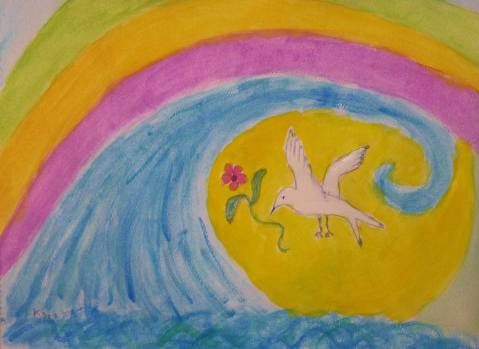
Karen Lyons Kalmenson
pulse orlando
a flood of tears
the rainbow cries,
for those who are
injured
and those who
have died.
Karen Lyons Kalmenson
hate is but a cruel maze
hate feeds
festers
and preys
most on those
who harbor
its ugliness
on their
shores.
defeating
its own purpose
and obliterating
its reason for
existence.
there is not gratification
nor satisfaction
to be found
for bottomless hole
that hate’s hunger
is.
hate is but a cruel
maze not even
a minotaur could
imagine.
♥TRY LOVE♥
Karen Lyons Kalmenson
Will Tuttle: Being Healthy While Saving the Planet
Source YouTube
Food is our most intimate and telling connection both with the living natural order and with our living cultural heritage. By eating the plants and animals of our earth, we literally incorporate them. It is also through this act of eating that we partake of our culture’s values and paradigms at the most primal levels. It is becoming increasingly obvious, however, that the choices we make about our food are leading to environmental degradation, enormous human health problems, and unimaginable cruelty toward our fellow creatures.
Incorporating systems theory, teachings from mythology and religions, and the human sciences, Dr. Tuttle presents the outlines of a more empowering understanding of our world, based on a comprehension of the far-reaching implications of our food choices and the worldview those choices reflect and mandate. He offers a set of universal principles for all people of conscience, from any religious tradition, that they can follow to reconnect with what we are eating, what was required to get it on our plate, and what happens after it leaves our plates.
Dr. Tuttle suggests how we as a species might move our consciousness forward so that we can be more free, more intelligent, more loving, and happier in the choices we make.
Dr. Will Tuttle, visionary author, educator, and inspirational speaker, has presented widely throughout North America, Europe, and the Pacific. Author of the acclaimed Amazon #1 best-seller The World Peace Diet, which has been published in over 15 languages, he is a recipient of the Courage of Conscience Award as well as the Empty Cages Prize. The creator of several wellness and advocacy training programs, he is also co-creator of VeganPalooza, the largest online vegan event. The editor of a recent book on the intersectionality of social justice issues, Circles of Compassion: Connecting Issues of Justice, he is also the co-founder of the non-profit Circle of Compassion and the Worldwide Prayer Circle for Animals. A vegan since 1980, he is a frequent radio, television, and online presenter and writer. He is featured in the acclaimed documentary film Cowspiracy as well as the documentary Animals and the Buddha. Dr. Tuttle’s Ph.D. from the University of California, Berkeley, focused on educating intuition and altruism in adults, and he has taught college courses in creativity, humanities, mythology, religion, and philosophy. A former Zen monk and a Dharma Master in the Korean Zen tradition, he has created eight CD albums of uplifting original piano music. With his spouse Madeleine, a Swiss visionary artist, he presents over 100 lectures, workshops, and concerts annually at college campuses, spiritual centers, conferences, and peace, social justice, animal protection, health, and environmental gatherings.
Order a FREE vegan kit: http://www.peta.org/living/food/free-vegan-starter-kit/
Take PETA’s Cruelty-Free Shopping Guide along with you next time you head to the store! The handy guide will help you find humane products at a glance. Order a FREE copy HERE
Want to do more than go vegan? Help others to do so! Click on the below for nominal, or no, fees to vegan literature that you can use to convince others that veganism is the only compassionate route to being an animal friend.
PETA: http://www.petacatalog.com/catalog/Literature-39-1.html
Looking for merchandise? Action for Animals has a very good sele : http://store.afa-online.org/home.php?cat=284
Have questions? Click HERE
Thoughts on diluting the vegan message
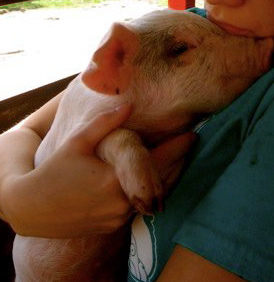
Wikimedia Commons
Source There’s An Elephant in the Room Blog
About
Today, one of the topics in cyberspace is sites, groups, and individuals that call themselves ‘vegan’ when they very plainly are not. ‘So what’s the problem – aren’t they harmless?’ I hear some ask. So I found myself considering two aspects of this: the first is the fact that this hijacking and redefining of a concept such as veganism happens at all, and the second is that these phony groups always seem to manage to gather followers.
It’s extremely encouraging to see veganism – true veganism – becoming more prevalent and mainstream in the world and that can only be a good thing.
However we live in a culture of media addiction where presentation triumphs so often over substance, a culture of celebrity worship, a culture where ‘trends’ are the star by so which many steer their moral compass through the shifting seas. ‘Vegan’ is becoming a ‘trendy’ word and as a result, there are those who would like to adopt it. In this cynical world of oversized egos there are many who crave publicity, and there will always be charlatans who claim that inclusion within their group or social circle will provide you with the info you need, and will entitle you to call yourself ‘vegan’.
However, sadly, there are too many of these that are to veganism, what snake-oil salesmen are to qualified medical practitioners. There are many who appear to ‘relax the rules’, to dilute the term veganism, to put time and effort into justifying various forms of animal use that they claim are acceptable. At first sight, they may seem less ‘stuffy’ than some other groups, ‘more practical’, perhaps even a bit edgy and irreverent. However, whether through genuine ignorance or cynical manipulation I am reluctant to speculate, any such group, site, or individual that does not promote a complete end to humanity’s exploitation of members of other species, uses the term ‘vegan’ under false pretenses.
And the harm? The harm is incalculable as they peddle misinformation, sowing confusion and misleading those whose quest for information is genuine. Because unlike those whose relatively harmless delusions lead them to firmly believe that they’re Henry VIII or a visitor from Mars, when it comes to veganism, misinformation costs lives. Billions of them every year. Humanity’s victims are depending on us for a clear and consistent message as they stand quaking in the slaughterhouses awaiting their turn for their precious and only lives to be hacked from them for our convenience.
That seems rather obvious, which can lead only to wondering why people seem to flock to groups that denigrate veganism as ‘extreme’ or ‘difficult’, and mock those who promote and it as ‘purist’, ‘stuffy’, and ‘vegan police’.
I started to try to phrase this paragraph diplomatically, but I reckon I can’t afford to be mealy-mouthed about it. The truth is that there are many people who want to be able to call themselves ‘vegan’ but who don’t want to change anything or cause themselves any inconvenience. They therefore seem to shop around for a ‘vegan’ group that will condone whatever devastating harm that they wish to continue to carry out to the helpless and innocent; where they will find like minds who will stroke their egos and join in the vocal condemnation of those who hold that veganism requires no redefining and absolutely no diluting. They want to talk the talk without walking the walk.
And why should I care – what’s it to me? Well there are billions of helpless, powerless, innocents whose mere existence is a torment; who have nothing to call their own – not their bodies, not their children, not their friends, not their lives. There are queues in the slaughterhouses trembling to the screams of their friends, frozen with terror in the certain knowledge that their own blood is about to join the stench of the rivers of gore assaulting their nostrils; goaded in sickening horror by the implacable and merciless predators with their hard hands and electric prods.
Every waking moment, I am aware of the weight of the responsibility that veganism places on the shoulders of every one of us whose eyes have been opened. It is not my place or my right to barter away and compromise the rights of even a single victim, not a single victim amongst those billions whose fundamental right to own their own selves is the first right veganism seeks to protect. And meanwhile, every single nonvegan choice causes devastating and terminal harm to one who is powerless to defend his or her self against the senseless tyranny of my species. So that’s why I care. That’s why we ALL should care.
With the huge responsibility we share as vegans, comes the additional responsibility of recognizing the sad reality of those who seek to hijack and corrupt the ethic for unfathomable reasons of their own.
All I can say is I beg you to remember who we’re in this fight for. They need us all. Stay strong, stay vegan.
Order a FREE vegan kit: http://www.peta.org/living/food/free-vegan-starter-kit/
Take PETA’s Cruelty-Free Shopping Guide along with you next time you head to the store! The handy guide will help you find humane products at a glance. Order a FREE copy HERE
Want to do more than go vegan? Help others to do so! Click on the below for nominal, or no, fees to vegan literature that you can use to convince others that veganism is the only compassionate route to being an animal friend.
PETA: http://www.petacatalog.com/catalog/Literature-39-1.html
Looking for merchandise? Action for Animals has a very good selection : http://store.afa-online.org/home.php?cat=284
Have questions? Click HERE
Read more…
Boycott Zoos!

Karen Lyons Kalmenson
we are harambe
we are the harambes
the ones lost amid
the confusion,
ignorance and intolerance.
the ones taken from where
we belong
and forced in boxes
that cannot contain
our spirits.
we are the ones,
the innocents who pay
for the failures and
failings of humans.
Karen Lyons Kalmenson
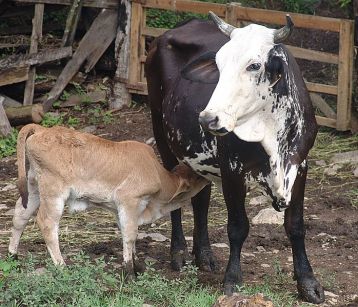
Wikimedia Commons
Source Ecorazzi
Guest Essay by April-Tui Buckley
One of the key responsibilities of parents is to teach their children respect. We try and raise them to be kind and considerate children who grow into respectful and compassionate adults. We have many more considerations as a parent, but this is one I prioritize myself, and I know most parents do. My own childhood was spent on a farm in New Zealand, not the most likely place to foster a vegan ideology, but believe it or not the seeds were sown there. I am also Maori and raised by a strong Maori woman. Respect for the land and its people were central to my upbringing. In our culture we are considered caretakers of the land, we govern it and care for it for future generations. By no means is the Maori culture vegan, but my culture also played its role in how I live as a vegan today.
I can’t say if I ever felt totally comfortable with what happened to the animals on our farms, but I can say my earliest memory is one of confusion. Why was I taught not to harm other people, to be gentle to the cats and dogs we referred to as pets, but then walk out the door of our home and watch as our father did unspeakable things to these animals? These animals we have spent the last few months or sometimes years, caring for. These animals that got my father up in the wee hours, walking the hills in the pouring rain just to save them. I had naively assumed he didn’t want them to suffer. That he saved these lambs out of empathy. But I was soon to learn that each and every animal on that farm, and all farms, were assets.
My father worked unbelievably long hours nurturing, caring for, and tending to the needs of all of them, wrecking his body in the process. But this was not empathy, as I had believed. By the time I was in my early teens I understood very clearly this was a job, these animals were profit and nothing more. I wondered what it took to care for and spend time with the animals, as I did, and then be physically able to end their life. It was so far from how I felt about animals myself. I wondered still, what on earth the word respect truly meant, when everything I learned living on a farm seemed to render the word meaningless. Why did they tell me to treat my cat gently or to stop hitting my sister? Why did they deserve respect, why could I not cause them harm, yet my Dad could slit the throat of any animal he wished to? Why was he allowed to take their babies? Why was he allowed to attach an electric dog collar to his supposedly much-loved working dog and electrocute him for turning the wrong direction? Why did my Maori mother teach me about racism, sexism, and oppression, and how important it is for us to fight them, yet serve me meat, fish, dairy, and eggs?
As I got older and braver, I began to question what I had been taught very openly. I was looking at photos of my father’s first kill, a pig when he was a teenager, I think around 13. I asked him that night what he felt when he killed his first animal. Literally, he did not understand the question.‘ I don’t know what you’re on about, I didn’t feel anything because it’s just a pig’. That is what he was taught and what he attempted to teach me. It is just an object. It does not have moral value and it does not have rights. It is not the same as your cat, your sister, or you. It is my job to kill it. This is the most confused, fucked-up message you can teach your children. Essentially we are teaching our children to love one and not the other, for no other reason than, I told you so. This is the way it is, I can’t explain why, but just do what I do, even if it makes no sense.
We cannot expect children to grow into respectful, compassionate adults, if what we actually teach them is this confused and selective philosophy. Most young children feel love and respect for animals, even those of us growing up in an environment full of death and commodification (otherwise known as farming). What we are teaching our children is actually quite the opposite of respect. We are teaching them to ignore their instincts. We are teaching them moral inconsistency. A mixed up philosophy that has no true value. It is based on cultural traditions, convenience and, quite honestly, one of the very worst human traits: selfishness. We are teaching our children that the only thing that matters is yourself. That respect is not something you give every sentient being. That you ignore your natural instinct and follow society’s messed up, meaningless, totally arbitrary and self serving set of rules as to who is or who is not allowed to be free, who is or is not allowed to live their life on their terms.
What do we have as a result of this immoral and inconsistent set of beliefs? We have violence. We have violence everywhere. In our homes, on our streets, in our schools, in our supermarkets, absolutely everywhere. All violence comes from the same place. Without respect, you have violence. A world without violence will only be possible when we fully understand what that word, respect, truly means and give every sentient being equal access to it.
I am now a mother myself and what we teach our daughter is very clear. We are anti racist, we are feminist, we are against any and all oppression, including speciesism. We are vegan. This is what I learned from the farm, this is what I learned from my Maori culture. That might seem a very weird thing to say given that I just explained the confusing messages I was taught. But farming meant I lived next to animals. I heard their excruciating cries for help. I saw, up close and personal, the terror in their eyes. I saw the love they had for their babies. That they were afraid for their life, just like we are when we think we are in danger. Maori culture is steeped in respect for the land, the sea, the plants, the people- alive or dead. I believe I took lessons I learnt from my people and extended it to include animals. Because it really doesn’t make sense otherwise.
we respect ourselves
and the world in which
we live.
we treat all with compassion
and our capacity to give.
we take not for granted
the beauty upon us
that our creator bestowed.
we bask within that light
from our inner light
that glows.
Karen Lyons Kalmenson
Source Bite Size Vegan
By Emily Moran Barwick
What would you do if you found out that everything you know, everything you believe, everything you’ve been told since you were a child was a lie?
And not just any lie, but one carefully crafted, finely tuned, expertly executed, and deliberately designed with the express purpose of assuring you that wrong was right, that bad was good, and that violence was love.
A lie powerful enough to manipulate you into taking part in horrific and barbaric acts you’d otherwise find appalling. Powerful enough to wash blood from your hands; to alter your perception so severely that murder appears mundane and compassion becomes extreme. [tweet this]
Hello, my name is Emily Moran Barwick. I’m an animal liberation activist, an artist, an educator and a vegan. I created the YouTube channel and accompanying website, Bite Size Vegan, where I educate people about veganism through a wide array of video styles – from humorous parodies, to detailed academic reports, to interviews with physicians and athletes, to videos for kids – while covering a diverse range of subjects.
In our time together today, I’m very likely going to challenge some of your life-long beliefs. I’m going to ask you to set your preconceptions aside and try to look at the ordinary with a fresh set of eyes.
I am aware that this is a great deal to ask of you, especially coming from a total stranger. I’m asking for your trust when I haven’t even earned it. But believe it or not, I am not here to force my beliefs upon you. Or to make you vegan. I won’t pretend to have that power. And no one really makes any lasting change through force anyway.
I’m simply here to show you what is really going on every second of every day all around the world behind closed doors. To present evidence—for your consideration—that things may not be as they appear.
Undoing a life-long belief is no easy task. But in order to make informed decisions, to look ourselves in the mirror and ask if we are truly living the values we purport to have, we must know the truth. We must educate ourselves about what is really going on, not rely on what we’ve been taught. We must make decisions based on facts, not fantasy.
I’ll want to preface this talk by saying that I’m going to be transparent with you and I’ll even tell you if I don’t know something. I’ll also be providing citations throughout this post for every fact I state, along with a bibliography below so that you can dig deeper as I’ll only be able to scratch the surface in this brief window of time we have together.
So let’s get started. Veganism is viewed as an extreme way of living. [tweet this] Vegans do not eat, wear, or use anything that came from someone else’s body. We don’t eat meat, drink milk or eat cheese. We don’t consume eggs or honey. We don’t wear leather, wool, silk, or down. We don’t use products that were tested on animals or contain byproducts from their slaughter. And we don’t attend circuses, zoos, aquariums, or any other event that exploits living beings for our entertainment and pleasure.
From the outside, such rigorous exclusions and avoidances can easily appear extreme. But remember today is about challenging appearances and assumptions of extremism and normality. Today is a lesson in unlearning.
And what better way to unlearn than to start our journey at the end and work our way back to the beginning? And what better way to question what’s accepted as good and normal than with something as wholesome and every day as a glass of milk?
The source of milk is no big secret: it comes from cows. But that’s about as far back as most people trace milk’s journey to our refrigerated grocery case.
Most of us grow up thinking that cows are made to be milked. We may think they have a constant supply of milk and even that they need to be milked to relieve the pressure.
Well let’s look at this critically for a moment. Cows are mammals, just like us. And mammals produce milk for one reason: to feed their babies. Cows carry their babies for 9 months, just like we do, they lactate to feed their babies, just like we do, and after weaning, they stop producing milk, just like we do.
So in order to have a constant supply of cow’s milk for human consumption, we need a constant supply of pregnant cows. In the dairy industry, cows are repeatedly inseminated, which is a nice word for raped. The restraining apparatus used to secure the cows is literally referred to within the dairy industry, at least in America, as a “rape rack,” so this isn’t a term dreamed up by vegans activists.
Once a cow gives birth, we face another roadblock to our milk’s journey. Babies, after all, drink their mother’s milk. So to make sure there’s constant supply of milk for us, the babies must be taken away soon after birth. This is precisely what occurs in the dairy industry. If the calf is a male, he is sent to a veal farm where he is tied down, unable to move, or locked in a cage where he cannot even turn around until he’s slaughtered while still only a few weeks old. Veal, an industry that even many meat-eaters oppose, wouldn’t exist without dairy. Every cup of yogurt, every scoop of ice cream and every glass of milk is directly connected to the deaths of those baby calves.
But we’re not quite done tracing milk’s path to our cereal bowls. While the slaughter of babies is certainly horrific enough, we cannot forget the mothers left behind. Cows bond intensely with their calves and will cry out for days when they are taken. When residents of Newbury, MA called the police to report disturbing noises emanating from the Sunshine Dairy farm at all hours of the day and night, the police explained that the mother cows were “lamenting the separation from their calves”—but not to worry as “the cows are not in distress and that the noises are a normal part of farming practices.”[1]
This is not anthropomorphizing. It is a mother’s grief and it’s utterly heartbreaking to watch.
The bodies of dairy cows generally give out at age 4 or 5 and they are regarded as “spent,” despite their natural lifespan of 20 years or more. They’re sent to slaughter for cheap meat and pet food, deemed unfit for human consumption. At the slaughterhouse, many of these mothers face their final and most brutal separation from yet another child. While formal statistics are difficult to obtain as most studies focus on the economic cost of “fetal wastage,” accounts range from approximately 10% to 70% of cows arrive at the slaughterhouse pregnant.[2][3][4][5][6][7][8][9][10][11]
In fact there are entire industries that rely upon the slaughter of pregnant animals. A wide array of scientific experiments use what’s called fetal serum from a range of animals, with bovine fetal serum being the most widely utilized.[12] Bovine fetal serum is obtained by cutting a living fetus out of the mother’s womb, piercing the heart and draining the blood. The process can take up to 35 minutes while the fetal calf remains alive.[13]
But this most horrific and final separation of mother and child was just the last in a cycle of pregnancy after pregnancy and loss after loss. In addition to this extreme psychological and emotional trauma, the physical demands of repeated milkings and the crowded and unsanitary living conditions lead to frequent infections and sores.
Dairy cows are pumped full of antibiotics and growth hormones, all of which seep into their milk.[14][15][16][17][18][19] In fact, there’s an official number of pus cells allowed in milk, euphemistically referred to as the “somatic cell count.” In the United States, around 22 million [22,177,500] pus cells are allowed per single fluid ounce of milk [750,000 cells/mL], with global allowable limits ranging from just under 12 million [11,828,000 cells/fl. oz. in Canada & the EU (400,000 cells/mL)] to 29.5 million cells/fl.oz. in Brazil [1,000,000 cells/mL].[20][21][22][23][24][25][26][27][28][29][30]
When we push onwards through to our dairy cow’s beginning, back past the first pregnancy, before she became the broken, hollowed-out shell eventually collapsing under the insane demands of her short life, we come to her birth. The moment she emerges into the world, wide-eyed and brand new. The moment she’s taken from her own mother.
You see we talked about what happened to the male calves who are sent off for veal. Well the daughters of the dairy industry are still separated from their mothers. But they’re kept around to take their mother’s place and keep the money machine going. Keep the milk flowing. So that in every grocery story, every corner shop, every gas station, will be sure to stock this wholesome, normalized, entirely ordinary product.
The animal products we perceive as mundane, when reverse engineered, reveal a perversely complex and, to put it lightly, ethically challenging, journey from genesis through processing and production to the end product. That is to say, from the animals’ birth, through confinement, abuse, slaughter and denigration of corpses to the shiny, happy, store-ready products we literally eat up without even a single thought as to what the animals went through.
We are being sold the pus-filled ultimate outcome of rape, enslavement, kidnapping, abuse, disease, torture, infanticide, and murder—whitewashed into an image of wholesome nutrition. As vegan activist Gary Yourofsky has said, it’s the greatest magic trick ever performed. [tweet this]
And people say veganism is extreme.
Unfortunately—or perhaps you may feel fortunately—we don’t have time to take this reverse journey in such depth with all of the products we create from living beings. But let’s at least take an abridged look at another seemingly harmless item. One consumed all over the world and with which most Americans start their day. One lovingly mixed into baked goods for birthdays and other special occasions. One decorated in celebration of peace and new life. The incredible, edible egg.
Like milk, the source of eggs is clear: they come from chickens. Unlike milk, chickens do not have to be impregnated to supply them. But anytime we make a living being into a machine, a supplier of inventory, the bottom line will always be profit. And increasing profit means increasing output and increasing efficiency.
Just like the mothers of dairy, the bodies of layer hens give out prematurely from the extreme demands of production.[31] Hens lose vital nutrients every time their body forms an egg. Every aspect of their lives is regulated ensure maximum output. From controlling their laying cycles with days and days of persistent light followed by long periods of complete darkness, to starving them for weeks at a time in an effort to force yet another egg cycle from their worn out bodies, a process benignly referred to as “induced molting,” to outright manipulation of their very genetic makeup.[32][33][34][35][36][37][38][39][40][41]
We’ve optimized our machines, you see, and bred one kind of chicken for meat and another kind for eggs. Because of this, the egg industry produces millions if not a billion unwanted male baby chicks every year. Just like male dairy calves, who are unable to produce milk, male layer chicks can’t lay eggs. So they are of no use.
To “dispose of” – as they say – these baby chicks, they are either painfully gassed, slowly suffocated in plastic bags, or they are ground up alive, referred to as maceration within the industry. We’re talking about the cute fluffy yellow baby chicks we adore come Easter time.
This is standard practice all around the world, with the United States and European Union specifying that chicks must be less than 72 hours old when the are killed –they are not even granted three days of life.[42][43] [SHOW SCREENSHOTS AVMA doc]
The sisters of the egg industry’s discarded sons get to live out their short lives in cramped battery cages, unable to even extend their wings.[44][45][46] Of course nowadays we hear about the rise of free-range and cage-free facilities.[47][48][49] But in truth, the only comfort these labels bring is to our own conscience.[50][51][52][53][54][55][56] Cage-free birds are crammed into tiny sheds and have twice the mortality rates of battery caged hens.[57]
Layer hens are generally good for 1-3 cycles, each lasting roughly a year. In countries where induced molting (again, the industry term for starvation) is illegal, they’re simply killed around their first birthday.
I hope you are starting to see the power of this lie. Of presenting cruel confinement, starvation, abuse, the barbaric murder of day-old babies and the slaughter of one-year-olds—themselves still children—as something completely normal and kind— packaged in perfect little orbs.
And we have the audacity to decorate them in celebration of new life. To fawn over the very chicks who were ground up alive for their production. To mix them into treats for our children and loved ones. To start our day with the products of abject misery and call it “sunny side up.” We might as well start our day by throwing chicks in a blender
We could spend all week reverse-engineering the paths of the seemingly endless number of animal-derived products we encounter on a regular basis. In fact Dutch artist Christien Meindertsma spent 3 years tracing and cataloguing all of the products made from a single pig: PIG 05049.[58][59]
Which brings us to the next layer of our collective self-deception: the systematic erasure of individual identity. You see this is where the lie is most vulnerable. Because beneath the years of indoctrination, we still believe ourselves to be animal lovers. We go to the movies and route for Babe the pig, cheer for the chickens of Chicken Run, and pull for Nemo the fish to find his way back to his father. Then we go home and eat bacon and eggs and make chicken fingers and fish sticks for the kids.
The only way to maintain this most glaring dissonance, this duality of our professed values and our daily actions, is to ensure that the animals we eat and use have no names, no faces, no identities. So we give them inventory numbers.
We brand them with hot irons or freeze their skin off. We tattoo and tag them, inject electronic transponders under their skin, or strap them to their necks or ankles. We even give them barcodes.[60][61] The important thing is that they are clearly identified as property. And that they are treated as such. Because as soon as we see them as individuals, we threaten the very foundation of the lie upon which we so desperately depend. [tweet this]
If their bodies don’t conform to our desires, we alter them at will. Baby pigs have their teeth cut out, their ears notched, their tails cut off and their testicles ripped out, all without anesthetic. Chickens, turkeys and other birds in the meat and egg industries have their sensitive beaks cut or seared off. Cows have their horns cut or burned off and are also castrated without anesthetic.
And with some of our most impressive mental gymnastics, which would be admirable if it weren’t so horrific, we say this barbaric mutilation, this conversion of living beings from someONES to someTHINGS is for their own good.
Because if we don’t clip their teeth or cut their beaks or slice off their tails, they’ll attack and chew on each other. What we fail to mention, is that these behaviors are stress responses to confinement in overly-crowded, insanity-inducing conditions. That if we didn’t put them in these abusive conditions, they wouldn’t react the way they do.
But we humans love to play the role of savior in the disasters of our own creation. We swoop in to milk the cow and relieve the painful pressure of her swollen udder. Pressure that wouldn’t exist had we not taken her child away.
And to top it all off, our fragile charade, we amass mountains of paperwork, conduct thousands of studies, spend untold amounts of money, form governmental, institutional and industry panels, all to decide, define and decreethe right way to kill.
You can pour through the documents from the USDA,[62][63][64][65][66][67][68][69][70][71][72][73][74][75][76][77][78][79][80] or the European Union,[81][82] or any country for that matter, to learn the legal speak that makes taking the life of a living being acceptable. And you don’t have to look too far to start finding caveats and loopholes. Religious slaughter without any form of stunning gets a pass. Birds and fish are excluded from humane slaughter regulations, the very name of which is a perfect embodiment of our desperate attempt to simultaneously be animal lovers and animal killers. To be their protectors and tormentors.
I mean it really is absurd when we step back and think about it. Do we have manuals on how to humanely rape? Or how to compassionately kidnap? Or ethically rob? Of course not because those are oxymorons. They cannot coexist. But when it comes to killing animals, we will bend over backwards and create massive paper trails of regulations to feel good about what we are doing.
Again, I must ask, is veganism really the extreme choice here?
Look at what we have to go through to make eating animals acceptable.
[At this point in the speech I play a video of worldwide undercover footage with the following lead-in]:
Before we move into issues of the environment and health impacts of diet, I’m going to play brief video. The portions of the footage where the location is known will be labeled as such. But it doesn’t mean that the same thing isn’t happening in other parts of the world. I trimmed down hours of footage into a 4-minute clip.
It will not be pleasant, but I’d implore you to watch anyway. You can’t make an informed decision without having all the facts. If you feel you must turn away, I’d just ask you to think on the question: “If I can’t watch process, do I have a right to eat the product?”
[the footage can be seen at from 20:55-23:55 in the video at the top of this post. What follows is the continuation of my speech after the footage has concluded]
In my years of being vegan and speaking with many, many non-vegans, I have yet to ever hear one reason that even comes close to justifying putting a sentient being through what we just saw. Not one.
You cannot watch that and say that the animals we kill for our food don’t know any better. That they die peacefully and humanely. They can sense the fear. They can smell the blood. And they fight. They fight to the end.
And you can’t say that it’s happening in some far away place because it’s happening all over the world. The CO2 chambers you saw – those were the medieval devices lowering pigs to an extraordinarily painful death of burning from the inside out – that is seen as the most humane method of slaughtering pigs.
It’s employed worldwide, including here in the United States.[83]
I know I’ve focused rather exclusively thus far on the ethical truths behind the mask of normality. But the wake of our destruction is littered with far more than the trillions of beings we kill every year.[84]
The environmental, health and social impact of what we put in our mouth is astounding. There is no way I’ll be able to cover these areas today in the depth they deserve, so I encourage you to refer to the resource page I’ll be leaving with you.
But let’s try to take a bird’s eye view of our impact on this planet. When it comes to the environment, we hear about conserving water, cutting down on emissions, halting deforestation. Environmental protection agencies encourage us to take shorter showers, carpool or ride our bikes, go paperless and recycle more. Our governments hold international conferences to address climate change and seek solutions.
All the while the single most devastating force behind our planet’s environmental collapse remains not only unspoken, but actually actively denied by the very organizations charged with saving our planet.[85]
Animal agriculture is the leading cause of climate change.[86] It’s responsible for up to 51 percent of GHG emissions compared to the 13 percent of all global transportation.[87] It uses a third of the earth’s fresh water,[88][89][90][91] up to 45 percent of the Earth’s land,[92][93] is responsible for 91 percent of Amazon rainforest destruction with 1-2 acres cleared every second.[94][95] It is also a leading cause of species extinction, ocean dead zones, and habitat destruction.[96][97][98][99][100][101][102][103][104][105][106]
The efforts we make to recycle and take shorter showers are rather insignificant in comparison. Accounting for variation in production system, the global average water footprint for a single pound of beef is 1,847 gallons/lb, with numbers ranging all the way to 8,000 gallons/lb.[107][108][109]
We can see here that without fail those food products with the smallest water footprints based on weight are plant-based.[110][111][112]
Of course weight doesn’t necessarily mean sustenance. Still, global averages show that “when viewed from a caloric standpoint, the water footprint of animal products is larger than for crop products” with “the average water footprint per calorie for beef [being] twenty times larger than for cereals and starchy roots.”[113]
And with protein being one of the greatest nutrition concerns for people considering veganism, it’s worth noting that “the water footprint per gram of protein for milk, eggs and chicken meat is about 1.5 times larger than for pulses” [114][115][116] with beef’s being 6 times larger. Leading to the conclusion that “it is more efficient to obtain calories, protein and fat through crop products than animal products.” [117][118][119]
But we don’t really need studies to tell us that eating animals requires more energy input and creates more waste than eating plants. How can it not?
Eating animals is incredibly inefficient. We are filtering our nutrients, our water, our resources, through someone else’s body. Globally, we’re feeding close to 40% of our grain to our food animals.[120] How can that not be worse for the environment than simply eating the plants ourselves? The United States alone could feed 800 million people with the grain we feed to our livestock. That’s more than the estimated 795 million people going hungry in the world today.[121][122] 98% of the massive water footprint for animal agriculture we just covered goes to growing feed crops for the animals we eat.[123]
I’m not suggesting that a global shift to veganism will automatically result in the proper redistribution of our crops to those in need, nor address the issue of unnecessary food wastage, but it’s the only way we can have enough food to feed everyone.
This is where many people point to small, local farms, and sustainable practices. Like grass fed beef. Or free-range eggs.
The thing is, we don’t have the land. There’s simply not enough land for the number of animals we eat every year. The amount of land that it takes to produce 37,000 pounds of plant-based foods will only yield 375 pounds of meat.[124][125][126]
The land required to feed 1 vegan for 1 year is 1/6th acre. It takes 3 times as much for a vegetarian, meaning someone who consumes dairy and eggs but no meat, and 18 times as much for a meat-eater.[127][128]
You can grow 15 times more protein on any given area of land with plants versus animals. On top of all of that, studies show that pasture-raised cows emit 40-60% more greenhouse gases than grain-fed.[129]
I could talk about the environmental cost of animal agriculture all day and we would only just be scratching the surface.
I do want to speak briefly to fishing and ocean health before moving on. I produced a 17-minute video report encompassing the most recent research on the state of our oceans, which you can refer to, but I’ll try to summarize some main takeaways.
Whether you eat fish and marine life or not, this matter impacts all of us. The ocean, or rather the phytoplankton within the ocean, provides somewhere between 50 and 80% of our oxygen[130][131][132] and the oceans ecosystems store carbon in massive quantities.[133]
Since we tend to go for the biggest fish first, only 10% of predatory fish species remain,[134] which could leave the unchecked species to feed on the ocean’s vegetation releasing the stored carbon. If we lost just 1% of these blue carbon ecosystems, it would be equivalent to releasing the annual greenhouse gas emissions of Australia.[135][136]
We pull 90-100 million tonnes[137] of fish from our oceans each year[138][139] with some sources even estimating 150 million tonnes.[140] There is no way for the marine populations to replenish themselves.
Our industrial fishing methods are incredibly inefficient, with some operations throwing 98% of their catches overboard, dead,[141][142] because they aren’t the targeted species.
As I said earlier, land-based animal agriculture is the leading cause of ocean dead zones, which are areas in the ocean starved of oxygen such that marine life suffocates and dies.
So the animals we are raising for food on land are killing the animals we are ripping from the ocean. And to add a further layer of perversity, we are feeding the fish we catch to the cows, pigs, chicken, and other land animals and to the fish we farm.
And people think veganism is extreme? When humanity is decimating habitats, consuming land and resources, polluting the oceans, destroying the rainforest, driving species after species into extinction, feeding plants that we could eat to animals and feeding other animals to animals that aren’t supposed to eat animals, all so that we can eventually eat the animals ourselves.
But of course as a consumer, we don’t see the trail. We see the pretty packages and sleek advertising. We see these ordinary, innocent, every day products. And we find comfort in the fact that most people eat the way we do; that most people don’t seem to be concerned. And we continue to believe the lie that this is the way it’s supposed to be.
Ethics aside, we have environmentally reached the point beyond personal choice–beyond “you eat how you want to eat and I’ll eat how I want to eat.” This is a global crisis and it’s not about you or me anymore.
We say that children are our future but what future can they have when we are eating the planet to death? The world cannot sustain meat, dairy and egg production. It simply can’t. We have to start aligning our actions with our values.
I’m going to speak very briefly to the impact that animal consumption has on our health.
We take drugs by the truckload, undergo dangerous surgeries, spend trillions of dollars on health care every year, in our stubborn refusal to acknowledge the simple fact that diet is the number one cause of disability and premature death.[143][144] That the vast majority of deaths in the United States are entirely preventable if we would simply change the way we eat.[145][146]
The denial of this truth is so pervasive, our desire to maintain the system we’ve constructed so strong, that only one quarter of medical schools in the United States teach even a single course in nutrition.[147][148] The doctors in whose hands we place our very lives aren’t even educated in the number one cause of disease and death in our country.
Heart disease, the number one killer in the United States, is a dietary disease that can be and has been reversed with a vegan, plant-based diet.[149][150][151][152][153][154][155][156][157][158] But instead we take handfuls of medications and have doctors crack open our chests to roto-rooter our arteries rather than stop eating animals.[159][160] After all, a vegan diet is too extreme, right?
Once we look at it objectively, from the outside, our behavior is baffling.
We serve meat, dairy and eggs at climate change conferences, supporting and consuming the very source of the problem that the conference was created to address.
We train doctors to save lives with years of expensive education covering every drug on the market while never addressing the true cause of disease.
We run our resources and nutrition through someone else’s body, squandering astronomical amounts of food and water and creating an astounding amount of waste.
We genetically manipulate, breed, confine, abuse, rape, torture, denigrate, mechanize, and murder sentient individuals under our self-created codes of conduct that bring comfort to consumers.
All to avoid facing the fact that we are living the greatest lie ever told.
But here’s the good news. We have the power to open our eyes. We have the choice to break the cycle and refuse to sell this lie to the next generation.
To realize that veganism, far from being an extreme lifestyle, is the most sane and rational way to live. It’s the most powerful tool we have for saving our planet, for improving our health when we eat health-consciously, and for regaining our compassion- for becoming the people we believe ourselves to be: Good people.
And good people don’t destroy the planet, leaving our children without a future. Good people don’t throw newborn babies into grinders. Good people don’t rip day old babies away from their mothers. Good people don’t rape, torture and murder. Yet “good people” everywhere are doing all of these things with every bite of every meal.
But that’s the beauty here. You no longer have to buy into the lie. You decide what goes into your body. You decide whether you want to continue to have others kill for you. You decide whether you want to continue consuming death, terror, and heartbreak. You have the information at you feet. The responsibility now lies in your hands. You decide. And my hope is, you’ll decide to go vegan.
———–
If you found this video impactful please SHARE it far and wide on all platforms. For Twitter you can use the pre-made tweet links found throughout this post.
If you would like to support Bite Size Vegan in creating free, educational resources about veganism, please see the support page or join us in the Nugget Army on Patreon.
Order a FREE vegan kit: http://www.peta.org/living/food/free-vegan-starter-kit/
Take PETA’s Cruelty-Free Shopping Guide along with you next time you head to the store! The handy guide will help you find humane products at a glance. Order a FREE copy HERE
Want to do more than go vegan? Help others to do so! Click on the below for nominal, or no, fees to vegan literature that you can use to convince others that veganism is the only compassionate route to being an animal friend.
PETA: http://www.petacatalog.com/catalog/Literature-39-1.html
Looking for merchandise? Action for Animals has a very good selection : http://store.afa-online.org/home.php?cat=284
Have questions? Click HERE
Vegan for 37 Years … and Still Kicking!

Wikimedia Commons
Source Veganism: A Truth Whose Time Has Come
By Butterflies Katz
When I stopped eating animals in 1970 – every teacher, doctor, parent and peer disagreed, and said ‘where will you get your protein? – you will die!’. Even though I stood totally alone, I still somehow knew that I was right… and they were wrong. That’s a fairly incredible place to be in life….and particularly at the age of 12. When I became vegan in 1979, again, I had never met another vegan and had only heard of The American Vegan Society. Standing alone is one thing, but also knowing you are in the right – which translates to all of society is in the wrong – is a burden I’ve been bearing much of my life.
I am growing sad and impatient for humanity to wake up to the simple obvious “Great Truth” that we should not be violent to animals. We activists try to speak every which way we can. We get creative with our advocacy, trying to get nonvegans to become vegans. I hope my public story serves as living proof that we should rewrite societal norms and laws if they are unjust, and help justice be served.
I would say it made me a better person to live vegan. I read about vegan nutrition to ensure I get what I need – and according to blood tests, I am getting all the necessary nutrients. I’m no super athlete (though you can be as a vegan), and I have minor flaws and pains as all humans do. But I feel certain that I am better than I would have been if I had not been vegan all these decades. So there you have it; we can live healthy, happy, harming-less lives.
So … I’m still kicking after 37 years of non-participation in animal exploitation. I hope I can stay here on Earth long enough to see humans realizing and embracing this notion that humans do not have the right to violently assault, breed and sexually violate, kidnap newborn infants from, make slaves of, torture and murder (and in Holocaust proportions) – other animals. They are other species of the same ‘animal kingdom’ we belong to. It is time that we take our next step and ‘let go’ of the very passe ‘predator’ mentality. We now have concoctions and formulations from plants to beautifully feed, dress, and care for ourselves and our rescued animal friends. Make your best effort to only support products and practices that are not derived from using animals.
The Truth of Veganism is so easy to see that a child can grasp it…often easier than brain-dirtied adult who believe the “greatest lie ever told”. Nonveganism (abusing and using animals for human financial gain) is a lie. Violating and exploiting the reproductive system of a cow (exploited for dairy), killing her newborn calf so humans can steal the sustenance that is ~ by nature ~ meant for her own calf – a bovine not a human – is a lie. This is not living in Truth; for those who consider themselves Truth seekers. Especially since we don’t need to – we should not have the legal or religious right to torture, enslave, exploit, objectify, and be violent to animals. The Truth is – we all, in our better selves – would like to live and enjoy life without making life “hell on Earth” for other animals. Remember when you were a kid and you liked animals; they were your friends. Well…they really are. The only thing that has changed is that you bought the lie that society was selling you. Understandable, it’s a lie that has permeated every corner of the globe for a very long time…yet it is still … a lie. It is an obvious Truth if humans can live great lives without intentionally harming innocent animals, that this is the more civilized and better way. I’m living proof that we can. Living as a vegan has not harmed me – nor other sentient beings. And according to unbiased science – unbiased science – and unbiased science – a vegan’s diet is the best thing we can do to help save the planet we all share, and has many benefits to humans and society. The heart and soul of veganism is that of HARMING LESS and HELPING MORE.
In another 37 years, I will be 95….hope I will be here and able to write the sequel to this post; a blog thanking humanity for rejecting “the greatest lie ever told” and becoming a vegan humanity.
Order a FREE vegan kit: http://www.peta.org/living/food/free-vegan-starter-kit/
Take PETA’s Cruelty-Free Shopping Guide along with you next time you head to the store! The handy guide will help you find humane products at a glance. Order a FREE copy HERE
Want to do more than go vegan? Help others to do so! Click on the below for nominal, or no, fees to vegan literature that you can use to convince others that veganism is the only compassionate route to being an animal friend.
PETA: http://www.petacatalog.com/catalog/Literature-39-1.html
Looking for merchandise? Action for Animals has a very good selection : http://store.afa-online.org/home.php?cat=284
Have questions? Click HERE
Read more…
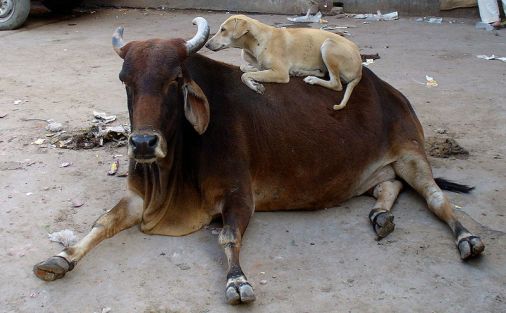
Wikimedia Commons
Source Free From Harm
By Robert Grillo
Have you ever heard someone exclaim, “I love my pets, but still eat meat. What’s wrong with that?” or “There’s nothing wrong with that!” So what is wrong with differentiating the animals we claim to love from the ones we stick forks into because we like the way they taste?
Our culturally-engrained assumptions
The statement or question itself reveals a lifetime of cultural conditioning that promotes the view of chickens, turkeys, cows and pigs as worthy of a far inferior standard of treatment and use when compared with our companion animals, as if raising and eating farmed animals were a foregone conclusion rather than a conscious, daily choice. But anyone who claims to give farmed animals even the slightest moral consideration must first admit that we are all products of this cultural conditioning which perpetuates the myth that they are worth nothing more than the products derived from their flesh and secretions. Many of the most influential narratives in popular films, novels, TV shows and food brands we grew up with reinforce this same message. And, as adults, we are rarely, if ever, challenged to think critically about those assumptions. The first step in taking the issue of eating meat seriously is to question what we’ve been taught.
Farmed animals are fundamentally like cats and dogs
Anyone who has spent some time with a farmed animal on a sanctuary or with caregivers who value their animals as companions rather than commodities can plainly see that there is fundamentally nothing different about these relationships with chickens, turkeys, cows or pigs than with the relationships most of us have with our traditional cat and dog companions. All species of domesticated animals, by virtue of their total dependence on us, rely on our good will to properly care for them. And if properly cared for, they often respond by bonding with their caregivers, seeking their affection, attention and recognition. Regardless of what we think about a species or an individual member of a species, each individual animal — including each individual chicken, turkey, cow and pig— cares about what happens to them. All birds, mammals, and fish (and various other marine animals) are highly sentient and socially-complex beings, with a strong sense of self, will to live and an equally strong aversion to suffering and death. They will fight for their lives as vociferously as would our cats and dogs. And beyond basic sentience, farmed animals have individual personalities just like our cats and dogs. So there is no moral justification for treating them differently.
Read More HERE
in some cultures dogs
and cats are food
yes, we all think
that is beyond rude.
but cows are sacred
in other cultures too.
so eating them?
the wrong thing
to do.
please extend your
love to all species
of animals on earth
in the eyes of
the creator…
they are all precious
and of equal worth!
Karen Lyons Kalmenson
Putting Out Michael Pollan’s Fire
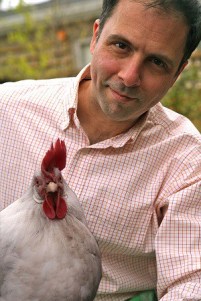
Robert Grillo
Source Vegan Place
By Guest Blogger Robert Grillo
Last night I watched “Fire,” the first episode of Michael Pollan’s Netflix mini-series Cooked based on his book by the same name. The show weaves together Pollan’s life as an author/personality in California with the story of a group of Aboriginal people in Australia portrayed as hunter-gatherers as well as a “pit master” from the American South. The central theme explores fire as an evolutionary and cultural symbol that allegedly predisposes us to eating animals. And the sweep from one cultural extreme to another is supposed to make some profound statement about the cultural universality of hunting, raising, killing, preparing and eating animals as a kind of rite of evolutionary passage and a remedy for our modern day aversion to cooking. In his search to find the primordial roots of eating flesh, Pollan’s new-age journey finds himself sitting around a fire pit, upon which a whole, gutted pig is searing, and drinking beer with his 50-something friends in a kind of male-bonding ritual. Here Pollan seems to go out of his way to impress upon us that he is as real and down-to-earth about food as he is worldly and philosophical.
“Fire” is stoked with all of the rhetoric and progressive foodie tropes that Pollan made infamous in The Omnivore’s Dilemma, including “thanking the animals for their sacrifice,” “knowing where your food comes from makes you an ethical eater,” “raise and kill them with kindness,” and, above all, honoring “the natural order” in which farmed animals are essential, not only as a human food source, but also as a source of fertilizer and ecosystem “balance.”
“Fire” cleverly interjects two subtle yet powerful anti-vegetarian messages to further bolster its case for eating animals. The first is the story of the former “animal rescuer” turned pig farmer who claims to have found a higher calling by raising pigs to feed her community. She would rather see her local town’s people eat pigs that were responsibly raised on her farm rather than from a factory farm. It’s a common logic that sounds plausible on the surface to many of us, until we recognize the false dilemma implicit in the statement, the false either-or scenario that excludes the very real possibility of feeding them with plant foods instead. She names her pigs and tells us that her impregnated mother sow reminds her affectionately of her grandmother. All the while she is fattening up and preparing her offspring for slaughter. In her final scene, she is bidding her pigs farewell as they are loaded on to the truck bound for their deaths, padding the truck with blankets to ensure that at least their transport to the slaughterhouse is cozy. Stories like this one seek to reassure us that farmers are good people who care, even if they do ultimately betray the juvenile animals who learned to trust them. And more importantly, they seek to obscure the fundamental distinction between farms and sanctuaries. They obscure the fact that farms admittedly value animals to the extent that they provide an economic resource and dispose of them when they outlive their usefulness. On the other hand, sanctuaries see each animal as an individual having intrinsic rather than economic value, worthy of living out their lives as comfortably as possible, much like the animals in our lives we regard as “pets.”
In another scene, Pollan insists that a young vegetarian guest at his dinner party sample the pig. Predictably, she is overcome with ecstasy upon tasting it, and Pollan and his male friends gloat in their “gotcha,” ego-stroking moment. But this decisive moment renders all of Pollan’s elaborate ethical posturing leading up to this point essentially meaningless; it is ultimately taste, and not ethics, that renders even vegetarians complicit to eating animals. This act of vegetarian surrender fulfills the meat-eater’s fantasy in which they imagine vegetarians sabotaged by their “natural” desire to eat flesh and the meat-eater’s triumph over the vegetarian’s betrayal of her values in the name of her taste buds. It says as much about the objectification of animals as it does about the male desire to control women.
But perhaps the most strikingly dishonest narrative ploy in “Fire” is the attempt to blur the important moral distinction between hunting and eating animals for reasons of survival as portrayed by the Aboriginal hunter-gatherers with Pollan’s celebratory pig roast in which eating animals, far from being necessary, becomes a glorified centerpiece intended to woo guests. Indeed, the eating of animals is fetishized here as straight up palate porn. Pollan indulges his animal-eating viewers by unapologetically wallowing in the pleasure he derives from the pig’s flesh, but also the satisfaction he gets from connecting to his “food roots,” his hunter-gatherer ancestry.
Throughout “Fire,” Pollan makes sweeping nutritional and environmental claims without citing any credible evidence, as if to suggest that his notoriety as a food writer somehow makes him a authority on nutrition, environmental science and animal behavior. One of the many highly debatable claims he makes is that farmed animals are beneficial and even necessary for healthy ecosystems. “There is something quite elegant ecologically about having plants and animals together,” he tells us. But, as environmental author and activist Will Anderson writes, “…we can accomplish magnitudes of recovery more if conservation biologists introduce native species in tandem with the end of animal agriculture. As it dies, ecosystems will thrive. Conservation biologists will need generations before plant and animal communities regain at least some relationships that are essential to the ecosystems. Grazing cattle will be replaced by the original inhabitants, the bison, antelope, deer, tallgrass and shortgrass, prairie chickens, and ground squirrels. Highlands and lowlands, forests and plains, all should be rid of the pox that livestock represent. Livestock were never needed as replacements to benefit ecosystems.”
In the end, Pollan’s dilemma is not really a dilemma at all. He advocates, without remorse, the eating of animals raised in preciously rare circumstances and available only to an affluent niche, readily admitting that he can’t justify most of the animal products he ends up consuming due to the difficulty of tracing them. His vague conclusion is that we at least express intent to do better, without any serious attempt to act on that intent or hold ourselves accountable in any meaningful way. In the end, Pollan’s “Fire” amounts to a half-baked, half-hearted recipe for a more evolved, ethical way of eating, but his lack of moral courage ultimately extinguishes the flames of that fire.
Robert Grillo is the director of Free from Harm which he founded in 2009. As an activist, author and speaker, Grillo focuses awareness on the animal’s experience and point of view, drawing on insights from sociology, psychology, popular culture, ethics and social justice to bridge the gap between humans and other animals. As a marketing communications professional for over 20 years, Grillo has worked on large food industry accounts where he gained a behind the scenes perspective on food industry branding. He is currently working on a new book about how popular culture uses a variety of fictions that appeal to our beliefs about farmed animals and animal products, heavily influencing our food choices. The book is based on his keynote presentation, Fictions, Facts and Food Choices.
tripe is the notion mr pollan sells
as all animals lovers know quite well.
rationalizations, excuses…
does he believe.
that perhaps he is the only one
by himself.
deceived.
Karen Lyons Kalmenson
Dr. Michael Greger: “How Not To Die” | Talks at Google
Source YouTube
Published on February 11, 2016
Dr. Greger visited Google NYC to discuss his new book – How Not to Die.
The vast majority of premature deaths can be prevented through simple changes in diet and lifestyle. In How Not to Die, Dr. Michael Greger, the internationally-recognized lecturer, physician, and founder of NutritionFacts.org, examines the fifteen top causes of death in America—heart disease, various cancers, diabetes, Parkinson’s, high blood pressure, and more—and explains how nutritional and lifestyle interventions can sometimes trump prescription pills and other pharmaceutical and surgical approaches, freeing us to live healthier lives.
The simple truth is that most doctors are good at treating acute illnesses but bad at preventing chronic disease. The 15 leading causes of death claim the lives of 1.6 million Americans annually. This doesn’t have to be the case. By following Dr. Greger’s advice, all of it backed up by peer-reviewed scientific evidence, you will learn which foods to eat and which lifestyle changes to make to live longer.
History of prostate cancer in your family? Put down that glass of milk and add flaxseed to your diet. Have high blood pressure? Hibiscus tea can work better than a leading hypertensive drug—and without the side effects. What about liver disease? Drinking coffee can reduce liver inflammation. Battling breast cancer? Consuming soy is associated with prolonged survival. Worried about heart disease (our #1 killer)? Switch to a whole-food, plant-based diet, which has been repeatedly shown not just to help prevent the disease, but arrest and even reverse it.
In addition to showing what to eat to help prevent the top 15 causes of death, How Not to Die includes Dr. Greger’s Daily Dozen—a checklist of the foods we should try to consume every day. Full of practical, actionable advice and surprising, cutting-edge nutritional science, these doctor’s orders are just what we need to live longer, healthier lives.
Order a FREE vegan kit: http://www.peta.org/living/food/free-vegan-starter-kit/
Take PETA’s Cruelty-Free Shopping Guide along with you next time you head to the store! The handy guide will help you find humane products at a glance. Order a FREE copy HERE
Want to do more than go vegan? Help others to do so! Click on the below for nominal, or no, fees to vegan literature that you can use to convince others that veganism is the only compassionate route to being an animal friend.
PETA: http://www.petacatalog.com/catalog/Literature-39-1.html
Looking for merchandise? Action for Animals has a very good selection : http://store.afa-online.org/home.php?cat=284
Have questions? Click HERE
Read more…
Why Vegan?
Source YouTube, The Vegan Activist
Order a FREE vegan kit: http://www.peta.org/living/food/free-vegan-starter-kit/
Take PETA’s Cruelty-Free Shopping Guide along with you next time you head to the store! The handy guide will help you find humane products at a glance. Order a FREE copy HERE
Want to do more than go vegan? Help others to do so! Click on the below for nominal, or no, fees to vegan literature that you can use to convince others that veganism is the only compassionate route to being an animal friend.
PETA: http://www.petacatalog.com/catalog/Literature-39-1.html
Looking for merchandise? Action for Animals has a very good selection : http://store.afa-online.org/home.php?cat=284
Have questions? Click HERE
Read more…
Farm to Fable: Support the book launch!
Click here to support my – Robert Grillo – book on my Indeigogo page at https://igg.me/at/grillo. Long story short, I’m partnering with Vegan Publishers to produce the book and we need your help to make that happen. Your support will go directly to completing, printing, distributing, and marketing this book. The more contributions we receive, the more books we can print and the more we can devote to maximizing the impact of exposing the fictions of the animal use industries. We’re also offering several perks! In addition to the books, we have tee shirts and framed portraits of some of our beautiful rescues for you!
Source Indiegogo
Pulling back the curtain on our culture’s fictions
My name is Robert Grillo and I’m the founder and director of Free from Harm, a non profit dedicated to farmed animal rescue, education, and advocacy.
I’ve recently completed a book called Farm to Fable: The Fictions of Our Animal Consuming Culture, which I began work on in 2009. It’s a long overdue, critical look at how we’ve all been brainwashed to accept and support animal exploitation.
For years I worked at ad agencies that helped peddle and push the consumption of animal products. At the time I too was under the spell of this brainwashing, so I didn’t quite realize that I was directly contributing to the success of this violent and unethical industry. As a vegan for seven years now, my goal is to expose these powerful fictions driven by the animal exploitation industries that are now more profitable than ever.
Why we need your help
I’m partnering with Vegan Publishers to produce the book and we need your help to make that happen. Your support will go directly to completing, printing, distributing, and marketing this book. The more contributions we receive, the more books we can print and the more we can devote to maximizing the impact of exposing the fictions of the animal use industries.
We’re also offering several perks! In addition to the books, we have tee shirts and framed portraits of some of our beautiful rescues for you!
The impact
Since 2012, I’ve given the Farm to Fable presentation to audiences across the U.S. where I’ve seen a spike in interest on the subject. Many have told me that it gave them new insights and inspiration, and offered an important “missing link” to empower and advance the animal movement. In 2015, I was approached by Vegan Publishers to write the Farm to Fable book which seemed like the logical next step in compiling all of the work I had done on the topic over the last four years.
I believe the impact of this book will be felt equally by two different audiences: the general public and animal advocates. Since all of us are continually subjected to these cultural influences, the book is relevant to everyone who wants to better understand how these influences shape our food choices and our beliefs about animals.
In the final chapter, I introduce an animal advocacy strategy I call truth-centeredness, which emerges organically from the dynamic between the fictional world of animal agriculture set against the reality of the animal’s experience. Simply put, truth-centeredness unleashes the power of truth to combat lies — the lies that keep animals oppressed.
Our challenge
While I’ve been a long-time writer, this is my first book project, so the biggest challenge is to get the book solid exposure. At the same time, I know that I can leverage the broad, international following Free from Harm has acquired over the years.
Other ways you can help
Any donations are valued and are critical to the impact of this book, but we don’t just need money! Sharing, posting, and talking about this campaign with your family, friends, and anyone else you know will help this project reach its goal!
When will I get this book?
Books and perks will be delivered in approximately three months after the campaign.
a heart beats
a sound is heard
the music of love.
without a single word.
we share this gift
with our animal
brothers and friends
and for them we will
fight…
until the need for this
fight
ends♥
Karen Lyons Kalmenson
“Trauma in Animal Advocacy” Casey Taft, PhD
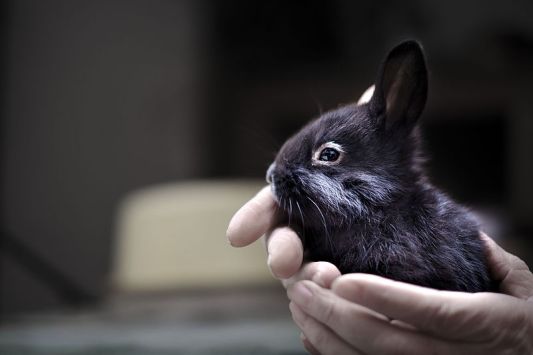
Wikimedia Commons
Source Vegan Publishers
By Casey Taft, PhD
Excerpt from Motivational Methods for Vegan Advocacy: A Clinical Psychology Perspective
Trauma in animal advocacy is not a topic that one sees discussed very often, but trauma is a central consideration in animal advocacy for a couple of reasons. Many animal advocates have personally experienced trauma themselves. In fact, for many of us, our personal experiences of abuse and injustice are what have helped us develop the mindset that we must fight to prevent all vulnerable creatures from experiencing unnecessary trauma and abuse. When one experiences trauma and abuse, they are more likely to be sensitive to trauma experienced by others and fight for justice for those oppressed.
While the experience of trauma may make us more attuned to the abuse of others, it also may leave us more vulnerable to trauma-related problems such as posttraumatic stress disorder, depression, and substance use difficulties. As animal advocates, we bear witness to extreme atrocities that nonhuman animals experience, some of us on a daily basis. This trauma exposure can wear on us and negatively impact our overall sense of well-being. Some may cope with these problems by turning their frustration and depression outward, resulting in difficulties with anger and aggression. Others may drink or use other substances to try to numb themselves to the pain.
It is important for all of us to be aware of what’s going on with us internally, and to decide for ourselves what degree of trauma exposure, if any, we are able to withstand. It does the animals no good if we are incapacitated with sadness and grief as we are exposed to trauma inflicted on them. We all must learn how best to take care of ourselves, both physically and emotionally, and surround ourselves with a supportive network that we can reach out to when we feel sad, frustrated, or a range of other negative emotions. We care so much about these animals and want to end their trauma, but the fact that we can only do so much to immediately end this trauma is devastating to many of us.
I have published research studies based on samples of military Veterans showing that when one experiences trauma, they’re more likely to view the world through an overly hostile lens. Some of my research shows that when one is exposed to trauma and experiences posttraumatic stress disorder, they have greater difficulties managing anger, are more likely to interpret events in a negative manner, and are more likely to lash out at others. This is based on a trauma-informed social information-processing model that my colleagues and I have elaborated in recent work (Taft, Murphy, & Creech, in press).
I mention this because it’s important that animal advocates exposed to constant trauma always be mindful that it’s easy to go down that abyss and view the world and all of its inhabitants as horrible. While the reality is that there is immense unnecessary suffering and humans are an incredibly destructive species, we need to prevent ourselves from developing such a cynical view that we’re not able to effect any kind of change.
In the last chapter we discussed core themes and how they can guide our behavior. Much of my clinical work has focused on how core themes can be disrupted by trauma, which can in turn negatively impact our relationships and ability to communicate. When we experience trauma, it can shake the very foundations of our beliefs and effects can reverberate across several domains of our lives. One of my mentors, Dr. Patricia Resick, developed and tested a highly successful treatment of posttraumatic stress disorder that has consistently and impressively demonstrated that when we address disruptions in these core beliefs, or cognitive schemas, we can help resolve traumas and develop healthier ways of viewing ourselves and others (Resick & Schnicke, 1992).
For example, when somebody is victimized in some way, or witnesses others being victimized, they may find it difficult to trust others. Or perhaps they suffer from difficulties related to self-esteem. They may harshly judge themselves when they make mistakes or for other minor infractions. Difficulties with trust and self-esteem can lead to depression, anger, and aggressive behavior. Traumatic events involving other people may also lead one to believe that others are not good or don’t need to be respected. They may have generalized this belief to everyone, which may also lead to a host of difficulties.
Power and control difficulties can develop when activists feel completely powerless to end horrific animal abuse. A profound sense of helplessness and uncontrollability can lead to chronic feelings of hopelessness. Feelings of powerlessness not only contribute to posttraumatic stress disorder (Finkelhor & Browne, 1985), but they can also contribute to power struggles with others and aggressive interactions (Schwartz, Waldo, & Daniel, 2005).
We can’t help others go vegan if we’re constantly skeptical of them and we assume the worst about them. We can’t help others go vegan if we jump down their throat immediately when they present us with one of the common justifications for animal use that we’re all too familiar with. Our best hope of creating a vegan world is to be calm but impassioned, assertive activists who can show non-vegans that we’re fully rational, compassionate people who want to help animals and prevent needless violence and abuse.
I have worked with many angry, violent Veterans who experienced severe combat-related trauma and posttraumatic stress disorder who were still able to change their perspective. It is by no means an easy task, but if one really pays close attention to their thoughts and how they are interpreting situations and themselves, as well as their feelings and other signs their bodies give them, they can train themselves to assume the best in others rather than assuming the worst. If we’re able to see things without assuming the worst, we’re more likely to recognize a desire to change and hints that a non-vegan is open to our vegan message.
We will miss those openings if we’re stuck in a state of negativity and hopelessness, so we must find a way to get help if we need it. I encourage anyone struggling with these issues to consider seeing a counselor who specialized in cognitive-behavioral therapy, which has been shown time and time again to be the most effective treatment for trauma-related problems (Keane, Marshall, & Taft, 2006).
Finally, recognizing the trauma experiences of non-vegans may also help open the door for true change to occur. When one experiences trauma, they will be particularly negatively reactive against more aggressive ways of approaching them. I have found that when I hear the person out and let them talk about their experiences, they will be much more likely to listen to my (vegan) point of view. Those who have experienced trauma in particular will be highly resistant to more confrontational, aggressive approaches, which is just another reason to be assertive, not aggressive, in our advocacy.
References
Finkelhor, D., & Browne, A. (1985). “The traumatic impact of child sexual abuse: A conceptualization.” American Journal of Orthopsychiatry, 55(4), 530– 541.
Keane, T. M., Marshall, A. D., Taft, C. T. (2006). “Posttraumatic stress disorder: Etiology, epidemiology, and treatment outcome.” Annual Review of Clinical Psychology, 2, 161–197.
Resick, P. A., & Schnicke, M. K. (1992). “Cognitive processing therapy for sexual assault victims.” Journal of Consulting and Clinical Psychology, 60(5), 748–756.
Schwartz, J. P., Waldo, M., & Daniel, D. (2005). “Gender-role conflict and self-esteem: Factors associated with partner abuse in court-referred men.” Psychology of Men & Masculinity, 6(2), 109–113.
Taft, C.T., Murphy, C. M., & Creech, S. K. (in press). “Trauma-Informed Treatment and Prevention of Intimate Partner Violence.” American Psychological Association.
 Casey is co-owner of Vegan Publishers, Professor of Psychiatry at Boston University School of Medicine, and staff psychologist at the National Center for PTSD in the VA Boston Healthcare System. He’s an internationally recognized researcher in the area of violence prevention, winning prestigious awards for his work from the International Society for Traumatic Stress Studies, the Institute on Violence, Abuse and Trauma, and the Centers for Disease Control and Prevention. He has published over 100 journal articles, book chapters, and scientific reports, and has a book forthcoming on trauma-informed violence prevention, published by the American Psychological Association.
she took
she took the sadness
that was all her world
and in a tight ball
of tears,
she curled.
and when she lifted her head
and reached out to
others in need.
the healing began
in deed and indeed♥
Karen Lyons Kalmenson
The Power of Discomfort

Karen Lyons Kalmenson
Source ABOLITIONIST VEGAN WHISPERS
By Frances McCormack
My partner and I sat opposite two acquaintances and Facebook friends, enjoying pleasant company and discussing travel, cats, and work. And then, the demeanour of one of our companions changed as he asked “What made you vegan?”
The question seemed to have been brewing in the air all evening, as it often does, but we were happy to answer, each with our personal narratives of the moment when we decided we couldn’t justify using animals anymore.
After we had each replied, the conversation took a turn that I have only seen in online interactions: we were interrogated (the next question came before we had the opportunity to answer the last) about plant sentience, about why vegans think animals are more important than humans (let me be clear: those who follow the Abolitionist Approach to Animal Rights don’t think that at all), about tradition, and various other objections to veganism with which most experienced advocates will be familiar. Our interlocutor showed no sign, at this point, of considering, or wanting to respond substantively to, our position.
It was clear that our acquaintance had planned to ask us about veganism in advance of our meeting, as he lined up, with some prompting from his wife (who otherwise remained silent), which question to ask us next. We were eager to dispel any myths about veganism and to help them understand, so we explained our position. Yet, for answering the questions that were put to us, we were derided as religious zealots, and made to feel like we were on trial. This was not an advocacy opportunity; this was an insistence that we defend our ethical standpoint. And although we were polite, and although the conversation took a different trajectory after a while, and although the evening ended amicably, we returned home to discover that we had been unfriended on Facebook.
For those who are new to advocacy, let me reassure you that such situations are extremely rare. Most conversations about veganism–especially those started by nonvegans–arise from genuine curiosity and interest, and the interlocutor will most often end the conversation by acknowledging that the information they sought has been provided, or by asking for some material they can peruse in their own time.
As with every discussion I have about veganism, I reflected on the process, and asked myself what we could have done differently, but eventually concluded that whatever we had done, the situation would have ended up with the same result. We tried asking questions instead of repeatedly defending our position in order to elicit some understanding of our interlocutor’s view of animals, but he was not interested in answering; the purpose of the exercise, it seemed, was to try to find some hole in our ethical position, and when that couldn’t be found, our interlocutor exclaimed “you win”, as though this had been a competition rather than a discussion of ethical issues.
And this discussion, strange though it was, confirmed for me how powerful vegan advocacy can be, even when it is polarising, or when it is uncomfortable for our interlocutor.
When we, as vegans, talk about veganism, we generally have a number of goals in mind: to attempt to persuade others, to effect change, to advocate for justice and fairness. But we tend to focus on these as our end goals and forget the transformative power of the vegan message as an end in itself.
When we talk about veganism, our conversation points to seldom-aired issues about our relationship with our fellow animals, about the chasm between our moral intuition about animals and how we treat them, about the nature of speciesism. It makes the often-ignored victims of our participation in animal use present merely by speaking of them as beings rather than disembodied objects. Not only are we questioning the status quo, but we are demonstrating that the alternative is better for all concerned, and, most importantly, the only manifestation of justice for other animals.
Being vegan is disruptive. Speaking the word “vegan” is disruptive. Advocating veganism is disruptive. To create something new, we have to deconstruct the old; this will invariably cause discomfort to some, and at times it may even cause discomfort to us. But, since we are not the victims of the injustice inflicted on our fellow animals, we must accept, if we commit to advocacy, that this occasional discomfort is part of the process of speaking for those who are.
As for our acquaintance, even though it seems as though he has retreated from our discussion of veganism by his unfriending, our conversation will not be so easy for him to shake off. He may remember that encounter with irritation, but his emotions will be accompanied by the triggers for those emotions–points of the discussion that particularly irked him. If something reminds him of us, or if our names are mentioned, that conversation will return. And he may reflect on his own defensiveness and work through his thinking about animals. But even if he doesn’t, as my partner notes, he cannot unlearn what he has learned. We have, nonviolently, disrupted his thinking about animals, and we cannot tell where that will lead.
As long as we talk to others about veganism in a nonviolent way, and without equivocation, no advocacy encounter is ever wasted. There will always be those few who respond unfavourably to our message, but we can never tell what happens as they process it. The stakes are so high for nonhuman animals if we don’t advocate for veganism that to do anything else is just unthinkable.
oh the strains of
growing pains…
nothing ventured
but enormous gains.
to spread the word
of compassion and
care…
for those who listen,
a world of love
to share.
Karen Lyons Kalmenson






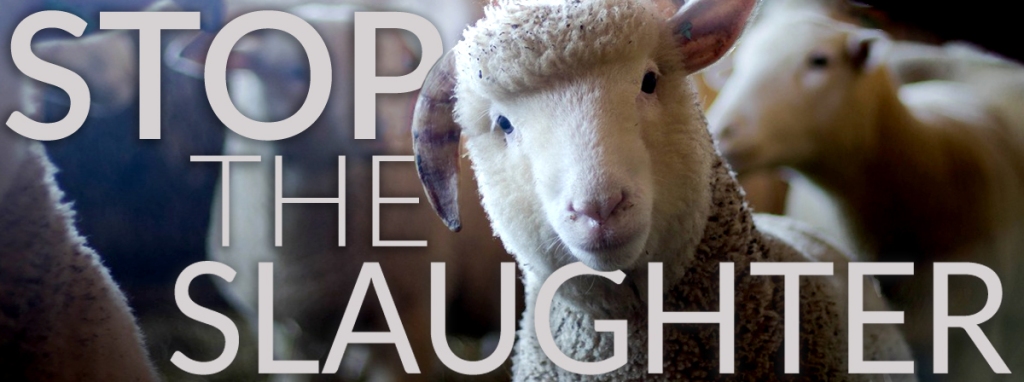



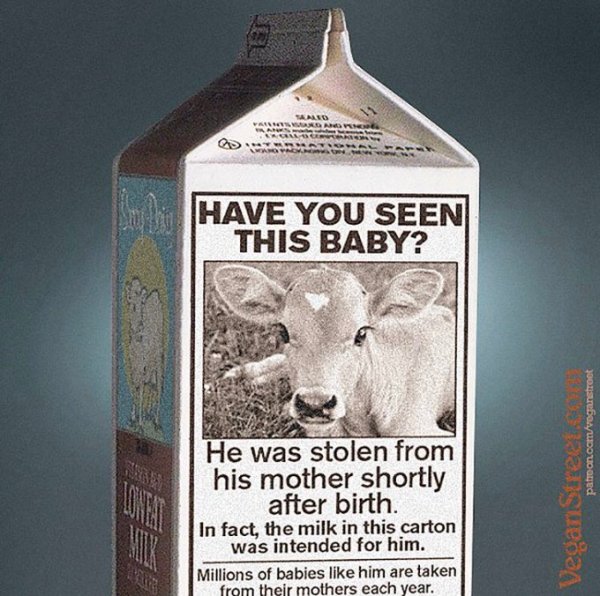


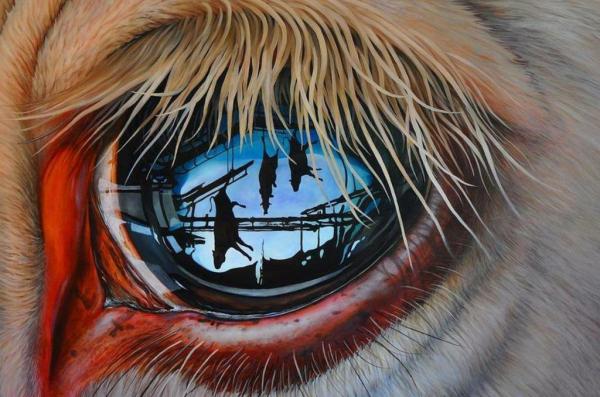


 Our Compass