HighestWelfare.Humane.Assured.GoodPractices.Vegetarian. Regenerative.Flexitarian.Lies...
What is the difference between No Welfare, High Welfare, and Highest Welfare when they all require animals to die? Only human comfort, NONE protect the actual animals. The most humane, ethical, and honest Webster-defined "welfare" is NOT exploiting animals - not using, not wearing, not eating, not killing - animals. The only meaningful position is vegan, everything else is just how humans euphemize animals' required suffering and violent deaths: no human exploits animals because they honestly believe that NOT exploiting animals is UNethical or INhumane.
We’re so vain – thoughts on intelligence
Source There’s an Elephant in the Room blog
About HERE
Another comment that often appears amongst the arsenal of tired old excuses that humans cling to in their attempts to justify the use of members of other species, centres around presumptions of superior intelligence when compared with every other species on the planet. When asked to provide examples, reference is sometimes made to landmarks of human endeavour such as writing symphonies, great works of literature, major inventions through the ages, and travelling to the moon, amongst others.
Well yes. These are indeed breathtaking achievements, but let’s just stop for a moment and get a grip on reality. Given that we, as a species, currently number some 7.5 billion individuals, there are relatively few humans whose names ring out across the centuries as beacons of intellectual prowess. Da Vinci, Archimedes, Newton, Tesla, Hawking and several others are names that stand out. For the rest of us – the vast majority, that is – no one is ever going to wax lyrical about our towering accomplishments.
What actually is intelligence?
Most of us are simply ordinary people, even though we are surrounded by technological marvels. Our expertise extends to knowing where the ‘on’ and ‘off’ switches are. If one of us were to be left somewhere with no tools or weapons, no instructions, no raw materials and no access to Google, I suspect that no one would ever be able to invent and create a computer for themselves, or write a symphony, or travel to the moon, and rocket scientists would not need to open their ranks to any newcomers. In fact many if not most of us would be seriously challenged to create some form of shelter or find something to eat without a handy supermarket.
To quote Isaac Newton in a letter in 1676:
“If I have seen a little further it is by standing on the shoulders of Giants.”
Although this is similar to a phrase used by the 12th century John of Salisbury, it may even pre-date him as he was known to have adapted and refined the work of others. Which really serves to illustrate the point that as humans, we are standing on the shoulders of giants, and the majority of us would never have attained the comforts and wonders that surround us, had it not been for the accumulated efforts of others. Thus, for us to claim some level of superior intelligence based on the achievements of the intellectual giants of our species could not even be called tenuous. It’s actually laughable.
So what about ordinary people like me?
So what about just general, common-or-garden intelligence then? When we look deeper into definitions of human intelligence, Wiki provides many angles and measures and it seems like the jury is still out on that one. There are theories about so many aspects; linguistic, logical, spatial, bodily, interpersonal, intrapersonal. There is no single definition that encompasses everything and I’ve been on the planet long enough to know that few of us would shine in even one of these areas, far less all of them.
Yet it is abundantly clear that despite the limitations that the majority of us have, whatever method by which we decide to define intelligence, however nebulous, however narrow, is the yardstick by which we as a species, generally presume to measure every other. It speaks to our elitist and speciesist mindset that we find and in fact expect to find articles about intelligence in the human animal separate from articles about intelligence in other animal species.
Looking for the sake of comparison at pages about intelligence in other animal species, I was not particularly surprised to find that the subject seemed to be broken up into a series of anecdotes, many of which are about individuals whose actions were in some way thought notable, combined with sparse paragraphs that say so little about a whole species as to be almost insulting, as well as one or two more lengthy pieces discussing wider issues such as theory of mind in animals. Our recognition of their skills is grudging even at best, frequently couched in surprised or patronising terms, determined that whatever we discover is not indicative of anything that would elevate their status to being worthy of their birthright to live their lives free from the violence and brutality of our merciless exploitation.

Shackles in a slaughterhouse for hens. Source There’s an Elephant in the Room blog
Life in a mirror
And in just the same way as our definition of ourselves as ‘animal lovers’ astonishingly disregards the copious bloodbath for which we are each personally responsible when we refuse to be vegan, our eager definition of ourselves as ‘intelligent’ includes pinnacles of human achievement that we personally can scarcely even understand, far less ascribe to. Despite this, we claim this ‘human intelligence’ as if it were our own, and we use it as a cudgel with which we bludgeon our way through the lives, the bodies and the habitats of our fellow earthlings; arrogantly assuming that although we have never taken the time to think about how this supposed intelligence manifests itself in the creature we see in the mirror, we are safe to assume that every other species is inferior.
And in just the same way as our definition of ourselves as ‘animal lovers’ astonishingly disregards the copious bloodbath for which we are each personally responsible when we refuse to be vegan, our eager definition of ourselves as ‘intelligent’ includes pinnacles of human achievement that we personally can scarcely even understand, far less ascribe to. Despite this, we claim this ‘human intelligence’ as if it were our own, and we use it as a cudgel with which we bludgeon our way through the lives, the bodies and the habitats of our fellow earthlings; arrogantly assuming that although we have never taken the time to think about how this supposed intelligence manifests itself in the creature we see in the mirror, we are safe to assume that every other species is inferior.
And what exactly is that creature in the mirror doing with all their intelligence? Well I know what the one in my mirror does. She cares for those for whom she feels responsible, looks after the place she thinks of as home, struggles to find a way to acquire the resources she needs to keep herself and those who depend on her fed, clothed, warm, safe and sheltered from the weather. Occasionally she’ll write, she’ll talk with friends, gather information about what others are doing with their time. It’s what I do. And let’s be honest, isn’t that what most of us do?
Recently I have shared a video or two that have been greeted with much delight – I’ll link them at the end. One depicts a tiny bird carefully and with consummate skill, sewing leaves together to create a shelter where she can build her nest. Another video gave an insight into the complex and fascinating life of members of the crow species.
And do you know what they were doing? They were looking after those for whom they were responsible, looking after the places they regarded as home, struggling to acquire the resources they needed to keep themselves and their dependants fed, safe and sheltered from the weather, gathering information about what others were doing with their time.
Common ground, shared priorities
In short, we have more that connects us with every other species than we care to admit. Each of us is simply living from day to day, caring for family, staying fed and sheltered. That is the level on which most of us function. And when we drop the assumption that we’re so superior to other species, other questions present themselves. Who the hell are we to measure all others by the standards we set – not for ourselves because we know we’re not in the same ballpark – but rather for a few individuals of our species? Who are we to decide that other species are not important enough to live unless they do so exclusively for our interests? And even – how do we actually know that we are the only species in which individuals come along every so often whose brilliance outshines us all?
We are a rather tragic species suffering from a delusion that we are apart from all others, brutalising and destroying our way through our days, rather than acknowledging our role as a part of the interwoven, interdependent network of life and living that is planet Earth. These delusions of ours are dragging the planet we share to the brink of an abyss of our making, a beckoning cataclysm caused by our arrogant assumption that our shared world and everyone who has fur or feathers, scales or wings, have no purpose other than to serve our petty whims and convenience. The end is perilously close, and time is running out for us to stop the behaviour that is causing the problem.
If we don’t wake up, and wake up very soon, it will be too late for every one of us, and being responsible for planetary disaster on an apocalyptic scale is hardly something that any intelligent species would do.
Be vegan.
Information and links:
Tailor bird
Crows
Birds and the Earth's magnetic field
Climate change links for information
what is true intelligence
a balanced blend of the creative
and common sense.
learning to fit into the world
not mold it around oneself
caring about the world
we live
and about its health.
Karen Lyons Kalmenson
Gun Violence: Striking at the Speciesist Root
Source Direct Action Everywhere
By Melissa Schachter, MSW
We are in the year of 2018, folks. If you are reading this, you likely live in a first world country and understand a set of values which separate the “no good doers” from the “good doers.”
We are taught at an early age what’s right and wrong. Society reinforces these values in almost everything we do. When we are in preschool, if we hit another child, we are put on timeout. When we are in high school, if we get in a fight, we get suspended. As an adult, we get arrested. And so it goes on. Every action we take is either encouraged or punished by the society we live in. These sets of values and beliefs have been pushed in our brains since we were children and our tiny little minds were sponges, soaking up all the information we could sustain.
Between birth and 3 years of age the human brain increases to 80% of its adult size. As children, we learn what to do to be rewarded and what to do to be punished. So the “food” that has been fed to us since we could chew is just that, food. We were never taught to ask any questions or find out more about the chicken leg we are being fed for dinner. After all, why would we? If this chicken leg came from an abused animal, we would have been informed by our loving society who would never let any animal die unless the animal really wanted to. This chicken lived a full life and happily gave himself up willingly so that we can feast upon his flesh. Right?
When we hear of stories of someone abusing an animal, people are not only outraged, but experience a strong tug on their heart that crushes a little of their spirit. We often create a picture in our heads of a small puppy or kitten being kicked or tormented by an abuser. The thought of a defenseless animal looking up at their abuser in bewilderment and utter confusion can quite literally make us break down in tears. We demand to know who this abuser is and call for justice from our system that has taught us right from wrong all our lives. Why does picturing an animal being hurt by another human make us so angry? What is it about this picture in our heads that awakens a place in our heart?
As many of you know, on February 14, a gunman set off fire alarms at a high school in Florida, luring teenagers out of their classrooms so that he could open fire with a semi-automatic AR15 assault rifle. This teenager, whose name I refuse to mention, killed 17 people and injured 14 others. Florida and other states are banding together to beg Congress to create stricter gun laws, with the hope that nothing like this will happen to our children again.
The shooter previously talked about shooting small animals and sending his dog over to the neighbors to attack their pigs. Far from an isolated coincidence, the FBI has identified cruelty to animals as a warning sign of more violence to come, and many school shooters and serial killers have a history of abusing animals.
A survey found that animals were abused in a shocking 88 percent of homes where physical abuse of human children was present. Society now recognizes animal abuse as a red flag for human violence. And abuse of “pet” animals is already against the law. People are outraged and on alert when dogs or cats are mistreated.
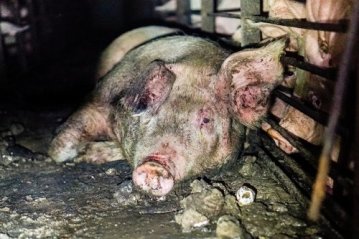
A mother pig at a Smithfield pig farm languishes in her own waste. (Source: Direct Action Everywhere)
Yet over 56 billion farmed animals are killed each year by humans, and much of society doesn’t blink an eye. There seems to be a disconnection between farmed animals and pets. Why do the values of our society that lead us to be outraged by a dog being abused fail to carry over and pertain to a different kind of animal?
Do slaughterhouse workers have the same correlations between animal murders and violence toward humans? According to the PTSD journal, “these employees are hired to kill animals, such as pigs and cows that are largely gentle creatures. Carrying out this action requires workers to disconnect from what they are doing and from the creature standing before them. This emotional dissonance can lead to consequences such as domestic violence, social withdrawal, anxiety, drug and alcohol abuse, and PTSD”.
So just to recap: abusing dogs and cats is statistically proven to lead to violence towards humans. Abusing or killing dogs and cats is against the law. But killing farmed animals who also live a life filled with abuse is not only socially accepted but legal. And statistics also back up slaughterhouse workers developing PTSD and going home to their families with more odds to use physical violence against them as well after a long day of killing farmed animals.
Looks like we have been fooled. We have been fooled by our parents, our families, our teachers, our friends, and they in turn have been fooled by grocery stores, advertisements, TV, magazines, just to name a few. Jokes on us. The meat and dairy industry have taken advantage of our young and sponge-like brains and used it to their benefit to put money in their pockets. And what has been the result? Heart disease, diabetes, cancer, strokes, obesity, pollution, drought, deforestation, climate change, and so many other atrocities, I’m just not able to name them all. But more than all this, we have been fooled that there is such a thing as “humane murder”. We have been taught to believe that we somehow OWN other creatures and that forcing them into a life of enslavement is our right. OUR. RIGHT.
What happened to these ethical values that connect everything else together? I’m just as confused as you are. What went wrong? “Money is the root of all evil”: heard that one before? Society has been tricked into thinking the way we have been taught to do things, is the ONLY way to do things.
The animal rights movement today is challenging societal norms. We are extending our moral values beyond their normal reach. Living an ethical life is not defined by what is taught to you, and it is not only about living your life without hurting others, but living a life defending those who cannot defend themselves.
Texas Animal Farmer’s Transition to Vegan Activism

Source Free from Harm: The following is an interview between Robert Grillo of Free From Harm and Bessie VonMessenger, a former animal farmer turned vegan activist living in Waco, Texas, whom we recently discovered from footage of a slaughterhouse vigil on Facebook. This is her story.
Source Free from Harm
By Free from Harm Staff Writers
Tell me a bit about your childhood and family life. How did growing up on a farm or farming environment shape who you are?
Growing up on a farm gave me an opportunity to witness the close family and friendships that farm animals have. When I was very young I raised a calf whose mama was sick. He began to see me as his mom and would moo happily when I gave him a hug. I watched him grow to become a strong bull with a heart filled with gentleness and empathy for his herd, as well as for me. When my family loaded him onto the trailer to be sold, I screamed and cried and begged them not to sell my baby, not to take him to the cruel auction house. I can still see that look of sadness in his eyes as we said goodbye.
I was witness to the many joys and heartaches of the animals at our farm. I watched mother cows caring tenderly for their young, and their families watching over the babies as they would stop to eat. I saw herd sires protecting the young as the trailer was loaded with babies to be sent to auction and I heard mama cows crying at the loss of their young. I witnessed chickens developing friendships and roosters protecting their hens in the mornings when we would collect their eggs. These experiences with the animals eventually opened my eyes to their very real feelings and family connections that make these animals individuals and not products.
What was the catalyst for your transformation from farming to veganism?
It took me learning to turn off the noise of tradition and social conditioning to finally go vegan. The strong memories I hold of the happiness and sadness of the farm animals left an impression on me. I began to understand how very much they are like us. I would never want to be used against my will or have my precious family taken from me and sold to slaughter. I realized neither do the animals want this life of suffering and grief. They want to live and be happy. You can see that desire clearly in the gentle caring eyes of a mother cow
Please read rest HERE
To grow is to learn
To learn is to grow
There is never enough
Kindness to know
Karen Lyons Kalmenson
2018 Veggie Pride Parade in NYC
Source YouTube, Donny Moss
As hundreds of New Yorkers took to the streets of Greenwich Village to participate in the 2018 Veggie Pride Parade, many onlookers spoke to TheirTurn on camera to give their honest feedback about the parade and its message.
Order a FREE vegan kit: http://www.peta.org/living/food/free-vegan-starter-kit/
Take PETA’s Cruelty-Free Shopping Guide along with you next time you head to the store! The handy guide will help you find humane products at a glance. Order a FREE copy HERE
Want to do more than go vegan? Help others to do so! Click on the below for nominal, or no, fees to vegan literature that you can use to convince others that veganism is the only compassionate route to being an animal friend.
PETA: http://www.petacatalog.com/catalog/Literature-39-1.html
Looking for merchandise? Action for Animals has a very good selection : http://store.afa-online.org/home.php?cat=284
Have questions? Click HERE
if we are going to have any future at all
our lives and plates must be kind…
and that is all!
Karen Lyons Kalmenson
Source HuffPost
By Jay Shooster
This piece was co-authored by Rockwell Schwartz, recent graduate of Vassar College’s Science, Technology, & Society program.
A shooting is happening right now at Vassar College. It is the fourth the campus has seen in the past six years. Over 115 have already been killed, their blood spilled on the college fields. Yet, it’s unlikely you’ve heard anything about it. The national media remains silent; not even the local news has covered the grieving families or lost friends. No candlelight vigils, no memorials, no communal mourning, as the victims remain unidentified and seemingly forgotten.
What’s happening at Vassar College should be shocking, but similar shootings have been largely ignored across the country. The annual death toll climbs well into the millions, yet there is no accurate record of the casualties. Why? Because the victims were born as members of the wrong species.
In the brewing national discussion on gun violence, the most numerous victims—animals—are left out of the conversation. For every human life taken by a gun, hundreds, if not thousands, of nonhuman lives have also been taken. Yet for these victims, gun control advocates not only erase their deaths, but also actively promote and protect the killings. We fail to label the unnecessary killing of animals as gun violence, and instead we euphemize and romanticize it as “sportsmanship.”
But hunting is gun violence. A bullet ripping through flesh, puncturing arteries, taking a life is violence no matter the victim’s species. And these deaths are far from as clean and easy as often presented: One study found that more than 1 in 10 deer died only after two or more shots, often suffering for over 15 minutes prior to death. White Buffalo, Inc.—an organization hired by Vassar College to conduct killings on its campus—became the subject of a lawsuit following undercover footage collected at one of its shoots. In one video, a mother deer is shot in the head right in front of her two fawns and she is seen still kicking as a park ranger places a plastic bag over her head. Even when hunting is carried out by paid professionals, there is still suffering and a surge of cortisol-driven terror.
One obstacle to seeing nonhumans as victims of gun violence is our tendency to reduce them to an anonymous collective. Victims matter more to us when we can see them as individuals, such as the rescued animals of Leilani Farm Sanctuary of Maui. We connect to the animals there as individuals because we know their stories. Particularly compelling is the relationship between Veronica the deer and Berney the wild boar. Veronica was rescued after hunters shot her mother in front of her when she was just a fawn. Berney wandered onto the sanctuary as a piglet, clearly also orphaned and searching for safety. Today, these two individuals, both members of commonly hunted species, live in safety. The sanctuary shares anecdotes of Veronica teasing Berney out of jealousy and Berney running over when his name is called. Once we see Veronica and Berney as unique individuals with their own personalities, interests, relationships, and needs, it becomes clear that shooting them would be an act of violence.
At some level, most of us understand that killing animals is wrong. Nobody feels good about telling a child that hunters shot Bambi’s mom. Even staunch hunting advocates will describe it as a necessary evil. Conversely, the public is captivated by stories of hunters saving the animals they had intended to kill. We love to watch the once-villain put his own safety on the line to help an animal in need. We care about these animals and sympathize with their suffering so much that a video posted last month of one doe’s rescue has already garnered over a million views. Understanding their deaths as gun violence—and including their interests in the national conversation—is the logical conclusion.
Following the statements of President Obama, who speaks of his respect for hunters, 2016’s three Democratic hopefuls have paradoxically condemned gun violence while ensuring that gun violence against animals continues undisturbed. This week, Bernie Sanders emphasized that his support for gun safety legislation would “not negatively impact” the hunting community. Hillary Clinton has also noted her “respect” for hunters, and whitewashed the killing of animals simply as “part of a way of life.” Meanwhile, Martin O’Malley has notoriously overseen the controversial Maryland black bear trophy hunt. He touts Maryland’s “comprehensive” gun safety legislation for not interrupting “a single person’s hunting season,” while he criticizes the records of both Sanders and Clinton as inconsistent on gun violence. In the end, it seems all three Democratic candidates, as well as President Obama, are pandering to conservative hunting advocates (and selling out the animals) to market a more palatable plan to stop gun violence against human beings.
We ought to demand more of progressive politicians. The majority of Americans believe that hunting animals is wrong. We must demand that they stop using animals’ lives as bargaining chips to appear moderate or reasonable on gun control. There is absolutely nothing to “respect” about the unnecessary killing of animals. There is nothing wholesome about shooting individuals who want to be free from harm. Hunting is gun violence, and it’s time we start acting like it.
Order a FREE vegan kit: http://www.peta.org/living/food/free-vegan-starter-kit/
Take PETA’s Cruelty-Free Shopping Guide along with you next time you head to the store! The handy guide will help you find humane products at a glance. Order a FREE copy HERE
Want to do more than go vegan? Help others to do so! Click on the below for nominal, or no, fees to vegan literature that you can use to convince others that veganism is the only compassionate route to being an animal friend.
PETA: http://www.petacatalog.com/catalog/Literature-39-1.html
Looking for merchandise? Action for Animals has a very good selection : http://store.afa-online.org/home.php?cat=284
Have questions? Click HERE
put away your rifles
pistols and guns
the taking of lives
is no sane persons
idea of fun!!!
Karen Lyons Kalmenson
2018 Conscious Eating Conference Videos
Source United Poultry Concerns (UPC)
UPC’s 7th Annual Conscious Eating Conference Saturday, March 10th, in Berkeley, California, was a huge success! We had an incredibly high caliber of speakers this year who gave insightful and in-depth presentations on important animal rights issues. Enjoy the videos and be sure to join us next year! We thank everyone who attended our conference this year, and we thank our speakers for providing so much nourishing food for thought and action!
All videos in one; presenters include the following:
Justin Van Kleeck, PhD
Animal Farming and the Roots of Speciesism
Adam Karp
Veganic Lawyering, Carnivore-Keeping, and Natalist Ruminations
Karen Davis, PhD
Don’t Just Switch From Beef to Chicken
John Sanbonmatsu, PhD
Lady Macbeth at the Rotisserie: ‘Femivores,’ Violence, and the New Maternalism in Animal Agriculture
Hope Bohanec
Sentience in the Sea
Clifton Roberts
The Humane Party – Animals, Politics, and the Future
Panel Discussion
Question & Answer Session
See previous years HERE courtesy Veg4Life
Source YouTube
By Earthling Ed
Watch the eye-opening speech that was given to thousands of students in universities across the UK.
take a 22 day vegan challenge ➝ http://bit.ly/22veganed
support my activism by becoming part of my patreon team ⤸ https://www.patreon.com/earthlinged
stuff:
✦ website: http://www.earthlinged.com
✦ FREE e-book: http://www.earthlinged.com/ebook
✦ vegan activism tees & hoodies: https://www.heartcureclothing.com/pro…
stay connected:
✦ facebook: http://www.facebook.com/earthlingedpage
✦ instagram: http://www.instagram.com/earthlinged
✦ podcast: http://www.soundcloud.com/earthlinged
projects:
✦ surge: http://www.surgeactivism.com
✦ land of hope and glory (uk ‘earthlings’ documentary): http://www.landofhopeandglory.org
✦ the official animal rights march: http://www.theofficialanimalrightsmar…
✦ the big vegan activism van: http://www.thebigveganactivismvan.com
the “i” you are
the self within
the growth that
can happen
as each day,
begins.
Karen Lyons Kalmenson
Domination Games
Source Humane Myth
By James LaVeck and Jenny Stein
Coming to terms with a culture of power abuse in the institutional animal advocacy movement
Justice is not achieved, nor maintained, without sacrifice. Confronting troubling issues within one’s own family, or within one’s movement, is messy, scary, and often costly. But sometimes, it is necessary.
As we write these words, there are individuals in the US animal movement who are being harmed or have been harmed by abuses of power carried out by those with high levels of influence and status. Secrets, lies, and aggressive suppression of criticism have enabled personal damage and betrayal of public trust to continue.
As a community, we animal advocates need to support victims when they come forward. We also need to encourage witnesses to speak out. Board members and others in positions of oversight must dramatically up their game, or, in some cases, step down. None of this will be easy. It will take courage on the part of many.
Secrets, lies, and aggressive suppression of criticism have enabled personal damage and betrayal of public trust to continue.
A culture of power abuse
For twenty years, we have witnessed a culture of power abuse grow within the US institutional animal advocacy movement, which we define as a group of multi-million dollar organizations whose competitive mentality and hierarchical structure mirrors that of for-profit corporations. Now, allegations have surfaced in the media of inappropriate sexual conduct and power abuse by former CEO Wayne Pacelle and former Vice President Paul Shapiro of the Humane Society of the United States (HSUS), along with former Executive Vice President Nick Cooney of Mercy for Animals. While none of this is a surprise to many veteran activists, it should signal the beginning of a long overdue course correction for our movement.
Our own personal experience as social justice filmmakers has given us a unique perspective, because our means of working for change has connected us with people in a wide range of contexts, including activism, education, politics, philanthropy, law, and the arts. Of all the different settings in which we’ve done our work, sadly, the most predictably toxic, destructive and exploitative has been that of institutional animal advocacy.
Thankfully, our work has given us the opportunity to closely collaborate with a large number of grassroots activists at the local and regional level. These individuals are among the most genuine, compassionate, and hardworking we have ever met. To us, they are the spiritual descendants of those citizen activists in past eras who took up causes like women’s rights or the abolition of human slavery, before they were popular, when few people in society had the imagination to realize that terrible injustices were taking place, and even fewer had the courage to publicly confront them. Such everyday heroes of our own era have been our role models and teachers. Making films and other educational tools to empower their efforts has been the honor of our lives.
In stark contrast, the more experience we have had with the higher ranks of the institutional movement hierarchy, right up to the top leadership of some prominent national organizations, the more we have encountered individuals whose cynicism, arrogance, narcissism, and addiction to domination are nothing short of breathtaking.
Sexual harassment is but one of several ways that influential leadership figures have compulsively preyed on those serving the cause.
Losing a generation
Sexual harassment, now widely understood to be more about domination than sex, is but one of several ways that influential leadership figures, not all of them men, have compulsively preyed on those serving the cause.
We have seen credit for the work of brave investigators, animal rescuers and community activists stolen by large organizations that should have been supporting, not undermining, their efforts.
We have seen promising academic careers sabotaged by demagogues viciously discrediting former students and associates who dared to express ideas of their own.
We have seen talented journalists whose refusal to toe the line cost them their platform for reaching the public.
We have seen celebrity supporters and key funders of grassroots organizations wooed away by corporatized charities.
We have seen well-intended members of the public duped into believing they are “helping animals” by eating their dismembered body parts adorned with “humane” labels.
We have seen idealistic activists pressured into taking part in the killing of animals who could have been saved.
We have seen some individuals so traumatized by such violations that they were driven to acts of self-damage, or had to spend years of their lives attempting to heal.
As it dawned on us one day, “this is a movement that consumes its young.” The addictions of leadership figures and those who enable them have generated such havoc, and disillusioned so many, that they have created a lost generation.
As it dawned on us one day, “this is a movement that consumes its young.”
Rotting from the inside out
Over the time we have been involved, starting in the late 1990’s, the US movement has come to be influenced more and more by the consumerist celebrity culture that has sapped our national vitality. Making matters worse, key leadership figures have actively promoted the methods and mindset of Washington political operatives. The result has been an increasingly cynical, manipulative and intellectually dishonest approach to many aspects of advocacy work.
In this unhealthy climate, wave after wave of new activists have become fodder for the “domination games” played by “celebrity” leaders and those in their inner circles. With cool detachment, they rapidly sort out who has something useful to offer their personal and organizational agendas, be it money, fame, political connections, creative talents, dedication, loyalty, or, as recent events have demonstrated, sexual appeal in the eyes of someone in power.
Patterns of serial abuse now being exposed in other segments of society are causing an awakening about the high cost of complicity and indifference. Like many other people, we recently watched the victims’ testimony against the disgraced physician who, in the course of his career, molested over 250 young gymnasts associated with the US Olympic program. In the faces of those young women as they publicly confronted their abuser, we saw no expressions of triumph, no gleeful vengeance, no sense of final resolution or peace. What we saw were the heavy eyes of those whose innocence had been stolen from them by a deranged person whose abuses were allowed to continue despite many victims coming forward. Such a profound level of disillusionment cannot be created by just one destructive individual. It is systemic. It involves many people looking the other way, or worse.
There was one moment of testimony that especially haunts us. It was when gymnast and activist Aly Raisman, in calling for an investigation of what, and who, enabled such outrageous abuse, declared that “USA Gymnastics is an organization that is rotting from the inside.” Our assessment is similar: Major segments of the US institutional animal advocacy movement are, like USA Gymnastics, rotting from the inside out.
Please read rest HERE
power corrupts
be it
large or small
but the greatest
power is kindness
which is not
power,
at all.
Karen Lyons Kalmenson
Source USA Today
By Beth Levine
Thank you for USA TODAY’s article “Winter Olympics shine light on Korean dog meat trade”. Most of us do not have any direct impact on what happens to dogs at the Korean Peninsula, but each of us make daily choices about what happens to pigs, turkeys, cows and other animals akin to dogs and humans in their sentience.
The question isn’t how much they suffer in their lives and deaths. The question is do we continue to kill animals when we don’t need to? A well-balanced plant-based diet is healthy. Research shows this. Vegan athletes show this. And the American Dietetic Association, Kaiser Permanente and Physicians Committee for Responsible Medicine support a vegan diet. If you are outraged and sickened by dogs ending up on the plates of others, would you honor your values of compassion, fairness and justice for other animals by going vegan?
Beth Levine; Rockville, Md.
Order a FREE vegan kit: http://www.peta.org/living/food/free-vegan-starter-kit/
Take PETA’s Cruelty-Free Shopping Guide along with you next time you head to the store! The handy guide will help you find humane products at a glance. Order a FREE copy HERE
Want to do more than go vegan? Help others to do so! Click on the below for nominal, or no, fees to vegan literature that you can use to convince others that veganism is the only compassionate route to being an animal friend.
PETA: http://www.petacatalog.com/catalog/Literature-39-1.html
Looking for merchandise? Action for Animals has a very good selection : http://store.afa-online.org/home.php?cat=284
Have questions? Click HERE
and when the spacemen finally land
they see our planet,
lush and grand
filled with humans
upon whom to dine.
eating meat then is
no good
when man
sits on the tine.
Karen Lyons Kalmenson
Is dairy the new tobacco?
Source The Wire
By Gene Baur
Gene Baur is the president and co-founder of Farm Sanctuary, a national farm animal protection organization.
As the Congress scrambled to pass a funding bill to prevent another government shutdown, a well-heeled set of operatives was hard at work behind the scenes, ensuring that our government ramps up subsidies for a cruel, wasteful and irresponsible industry: factory-farming dairy production.
This is not something you’re likely to read in the news — because, frankly, it’s nothing new. For decades, agribusiness has been pulling levers in the U.S. Capitol, and billions of our tax dollars have been wasted in propping up our antiquated dairy industry, one of the most deeply entrenched interests in Washington, D.C.
These days, its cadre of lobbyists, bolstered by campaign contributions to politicians, is seeking to appropriate and misuse government resources to keep dairy farmers in business even as the demand for dairy products has dropped. Hundreds of millions of pounds of cheese and butter sit in reserve, millions of pounds of excess milk are being spilled out onto fields, and yet our government continues to invest in a broken system. It is time for the government to stop supporting this harmful and abusive industry.
These dairy pushers aren’t just encouraging wastefulness, they’re also misleading American families, who are led to believe that cows’ milk is actually good for us. In fact, cows’ milk is for baby calves, not humans — and we can live well and obtain all the nutrients we need, including calcium, without consuming dairy or other animal products.
Exploiting animals for food is inherently inefficient, and requires that we grow vast quantities of corn, soy, and other crops to feed them. Animal agriculture is a leading cause of our planet’s most significant environmental threats, including the depletion of water and other precious resources and the destruction of rainforests and natural ecosystems. It is a primary cause of the earth’s loss of biodiversity, and is a leading contributer to climate change rivaling the entire transportation industry. More than a quarter of all greenhouse gas are a direct result of the food system.
Large-scale factory-farm operations (also known as confined animal feed operations) produce enormous quantities of manure which is stored in lagoons and spread on fields, contaminating the land, water, and air.
The health and quality of life of the people living nearby is diminished and their property values drop because of the foul odors and toxic emissions. Sullied groundwater leaches into streams, polluting drinking water and contributes to fish kills. Rather than requiring that industrial farms act as responsible stewards, federal tax dollars are used to enable and support their irresponsible practices.
Environmental and human health risks are exacerbated by the indiscriminate use of antibiotics on factory farms, which has led to the development of antibiotic-resistant pathogens. These present risks to consumers who eat contaminated food, and they also pose risks in the environment, where antibiotic-resistant bacteria have been found in groundwater. When people are sickened, formerly life-saving drugs can be rendered useless.
For decades, American schoolchildren have had cows’ milk foisted on them, along with artery-clogging cheese and other fat-laden animal products. Obesity and heart disease have become too common. Lawmakers are quick to speak against tobacco subsidies, and yet they overlook the fact that billions of taxpayer dollars are used to support and boost an industry that costs us billions of dollars in health problems.
Consumers are getting the message, and the marketplace is adjusting. Demand for plant-based milks is expanding, and the consumption of cows’ milk is decreasing. Federal food policy should support and encourage this trend.
Just as the tobacco industry had to make adjustments, so too should the dairy industry. With the 2018 farm bill just around the corner, the time is right to decry spilled milk.
Order a FREE vegan kit: http://www.peta.org/living/food/free-vegan-starter-kit/
Take PETA’s Cruelty-Free Shopping Guide along with you next time you head to the store! The handy guide will help you find humane products at a glance. Order a FREE copy HERE
Want to do more than go vegan? Help others to do so! Click on the below for nominal, or no, fees to vegan literature that you can use to convince others that veganism is the only compassionate route to being an animal friend.
PETA: http://www.petacatalog.com/catalog/Literature-39-1.html
Looking for merchandise? Action for Animals has a very good selection : http://store.afa-online.org/home.php?cat=284
Have questions? Click HERE
the truth even when written
read and/or forgot
is the truth
whether all
believe it
or not!
Karen Lyons Kalmenson
Raising Children Who Will Stand for Justice
Source JoAnnFarb.com
About JoAnnFarb.com
In 1942 President FDR – husband to social justice hero Eleanor Roosevelt, signed an executive order that put thousands of law-abiding Japanese American citizens in prison camps. There was little outcry. In the 1970s, in collaboration with doctors, our government forced African American men to endure late stage syphilis. Few with knowledge of this objected. U.S. history begins with violently removing indigenous inhabitants from their ancestral lands. Shockingly, in the 1800s, some abolitionists opposed women voting. Today some who support civil rights for people of color oppose marriage equality for LGBTQ identifying individuals. The book, The Immortal Life of Henrietta Lacks, describes a large American hospital in the 1950s injecting cancer cells into hundreds of patients without their knowledge or consent. Three Jewish doctors were the only ones to object. But their views were marginalized as being “overly sensitive because of the Holocaust.” History is full of similar examples. Perhaps that is why Albert Einstein said, “The world is a dangerous place not because of those who do evil, but because of those who look on and do nothing.”
The Holocaust is one of the most egregious examples of human’s capacity to look away and disregard injustice. After hearing about it, many wanted to know, “How did so many seemingly average people allow it to happen? The classic experiment by Stanley Milgram sought to answer this. His data showed that under certain conditions, half of us will go along with things we know harm others. Milgram stated, “Ordinary people, simply doing their jobs, and without any particular hostility on their part, can become agents in a terrible destructive process.” Some cultures (and by implication their cultural practices) appear to be less vulnerable to this. So it’s worth asking, what practices might make us less likely to ignore injustice threatening someone else?
I raised two children to adulthood as vegans. We taught them the moral basis for this lifestyle: When we have a choice, choose non-violence and non-exploitation. I watched our vegan practice lay a foundation for each to think critically about how their personal actions may impact injustice happening to others. I have been heartened over and over to see my children risk disapproval in social situations rather than be complicit in harms to others. From speaking up to a bully who was threatening a peer, to expressing concern about planned classroom activities that would harm animals, my children did not, “look on and do nothing.”
Increasingly our main vote is how we spend our dollars. But the greatest contribution of veganism is not its boycott of intentional violence. Rather, it’s the ripple effect resulting from someone standing firmly in solidarity with justice, nonviolence and compassion. This inspires those around them to consider their own choice of where to stand. The fact that human beings have the capacity to ignore injustice happening to those we have been taught to “otherize,” is what has enabled every human-caused tragedy. One group (in terms of number of individuals impacted) has been more victimized and exploited by this phenomenon than any other: The non-human beings we’ve been, “taught” to eat, hunt, experiment on and use for entertainment. So why not “teach” something else?
To embrace a vegan ethic, is an important step if one seeks to avoid being complicit in violence and exploitation against the vulnerable. This effort encourages critical thinking and compassion – the very things we most need if we wish to see justice flourish. Modeling for the next generation a conviction to practice non-violence in our diet, what we buy, and what we endorse, may be the single most powerful action any of us can take at this time in history. Please join the peaceful revolution.
what type of legacy do you want to leave
what are the principals in which you
believe.
teach by example
live the way
show that kindness
truly
rules
the
day!
Karen Lyons Kalmenson
“Clean Meat”? – Two Animal Rights Advocates Say No
Source United Poultry Concerns
Why “growing meat without animals” is NOT a solution: two views
On Jan. 10, we published “Slaughter-Free Flesh for Humanity” which drew fire from some animal rights advocates including Joan Harrison, whose letter, “When Even ‘Clean Meat’ Isn’t Clean Enough,” appeared in The Wall Street Journal, January 13, 2018, as follows:
Regarding Matthew Scully’s review of Paul Shapiro’s “Clean Meat” (Books, Jan. 6): I’m afraid I cannot agree with my fellow activists’ enthusiasm about so-called clean meat. The new technology may relieve animal suffering to some extent in the short term by using donor herds, which would suffer and be enslaved to provide cells out of which meat is then laboratory grown. Though this may end factory farming, which would be a blessing, it will do nothing to end the public’s identification of animals with food. Indeed, it will likely confirm this.
The object is not to end factory farming; the object is to end animal farming as such. The promoting of meat of this sort is thus a pernicious undermining of animal liberation. According to psychology professor and animal activist Bill Crain, experiments show that people eating the flesh of animals generally perceive animals in a negative light in contrast to people who don’t. Is this something we really wish to encourage? What about flesh emerging from a bioreactor? Why not promote Monsanto’s GMOs? And what about developing meat from human cells? If the latter is repulsive to you, and clean meat from cows, pigs, chickens and lambs nevertheless seems okay, you are still under the sway of speciesism, the evils of which are well known. A simpler solution is available, though it’ll take some time, one that is consistent with and would facilitate the liberating of animals both nonhuman and human: adopting a plant-based diet. It’s already happening.
Joan Harrison
New York
On Jan. 25, UPC President Karen Davis asked Philosophy Professor, John Sanbonmatsu – who (spoke) at our March 10, 2018 Conscious Eating Conference in Berkeley, CA – what he thinks of “clean meat.” He wrote back:
RE: “Clean Meat,” I think it is folly, for several reasons:
I think too many vegans are thinking of this as the Holy Grail, which may subtly be taking pressure and urgency off of other modes of action and analysis.
The framing of the discourse as “clean” vs. “unclean” meat aestheticizes meat, which is already an aestheticized commodity. The reality is, one form of “meat” is based on genocidal violence, exploitation, and injustice, and the other isn’t. So it should be framed as a choice between violence and nonviolence, not “cleanliness” in either an aesthetic or “morally virtuous” sense (as in, I have a “clean conscience”). One of the cafes here in Cambridge [MA] is called “Clear Conscience Cafe,” and naturally they serve grassfed Angus beef, etc.
I think it’s a terrible mistake to confuse the issue in consumers’ already confused minds between “good” and “bad” forms of animal products. I was in NYC over the weekend, and one of the grocery stores had organic turkey and pig sausages literally mixed in with the vegan “meat” products. So the messaging is, “This is where you get the ‘alternative’ and ‘healthy’ stuff, take your pick.” The last thing we need is to have ontological meat (i.e. flesh) being sold to consumers as more “ethical” meat.
Most higher-end consumers will continue to choose “organic” and “local” animal flesh over synthetic, lab-grown meats. Why? Because they are figured as “authentic.” Michael Pollan sneers when the topic of syn-meat comes up: like, who would want THAT? Just think about how educated Americans have been steering away from “processed” and “artificial” foods for a generation. And now we want them to eat burgers made with lab-grown cow cells? No way. The meat industry will turn right around and promote authentic meat even more heavily than they do now.
The whole synthetic meat movement is perpetuating the lie that the only reason, or main reason, we can’t have universal veganism and an end to animal agriculture is because there are no “good” alternatives. That, and the lie that the reason people “can’t” (or won’t) give up eating animals is because animals just taste TOO GOOD. Well, I don’t believe that. Yes, there are undoubtedly some people so hooked on the exact specific taste of bacon or whatever that they will cling to it until Doomsday. But I don’t think that accounts for most or even a big part of resistance to Animal Rights or to veganism specifically.
What’s going to happen with this stuff is precisely what happened to Whole Foods and the whole “humane meat” industry: synthetic meats will not be competing with cheaper meat commodities; this industry will be competing with the chi-chi market for specialized foods. So the price point is going to be set high, because that’s where the market is going to be most lucrative (because this is capitalism). Meanwhile, as I said, if the typical consumer is faced with a menu of “real” chicken and “synthetic real” chicken, he/she is going to choose the real chicken most of the time, or so I believe.
If humans think so little of the dignity or suffering of animals that they can’t or won’t countenance giving up farmed animal flesh until and unless there is an exact, one-to-one replacement, in taste, texture, availability, etc., then what are the odds that they will make any concerted effort to switch to synthetic meats at all?
Against the odds, somehow, we need to smash speciesism as an idea and a set of institutions and beliefs and interpellated identities. If we don’t challenge that, if we can’t undermine it, I think it’s going to continue to be game over for animals, and all of the synthetic meats in the world won’t amount to anything.
John Sanbonmatsu, Ph.D.
Associate Professor of Philosophy
Department of Humanities and Arts
Worcester Polytechnic Institute
Worcester, MA 01609
there needs to be
and this cannot wait
an absence of ALL
animal products
on our plates!!!
Karen Lyons Kalmenson
The Human Superiority Complex or Conflict?

Trump Jr. with deer trophy kill, photo found as part of an interview at http://www.deeranddeerhunting.com/blogs/im-a-deer-hunter-donald-trump-jr
Source Free From Harm
By Robert Grillo
In discussions of animals exploited for food or other human benefit, we often hear the following statements: “I’ll always put a human before an animal” and “Humans are more important than animals.” But even if we believe or could prove to be superior to other animals, in however we arbitrarily define our superiority, the fact that one feels superior to others does not justify exploiting, enslaving, killing, and eating them. A leading brain surgeon is not justified in violating someone with lower cognitive abilities or less education than himself, such as a patient who suffers from dementia.
Even in cases where we may subjectively feel superior over someone else in competitions, there are strict rules to the game, and harming our competitors solely on the basis of feeling superior to them would be considered “playing dirty” and disqualify us. That’s because we do not base morality on how well someone scores on an IQ test or how great an artist they are. The only morally relevant criteria for how we treat someone is whether they can suffer. All nonhuman animals qualify, since they visibly demonstrate fundamental interests in staying alive and avoiding pain, suffering, and death — not to mention a whole set of other complex interests that would be otherwise denied them.
But there is a deeper issue to explore in the all-too-human obsession with feeling superior over other animals. Although we control the fate of the other animals on this planet, we still find it necessary to continually exert our self-professed superiority.
Please read rest HERE
About Robert Grillo
to truly grasp and comprehend
the equality of all living beings,
is to reach the highest
level of consciousness
Karen Lyons Kalmenson
15,000 Scientists Urge the Adoption of a Plant-Based Diet

Source VegNews
Source v-dog, VegNews
By Anna Starostinetskaya
In their first official warning since 1992, an international assembly of scientists from 184 countries predict imminent world demise unless action to fight climate change is swiftly implemented.
A viewpoint article published by the Alliance of World Scientists (AWS) in October (2017) outlined the increasing importance of changing human behavior to avoid environmental destruction. The current article is an update to a 1992 paper published by the Union of Concerned Scientists warning the public that current human practices would soon lead to devastating conditions such as ocean acidification and dead zones, ozone depletion, decreased freshwater availability, marine-life depletion, forest loss, and biodiversity destruction. “A great change in our stewardship of the Earth and the life on it is required,” the 1992 warning stated, “if vast human misery is to be avoided.” The new document builds on the previous warning, but with more urgency, by outlining how the aforementioned negative environmental trends have accelerated in the past 25 years. “It is also time to re-examine and change our individual behaviors,” the current warning advised, “including limiting our own reproduction (ideally to replacement level at most) and drastically diminishing our per capita consumption of fossil fuels, meat, and other resources.” The warning—which was signed by 15,000 scientists from 184 countries—further recommends adopting and promoting a plant-based diet to reduce environmental degradation.
Order a FREE vegan kit: http://www.peta.org/living/food/free-vegan-starter-kit/
Take PETA’s Cruelty-Free Shopping Guide along with you next time you head to the store! The handy guide will help you find humane products at a glance. Order a FREE copy HERE
Want to do more than go vegan? Help others to do so! Click on the below for nominal, or no, fees to vegan literature that you can use to convince others that veganism is the only compassionate route to being an animal friend.
PETA: http://www.petacatalog.com/catalog/Literature-39-1.html
Looking for merchandise? Action for Animals has a very good selection : http://store.afa-online.org/home.php?cat=284
Have questions? Click HERE
our spinning blue orb
once a paradise,
decimated by man…
not very nice.
Karen Lyons Kalmenson
Sue Coe: Art of the Animal
Source Vimeo
Posted by Our Hen House
By Sue Coe
New York-based British artist, Sue Coe, in sketching, drawing, and painting what she has seen in factory farms, slaughterhouses and other places where animals are made to suffer all over the world, is both witness and change agent. Our Hen House (ourhenhouse.org), the internet’s hub of all things vegan and animal rights (which was just named by VegNews Magazine the Indie Media Powerhouse of 2011), is proud to announce the latest installment in our Art of the Animal series: a new video-short, “Sue Coe: Art of the Animal.” Our Hen House’s ongoing Art of the Animal video series speaks with artists of all kinds who speak up for animals through their medium. Now, we invite you and your site’s visitors to experience the revelatory images that document the reality of animal exploitation, and to learn first-hand from Sue Coe how her journey into this oftentimes dark, but very real world, manifested.
Directed by Our Hen House’s Executive Director, Jasmin Singer, the video-short takes the viewer on a journey narrated by Sue Coe, and features selections from her vast body of work. Coe describes the impetus behind her life’s work – growing up next door to a hog farm and hearing the hogs’ screaming as they were led to slaughter. These experiences left an indelible mark on the artist. In turn, Coe leaves her own mark on the hearts and minds of anyone who views her images, which have been shown in galleries and museums all over the world. The unapologetically graphic nature of Coe’s work results in viewers bearing witness to suffering – a fate that began for Coe so many years ago – yet also leaves many feeling inspired to create change. For Sue Coe, and for many of us who take in her images, complacency is no longer an option. Though many vegans and animal rights advocates are already aware of these realities, even seasoned activists will be moved and inspired by Coe’s artistic explorations of animal suffering.
Order a FREE vegan kit: http://www.peta.org/living/food/free-vegan-starter-kit/
Take PETA’s Cruelty-Free Shopping Guide along with you next time you head to the store! The handy guide will help you find humane products at a glance. Order a FREE copy HERE
Want to do more than go vegan? Help others to do so! Click on the below for nominal, or no, fees to vegan literature that you can use to convince others that veganism is the only compassionate route to being an animal friend.
PETA: http://www.petacatalog.com/catalog/Literature-39-1.html
Looking for merchandise? Action for Animals has a very good selection : http://store.afa-online.org/home.php?cat=284
Have questions? Click HERE













 Our Compass