HighestWelfare.Humane.Assured.GoodPractices.Vegetarian. Regenerative.Flexitarian.Lies...
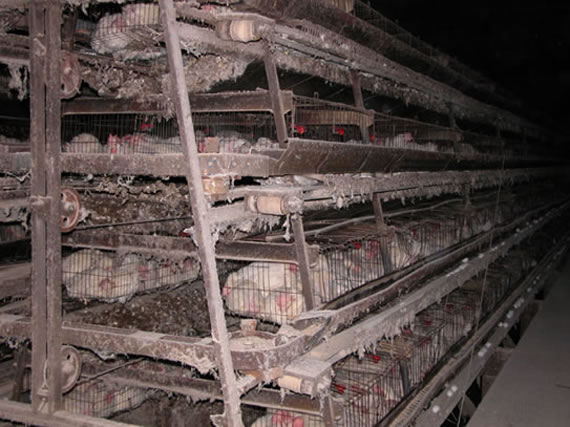
What is the difference between No Welfare, High Welfare, and Highest Welfare when they all require animals to die? Only human comfort, NONE protect the actual animals. The most humane, ethical, and honest Webster-defined "welfare" is NOT exploiting animals - not using, not wearing, not eating, not killing - animals. The only meaningful position is vegan, everything else is just how humans euphemize animals' required suffering and violent deaths: no human exploits animals because they honestly believe that NOT exploiting animals is UNethical or INhumane.
3.4 Million “Live Inventory” – Chickens and Turkeys – Drowned or Starved to Death in North Carolina Storm
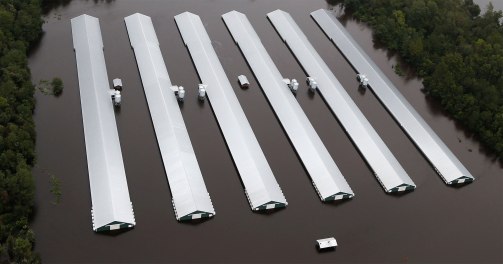
Chicken farm buildings inundated with floodwater from Hurricane Florence near Trenton, N.C., Sunday, Sept. 16, 2018. (AP Photo/Steve Helber)
Source Animals 24/7
By Karen Davis, PhD, President of United Poultry Concerns
Afterword by Merritt Clifton, Animals 24/7
A caring person’s reaction to learning that millions of chickens and turkeys and pigs drowned in North Carolina this month is the gut-wrench of sorrow and pity for these helpless souls and outrage at the companies that didn’t see fit to protect their captives from the hurricane they knew was coming.
But just as farmed animal businesses are indifferent when a fire burns and suffocates to death millions of chickens and other animals trapped in cages, crates, and confinement sheds, so they are indifferent when, instead of flames, the disaster occurs in the form of floods.
The North Carolina Department of Agriculture and Consumer Services reported last week that 3.4 million chickens and turkeys and 5,500 pigs died in Hurricane Florence. The company most cited was Sanderson Farms who told journalists that 1.7 million of its 20 million chickens drowned or starved to death in the sheds when the company couldn’t get food to them.
Pleased to report that none of its personnel appear to have died in the storm, Sanderson Farms noted, by contrast, that its “live inventories” were not so lucky, and that its focus now is on “replenishing our live production inventories.”
Companies like Sanderson needn’t worry. Between insurance payouts and the U.S. Department of Agriculture’s indemnification program, agribusinesses can comfortably repair and rebuild their flood-or-fire-damaged buildings and quickly restock millions of new individuals, the same as they always do whenever weather or diseases such as avian influenza devastate their “inventory.”
Does anyone think that companies permitted by the U.S. Department of Agriculture to suffocate millions of chickens and turkeys to death in rolling tides of fire-fighting foam as a means of mass extermination – does anyone think these companies care about the animals? An article in Poultry World on September 20th exemplifies what matters to them: North Carolina-based Butterball, the largest turkey producer in the U.S., assured everyone that the storm’s impact “would not lead to any pre-Thanksgiving turkey shortage.”
While businesses that “own” animals have an obligation to protect them against foreseeable disasters, the unfixable problem is that the entire life of the majority of animals in food production is so miserable that just about anything that ends their life sooner than later may be viewed as preferable to being “saved.” Saved for what? The experience of chickens and turkeys, in the words of veterinary scientist John Webster, is, he said, “in both magnitude and severity, the single most severe, systematic example of man’s inhumanity to another sentient animal.”
The only way out of “man’s inhumanity” for these animals is to be rescued or dead. “Rescue” must mean more than literally removing a certain number of animals from whatever human-engineered horror they are in – important as every rescue is. The rescue these animals need most from us is from the plate. If people don’t buy them, they won’t be born, and that will be good.
References in order of citation:
United Poultry Concerns, National Fire Protection Association Rejects Pleas for Farmed Animals in Second Round of Proposals, January 17, 2015.
Sanderson Farms, Sanderson Farms assesses damage from Florence. September 18, 2018.
Hurricane Florence claims 3.4 million US poultry, Poultry World, September 20, 2018.
United Poultry Concerns, Avian Influenza (Bird Flu) – What You Need to Know, 007.
United Poultry Concerns, Government Approves Firefighting Foam to Exterminate Birds, 2006.
John Webster, A Cool Eye Towards Eden, Blackwell Science, 1994.
Afterword by Merritt Clifton
Among the grossest of ironies associated with the enormous loss of farmed animal life resulting from Hurricane Florence, and at least four previous hurricanes that have devastated North Carolina farm country since 1995, is media coverage using careless phrases such as “pig and poultry farmers are hard-hit,” “hen and hog farmers are devastated,” etc.
While the farmers are economically harmed to some extent, and a farmer is occasionally hit by flying debris or drowned when his pickup truck slides off the road, almost all of the hard hits and devastation––by more than a million-to-one ratio––are experienced by the animals involved, not the humans.
Disaster vs. daily routine
The major difference, when natural disaster such as a hurricane hits, is that suddenly the humans experience––for a few hours or days––some of the stress and terror felt by farmed animals as a matter of daily routine. For the animals, the stress and terror merely takes a different form.
The violence the animals absorb and witness throughout their brief lives in time of disaster gives way to terminal neglect, sometimes ended by “depopulation” before the neglected animals would otherwise die.
Ironically, as United Poultry Concerns founder Karen Davis has written about elsewhere, the “rolling tides of fire-fighting foam” now used in state-of-the-art poultry “depopulation” are both a killing method which is no longer legally used to kill dogs and cats in almost every state, and markedly less cruel than the former standard methods of manual strangulation or neck-breaking, asphyxiation with exhaust fumes, live burial, and even burning flocks alive, all of which are also still legal and still used to some extent by agribusiness.
“Depraved indifference”
In almost any other context, such “depopulation” might be prosecuted as “depraved indifference” to animal suffering, but down on the factory farm it is business as usual, done somewhere almost every day to clear barns of “spent” hens or diseased poultry, while unwanted male chicks hatched by the egg industry are macerated alive by the multi-millions and mixed into feed or fertilizer.
In context, even the biggest natural disasters ever to hit the U.S. have caused very little animal suffering compared to the routine operations they have temporarily disrupted.
Order a FREE vegan kit: http://www.peta.org/living/food/free-vegan-starter-kit/
Take PETA’s Cruelty-Free Shopping Guide along with you next time you head to the store! The handy guide will help you find humane products at a glance. Order a FREE copy HERE
Want to do more than go vegan? Help others to do so! Click on the below for nominal, or no, fees to vegan literature that you can use to convince others that veganism is the only compassionate route to being an animal friend.
PETA: http://www.petacatalog.com/catalog/Literature-39-1.html
Looking for merchandise? Action for Animals has a very good selection : http://store.afa-online.org/home.php?cat=284
Have questions? Click HERE
some people think what we do is futile,
that is old news…
but win or lose,
this is the battle we choose!
Karen Lyons Kalmenson
Costco’s Hidden Graveyard
Please sign petition HERE (scroll down past video)
Source Direct Action Everywhere
Picture a farm. You’re likely seeing rolling hills of green grass dotted with a few dozen cows. What most Americans don’t know is that the typical small family farm now breeds thousands of animals and confines them in horrendous living conditions. Drone footage of this Costco farm revealed over 20,000 hutches designed to imprison baby cows and separate them from their mothers. There are as many calves on this one farm as there are humans in the entire city.
Confinement
Calves were confined in hutches so small they could barely turn around. They live in these hutches their entire childhood, never let out to run or play.
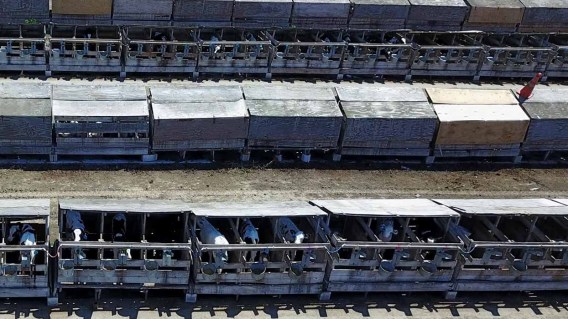
Source Direct Action Everywhere
Greed
The farm owners live nextdoor in a $1.7 million mansion with a pool, tennis court, and boat. Profiting off of the backs of baby animals they tear away from their mothers.

Source Direct Action Everywhere
Death
DxE investigators found a mass graveyard with bodies of cows piled on top of one another. This is the only place babies and mothers were seen together.
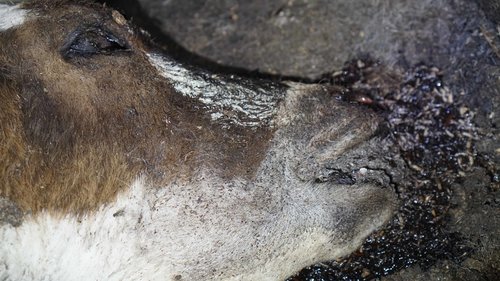
Source Direct Action Everywhere
Order a FREE vegan kit: http://www.peta.org/living/food/free-vegan-starter-kit/
Take PETA’s Cruelty-Free Shopping Guide along with you next time you head to the store! The handy guide will help you find humane products at a glance. Order a FREE copy HERE
Want to do more than go vegan? Help others to do so! Click on the below for nominal, or no, fees to vegan literature that you can use to convince others that veganism is the only compassionate route to being an animal friend.
PETA: http://www.petacatalog.com/catalog/Literature-39-1.html
Looking for merchandise? Action for Animals has a very good selection : http://store.afa-online.org/home.php?cat=284
Have questions? Click HERE
whoever accepts this insanity
has lost whatever is left
of their humanity
Karen Lyons Kalmenson
Heading in the direction of being vegan
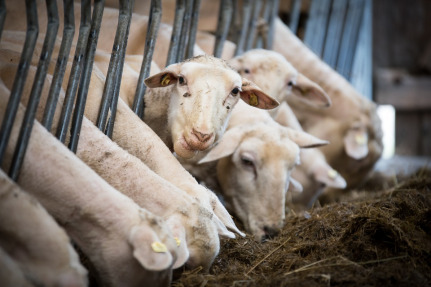
Source There’s an Elephant in the Room blog
Source There’s an Elephant in the Room blog
About HERE
‘…or if we can’t be vegan we can at least head in that direction.’ I’ve seen so many variations on that theme as a comeback to the call to be vegan that appears in almost every piece I write. Today I saw it again. I’ve given the words a lot of thought and I have to conclude that when ‘heading in the direction of veganism’ is thought to be a possibility, it is a clear illustration that the speaker hasn’t really grasped what veganism is.
Please note that as always, this statement does not refer to new vegans who are currently transitioning, incorporating the ethic into their life. This transition period is generally very short (for many it can’t happen quickly enough), but can vary depending on circumstances.
Pragmatism or betrayal – it’s a matter of perspective
At this point I can almost hear the rasp of keyboards being dragged into position by the ‘every little helps’ and ‘can’t all be perfect’ brigade (some vegan, some not), ready with their ‘world won’t go vegan overnight’, and ‘we have to be realistic’ preludes to a blistering criticism of such ‘purist attitudes’. Yes, I’ve been around on social media a good while and I’ve seen and heard most of the put-downs. The phrases lack originality, probably because they have become overused stock items, plucked whole and unconsidered from the shelf of platitudes that we have all, at one time, been guilty of using without due examination.
Just to be clear, although born vegan as I think we all are, I was not raised vegan and am ashamed to say I spent most of my life that way. I woke up with a jolt in 2012.
That year, and for as many of my (then) 56 years as I could recall, I thought of myself as a reasonably intelligent person, ethically aware, honest and honourable. I wasn’t perfect (who is?) but I thought that I was trying. I often said that I thought of myself as an animal lover. I abhorred what I considered to be cruelty to any animals, and as well as sharing petitions and ranting about ‘cruelty‘ and the need for ‘compassion’ to any that would listen, I donated to a number of organisations that claimed to look out for the interests of animals. In return, they sent me images in the post, many of which were so vile that I have been unable to forget them. I once even received a manicure kit (?) in a leather wallet if I recall, inscribed with the logo of some ‘Humane Society’ or other. I detected no irony in this.
Of course, as an animal lover and a hater of ‘cruelty’ I shopped for the very best, most ‘humane’ labels (as endorsed by the XYPCA of course), spending as much as I could afford on the animal products that I had grown up to believe were essential for the health of my family.
The curse of compromise
So, without a trace of conscience (why would I have, what with the humane labels and donations and the back-patting of the ‘animal welfare‘ organisations whose staff were paying their mortgages with my cash?), I snoozed on in my ethical bubble. I didn’t eat ‘meat’ or at least, not often (doesn’t everyone say that?), but cheese… oh, how I loved the taste of cheese. And eggs. And I delighted in wearing wool. Angora – bliss! I loved leather; boots, shoes, jackets, bags, chairs. Touching it and breathing in the scent was so pleasurable. Now, as my gorge rises at the memory and I fight not to gag with disgust it is hard to believe the person I was, but that’s how I can write about this. I’m not pointing a superior finger and finding fault. I’m writing from bitter and heartbreaking experience. But moving on.
I made it clear to my conscientious consumer contemporaries that I was very much one of them. Saving the forest, planting trees, worrying about litter, sending (most of – well it’s not always convenient, is it?) my glass bottles for recycling, visiting second-hand shops for clothes and furniture. I was ‘mostly’ vegetarian, except for the odd occasion (to be sociable, you understand – I mean, when someone goes to the bother of cooking something for you…). And prawns. Oh – and apart from the leather. And the sweets loaded with gelatin. And silk scarves (well so what? They were presents!). Oh yes, what a trooper I was!
Where was I heading?
So, since I was so ethical and conscientious, would you say I was ‘heading in the direction’ of being vegan? After all, many of the things that I was doing were the very things we see so many ‘pragmatic’, ‘realistic’ people suggesting that we could all do to ‘cut down on animal cruelty’ and ‘reduce suffering‘ because we ‘can’t be perfect’.
I’m sure some would say I was definitely ‘heading in the direction’ of veganism. But they’d be talking absolute rubbish. I was not moving at all, not heading in any direction, wallowing smug and satisfied in the absolution that I bought every so often with donations. I was not vegan. I remained completely committed to using other individuals for my own most trivial interests without even questioning why. I wasn’t even aware that there was such a thing as veganism; except of course what I’d heard about the stereotypical, undernourished, sandal-wearing hippy, choking down worthy muesli only one step removed from sawdust, while taking a break from hugging trees.
The loop of mistaken need and entitlement
And this brings me to the whole point of this and it’s a point I’ve made before. When we are not vegan, we are hurting, harming and killing innocent and defenceless individuals who value their lives and don’t want to die. There are no exceptions.
*** – whether we have one victim or billions is irrelevant. By not being vegan we are harming and killing others because we think it’s somehow acceptable to do so; maybe because we think we have to; maybe because we feel entitled, maybe because we consider our own interests are more important than those of our victims. However we square our actions with our conscience – if we even have a conscience about them – we are killing other individuals when we have no need or right to do so. We can do it to fewer individuals, we can do it to fewer species; we can obsess about the environments or practices that facilitate our consumer choices; we can make judgements and protest about the degrees of brutality and violence that are completely inevitable elements of our demands, make different menu choices one or two days a week, but – Return to *** and keep reading the loop. It’s the way it is.
Breaking out of the loop
I say that I woke up in 2012. It was in 2012 that I stumbled across information that led me to understand what veganism is, and I broke out of the loop and became vegan. I was not heading that way. How could I be? I was stuck in the loop of self-congratulatory ‘conscientious’ consumerism. I was a killer. When I was a killer, I couldn’t gradually head in the direction of not being a killer, because it’s a binary thing. One is a killer or one is not a killer. And each of us is a killer until the final time that we take a life. It’s really that simple and it’s not on a sliding scale. And we can only make the switch from killer to non killer, non vegan to vegan, once we actually know what veganism is.
Once we know, we each have a personal choice to make, and no other can make that choice for us. We can choose to be vegan. Or we can choose not to bother. It is a personal thing, a decision driven by the values that we hold and the way in which we wish these to define us.
As a vegan advocate, all I can ever do is explain how veganism is the only way that allows us to live in a way that reflects the values that most of us like to claim are important. The issue that we must address is not how we treat our unnecessary victims but rather the fact that we have victims when it is unnecessary. Once we, as individuals, deal with that as consumers at the checkouts, everything; health, environment and everything else will flow directly from our changed behaviour.
Before we have even heard about veganism, we cannot be ‘heading in its direction’ because it’s binary and we are stuck in a loop. Once someone knows what veganism is, reallyknows that it is a rejection of harm to other individuals who value their lives and want to live, it is at best disingenuous to excuse continued harm and killing by claiming to be ‘heading in the direction’ of being vegan. I’ve heard it said that once you know what it is, the only honest reason not to be vegan is ‘because you don’t give a shit’. There’s a lot of truth in that.
Be vegan.
*In case any readers wonder if it’s safe to click on any of the links in my essays, please note that I do not use images depicting violence and gore.
Order a FREE vegan kit: http://www.peta.org/living/food/free-vegan-starter-kit/
Take PETA’s Cruelty-Free Shopping Guide along with you next time you head to the store! The handy guide will help you find humane products at a glance. Order a FREE copy HERE
Want to do more than go vegan? Help others to do so! Click on the below for nominal, or no, fees to vegan literature that you can use to convince others that veganism is the only compassionate route to being an animal friend.
PETA: http://www.petacatalog.com/catalog/Literature-39-1.html
Looking for merchandise? Action for Animals has a very good selection : http://store.afa-online.org/home.php?cat=284
Have questions? Click HERE
be your own process evolution
or an epiphany, revolution
share the goodness
that you have learned
and perhaps a few more hearts
and minds
will turn.
Karen Lyons Kalmenson
Mindful Meats: My Neighborhood Slaughterhouse

Source HumaneFacts.org, free from HARM
Source free from HARM
By Hope Bohanec
“Mindful” Meats?
I live in ag country. When you drive around Sonoma County, especially getting out of any city just by a couple of miles, there are signs of animal agriculture everywhere. I often drive by dairy operations with signs posted that say “Real California Milk” and “Certified Organic Dairy,” as if appeasing the people driving by implying that “only good things are happening on this farm.” Yet if you look closer you may see rows and rows of white plastic calf hutches, like uniformed cartons of milk, each containing a tiny baby calf who was taken from her mother at birth, chained to the plastic hutch in all weather extremes–alone, frightened, and miserable. For each of these calves there is a grieving mother who will never know her baby, traumatized with each calf dragged from her after birth.
My Neighborhood Slaughterhouse
Most people have no clue what is truly going on inside animal agriculture, especially the slaughterhouse – that ominous place that ends all tomorrows for farmed animals. There is a slaughterhouse down the street from where I live in Petaluma on a major road just outside of downtown. For many years it was called Rancho Veal. Of course, veal has been exposed to be the poster-child of cruelty and most people now agree that confining a baby cow so tight that he can’t even turn around, then slaughtering him when he is just weeks old, is callous and cruel. But what people don’t realize is that most animals who are slaughtered for meat are just weeks or months old when they take their portentous journey to the abattoir.
Rancho Veal was recently acquired by Marin Sun Farms and received a fresh coat of bright white paint complete with their logo, looming two stories high, on the front of the building. On the west wall, facing the oncoming traffic heading to downtown, they added huge letters spelling out the name of a producer they’re in partnership with, “Mindful Meats.” When I first drove by this new sizable marketing endeavor, I had to pull over and take a moment for a figurative face-palm. Shaking my head, I pondered what I was seeing. It’s truly appalling and as a spiritual person, I am deeply disturbed.
Please read rest HERE
Order a FREE vegan kit: http://www.peta.org/living/food/free-vegan-starter-kit/
Take PETA’s Cruelty-Free Shopping Guide along with you next time you head to the store! The handy guide will help you find humane products at a glance. Order a FREE copy HERE
Want to do more than go vegan? Help others to do so! Click on the below for nominal, or no, fees to vegan literature that you can use to convince others that veganism is the only compassionate route to being an animal friend.
PETA: http://www.petacatalog.com/catalog/Literature-39-1.html
Looking for merchandise? Action for Animals has a very good selection : http://store.afa-online.org/home.php?cat=284
Have questions? Click HERE
to possibly consider any form of slaughter humane
is morally bankrupt
and frankly,
insane!
Karen Lyons Kalmenson
Free online vegan event Sept 19-23
Please click HERE to register for free
Source Vegan Warrior Summit
Beginning September 19th, immerse yourself in this life-changing, 5-day video conference with over 30 vegan experts from around the globe. This summit will help you discover the key insights and strategies for restoring, balancing, and invigorating your body, mind, and soul so you can spark new pathways for personal and global change and we can create that compassionate, vegan world we all wish to see!
Order a FREE vegan kit: http://www.peta.org/living/food/free-vegan-starter-kit/
Take PETA’s Cruelty-Free Shopping Guide along with you next time you head to the store! The handy guide will help you find humane products at a glance. Order a FREE copy HERE
Want to do more than go vegan? Help others to do so! Click on the below for nominal, or no, fees to vegan literature that you can use to convince others that veganism is the only compassionate route to being an animal friend.
PETA: http://www.petacatalog.com/catalog/Literature-39-1.html
Looking for merchandise? Action for Animals has a very good selection : http://store.afa-online.org/home.php?cat=284
Have questions? Click HERE
If we learn and teach
Each other a little
Each day,
Perhaps together
We can send cruelty
Forever away
Karen Lyons Kalmenson
If you would like to place an animal through Free for Life

Source: Animal Place, Free for Life, http://www.freeforlife.org/
Source Animal Place, Free for Life
If you would like to place an animal through Free for Life, please click HERE
Are you raising an animal as a student agricultural project? Are you having a change of heart about selling or slaughtering your animal? You have a choice. You can let them live. You can let them be free for life. We accept or can help find placement for cows, pigs, sheep, goats, chickens, turkeys, rabbits, and other animal species.
If you are a student and you want to place an animal with Free for Life, or if you have questions, please fill out this form and we will contact you asap. You can give as much or as little information as you feel comfortable with right now. If you are a parent/advisor, please see next section below HERE.
Order a FREE vegan kit: http://www.peta.org/living/food/free-vegan-starter-kit/
Take PETA’s Cruelty-Free Shopping Guide along with you next time you head to the store! The handy guide will help you find humane products at a glance. Order a FREE copy HERE
Want to do more than go vegan? Help others to do so! Click on the below for nominal, or no, fees to vegan literature that you can use to convince others that veganism is the only compassionate route to being an animal friend.
PETA: http://www.petacatalog.com/catalog/Literature-39-1.html
Looking for merchandise? Action for Animals has a very good selection : http://store.afa-online.org/home.php?cat=284
Have questions? Click HERE
look into the depths of an animals eyes
see your soul and the soul
behind the eyes you see.
there dwells your true
humanity.
Karen Lyons Kalmenson
The Impact of Anonymous for the Voiceless
(Note: I’ve always been rather opposed to, and reluctant to use, the term “voiceless” in reference to animals: non-human animals are not voiceless, human animals just choose to not listen.)
Source Their Turn
By Donny Moss
During Direct Action Everywhere’s (DxE) 2018 Animal Liberation Conference, an estimated 500 animal rights activists took to the streets of San Francisco to participate in what was, at the time, the largest Anonymous For the Voiceless (AV) event ever. As more than 100 video screens displayed footage of animal exploitation in six “Cubes of Truth,” dozens of advocates conducted vegan outreach with pedestrians who stopped to watch the videos. Animal rights activists Chase Avior, Jane Velez-Mitchell and James Aspey spoke to TheirTurn about the impact of AV.
Anonymous for the Voiceless uses “standard-practice” footage of animal agriculture to expose the public to the atrocities that the industry goes to great lengths to hide, and it provides people with tools to switch to a vegan lifestyle.
Since its inception in April, 2016, AV has staged over 4,000 “Cubes of Truth” in 650 cities around the world, convincing over 214,000 people to consider making the transition to veganism.
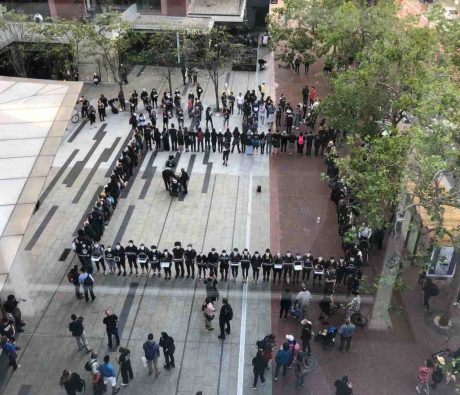
Source Their Turn: Cube of Truth in San Francisco organized by Anonymous for The Voiceless and Direct Action Everywhere during the 2018 Animal Liberation Conference.
Order a FREE vegan kit: http://www.peta.org/living/food/free-vegan-starter-kit/
Take PETA’s Cruelty-Free Shopping Guide along with you next time you head to the store! The handy guide will help you find humane products at a glance. Order a FREE copy HERE
Want to do more than go vegan? Help others to do so! Click on the below for nominal, or no, fees to vegan literature that you can use to convince others that veganism is the only compassionate route to being an animal friend.
PETA: http://www.petacatalog.com/catalog/Literature-39-1.html
Looking for merchandise? Action for Animals has a very good selection : http://store.afa-online.org/home.php?cat=284
Have questions? Click HERE
It is up to us to articulate
What animals would if they could
And this cannot wait.
Karen Lyons Kalmenson
My Journey from ‘Humane’ Dairy Farmer to Vegan Cheese Maker
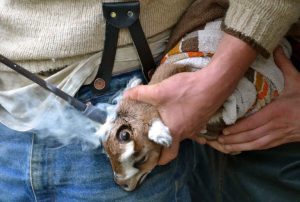
Source Free From Harm: Baby goat being disbudded with a hot iron.
Source Free From Harm
By Free From Harm Staff Writers
The following is a first person account of Susana Romatz’s transition from dairy goat farmer to vegan cheesemaker.
My life has been a tapestry of contrasting and at times contradictory threads.
As a youngster, I binge-read books like Little House on the Prairie and My Side of the Mountain. I loved the idea of self-sufficiency and homesteading. I made acorn pancakes with my best friend Krista (we ground up acorns with a brick and added water; they were delicious! Just kidding, they were awful, like eating bitter sand). I once tried to whittle a log into a bust of a famous president with a jackknife knicked from my dad’s wardrobe. I was jealous of my cousins in the country who fished and hunted.
And so, many years later, when I saw the ad requesting help on a “humane dairy” goat farm in Oregon, I jumped at the chance to get my country girl on.
It’s relevant to note that ten years before that, I had tried to go vegan. I was working at PetSmart and it was there that I met Pinkie, a tiny black and white spotted puppy with blue eyes. I fell in love with her and adopted her. But alas, her kidneys weren’t formed correctly and as she grew larger and larger, topping the scales at 80 pounds, her kidneys began to fail. She only lived for two years, but in those two years I learned what it meant to love a dog. I was crushed when she died.
After that time, I couldn’t bring myself to eat animals any more. I just couldn’t see the difference between my beloved dog and the animals on my plate. I began to watch videos on animal welfare, and donated money to animal activism groups. I tried to go vegan altogether, but didn’t pull it off for a myriad of reasons, mainly willpower and lack of education. I was a vegetarian for years.
Then when I moved to Oregon, I began to hear the phrase “humanely raised” used in reference to meat and dairy products, and it piqued my interest. In Michigan, nobody had ever talked about humanely raised animals, because they weren’t much thinking about meat as animals— it was just meat, which is meant for eating. How the meat got that way only a few knew and fewer than that cared. In Oregon it seemed that more people were aware of what happens in commercial meat production, and they knew it was wrong.
Please read rest HERE
Order a FREE vegan kit: http://www.peta.org/living/food/free-vegan-starter-kit/
Take PETA’s Cruelty-Free Shopping Guide along with you next time you head to the store! The handy guide will help you find humane products at a glance. Order a FREE copy HERE
Want to do more than go vegan? Help others to do so! Click on the below for nominal, or no, fees to vegan literature that you can use to convince others that veganism is the only compassionate route to being an animal friend.
PETA: http://www.petacatalog.com/catalog/Literature-39-1.html
Looking for merchandise? Action for Animals has a very good selection : http://store.afa-online.org/home.php?cat=284
Have questions? Click HERE
Our compassionate world
gratefully revolves
Around those who have
Thankfully,
Evolved
Karen Lyons Kalmenson
WoDES: World Day for the End of Speciesism – August 25, 2018
Please click HERE for list of actions by country
Source End of Speciesism
For the 4th year in a row, a great variety of actions will be held all over the planet for the World Day for the End of Speciesism.
Sexism, racism, speciesism: unjust ideologies
In our societies our relationship with animals is based on speciesism. By analogy with racism and sexism, speciesism refers to an ideology that considers the lives and interests of animals as insignificant just because they are of a different species. Speciesism is untenable because humans are not the only ones to feel emotions and therefore we have to respect the lives and interests of the other sentient beings who share this planet with us.
All sentient beings are equal
Regardless of the differences between species, it is clear that all sentient beings are equal in their capacity to feel pain. No matter what our ‘race’, sex, species may be, the important thing is what we feel, our interest in not suffering, in not being a victim of violence and in continuing to lead the happiest life possible. Discrimination based on species is just as arbitrary as any other discrimination based on an illogical criterion. Equality tainted by exclusions and arbitrary discrimination is by definition inequality, injustice.
Therefore all sentient beings, regardless of species, must be included within the circle of moral consideration. This does not mean treating them all in an identical way but really taking their interests into account as if they were our own.
Denying intelligence in order to neglect interests?
Our society does not disdain babies nor people with mental disabilities, although they appear to lack complex intellectual abilities, but grants them greater protection, and rightly so. Indeed, they also suffer, are unable to defend themselves and should therefore be protected. In the same way, regardless of their mental faculties, animals are sentient beings that have an interest in living the longest and happiest lives possible and should also be protected. In addition, more and more studies show that we have immensely underrated the mental capacity of most animals1.
Ethology: animals are individuals in their own right
Far from espousing the theory of animals-as-machines, modern ethologists invite us to see animals as individuals in their own right, feeling emotions, having preferences, desires and their own personality. We now know that self-awareness, culture, altruism and the ability to use tools exist in many animals.
Society must change
Injustices of the past have been abolished or reduced, such as feudality and the low status assigned to women. They too were so embedded in the collective consciousness that they were thought to be eternal. But history has shown the opposite and we can easily imagine that one day slaughterhouses will be deemed to be a symbol of barbarity. More and more of us are beginning to take a stand against injustice to animals, which has become one of the most important social debates of our time.
The goal of the World Day for the End of Speciesism is to denounce the unjust ideology that makes this barbarity possible.
We are working for a world that takes the lives and interests of all into consideration. This world is already on its way. Let’s work together so that it arrives as soon as possible!
1 Recently the chimpanzee Ayumu shattered the idea that humans always have better mental abilities than other animals by beating humans in a test of memory: https://www.youtube.com/watch?v=zsXP8qeFF6A

Source End-of-Speciesism.org
Order a FREE vegan kit: http://www.peta.org/living/food/free-vegan-starter-kit/
Take PETA’s Cruelty-Free Shopping Guide along with you next time you head to the store! The handy guide will help you find humane products at a glance. Order a FREE copy HERE
Want to do more than go vegan? Help others to do so! Click on the below for nominal, or no, fees to vegan literature that you can use to convince others that veganism is the only compassionate route to being an animal friend.
PETA: http://www.petacatalog.com/catalog/Literature-39-1.html
Looking for merchandise? Action for Animals has a very good selection : http://store.afa-online.org/home.php?cat=284
Have questions? Click HERE
In the eyes of our creator,
None are less
And none are
Greater
Karen Lyons Kalmenson
Source In Defense of Animals
We’re excited to announce that our farmed animals campaign has teamed up with viral YouTuber Erin Janus to launch 60 massive billboards across Los Angeles featuring her Dairy is Scary video during June “Dairy Month.”
In both English and Spanish, the billboards invite onlookers to watch Erin’s video exposing common dairy industry practices of forcibly impregnating cows, stealing their babies, and turning them into veal and hamburgers long before their 25-year natural lifespan. The video finishes with Erin calling on the public to, “Try any milk but dairy milk,” and directs viewers to enjoy the health benefits of dairy-free by taking our 21-day dairy-free challenge.
In our fight for animal welfare, the environment, and our own personal health; making the decision to go dairy free is one of the most impactful steps that we as individuals can take.
Try our 21-Day Dairy-Free challenge today at www.dairyfreechallenge.com.
Order a FREE vegan kit: http://www.peta.org/living/food/free-vegan-starter-kit/
Take PETA’s Cruelty-Free Shopping Guide along with you next time you head to the store! The handy guide will help you find humane products at a glance. Order a FREE copy HERE
Want to do more than go vegan? Help others to do so! Click on the below for nominal, or no, fees to vegan literature that you can use to convince others that veganism is the only compassionate route to being an animal friend.
PETA: http://www.petacatalog.com/catalog/Literature-39-1.html
Looking for merchandise? Action for Animals has a very good selection : http://store.afa-online.org/home.php?cat=284
Have questions? Click HERE
be the milk of human kindness
be dairy free
farm animals so need
our advocacy!!!
Karen Lyons Kalmenson
60 years prison for piglet rescue
Please sign petition HERE (scroll down past video)
Source Direct Action Everywhere
Utah: drop the charges for saving Lily. Whistleblowers who expose animal abuse should be protected, not prosecuted.
DxE activists are facing up to 60 years in prison as new charges are filed for the rescue of a dying piglet from an abusive factory farm #Smithfield5 #ProtectLily Help us caption & translate this video! https://amara.org/v/iqOq/
About
My name is Wayne. As a former Northwestern law professor, MIT-educated social scientist, and open rescue investigator, I’ve spent decades on research and working to help animals both inside and outside the system.
My experiences led to the 2013 founding of Direct Action Everywhere (DxE), a global grassroots animal rights network committed to total animal liberation. What sets DxE apart is our unapologetic mission to create a world where every animal is happy, safe and free within one generation.
Order a FREE vegan kit: http://www.peta.org/living/food/free-vegan-starter-kit/
Take PETA’s Cruelty-Free Shopping Guide along with you next time you head to the store! The handy guide will help you find humane products at a glance. Order a FREE copy HERE
Want to do more than go vegan? Help others to do so! Click on the below for nominal, or no, fees to vegan literature that you can use to convince others that veganism is the only compassionate route to being an animal friend.
PETA: http://www.petacatalog.com/catalog/Literature-39-1.html
Looking for merchandise? Action for Animals has a very good selection : http://store.afa-online.org/home.php?cat=284
Have questions? Click HERE
when the law is the crime
please take a moment and sign…
so worth the time
thank you!!!
Karen Lyons Kalmenson
Please, always report cruelty to authorities, especially during times of imminent danger or harm. The following are a few sources to use when reporting animal abuse. See below for sample statement to Interpol, or for reporting child abuse.
1) http://www.interpol.int/Forms/Contact_INTERPOL
2) http://www.peta.org/about/contact-peta/email-form.aspx
3) https://www.humanesociety.org/resources/report-animal-cruelty
4) http://www.peta.org/about/contact-peta/report-cruelty.aspx
5) https://www.internet-signalement.gouv.fr/PortailWeb/planets/Accueil!input.action
6) http://www.peta.org/action/get-active-online/cruelty-on-the-internet.aspx/
PETAIndia
9 Things to Do if You Witness Cruelty to Animals
Additional instructions for reporting abuse on FaceBook (or other site)
If you witness cruelty on Facebook, abuse to children or animals in videos or pictures, please do not report to Facebook; if you report to Facebook the evidence may be destroyed. Please contact local authorities immediately.
Click HERE to refer to INTERPOL. Please note that Interpol may not receive your direct request for help in a timely manner; you need to contact your local, or nearby, police or law enforcement personnel who will then contact Interpol if appropriate. However, please click HERE for general Interpol inquiries and to report appropriate crimes. Scroll down to Interpol General Secretariat to include and submit information. Please note that this should not be your only source of reporting; you should contact local law enforcement as well.
Please click HERE to report online child sexual abuse to the Virtual Global Taskforce, Combating Online Child Sexual Abuse
Send INTERPOL or VGT the URL (link) to the Picture or Video you want to report.
As above, contact local, or nearby, police or law enforcement personnel or HERE to report online child sexual abuse to the Virtual Global Taskforce, Combating Online Child Sexual Abuse.
For Interpol, enter your email address in the appropriate box, enter “GRAPHIC VIOLENCE ON FACEBOOK” in the Subject Box, and then paste the “URL” referring to the Photo or Video you wish to report – with a brief message(see below for sample).
Sample Statement
I have been witness to blatant animal cruelty (or child abuse) on Facebook at the following link:
These images are extremely disturbing and clearly establish blatant crimes against animals (or children). After viewing the provided material, you will understand that this is indicative of unlawful acts of animal cruelty (or child abuse) as established by the (Animal Welfare Act) and relevant local and international statutes. I respectfully request that your resources be applied to remove this material and charge the perpetrators with relevant unlawful crimes.
Thank you for your rapid attention to this urgent appeal.
Name
Order a FREE vegan kit: http://www.peta.org/living/food/free-vegan-starter-kit/
Take PETA’s Cruelty-Free Shopping Guide along with you next time you head to the store! The handy guide will help you find humane products at a glance. Order a FREE copy HERE
Searching for Cruelty-Free Cosmetics, Personal-Care Products, Vegan Products, or more?
Click HERE to search.
Want to do more than go vegan? Help others to do so! Click below for nominal, or no, fees to vegan literature that you can use to convince others that veganism is the only compassionate route to being an animal friend.
PETA: http://www.petacatalog.com/catalog/Literature-39-1.html
Vegan Outreach: https://veganoutreach.org/order-form/
no reason to stay still
apathy KILLS!!!
Karen Lyons Kalmenson
Meet the Vegan, All-Female Anti-Poaching Team That Has Been More Effective at Defending Animals Than Any Other

Source: International Anti-Poaching Foundation, One Green Planet
Source One Green Planet
By Estelle Rayburn
Poaching is one of the largest threats presently facing precious endangered animals such as elephants, lions, and rhinos. Fed up with this senseless, ecosystem-destroying “sport,” an Australian convervationist and former military sniper named Damien Mander founded the International Anti-Poaching Foundation (IAPF) a decade ago. Since then, Mander has been working tirelessly to land on the best methods for combatting poaching and preserving wildlife in African nations.
Initially, Mander tried what he reportedly called “a fairly military approach” to fighting poaching. But in recent years, he began to rethink his strategy. He wondered, what if women were put at the forefront of wildlife conservation efforts rather than men? What if we moved away from the norm and towards something totally new?
Seeking to answer these questions, Mander launched a program called “Akashinga” (meaning “the brave ones”) in 2017. The project’s goal? To recruit African women who come from disadvantaged backgrounds — abuse survivors, single mothers, abandoned wives, sex workers, and orphans — and train them to be wildlife rangers.
To prepare them for the complex and dangerous job of African wildlife conservation, women who enlist in Akashinga go through the same training as male anti-poaching rangers. They are required to complete an extensive program covering everything from crime scene preservation to crisis management to camouflage.
To prepare them for the complex and dangerous job of African wildlife conservation, women who enlist in Akashinga go through the same training as male anti-poaching rangers. They are required to complete an extensive program covering everything from crime scene preservation to crisis management to camouflage.
So far, this unique program has been wildly successful. With nearly three dozen women on the team, Akashinga has already made around 60 arrests, resulting in a combined total of more than 41 years of jail sentences. Recently, Akashinga has successfully taken action against individuals associated with serious crimes such as zebra poaching, ivory smuggling, and sable antelope snaring.
According to Mander, Akashinga has been “more effective” than any other program he’s seen, which is saying a lot considering his long history of involvement in wildlife conservation. As he pointed out, women have a special ability to “de-escalate everything,” which may very well have something to do with the program’s great success.
In addition to empowering women and thwarting trophy hunting, Akashinga is also having a positive impact on local communities: More than 70 percent of the project’s operational costs go directly back into African communities via employment and goods and services.
As Mander reportedly said, “This is the evolution of man to see something we should have seen in the past. Women will change the face of conservation forever.”
We certainly agree with that, and we look forward to seeing this project continue to grow and thrive in coming years! If you’d like to support this awesome program, you can make a donation to the IAPF here. Your generous contribution will go towards the training and supplies needed to keep this animal-saving organization alive.
And even if you aren’t able to donate at this time, you can still help by spreading the word about this organization’s important work with everyone in your network!
Image Source: International Anti-Poaching Foundation/Facebook
Order a FREE vegan kit: http://www.peta.org/living/food/free-vegan-starter-kit/
Take PETA’s Cruelty-Free Shopping Guide along with you next time you head to the store! The handy guide will help you find humane products at a glance. Order a FREE copy HERE
Want to do more than go vegan? Help others to do so! Click on the below for nominal, or no, fees to vegan literature that you can use to convince others that veganism is the only compassionate route to being an animal friend.
PETA: http://www.petacatalog.com/catalog/Literature-39-1.html
Looking for merchandise? Action for Animals has a very good selection : http://store.afa-online.org/home.php?cat=284
Have questions? Click HERE
warrior woman
she lives her life
by her own rules
with an open heart
and zero tolerance
for fools.
Karen Lyons Kalmenson
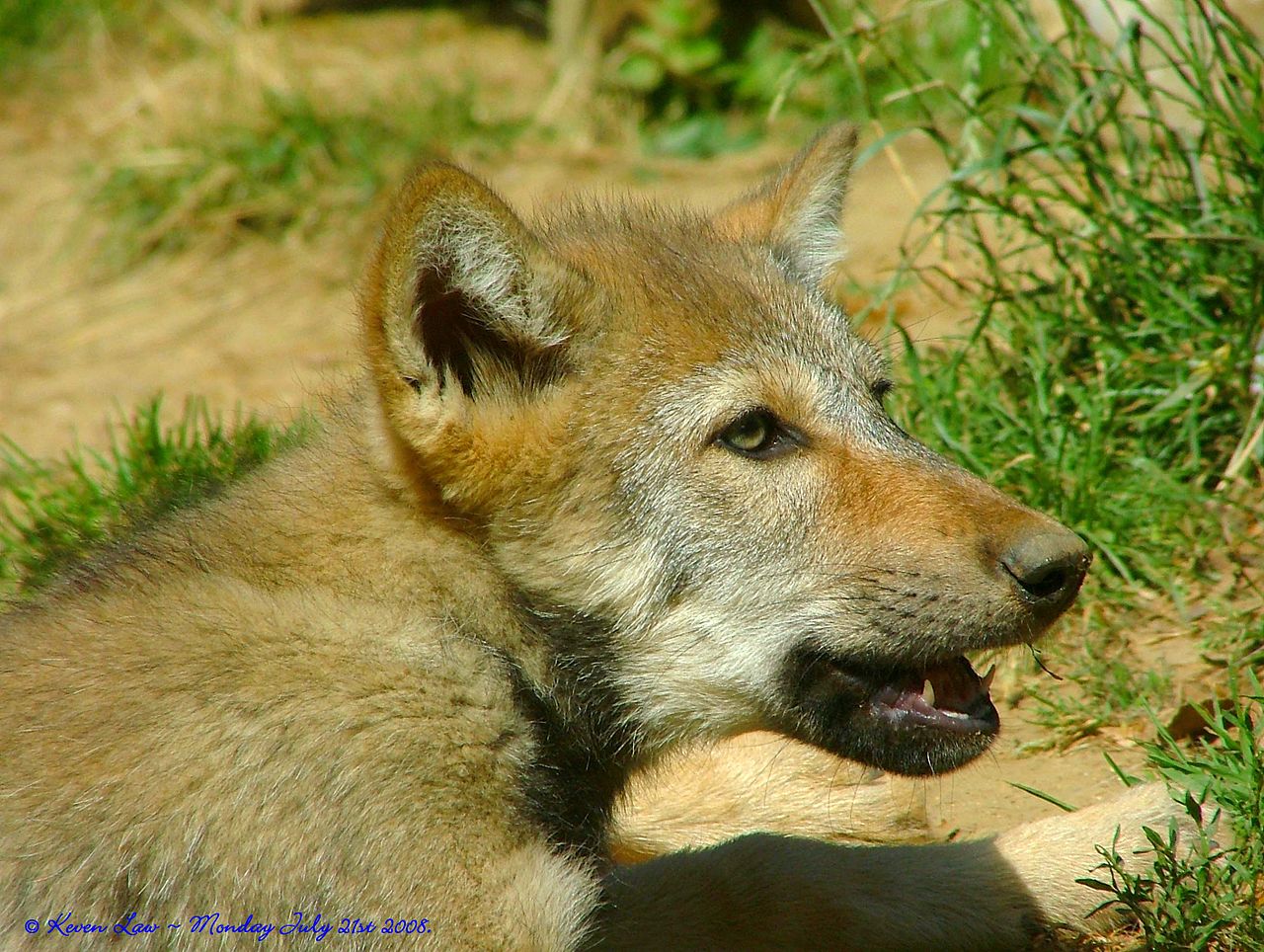
Wikimedia Commons, Keven Law
Source The Spokesman Review
By Chris Bachman
Most of us are familiar with the “Boy Who Cried Wolf.” This is the story of the scientist who cried “truth” and the price attached. Science is humanity’s tool for revealing the truth. Denying the truth does not change it.
Dr. Robert Wielgus is a man of honor and integrity whose voice was silenced, ironically, through an act of social predation. As director of the Large Carnivore Conservation Laboratory at Washington State University, his work with large carnivores was well respected. Dr. Wielgus’ and his students’ research found that wolves and livestock can coexist. Wolves do not naturally hunt livestock – not a single wolf predation occurred when livestock were kept a half-mile from an active wolf den site. Had this peer-reviewed science been observed, unnecessary cattle deaths and slaughter of the Profanity Peak Pack could have been avoided.
Many animals have evolved to birth their young in spring, a time of plentiful resources. In spring, wolf sociality revolves around birthing puppies. Wolves remain close to the den site during this time. Livestock also birth in the spring, however human intervention has altered this to late winter so calves are ready to graze by spring. The release of cow and young calf onto public land to graze coincides with the birthing of wolf puppies and increased energy needs for the pack.
Gray wolves hunt cooperatively in family units known as packs, a social unit composed of diverse individuals with a hierarchy and social structure that facilitates cooperative hunting. Cooperative hunting involves socially complex meat-eating animals working together, with division of labor and role specialization increasing the success of the group and the individual. Cooperative hunting offers increased access to food with decreased risk to the individual, and is linked to intelligence, social organization and the evolution of sociality. Sociality is the degree to which individuals in an animal population form cooperative societies.
Cooperative hunting is also called social predation. This behavior is not unique to gray wolves; it is a behavior ever-present in humans. It is sadly ironic that Dr. Wielgus, a predator aficionado, would fall victim to social predation. In human terms, social predators are individuals who thrive embracing the pack mentality, rarely having the courage to act alone. They prey on other humans and are widely known for the predictable traits of egocentrism and aggressive social mannerisms. Dr. Wielgus was depredated by social predators – agency professionals, legislators and community members – whose self-interests are more important than truth.
Dr. Wielgus questioned the actions of the Washington Department of Fish and Wildlife and a public lands rancher that led to the slaughter of the Profanity Peak wolves. Livestock and salt blocks were placed within 200 yards of a wolf den on public land. Once discovered, no action was taken to remove the livestock, despite numerous warnings. Salt blocks were left in place, complicating the situation. When agency and industry refused to listen, Dr. Wielgus risked his reputation and went to the press and public. Once cattle were killed, seven wolves – adults and puppies – were slaughtered. This situation could have been avoided through adaptive husbandry practices and respect for nature. One rancher’s husbandry practices, coupled with WDFW’s lethal removal policy, is responsible for the killing of 15 of our recovering wolves.
Additionally, Dr. Wielgus’ research revealed that killing wolves does not lead to fewer predations on livestock; killing alters the sociality within the pack, impacts cooperative hunting, and can increase the number of breeding pairs and the overall number of wolves, leading to more predation on livestock. Killing a whole pack vacates habitat open to colonization by new wolves, also found to increase the number of livestock preyed upon. These findings do not align with WDFW’s lethal removal policy and do not support grazing cattle on our public lands. Industry and agency refused to recognize the scientific truth. Instead of adapting, they chose to kill the messenger.
Chris Bachman, a biologist and wolf advocate, is the wildlife program director at The Lands Council in Spokane. He also chairs the Eastern Washington Wolf Coalition.
Order a FREE vegan kit: http://www.peta.org/living/food/free-vegan-starter-kit/
Take PETA’s Cruelty-Free Shopping Guide along with you next time you head to the store! The handy guide will help you find humane products at a glance. Order a FREE copy HERE
Want to do more than go vegan? Help others to do so! Click on the below for nominal, or no, fees to vegan literature that you can use to convince others that veganism is the only compassionate route to being an animal friend.
PETA: http://www.petacatalog.com/catalog/Literature-39-1.html
Looking for merchandise? Action for Animals has a very good selection : http://store.afa-online.org/home.php?cat=284
Have questions? Click HERE
when truths become relative
to from whom they speak
our society and values
turn ashen
and weak.
Karen Lyons Kalmenson
Wikimedia Commons, Ethelred
Source One Green Planet
By Estelle Rayburn
When it comes to reducing your impact on our planet, some choices make a bigger difference than others. Of course, you want to strive to do the most possible good for our Earth. So what’s the best action you can take to limit your environmental impact? According to a recent study published in the journal Science, staying away from meat and dairy products is the single most effective way to help the planet.
Scientists arrived at this conclusion after an analysis of how farming affects the Earth revealed some eye-opening statistics. According to the research, if people stopped consuming meat and dairy products, we could reduce global farmland use by over 75 percent — that’s an area that could fit all of the U.S., China, the European Union, AND Australia — while still feeding the world’s growing population successfully.
The analysis also uncovered that meat and dairy provide just 18 percent of the calories and 37 percent of the protein consumed globally, yet they take up a whopping 83 percent of the world’s total farmland and account for 60 percent of the greenhouse gases emitted in the agriculture sector. Moreover, growing any type of vegetable or cereal takes far less land and is far more sustainable than producing even the lowest impact meat and dairy, according to the study.
In fact, the research revealed that grass-fed beef, which is generally considered to have a relatively low impact as compared to other types of livestock, still takes a much higher toll on the environment than plant-based foods. As University of Oxford researcher and study leader Joseph Poore reportedly put it, “Converting grass into [meat] is like converting coal to energy. It comes with an immense cost in emissions.”
Poore also described the tremendous good ditching meat and dairy can do beyond just cutting greenhouse gas emissions: “A vegan diet is probably the single biggest way to reduce your impact on planet Earth, not just greenhouse gases, but global acidification, eutrophication, land use and water use.” He went on, “It is far bigger than cutting down on your flights or buying an electric car,” as these actions merely decrease greenhouse gas emissions without helping out significantly in the other areas. Not to mention that going vegan can also help reverse the current mass extinction of wildlife, which is largely driven by wild areas being taken over for livestock production.
Overall, this study largely confirms what we already knew: Livestock production is the number one cause of global climate change. However, it provides concrete evidence that swapping out meat and dairy for delicious plant-based alternatives is not just good for the planet — it’s the single best thing you could ever do!
To learn more about how you can save the Earth through your food choices, check out the Eat For The Planet book. And don’t forget to tell everyone in your network that cutting meat and dairy has been proven to be the best step you can take in the pursuit to limit your carbon footprint!
Order a FREE vegan kit: http://www.peta.org/living/food/free-vegan-starter-kit/
Take PETA’s Cruelty-Free Shopping Guide along with you next time you head to the store! The handy guide will help you find humane products at a glance. Order a FREE copy HERE
Want to do more than go vegan? Help others to do so! Click on the below for nominal, or no, fees to vegan literature that you can use to convince others that veganism is the only compassionate route to being an animal friend.
PETA: http://www.petacatalog.com/catalog/Literature-39-1.html
Looking for merchandise? Action for Animals has a very good selection : http://store.afa-online.org/home.php?cat=284
Have questions? Click HERE
One cannot choose nor
Discriminate
The environment begins
On our plates
Karen Lyons Kalmenson










 Our Compass