Skip to content

HighestWelfare.Humane.Assured.GoodPractices.Vegetarian. Regenerative.Flexitarian.Lies...

What is the difference between No Welfare, High Welfare, and Highest Welfare when they all require animals to die? Only human comfort, NONE protect the actual animals. The most humane, ethical, and honest Webster-defined "welfare" is NOT exploiting animals - not using, not wearing, not eating, not killing - animals. The only meaningful position is vegan, everything else is just how humans euphemize animals' required suffering and violent deaths: no human exploits animals because they honestly believe that NOT exploiting animals is UNethical or INhumane.

First Strike and You’re Out: A Model Law, US friends, please take action

October 6, 2010

First Strike and You’re Out!

Contact your state legislators today and ask them to support a “First Strike and You’re Out” law for those who are convicted of animal neglect or cruelty.

Send your letter!

Currently, most states have no mandatory requirements keeping those who are convicted of animal abuse crimes away from animals following their convictions—despite the fact that offenders have demonstrated, through their actions, their utter disregard for the welfare of animals, and that recidivism in some cases can reach 100%.

ALDF’s First Strike and You’re Out law provides another tool to help combat animal neglect and cruelty by mandating that those who are convicted of a violation of their state animal protection laws are prohibited from owning or having contact with animals for a set period of time, ranging from five years for a first misdemeanor offense up to the lifetime of the offender following a second felony offense.

Enacting a First Strike and You’re Out law in your state will help in the fight against animal neglect and cruelty by keeping offenders away from potential new animal victims. This proposal will also help reduce the huge economic toll which repeat offenders impose on their communities—animal abuse cases can be very costly, often requiring the cooperation of several local agencies.

MESSAGE TEXT

Currently, most states have no mandatory requirements keeping those who are convicted of animal abuse crimes away from animals following their convictions. This is despite the fact that offenders have demonstrated, through their actions, their utter disregard for the welfare of animals, and that  recidivism in some types of animal abuse cases can reach 100%.

Yet having an animal in one’s life is a privilege, not a right – and with that privilege comes certain responsibilities, including the responsibility of providing adequate care and otherwise not abusing or neglecting the animal. The FIRST STRIKE AND YOU’RE OUT law drafted by the Animal Legal Defense Fund provides another tool to help combat animal neglect and cruelty by mandating that those who are convicted of a violation of their state animal protection laws are prohibited from owning or having contact with animals for a set period of time, ranging from five years for a first misdemeanor offense up to the lifetime of the offender following a second felony offense.

A FIRST STRIKE AND YOU’RE OUT law will also help reduce the huge economic toll that repeat offenders impose on their communities – animal abuse cases can be very costly, often requiring the cooperation of several local agencies.

Please support a FIRST STRIKE AND YOU’RE OUT law in our state for criminals who are convicted of animal neglect and cruelty. Such a law would:

– Separate offenders from potential new victims.
– Help to reduce future crimes against animals and save limited community resources.
– Set a period of time where offenders who have already demonstrated their irresponsibility with animals are not allowed contact with them.
– Address the near 100% recidivism rate for offenders like animal hoarders.

For more information on ALDF’s model law, or for assistance in drafting a FIRST STRIKE AND YOU’RE OUT law for our state, please visit http://www.aldf.org/firststrike or contact legislation@aldf.org.

RELATED, PLEASE SIGN (Click the red button in the video or visit HERE)
Vodpod videos no longer available.

RESOURCES

ALDF Model Animal Protection Laws Collection

View this document on Scribd

Read more…

Bosnian girl who threw litter of puppies into fast-flowing river will not face animal cruelty charges

October 6, 2010


UPDATED PROTEST INFORMATION:

Please see below for SAMPLE LETTER and addresses to protest no criminal charges or associated penalties.

From Daily Mail

A young girl who was filmed throwing puppies into a river to drown will not face animal cruelty charges, furious animal rights campaigners have announced.

Police in Bugojna, Bosnia, have dropped plans to prosecute the youngster because they say she is not old enough to face court.

The decision was revealed by angry animal rights campaigners PETA.

They say local police and animal care groups claim all the pups were rescued from the fast flowing Vbras river by an old woman who claimed to have found them by the shore.

Animal cruelty is black and white: If you eat them, wear them, test on them, or exploit them in any way for food, fun, pharma, or fur … you throw them.  Think about it, please make the connection.

But German PETA spokeswoman Nadja Kutscher said: ‘This is outrageous. The puppies that the old woman was with were completely different ones to those thrown into the river in the video.

‘The puppies would never have survived in the river.’

The original 44 second YouTube clip shocked hundreds of thousands around the world.

In the horrific footage some of the black and white pups could be heard whimpering in a basket before crying pitifully as they were flung through the air.

At one point the girl, wearing a red hoodie, shouted ‘Wooo!’ as she hurled them into the river one by one.

The blonde girl – believed to be under 18 – and her parents were questioned by local police and warned they could face a £5,000 and an animal cruelty charge last month.

But PETA in Germany revealed: ‘The animal protection agency which works down in Bosnia has announced that the investigation has been closed and neither the girl nor the parents will be charged.

‘The child is said to be too young for any kind of punishment.’

Bosnian law requires anyone who kills or injures an animal to pay a fine ranging from €15 to €5,000 (£12 to £4,150) .

People for the Ethical Treatment of Animals (PETA) offered a €1,500 (£1,300) reward at the time to help catch the girl in the film.


Question: What’s the Difference?

Answer: You.


SAMPLE LETTER:

To Whom It Concerns,

I am contacting you regarding the Bosnian juvenile who was filmed throwing puppies into the Vrbas river. I would like to express my outrage over the charges being dropped on the basis that the girl is too young for any kind of punishment.

Her actions were calculated and motivated by a desire to harm. She did not show the slightest sign of remorse after hurling the puppies, nor did she show any sign of empathy toward the whimpering of the puppies. On the contrary, she seemed to derive great pleasure from causing these animals pain and suffering. She was also quite aware that the chances of these puppies surviving in the fast flowing river were minimal – claims that an old woman rescued the puppies seem highly unlikely, as the puppies retrieved by the old woman in no way resemble the ones shown on the video footage.

Studies show that acts of cruelty toward animals are the first signs of violent pathology that includes human victims. Violent and aggressive criminals are more likely to have abused animals as children. Animal abuse is not just the result of a minor personality flaw in the abuser, but a symptom of a deep mental disturbance. A child harming or killing a an animal is a precursor to some very serious violent behavior. If allowed to pass without punishment, children are more likely to be violent later in life.

If this girl is not taught to take responsibility for her actions at this crucial stage, she will very likely repeat this harmful behavior.She is not too young to be punished, but only a proper punishment may ensure that she learns from her vile deed.

NAME

WHERE TO SEND YOUR MESSAGE:

Bugojno Police (use contact form following phone number below):

http://www.mupsbk-ksb.gov.ba/index.php?option=com_content&task=view&id=308&Itemid=38

Postal adress:
Policijska uprava Bugojno
Wagnerova 8
70230 Bugojno
Bosna and Herzegovina
Phone: 030-251-206, 030-252-411

Online contact form, Central Bosnia Canton – canton that includes Bugojno.
http://www.mupsbk-ksb.gov.ba/index.php?option=com_contact&Itemid=3

Pošaljite Email: Via Email

Vaše ime: Your Name

E-mail adresa: Email Address

Unesite svoju poruku:  Message

Posalji: Send

Hvala! : Thanks!

Online contact form, Drago Vukoja, the Police Commissioner:

http://www.sbk-ksb.gov.ba/index.php?option=com_contact&task=view&contact_id=8&Itemid=27

E-mail: To send via email

Unesi svoje ime: Enter your email address

Tema poruke: Enter Your name

Unesi poruku: Enter your message

Municipality Bugojno
307. Motorizovane brigade 92
70230 Bugojno
Tel: + 387 (0) 30 251 444
Fax: +387 (0) 30 251 222

Mayor of Bugojno, Mr Hasan Ajkunic
Tel.: + 387 30 251 444
Fax: + 387 30 251 222
E-mail:bugojno@bih.net.ba

FROM THE FACEBOOK NOTE: http://www.facebook.com/note.php?note_id=155509291149914&id=670435094&ref=nf

Read more: Elderly woman ‘didn’t save puppies’

Read more: 4chan users hunt for puppy-thrower


Read more…

Loro Parque, Tenerife, Spain: Numerous Orcas and Dolphins in captivity. Please take action: one petition, one sample message

October 5, 2010

By Anne Holmberg (Can only be seen if you have a valid Facebook account)

Dear friends,

In the Atlantic Ocean are some Paradise islands especially for Northern European tourists. Canaries Islands. One of them is Tenerife. Here are many Orcas and Dolphins in captivity to entertain these visitors in a place called Loro Parque..

http://www.loroparque.com/en/orcas.asp

Look how many Orcas  and Dolphins in the pictures. In addition, sea lions, penguins and parrots.

http://www.youtube.com/watch?v=pSX6QEj7zWk

http://www.youtube.com/watch?v=XTgtJSlImY4

We all know that Orcas and Dolphins are the animals who are least able to be in captivity. They suffer so terribly.

I want this park closed.

PLEASE SIGN THIS PETITION

PLEASE SEND THIS SAMPLE MESSAGE IN SPANISH

WHERE TO SEND SAMPLE MESSAGE (via webform)

SAMPLE MESSAGE (Courtesy of Luciana)

ESTIMADOS: tenemos una preocupacion muy grande en nuestros corazones. Como explicar a nuestros hijos que el abuso contra las especies animales esta mal y al mismo tiempo los llevamos a parques donde tienen animales en cautiverio? Esto no tiene sentido. Por mas que un parque le provea lo mejor que pueda a un animal para su comodidad, esto no remueve la esclavitud a la que se le somete y esto en este siglo es algo que como padres no podemos apoyar. El conocimiento de que estos seres son sensibles, tienen un ambito social, un sistema nervioso hace inhumano el mantenerlos prisioneros en un parque y lucrar de esa esclavitud. No apoyamos sus actividades y con el tiempo se daran cuenta que menos personal so hacen, al pasar el tiempo tenemos que reflexionar sobre nuestro impacto no solo entre nuestra especie sino tambien con otras especies. El ejemplo que dejan al esclavizar a animales es un muy mal impacto.


RELATED ACTION

Dolphin Slaughter Exposed by Eco-Activists, The Cove: Five actions you can take right now

SAMPLE MESSAGE (Can be used for any similar protests, just modify the beginning)

To Whom It Concerns,

I am writing today to encourage Loro Parque to relinquish the whales and other marine mammals and fish back to their natural habitat. These beings have been subjected to horrific enslavement, imprisoned by you, forced to endure inadequate space, inferior medical treatment and care, lack of companionship, and involuntary training, made to perform tricks to the delight of apathetic and ignorant audiences.  As the result of a more attentive and compassionate group, individuals comprising a large global audience concerned with these animals have been respectfully offering scientific and medical evidence establishing the debilitating natures to which you expose them.  Sadly, however, corporate greed and indifference have resulted in their deteriorating mental and physical states. By refusing to release them, you are establishing your approval of animal cruelty, and I am appalled to learn of your deliberate involvement in the exploitation of animals.

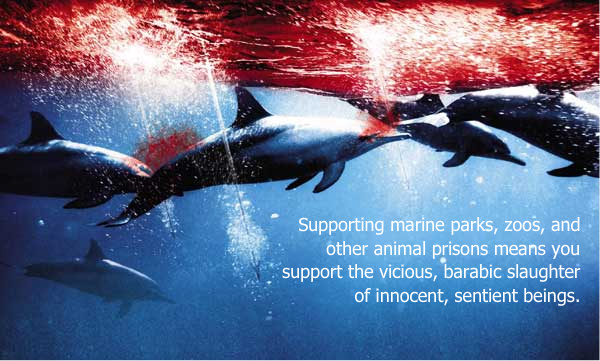
Although you may assert that humane protocols must be followed in accordance with International Marine Care standards, the visual evidence validates the position that these directives are often ignored in favor of park management profit; nevertheless, establishing a threshold of humane treatment is ambiguous at best, these standards being implemented by those with questionable interests, its oversight managed by those who exploit animals for funds. Furthermore, although you may be unaware of such acquisition procedures, many dolphins are captured during a yearly, epic slaughter in Japan as documented in “The Cove”, a chronicle of the savage and once secretive butchery as inflicted on these decidedly sentient creatures. As such, it is important to recognize that all animals, fundamentally valuable beyond monetary benefit, are being exploited in demonstrably cruel and unnecessary manners. Additionally, many of these captive animals still display behaviours typical of those calling to their family members while other animals continually languish as well.

I hope you make the compassionate decision to discontinue your imprisonment of them and reject complicity in the unethical industry that profits from their suffering. However, as long as you continue to unnecessarily capitalize on the exploitation, imprisonment, and maltreatment of them, I will not financially support you. It is important to recognize that consumers are increasingly rejecting those businesses that are complicit in the suffering and unnecessary treatment of animals by shifting their loyalties to those companies that do not participate in the exploitation of them, and I hope that you will extend such an ethical and empathetic gesture as well.

I look forward to a positive response.

Sincerely,

NAME/ADDRESS

RELATED RESOURCES

The Case Against Marine Mammals in Captivity

View this document on Scribd

Imprisoned for Life: Marine Mammals in Captivity – P 1/2

Vodpod videos no longer available.

Read more…

Caught in the Web: Wildlife Trade on the Internet

October 5, 2010

Killing with Keystrokes, Wildlife Trade on the Internet: Superhighway to Extinction

From
IFAW

The Internet has become the world’s largest marketplace, open for business 24 hours a day, seven days a week. Unregulated, anonymous and virtually unlimited in reach, the Internet provides endless opportunities for illegal criminal activities and transactions. Increasingly, the Internet is being used to conduct illegal trade in wildlife. This illegal trade in live and dead animals and their parts is estimated to rival the scale of illegal trafficking in drugs and weapons.

Investigations into the illegal wildlife trade on the Internet conducted by the International Fund for Animal Welfare since 2004 have revealed staggeringly high numbers of wildlife products traded daily.

In March 2004, IFAW published Elephants on the High Street: an investigation into ivory trade in the UK, which documented vast quantities of ivory sold illegally over the Internet, in the UK and internationally, with little or no monitoring or law enforcement. The report concluded that there is widespread ignorance of laws restricting the ivory trade and that traders aware of the legal restrictions can easily find ways to get around them with little chance of detection.

IFAW’s 2005 report, Caught in the Web: Wildlife Trade on the Internet (see also below), found an astonishing 9,000 wild animals and animal products for sale in just one week. This figure was all the more alarming since the survey was conducted solely on English language Internet sites and restricted to trade in just five categories of CITES-protected species; live primates, elephant products, turtle and tortoiseshell products, other reptile products and products from wild cats.

IFAW’s Dutch Animal Trade Survey 2006: Caught in the Web reported on a month-long study of legal and illegal trade in wild animals on private and commercial Dutch-language web sites. In that one month, at least 150 Dutch-language web sites were found to be selling endangered species of mammals, land tortoises and sea turtles, protected birds, reptiles and amphibians.

IFAW’s global 2007 follow-up report, Bidding for Extinction (see also below) ,revealed a rampant trade in elephant ivory across eBay™’s global network of auction sites. Our one-week snapshot survey tracked more than 2,275 ivory items for sale on eight national eBay™ web sites (UK, Australia, China, Germany, Netherlands, France, Canada and USA).

More than 90% of the listings even breached eBay’s own wildlife policies. Many sellers were allowed to list items with no provenance of legality while eBay’s enforcement of their largely vague and variable listing rules appeared haphazard and hopelessly overstrained.

As a result of this study and ongoing consultations with IFAW, eBay in June 2007 announced a global ban on cross-border trade in ivory products for all eBay national sites.

In 2008, IFAW undertook the largest investigation of the Internet wildlife trade the organization had ever attempted. The results were published in a report entitled Killing with Keystrokes: An Investigation of the Illegal Wildlife Trade on the World Wide Web (or see below).

In the course of six weeks, IFAW was astonished to find more than 7,000 wild animals and animal products for sale online. This figure was all the more alarming because the survey was restricted to trade only in CITES Appendix 1 species (considered the most endangered in the world), and only in the following categories: primates, elephant, reptiles, large wild cat products, rhinoceroses and birds.

IFAW tracked more than US$30 million worth of advertised animal products and over US$3.6 million in actual commerce, meaning money that actually changed hands.

This landmark investigation helped us understand the volume and geographic scope of the global Internet wildlife trade, identify key Internet wildlife trade markets, determine the species most affected, and highlight significant issues and trends related to the online trade in wildlife.

On October 19, 2008 — after further consultations with IFAW about the results of our investigation — eBay announced that it was banning all ivory products on all of its platforms worldwide

The Netherlands was not included in the 2008 investigation but we knew it was important to include this country in our findings. Therefore, a follow-up investigation was conducted in the Netherlands in mid-2009. (Click here for the 2008 Netherlands report)

The implications of the growing Internet trade in wildlife reverberate beyond national and regional borders. Yet contemporary international law has fallen behind in its consideration of this deadly Internet activity and current legislation and enforcement schemes have proven insufficient in dealing with the scale of the problem.

We are continuing to campaign for stricter regulation of wildlife trading over the Internet wildlife trade.

Vodpod videos no longer available.

WHAT CAN I DO?

Subscribe to our newsletter
Sign up now to receive regular updates on our campaigns. more

Read more…

Stop the Lies: Pass the Truth in Fur Labeling Act

October 4, 2010

IMMEDIATE, Please Sign: Stop the Lies, Pass the Truth in Fur Labeling Act

Schwarzenegger Vetoes Fur Labeling Bill
By Brandon Bosworth

It didn’t really seem like that controversial of a bill. California Assembly Bill 1656 would prohibit the sale of any item of clothing made of any amount of fur without a tag or label naming the animals from which the fur was acquired, and the country of origin of any imported furs. (Used items would be exempt.) Sounds reasonable, doesn’t it?

It was certainly reasonable to the California Assembly, which passed Bill 1656 in a 58-10 vote. And it was reasonable to the California Senate, which passed the bill by a vote of 22 to 11. However, apparently a little bit of truth in labeling was not reasonable to the Governator himself, Arnold Schwarzenegger. This week he vetoed the bill.

First, a little bit of info as to why Bill 1656 was needed. In 2009, an investigation by a local CBS news affiliate found that many unlabeled fur items were being sold in California stores. These items were often described by salespeople as containing fake fur. Accurate labeling isn’t required by federal law, which exempts items of clothing priced at less than $150 from any fur labeling requirements. (Although the federal Truth in Fur Labeling Act would change that.) In most cases, the faux fur actually was the fur of a raccoon dog.

Raccoon dogs are, like their name implies, canines with a strong resemblance to raccoons. Native to Asia, they are social, friendly animals. They are also a source for cheap fur. Raccoon dogs are raised and slaughtered in brutal conditions in China, so their fur can be used to adorn the clothing of would-be fashionistas. Often, the clueless fashion victims don’t even know they are wearing dead dog. Investigations by the Humane Society of the United States over a three year period found that raccoon dog fur trim was on more than two-thirds of the jackets they tested, labeled or advertised as faux.

Related, Shannon Keith on ISSUES with Jane Velez-Mitchell

Vodpod videos no longer available.

So why would Schwarzenegger veto a bill that would simply make it easier for consumers to make informed, humane choices? According to the San Francisco Gate, “he had concerns about the costs for both merchants and manufacturers, as well as the potential fines — $500 for the first violation, and up to $1,000 for subsequent ones.”

This is ludicrous reasoning. For one, clothing companies can surely afford to put a cheap label on a piece of merchandise. After all, the labels aren’t printed in gold on rare papyrus. As for the fines, stores involved in the CBS fur investigation included such struggling mom-and-pops as Bloomingdale’s and Macy’s. I tend to doubt either of these would face bankruptcy due to a $500 fine. Finally, five states — Delaware, New Jersey, New York, Massachusetts, and Wisconsin — enacted similar fur labeling laws with no negative effects. Ask your senators to pass the federal bill; if that becomes law, California retailers will have to make the switch anyway.

Of course, the “merchants and manufacturers” that are so close to Mr. Schwarzenegger’s heart could easily avoid both the cost of labeling fur items and the potential fines from failing to do so. They could simply stop making and selling anything made with fur, real or fake. The only reason this sort of thing even exists in the 21st century is to appeal to the misguided vanity of a dwindling minority who still finds fur somehow “fashionable.” Isn’t it time we acknowledge that an animal’s fur belongs on the animal, not on us?

Stop the Lies: Pass the Truth in Fur Labeling Act HERE

By Stephanie Feldstein

Investigations by the Humane Society of the United States found that major retailers throughout the U.S. were advertising fur-trimmed clothing as faux, even when it was made from real animal fur. Of the garments they tested, 96 percent of “faux” fur trims were actually made with raccoon dog, domestic dog or wolf fur.

Read more…

Hey, Louisiana, don’t you think it’s about time you finally SET TONY FREE!?!

October 4, 2010

Please take action in two ways:

1. Sign petition

2. Send a message (sample provided)

See below under WHAT YOU CAN DO.  Thank you.


Targeting: Mayor Michael Chauffe, Lt. Governor Mitch Landrieu, Maria Davidson (Large Carnivore Program Manager), J. Mitchell Ourso, Jr. (Iberville Parish President ), Robert J. Barham (Secretary), Richard J. Ward, Jr. (Iberville Parish District Attorney ), and Fred Kimmel ((Ms. Davidson’s supervisor))

Started by: Angie Tipler

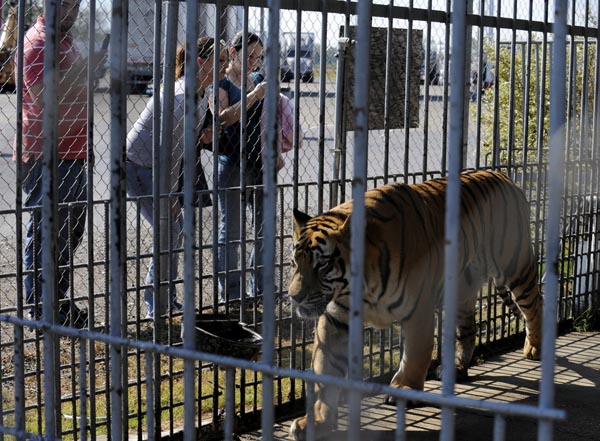
Description: Off Interstate-10 at exit 139 is Tiger Truck Stop that uses a live Siberian/Bengal tiger named Tony as a gimmick and roadside attraction.

A 1993 Iberville Parish County Ordinance prohibited the display of wild exotic animals as pets but was never enforced. The ordinance was amended on March 17, 2009, to allow Tony’s owner Michael Sandlin to keep Tony.

Mr. Sandlin then had to secure a license from the Louisiana Department of Wildlife and Fisheries. LDWF’s Large Carnivore Manager, Maria Davidson, stated:

It is the Department’s position that private possession of tigers poses a significant hazard to public safety and is detrimental to the health of the animal. Prolonged confinement is by its nature stressful to tigers and proper long-term care by experienced persons is essential to the health of the animal.

NEVERTHELESS, on December 14, 2009, the LDW&F granted a permit to allow Tony’s owner to keep him at the truck stop.

Some of the dangers to Tony both physically and mentally include:

  • 1. Constant inhalation of diesel fumes as his cage is literally within feet of the gas pumps.
  • 2. Sight-seers continually crowding around his cage and flashing lights in his face from cameras.
  • 3. People throwing things at the Tony.
  • 4. Living on concrete which has been linked to a painful condition of fluid collection around an animal’s joints.
  • 5. Deafening noise from the big trucks and cars passing through 24 hours a day.
  • 6. Living alone with no enrichment whatsoever or animals of his kind.
Vodpod videos no longer available.

There is something obviously wrong when the laws are broken and changed to cater to one individual, whose greed, ignorance, and cruelty were more important to the Louisiana Department of Wildlife and Fisheries than the welfare of Tony.

WHAT YOU CAN DO

1. Sign Petition

The permit renewal is set for December 2010, please sign: Urge The LDWF Not To Renew Tiger Truck Stop Permit

2. Send Message to http://www.wlf.state.la.us/contact

Sample Message  (please consider modifying and shortening so they receive a variety of messages; this length was accepted, though):

I am appalled to learn about the condition of a Siberian Bengal tiger, named Tony, as kept under the “guardianship” of Michael Sandlin as a roadside attraction in Grosse Tete, LA; I have learned that Tony has been forced to live in deplorable and neglectful conditions for two decades while being subjected to abusive conditions for the amusement of people.  Indeed, USDA records establish a continuous and lengthy history of violations that Mr. Sandlin has committed against Tony.  Historically, wild animals have not fared well in captivity but instead have suffered from human interference and exploitation.  Despite what you may believe, humans are unable to adequately provide favorable environmental conditions, the lack of which directly contributes to animals’ debilitating conditions, psychological deterioration, and at times premature deaths; Tony must now be protected from further commercial endeavors, destructive influences, debilitating health, and inferior living conditions.

Animals are sentient creatures, capable of thought, love, pain, and suffering, and as sentient beings ourselves, humans have an obligation to provide protection when needed and liberation from imprisonment.  Please, I ask those responsible, to consider compassion and empathy and vacate Mr. Sandlin’s license in December 2010 and relinquish Tony into the care of an appropriate wildlife reserve  (such as Big Cat Rescue).  Until such a time I will have to promote a boycott of your lovely communities and share this news with others.  Because the current financial climate is grim, it would be a unfortunate to lose potential tourist dollars.  Indeed, releasing Tony would be medically and mutually beneficial considering national, and even global, recognition of your compassionate gesture.  Please consider this request and support Tony’s relocation to an environment free from exploitation.

Thank you for your time.

NAME/ADDRESS

~~~~~~

Information regarding violations, PETA response to Free Tony the Tiger WordPress

Thank you for contacting us with your concerns about the Tiger Truck Stop. We have campaigned against this roadside hellhole for many years. We have filed complaints with the U.S. Department of Agriculture (USDA) and state officials, and have written countless letters and worked with local activists in an effort to get the tigers “retired” (there used to be several tigers in 2 different locations). We wrote to the owner of the truck stop asking him to relinquish the tigers to a sanctuary; we offered to help pay the costs. We’ve had this as an action alert on our Web site.

After years of complaints, in July 2002, the USDA charged the owner of the Tiger Truck Stop, Michael S. Sandlin, with violating the Animal Welfare Act in the areas of veterinary care, handling and housing. The violations cited over three years included having an insufficient number of trained employees and keeping the tigers in unsound facilities. An inspector also found the cats had no veterinary care program and improper nutrition. Mr. Sandlin paid a $1,000 fine and was ordered not to possess or exhibit more than two exotic cats. As a result, Sandlin decided to give up three of his four tigers to a facility in Tennessee. At this time, there is one tiger—Tony—still on display in Louisiana.

Wendell Sandlin (Michael’s father), owner of the Tiger Travel Plaza in Fort Hancock, Texas, relinquished the 4 tigers he had on display to a sanctuary. In June 2003, he agreed to relinquish his own USDA license for 3 years and was assessed a $7,500 fine, a fine that was suspended if he didn’t violate the AWA for 3 years.

The simple fact remains that just about anyone can have exotic animals as pets or for use as props. For the most part owning an exotic cat, bear, or other naturally free-roaming animal is as simple as applying for a state permit. Many state departments of wildlife have the most minimal requirements for keeping these animals. Louisiana is no exception.

In 2009, after months of aggressive campaigning to get Louisiana officials to order Michael Sandlin to give up Tony, they did the exact opposite. On February 17, 2009, the Iberville Parish Council voted to allow Michael Sandlin to keep Tony at the truck stop. While they did impose conditions on “improving” Tony’s care, this action opened the door for Sandlin to qualify for a state permit from the Louisiana Department of Wildlife and Fisheries, which granted him one in December 2009.

We are disappointed to say the least.

We are asking people to strongly voice their objections to Michael Sandlin receiving a state permit. Please drop a note to:

Robert Barham, Secretary
Louisiana Department of Wildlife and Fisheries
2000 Quail Dr.
Baton Rouge, LA 70808
225-765-2800
http://www.ibervilleparish.com/contactus/phonenumbers.html.

Thank you again for your concern.

Yours for the animals,

Jennifer O’Connor

Animals in Entertainment Campaign Writer

Sign up for e-news http://www.peta.org/lists.asp.

Here is the only other PETA reference I have found on their website with respect to Tony from November 25, 2008:

http://blog.peta.org/archives/2008/11/activists_knock.php


ADDITIONAL SITES/RESOURCES

RELATED, ADDITIONAL ACTIONS AT CATLAWS.COM

CatLaws HomeElected OfficialsBig Cat IssuesElectionMedia

RELATED, State Laws Governing Private Possession of Exotic Animals

Read more…

Mother Denied Right to Breastfeed Newborn by Employer

October 4, 2010

Angela Ames holds her sons Henry, 1 year, left, and Max, 4 months, in the backyard of their West Des Moines home last month. Ames said she quit her job as a loss mitigation specialist at Nationwide when she was denied access to a lactation room for expressing breast milk. She has filed a civil rights complaint against the company.

From Care2
By Ann Bibby

Angela Ames, a loss mitigation specialist for Nationwide Advantage Mortgage, returned to work a month after the birth of her second child, expecting to be able to use the company’s lactation room. She was greeted with paperwork, which the staff nurse informed her needed to be filed and processed before she could access a lactation room. This would take three days and even then, a room might not be available.

Mother’s Need Not Apply

Ames went to her supervisor where she learned that in addition to the lactation issue, she had just two weeks to catch up on her backlog of work, or she would start receiving write-ups. The supervisor also stressed the need for Ames to begin working overtime immediately, which she agreed to do.

Rock and a Hard Place for Working Mothers

But back at her desk, as milk leaked from her breasts, Ames recalled how she’d had to put her older son on formula because he hadn’t gained enough weight from breastfeeding. Her newborn, born five weeks early after a difficult pregnancy, needed the advantage of being breastfeed. His welfare and the company’s needs weren’t compatible.

Ames resigned that afternoon.

Civil Rights Issue

The story doesn’t end here. Ames decided to file a civil right’s complaint against her employer. The complaint comes at the end of the line for a mother whose pregnancy was treated as an inconvenience, one that bordered on willful misconduct in her employer’s eyes.

The state of Iowa has no legislation guaranteeing lactating women access to a safe, clean environment that is not a restroom. The Legislature took up a bill aimed at providing the women of Iowa this right last spring, but it died in committee.

…the true barrier to women breastfeeding at work isn’t legal; it is cultural. 

Margaret Heffernan


Company Policies

Nationwide does have a policy providing lactation rooms for their nursing employees, and a spokesperson at the national headquarters was unaware of the three day waiting period rule that Ames was told of.

Ames’ supervisors called her back from maternity leave early, telling her that her short-term disability would expire before the return date they’d agreed on before the birth of her son. They told her they would only hold her job for a week past the July 12th date on which they expected her return.

Mothering While Employed

None of this would come as a surprise to the hundreds of thousands of working mothers in the United States. Pregnancy is treated as an illness. Mothers are forced to use sick leave or take disability in order to give birth and take the minimum six week recuperation time off afterward. Despite a patchwork of lactation laws, finding a place to pump breast milk at work remains problematic for many. And most Americans still largely view breastfeeding a baby, or toddler, outside of one’s home, with disgust.

A Family Struggles

Ames and her family are now struggling financially as her husband, an electrician, has been laid off for some time. But faced with a no-win scenario, Ames felt she had little choice but to quit her job.

Her complaint is still under investigation.

RESOURCES

NCSL: US and US Territory Breastfeeding Laws, Updated September 2010

Breastfeeding in the Workplace: US Law Map

View this document on Scribd

Read more…

Help Stop the Federal Wolf Killing Plan

October 3, 2010

Immediate, US friends, please sign:
Help Stop the Federal Wolf Killing Plan

BACKGROUND

The federal Wildlife Services agency (a branch of the U.S. Department of Agriculture) is the primary wolf-killer in the United States — and now wants to expand their wolf-killing operations… even in the face of a court ruling restoring protections to these iconic animals.

Wildlife Services plans to work with Idaho officials to eliminate up to 80 percent of the wolves in central Idaho by land and from the air. Their plan also includes killing entire packs — including gassing helpless wolf pups in their dens — and surgically sterilizing alpha wolf pairs.

Help stop the killing. Urge President Obama’s Secretary of the Department of Agriculture to nix the planned wolf slaughter and rein in Wildlife Services.

MESSAGE TEXT

I am writing today to speak out against Wildlife Services’ outrageous plans to drastically expand the types of lethal methods used to kill federally protected wolves.

The latest plan outlined in Wildlife Services’ Draft Environmental Assessment Gray Wolf Damage Management in Idaho discards science-based management and harkens back to the days of the agency’s wholesale slaughter of wolves and other native predators.

The plan calls for killing off entire packs by tracking and shooting them from the air, gassing pups and their mothers in their dens and even calls for alpha wolf pairs to be surgically sterilized.

The gassing of pups in their dens and sterilization are inappropriate for a species listed under the Endangered Species Act. These methods do not represent responsible wildlife management for the 21st century. In addition, the use of gas is not even currently legal and likely would not be approved by the U.S. Fish and Wildlife Service or the Environmental Protection Agency.

The wolf-killing methods outlined in the Environmental Assessment are inappropriate and conflict with Wildlife Services’ mission to “create a balance that allows people and wildlife to coexist peacefully.”

I don’t want my tax dollars to be used to kill native wildlife under this misguided and archaic scheme. Wildlife Services should instead reduce wildlife conflicts and encourage peaceful coexistence with predators by using and promoting nonlethal tools and best management practices to preemptively reduce livestock loss.

Thank you for considering my comments on this important matter.

Vodpod videos no longer available.


Read more…

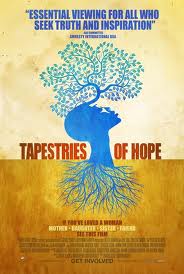
Tapestries of Hope

October 3, 2010

Immediate, US friends, please visit HERE to request your congressperson pass The International Violence Against Women Act (IVAWA, Please see below for document.)

Tapestries of Hope is a feature-length documentary that reveals the story of human rights activist Betty Makoni and the Girl Child Network (GCN) in Zimbabwe, Africa. The documentary exposes the myth behind the belief that raping a virgin cures a man of HIV/AIDS. The film is co-written and directed by award winning filmmaker, Michealene Cristini Risley, co-written and produced by Susan Black, and also produced by Christopher Bankston, Anand Chandrasekaran, and Ray Arthur Wang.

Plot
Director Michealene Cristini Risley travelled to Zimbabwe to explore the rape and AIDS crisis in the country. She had previously befriended Betty Makoni, a born and raised Zimbabwean, and got to know about Makoni’s organization, The Girl Child Network, which aims to re-empower abused kids and provides a network of protection for these girls.

The stories were told by the girls of Zimbabwe and Makoni was the main cast for this film. Throughout the film, Makoni helps these girls to become re-empowered and find their voice. Part of healing process for girls is about speaking out about the crimes committed agains them. During filming Risley and her assistant were arrested and incarcerated . The film was also seized by the Zimbabwean Intelligence Office (C.I.O). However, the team managed to retrieve the footage before being deported from Zimbabwe. http://www.voanews.com

Vodpod videos no longer available.

Help Spread “Tapestries of Hope” to Girls Worldwide: Tell Congress to Pass the International Violence Against Women Act! We’ve already done the work for you, just go to this link and type in your zip code and your local representative’s information will pop right up. -send a letter now!-

Read more…

Vigil For Society’s Casualties

October 2, 2010


RELATED, PLEASE SIGN TWO PETITIONS:

Speak Out Against Mormon Leader’s Anti-Gay Sermon After Suicides

Mormon leader gives anti-gay sermon after suicides – Sign the open letter!

From AlterNet
Posted by Antoine

NYU LGBT and Delta Lambda Phi host “Glowlight Vigil”

For the families of the five young men who committed suicide, September 2010 is a month and a year they would not likely ever forget. These families and others around the nation were rudely awakened to the stark reality of the effects of how vicious and callous homophobia, hatred and bullying was to their sons. By their deaths, these young men have become present day martyrs, expressing through their still, lifeless bodies, what they couldn’t say alive: giving their lives to remove the pain raging in their minds, wanting to let the hurt, rejection, and loneliness stop and drawing attention to the suffering many others endure for who they are. By their deaths, they screamed to the world that young male and gay between the ages of 13 and 20 are the most vulnerable members of the lesbian, gay, bisexual and transgender community. Their deaths have roused many to the perils of those who are young and struggling with their sexual identity and acceptance in today’s society.

A New York University LGBT organization and Delta Lambda Phi plan to host a “Glowlight Vigil” in Washington Square Park at 9:00pm on Sunday, Oct 3.

Below is a list of six young men who felt powerless and so devoid of hope that the only choice they felt existed was to remove themselves from this life. A common theme in all the stories surrounding the reasons why they killed themselves is focused on bullying, name-calling, homophobia and other derogatory comments against young men who were at their most fragile; their sexual identity, like a chrysalis emerging from the protection of the cocoon.

Justin Aaberg, 15, Anoka, Minnesota – Hung himself

Justin was a talented and accomplished cellist, and a composer. On Friday, Jul 9, just weeks after completing freshman year at Anoka High, Justin hanged himself in this bedroom. His mother and two brothers found him. Tammy Aaberg said, “I touched him, because I just couldn’t believe it. I thought I was in a nightmare, and he was so cold and I just screamed and ran out and called 911.” Justin’s mother said she knew for about a year that he was gay, and feared for his safety. But, when he died, she began to hear from other students of how he was harassed and bullied at the school. Justin’s death was part of a series of seven suicides in the Anoka-Hennepin School District in the past year, where some of the students who killed themselves were gay. There are concerns that bullying at the school pushed many over the edge.

Billy Lucas, 15, Greensburg, Indiana – Hung himself

According to WXIN Fox 59, on Thursday, Sept 9, Billy’s mother found him hanging in the family’s barn. To many, it seemed as though he didn’t quite fit in. Some of his classmates said he was bullied for being different, but even though he never told anyone he was gay, he was picked on because the other students thought he was. Students told reporters that the bullying against Billy had become worse, and on the same day he died, some students had told him to “kill” himself. One student, Dillen Swango said, “They said stuff like ‘you’re like a piece of crap’ and ‘you don’t deserve to live.’ Different things like that. Talked about how he was gay or whatever.” School principal, Phil Chapple doesn’t deny that students are bullied in the high school, but he said he didn’t know Billy was one of the victims. A Facebook page dedicated as a memorial to Billy, with close to 6,000 followers included some who acknowledged that they knew he was bullied, “everyone made fun of him.” Bullying at Greensburg High School is a practice with a long history, and according to the principal, “We’re discussing where we are going. Where we are looking to establish a committee.” One former student, who did not want to be identified, said that he was bullied several times because he is gay, “I was gay. I was called f**, queer. [i] was thrown up against lockers. I would tell the school officials about it and they would dismiss it. I can’t help but take it personally because when all of this was happening to me I was the same age he was. I also attempted to commit suicide.”

Asher Brown, 13, Cypress, Texas – Shot himself

According to the Houston Chronicle, on Thursday, Sept 21 at about 4:30 pm Asher used his stepfather’s 9mm Bereta and shot himself in the head, leaving a note. The family said that in the morning he told his stepfather that he was gay. But the family said that Asher was constantly harassed by four students at the Hamilton Middle School in the Cypress-Fairbanks Independent School District, he was “bullied to death” — picked on for his small size, his religion and because he did not wear designer clothes and shoes. His mother and stepfather said that while some of the kids accused him of being gay, others performed mock gay acts on him in his physical education class. The parents said they complained to school officials who did nothing. School officials said that they had not received any complaints, which angered Asher’s parents, who called for justice and suggested a cover up to protect the four students who constantly bullied their son. But comments from other parents and students on a Website for a local television station, KRIV-TV Channel 26, said that Asher had been bullied for several years with school officials doing nothing to stop it. The day before his death, Asher reported to his parents that another student tripped him as he walked down a flight of stairs at the school, and when he hit the stairway landing and went to retrieve his book bag, the other student kicked his books out of reach and then kicked Asher down the remaining flight of stairs.

Seth Walsh, 13, Tehachapi, California – Hung himself

Seth loved to sing and dance, swim, and perhaps most of all, laugh, The Bakersfield Californianreported. He also had big plans, together with his best friend, Jamie Elaine Phillips, they were going to travel to France when they were adults. CBS NewsCrimesider reported that on Sunday, Sept 19, Seth hanged himself from a tree in the back yard of his home. He was discovered unconscious, cut down and rushed to hospital where he remained on life support for eight days, finally succumbing to his injuries in the afternoon of Monday, Sept 27. Friends told NBC affiliate KGET that Seth had been picked on for years because he was gay. Some of the young people who taunted Seth the day he hanged himself said that they did not think their actions constituted a crime. “Several of the kids that we talked to broke down into tears,” Jeff Kermode, Tehachapi Police Chief, said. “They had never expected an outcome such as this.” While reports state that on the day he hung himself, he had encountered a group of teens in a park; details of what transpired remain unclear. Seth’s grandparents confirmed Thursday that their grandson was gay, and had known he was gay since he was in the third grade. Kermode said an ongoing investigation has determined Seth was bullied for at least the past two years. While bullying itself is not a crime, police are looking at any underlying crimes that may have occurred, such as assault, vandalism or criminal threats. According to TehachapiNews.com, Seth’s mother, Judy Walsh said, “He was different. He knew he was different. He was a very loving boy, very kind. He had a beautiful smile. He liked fashion, his friends, talking on the phone. He was artistic and very bright.” She hopes her son’s death is a wake up call to the community to “develop more tolerance for different people.”

Tyler Clementi, 18, Ridgewood, New Jersey – Jumped off the George Washington Bridge, NYC

Sometime on Wednesday, Sept 22, Tyler jumped from the George Washington Bridge, which spans the Hudson River, linking New York with New Jersey. When his body was recovered, according to the New York Daily News, the 18-year-old’s cause of death was suicide by drowning. Tyler’s final act came three days after another 18-year-old, with whom he shared a dorm room at Rutgers University. filmed and broadcasted live on the Internet Tyler having some type of sex with another man in his room. The roommate, Dharum Ravi and another student, 18-year-old Molly Wei, who were involved in the filming and broadcasting, was arrested and charged with invasion of privacy, but following the recovery of Tyler’s body, mention has been made of upgrading the charges to classify the action by Ravi and Wei as a hate crime. On his Facebook page, Tyler posted a note mentioning what he intended to do. Subsequent reports state that it wasn’t the first time this had happened and that Tyler had complained to university officials, and even to posted comments on a gay Website.

Raymond Chase, 19, Monticello, New York – Hung himself

Described as an energetic and lively young man, Raymond, an African-American 19-year-old college sophomore was discovered hanging in his dorm room on the campus of Johnson & Wales University in Providence, RI. Raymond who was from Monticello, NY was studying culinary arts. Details about what led him to take his own life are as yet unavailable.

An award-winning journalist, Antoine B. Craigwell is currently engaged in writing a book on depression in Black gay men. As a journalist, he reported for several prominent business magazines, community-based newspapers, and online magazines. In 2008, he earned two awards from the New York Association of Black Journalists. Antoine graduated from Bernard M. Baruch College of the City University of New York (CUNY) with degrees in journalism and psychology. As a member of the New York Association of Black Journalists, the National Association of Black Journalists, the Society of Professional Journalists (SPJ) and the Deadline Club (SPJ, NY Chapter), and the Baruch College Alumni Association, Antoine is actively involved in giving back to his community. He was a volunteer tutor teaching journalism to high school students at Harlem Live. Antoine, as a public speaker, presented the keynote address, “Business of the Church in the Community” for Black History Month in 2007, and was a guest speaker on “Recapturing the Male Image,” for the 3rd Annual Men’s Conference held at York College, CUNY, September 2008. Antoine was a workshop presenter in Dec 2008, “It’s all in the questions: Coming up with great interview questions,” and in Nov 2009 “Grammar for Journalists”, for the Annual NYC High School Journalism Conference at Baruch College, CUNY. In July 2009 he was a panelist on GritTV with Laura Flanders discussing the film “Bruno”.
~~~

CONTACT INFO:
Toll-free 1-888-THE-GLNH (1-888-843-4564)

HOURS:

Monday thru Friday from 1pm to 9pm, Pacific Time
Saturday from 9am to 2pm, Pacific Time

(Monday thru Friday from 4pm to midnight, Eastern Time
Saturday from Noon to 5pm, Eastern Time)

Email: glnh@GLBTNationalHelpCenter.org

How To Help a Suicidal Friend
By , About.com

Lesbian, gay, bisexual, transgender and questioning youth are up to four times more likely to attempt suicide than their heterosexual peers, according to the Massachusetts 2006 Youth Risk Survey. A 2007 San Francisco State University Chavez Center Institute study shows that lgbt and questioning youth who come from a rejecting family are up to nine times more likely to attempt suicide than their heterosexual peers. And for every completed suicide by a young person, it is estimated that 100 to 200 attempts are made (2003 Youth Risk Behavior Surveillance Survey). Here are steps you can take to help a suicidal friend:

Lend an ear. Make a call.

Loneliness. Isolation. Fear. Regret. Rejection. These are common feelings a suicidal friend may be experiencing, especially after coming out. Name calling and bullying in school, at home or in the community can amplify these feelings, leading to depression and sometimes suicide.

Read more…
Police chief: Shooting of dog ‘unfortunate’

October 2, 2010


Gloria, an 11-year-old Labrador Retriever, is seen in an photo at the Hallock family home in Oakland. Gloria was shot and killed on Tuesday by Oakland police who were responding to a burglar alarm at the house. Photo courtesy of Mary Kate Hallock

From SFGate
By Henry K. Lee, Chronicle Staff Writer

Oakland Police Chief Anthony Batts said Friday that the fatal shooting of a family dog by an officer investigating a burglar alarm was “unfortunate” and that the department would be investigating the incident, the second police killing of an animal in five months.

Gloria, an 11-year-old arthritic yellow Labrador owned by Ward and Mary Kate Hallock since she was a puppy, was shot dead Tuesday after it advanced on an officer “in a threatening manner,” police said.

The officer, identified by sources as Victor Garcia, shot Gloria three times with his .40-caliber Glock semiautomatic handgun after the dog came out through an open rear door of the Hallocks’ home on Burgos Avenue in the Knowland Park neighborhood in the Oakland hills.

Garcia told investigators that “the dog was growling and closing the gap between them as the officer was retreating backward,” police said in a statement Friday. “As the dog continued to advance, the officer discharged his firearm, killing the dog.”

Garcia has not been placed on leave pending an investigation into the incident, police said.

The shooting outraged the Hallocks and their two children. While acknowledging that Gloria was known to bark and be protective, they said police did not have to use deadly force and could have used a Taser or pepper spray, or even thrown the dog some food to calm her down.

In a statement Friday, Batts said, “It is an unfortunate incident when you have a family pet protecting its home and officers responding to protect the property. The end result is not something we wanted, and my heart goes out to the family who has lost their dog.

“We are investigating the incident to ensure that proper policies and procedures were followed and evaluating possible ways to improve outcomes related to future contacts with animals,” the chief said.

Batts’ comments echoed remarks he made after an officer shot and killed a young deer in an East Oakland backyard May 1.

The officer who killed the deer has been disciplined, and Sgt. Terrance West, who ordered that the deer be shot, has been demoted to officer, source said.

West was demoted after an internal investigation determined that the shooting, which was caught on videotape, was not in accordance with department policy, the sources said.

Ward Hallock said Friday that he was heartened by Batts’ statement about Gloria’s killing.

“I’m sincerely glad to hear him speak in that tone,” he said. “A lot of law enforcement folks can’t do that; they’re more of a command tone than what he (Batts) portrayed there.”

Hallock said he also appreciated getting a call from Sgt. Randy Brandwood, the patrol supervisor at the time of the incident.

“He was quite contrite,” Hallock said. “He’s a dog owner himself.”

Hallock said he wants to sit on some kind of citizen review board that would look at policies for how officers should deal with house pets and other animals.

“Some people are afraid of dogs,” he said. “A dog can rush and it can be misinterpreted on both sides of the fence.”

He added, “I’m not out to get them (the city or police) or cause them any financial harm. I just want to do what I can as a citizen, to offer my services to volunteer on a board, to help develop policy that will reduce, if not eliminate, this kind of incident.”

Additional information, audio, click on arrow:


Related, Oakland police criticized for shooting deer
Vodpod videos no longer available.

Deer killed in May

Answering alarm, Oakland police kill family dog
By carolynjones@sfchronicle.com

In May, police shot a deer that had leapt over a fence into a backyard on the 1700 block of 90th Avenue in East Oakland. When the deer did not die right away, police continued to fire at the animal.

Read more…

Against NASA Primate Experiments & What You Can Do

October 1, 2010
by

From Animal Defenders International (ADI)

NASA’s experiments on monkeys are cruel, unnecessary, premature and a waste of taxpayers’ money.

They are expected to cost $1.75 million of US taxpayer money and they are scientifically unsupported. Our video shows that these monkey experiments have been criticized from every side, scientists, animal protectionists, astronauts, former NASA employees, and even the European Space Agency.

ADI is not opposed to space exploration, but Congress needs to take a stand and stop what can only be described as cruel folly.

ADI: One Giant Leap Backwards
Vodpod videos no longer available.

Former NASA engineer speaks out against primate experiments
Vodpod videos no longer available.

ADI w/ Jane Velez-Mitchell against NASA vivisection
Vodpod videos no longer available.

WHAT YOU CAN DO:

  • Please Tell the Department of Energy to Save Monkeys from NASA’s Cruelty HERE
  • Ask Administrator Bolden to Stop the Use of Monkeys in Space Radiation Studies HERE
  • Please note, if you are not a resident of the U.S., leave the postal code field blank in order to submit your message.

Read more…

Everything we know about animals

October 1, 2010
by

From Yale Daily News
By Jenny Dai

Everything we know about animals demands that we treat them better, University of Colorado professor Marc Bekoff said at a talk Thursday sponsored by the Yale College Student Animal Welfare Alliance.

Before an audience of 18 in Branford College, Bekoff spoke about his research on animal emotion and cognition. While evidence suggests that animals experience emotions such as pain and joy, he said, it has yet to stop researchers from using animals in laboratories or factory farmers from slaughtering them.

“People think that pain doesn’t matter to [the animals] as much as our pain matters to us,” he said.

Bekoff’s research in cognitive ethology, or the study of animal minds,has taken him around the world. Working with orphaned elephants at a rehabilitation center in Kenya, he said elephants who see family members being killed suffer from post-traumatic stress disorder.

“They are just emotional wrecks,” Bekoff said. “I’ve seen these elephants, and they are really screwed up.”

Bekoff has also worked with the Hong Kong-based charity Animals Asia Foundation to rescue moon bears, who are farmed for their bile, used in traditional Chinese medicine.Moon bears, he said, are kept in cages for up to 30 years, with catheters threaded into the gallbladders to collect bile. In addition to emotional trauma, Bekoff added that some bears arrive at the rescue center with serious diseases such as liver cancer.

photo

Photo by Victor Kang

Bekoff became so close with one of the moon bears, Jasper, that he tried to teach Jasper to send e-mails, he added.

“I miss him when I’m not in China,” he said.

Bekoff also talked about his experiences as an activist for treating animals humanely, which he said has been frustrating. People distance themselves from animals’ emotions, which allows people to continue abusing them.

“We are an amazing species,” said Bekoff. “We do amazingly great things and we do amazingly horrible things.”

Whitney Barlow ’11 said she enjoyed how Bekoff interacted with the audience. Toward the end of the talk, Bekoff asked everyone in the audience to introduce themselves.

“I learned as much from him as I did from the audience,” she said.

Elsa Cardenas, a research technician at the Yale School of Public Health, said while she herself would never be a vegan like Bekoff— she said she eats “a lot of meat”— she respected his work.

Katharine Konietzko ’14 said she was disheartened to see few people at the talk.

“[Animal ethics] is like this muffled scream,” she said. “Why isn’t this on the front burner for everyone?”

Bekoff also spoke at Quinnipiac University later Thursday.

RELATED:
Marc Bekoff on Animals, Animal Emotions, Science, and More
Vodpod videos no longer available.

Read more…

Context

October 1, 2010
by

Editor’s Note: When I read the news this morning I came across a brutal, gruesome piece about a family who had been murdered; it was shocking and extremely upsetting, a nightmare in print, described as bloody, fearsome, and agonizing.

However, the commentary provided further details that the perpetrator used a stun gun on the victims prior to murdering them, so apparently their deaths were humane and therefore socially acceptable …

I received no less than ten emails this morning asking me to sign and publish a petition against using a particular instrument to slaughter animals. It had in its title Extreme Cruelty. I asked myself, then what is tolerable? Just Cruelty? And who defines such?

And what makes murder “humane”? The loss of consciousness prior to being skinned, dismembered, or eviscerated?

For those who strive for “less-barbaric” forms of murder, how can you even be certain that these animals are always unconscious prior to being sawed in half? It is impossible. In Joby Warrick’s exposé They Die Piece by Piece, Investigation Reveals Rampant Cruelty in Industrial Slaughterhouses he establishes that this is an illusion. Indeed, 287 chickens, 3.68 pigs, and 1.120 cows are murdered EVERY SECOND, just in the United States. Stunning procedures are a moral stupor, an ambitious foray into ethics meant to benefit HUMANS and not the victims.

Slavery is equally reprehensible, but what is acceptable? As long as one has five minutes in the sun, or an unshackled leg, then one can be ethically “reared” and then destroyed?

My goal is not to criticize or condemn whatsoever. I understand the temptation and the desire to implement measures NOW, to diminish suffering NOW, but studies have proven that welfare “improvements” only serve to increase suffering by ironically increasing public demand and subsequent death.

In recent years the UK has seen an explosion in the popularity of free-range eggs – thanks in part to many high profile campaigns by animal welfare organisations.

Farming UK

And, interestingly, these measures are fluid and can be compromised, meaning the human manufactures the humane based on the human benefits:

THE RSPCA is relaxing its rules on stocking densities for free range hens because soaring demand by consumers means farmers are running out of space.

The maximum number of hens allowed outdoors under the RSPCA Freedom Food assurance scheme will rise from the current 1,000 birds per hectare to 2,000 over the life of the flock.

Animals Australia

And this all goes without saying that cage-free is just as inhumane as caged animals, but it makes people feel better about eating them.

Furthermore, it is insufficient to ask how I would prefer to be enslaved and murdered because I will never meet this decision and nobody is giving the animals the choice anyway: animals are non-consenting victims, and as long as non-human animals are bred to be dead by human animals, none will ever enjoy any conditions even remotely “humane”.

Please don’t make slavery and murder humane by accepting forms of husbandry and slaughter you feel are less malicious: doing so is speciesist and only endorses the depraved precept that animals are products.

The only humane is vegan.  SRL

Forwarded by AR News (Brennan Browne)
By Bea Elliot

Jim Sinclair who has autism, helped organize Autism Network International. He has written some insightful and poetic essays regarding his autism and his experiences living in a world in which he is “different”.

The ANI was founded not for parents or family, but rather for the people with autism. Their annual retreat attempts to provide a space in which they can interact with each other without the pressures of a world trying to find a “cure” for their differences.

Sinclair is also pro animal rights. He wrote the following poignant piece in response to Temple Grandin, who works for the meat industry by providing more efficient methods of animal slaughter.

Read more…
A manufacturer of suffering

September 30, 2010
by

A victim of fur fed another victim of fur: mashed hens, in a hideously depraved method of death, a “Slaughter Mobile”, of which people are perversely proud.

Editor’s Note: I have been criticized for my assertions that if you consume non-human animal flesh, you support the WEARING of non-human animal flesh, that eating animals is directly associated with and supportive of the wearing of them. Relentless excuses claiming pro-flesh consumption is not indicative of endorsing the wearing of skin or fur abound, but I maintain that they are as ONE, and that self-serving validations are what define the particular discord. Indeed, speciesism is speciesism; ironically, speciesism doesn’t discriminate, only humans do. Exploitation is exploitation, if you endorse the suffering and killing of one, you are directly responsible for speciesism and the subsequent suffering and killing of ALL.

And now, for those still in denial, witness how flesh consumption promotes flesh apparel. I have no words, the reduction of human animals is on the floor of the tenth circle. This is not even an undercover video, this is a promotional video for a product: a twisted, vile, and perverted manufacturer of suffering, based on the demand for suffering. In all forms. Please refuse complicity, take steps now to diminish your contribution.

Below, please find contact details and a sample message you may send, although given the indifferent depravity demonstrated in their own promotional footage, I suspect mere words will be lost.

Thank you.

A world first for the efficient processing of spent laying hens directly on the farm

The new “Slaughter Mobile” opens up a new dimension for the efficient processing of spent laying hens: With its closed system the unit slaughters the animals as stress-free as possible and produces the mash, that can be used for the feed and the petfood industry as well as bio-gas plants. Even infected flocks can be disposed of very efficiently and extremely safely directly on the farm.

Promotional Video from Petsmo Products of Finland, Contact Details Below:
Vodpod videos no longer available.

Bloody Harvest: Finnish Fur Farms, from FurStop.Com:
Vodpod videos no longer available.

RESOURCES

Read more…