HighestWelfare.Humane.Assured.GoodPractices.Vegetarian. Regenerative.Flexitarian.Lies...
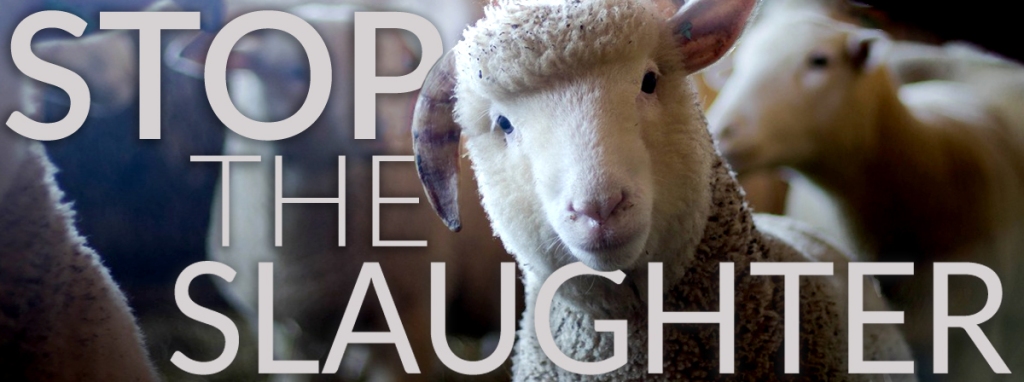
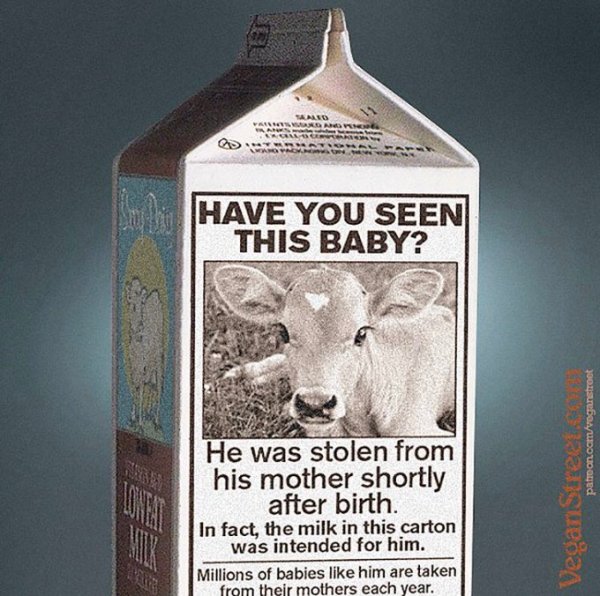
What is the difference between No Welfare, High Welfare, and Highest Welfare when they all require animals to die? Only human comfort, NONE protect the actual animals. The most humane, ethical, and honest Webster-defined "welfare" is NOT exploiting animals - not using, not wearing, not eating, not killing - animals. The only meaningful position is vegan, everything else is just how humans euphemize animals' required suffering and violent deaths: no human exploits animals because they honestly believe that NOT exploiting animals is UNethical or INhumane.
Trick or Vegan Treat …

For a cruelty-free Halloween for those who celebrate, lists from VegNews & PETA.
From VegNews
The Official Guide to Vegan Halloween Candy
Mining through gobs of candy every October can be mind-boggling, but VN’s definitive guide to vegan treats will make this your best Halloween yet.
If ever there is a time for an out-of-control sugar rush, Halloween night is it. Before pulling treats from the depths of a candy-filled pillowcase or grabbing fistfuls from a skeleton-shaped party bowl, consult VN’s comprehensive list of vegan-friendly candy to ensure that all holiday snacking is animal by-product free.
- Airheads Taffy (website)
- Allison’s Gourmet vegan caramels (website)
- Annie’s Organic Bunny Fruit Snacks (website)
- Azure Chocolat Beauty Bark (website)
- Biona Organic Wine Gums (link)
- BoomChocoBoom! Ricemilk Bar (website)
- Brachs Fruit Slices (website)
- Charms Blow Pops (website)
- Charms Pumpkin Flat Pops (website)
- Chick-o-Sticks (website)
- Chuao Chocolatier Spicy Maya (website)
- Clif Kid Organic Twisted Fruit (website)
- Crispy Cat Candy Bars (website)
- Crows (website)
- Cracker Jack (website)
- Cry Baby Candy (website)
- Diivies Super Stars (website)
- Dots (website)
- Dum-Dums (website)
- Endangered Species dark chocolate (website)
- Endangered Species Dark Chocolate Halloween Bug Bites (website)
- Ginger People Ginger Chews (website)
- Go Max Go candy bars (website)
- Goody Good Stuff Sours (website)
- The Humphrey Company Original Popcorn Balls (website)
- Jolly Ranchers hard candy (website)
- Let’s Do Organic Gummy Bears (website)
- Mamba Sour Fruit Chews (link)
- Mary Janes, regular and peanut butter kisses (website)
- Newman’s Own Licorice Twists (website)
- Now and Later (website)
- NuGo Organic Chocolate Bar (website)
- Panda Soft Licorice (website)
- Peanut Chews, Original Dark (website)
- Pez (website)
- Pure Fun Organic Halloween Pops (website)
- Q.Bel Double Dark Wafer Bars (website)
- Saf-T-Pops (website)
- Seitenbacher Gummy Candies (website)
- Sjaak’s Organic Chocolates (website)
- Sour Patch Kids (website)
- St. Claire’s Organic CandyTarts (website)
- Stockley’s Cinder Toffee Candy (link)
- Super Bubble (website)
- Surf Sweets Fruity Bears, Gummy Swirls, and Super Sour Bears (website)
- Swedish Fish (website)
- Sweet & Sara Marshmallow ghosts and bats (website)
- Tropical Source chocolate bars (website)
- VerMints (website)
- Whizzers Chocolate Beans (website)
- YummyEarth lollipops (website)
Click here for the Ultimate Pumpkin Carving How-To with Dan Piraro!
Click here for the lowdown on Eco-Conscious Halloween
Rap Artist 50 Cent Asked to Sponsor Rhino
From Discovery News
By Jennifer Viegas
Rapper 50 Cent, who was shot nine times and lived to tell the tale, is now being pressured by South African community group eblockwatch to support a black rhino that also survived being shot nine times.
The rhino, named “Phila,” survived two poaching incidents, during which she sustained wounds from nine bullets fired from automatic weapons.
Phila currently lives on a private farm, whose owner cut off Phila’s tusk in hopes of saving her from poachers after the rhino was shot twice. According to the South Africa Sunday Times, poachers still came to the farm later, shooting her 7 more times in an attempt to gouge out what was left of Phila’s horn.
The paper reports that conservation groups have noted a spike in poaching incidents from the area this year, with 227 rhinos killed in 2010 alone. That’s almost double the entire number of kills from last year: 122.
We as humble eblockwatch members and fellow South African’s ask if Mr Mandela could assist us (to) make contact with 50 Cent…
Wildlife experts attribute the increase in poaching incidents to demand from the Asian market, where rhino horn is used in traditional “medicines.” It’s said to be an aphrodisiac, among other things, a claim that’s completely unfounded.
Eblockwatch has been unable to reach 50 Cent, but this community group appears to be as plucky as the rhino. They’ve already created a popular online campaign utilizing their website and social media to get the word out.
Andre Snyman, founder of the group, says it “will use its tried and tested formula to solve problems by harnessing the collective powers of another South African to try and pursue 50 Cent to be the Godfather to our heroine Rhino Phila.”
He added, “We as humble eblockwatch members and fellow South African’s ask if Mr Mandela could assist us (to) make contact with 50 Cent…”
Who knows? Maybe if 50 Cent refuses the offer or remains silent, perhaps various individuals can chip in to support Phila’s care. If the rapper does agree to support the rhino, Snyman jokes that Phila should be renamed “One Pound,” since she’s heftier than 50 Cent.
To assist in keeping Phila free in the wild – and also protected from poachers – you can contact Selomie Maritz (in South Africa):
Mobile +27 71 864 7500
Email selomie@naboomspruit.co.za
Read Phila’s story Watching Over Phila HERE
Please Sign: Rhinoceros in South Africa need your help before their extinction
Cameron Todd Willingham: Wrongfully Convicted and Executed in Texas

Cameron Todd Willingham was executed in Texas in 2004 for allegedly setting a fire that killed his three young daughters 13 years earlier. He always claimed his innocence, and the arson investigation used to convict him was questioned by leading experts before Willingham was executed. Since 2004, further evidence in the case has led to the inescapable conclusion that Willingham did not set the fire for which he was executed.
The Texas Forensic Science Commission is currently investigating whether professional negligence or misconduct played a role in the forensic evidence that led to Willingham’s conviction.
Read more on the case below, along with news coverage and key documents.
• Texas Forensic Science Commission — History and Key Documents
• Myths and Facts About the Willingham Case
• The New Yorker: “Trial By Fire”
Case Summary
On Christmas Eve 1991, a fire destroyed the Corsicana, Texas, home Cameron Todd Willingham shared with his wife and three daughters, killing the three girls. Willingham, who was asleep when the first started, survived. His wife was at the Salvation Army buying Christmas presents for the girls.
Willingham’s conviction was based on erroneous forensic analysis … Willingham was executed by lethal injection in Huntsville on February 17, 2004.
At Willingham’s 1992 trial, prosecutors claimed he intentionally set fire to his home in order to kill his own children. Willingham said he was asleep in the home when the fire started and always maintained his innocence. He was convicted based on the testimony of forensic experts who said they had determined that the fire was intentionally set and a jailhouse informant who said Willingham had confessed to him. On October 29, 1992, he was sentenced to death. (Download the full trial transcripts here.)
Thirteen years later, in the days leading up to Willingham’s execution, his attorneys sent the governor and the Board of Pardon and Parole a report from Gerald Hurst, a nationally recognized arson expert, saying that Willingham’s conviction was based on erroneous forensic analysis. Documents obtained by the Innocence Project show that state officials received that report but apparently did not act on it. Willingham was executed by lethal injection in Huntsville on February 17, 2004.
Months after Willingham was executed, the Chicago Tribune published an investigative report that raised questions about the forensic analysis. The Innocence Project assembled five of the nation’s leading independent arson experts to review the evidence in the case, and this prestigious group issued a 48-page report (below) finding that none of the scientific analysis used to convict Willingham was valid.
…issued a report finding that experts who testified at Willingham’s trial should have known it was wrong at the time.
In 2006, the Innocence Project formally submitted the case to the Texas Forensic Science Commission, asking the empowered state entity to launch a full investigation. Along with the Willingham case, the Innocence Project submitted information about another arson case in Texas where identical evidence was used to send another man to death row. In that case, Ernest Willis was exonerated and freed from prison because the forensic evidence was not valid.
In 2008, the Texas Forensic Science Commission agreed to investigate the case. The panel’s review has been interrupted several times over the last two years, however, and continues today. In 2009, an arson expert hired by the commission issued a report finding that experts who testified at Willingham’s trial should have known it was wrong at the time. Days before the expert was set to testify, however, Gov. Rick Perry replaced key members of the panel, delayed the investigation for months.
An investigative report in the September 7, 2009, issue of the New Yorker deconstructs every facet of the state’s case against Willingham. The 16,000-word article by David Grann shows that all of the evidence used against Willingham was invalid, including the forensic analysis, the informant’s testimony, other witness testimony and additional circumstantial evidence.
A Court of Inquiry in the Willingham case is scheduled for Oct. 14 and 15, 2010, Watch the hearing streaming live online here.
And the Texas Forensic Science Commission is scheduled to discuss the case at its regular meeting on October 15, 2010, also in Austin. Watch the TFSC meeting live online here.
Read more about the TFSC and download key documents relating to the panel here.
Resources in the case are below, along with background on the role of unvalidated forensics in wrongful convictions.
Nightline: The Wrongful Execution of Cameron Todd Willingham
Vodpod videos no longer available.
Suffolk County NY Approves Animal Abuse Registry

From CBS News
A new measure to create the nation’s first animal abuse registry has been approved in Suffolk County.
Those convicted of animal abuse charges would be required to be on the registry for five years.
Natalie DiTommasso’s Jack Russel Terrier, named Poppie, was rescued from a Suffolk County home where he was tortured.
“It’s very sad to think what he came from. I think of it every day,” DiTommasso said. “He’s in a loving home right now, [but] he still hides his food.”
The abuse of Poppie and other pets like him prompted an historic vote for animals, just passed by Suffolk County lawmakers and now garnering national attention.
“Just as sex offenders are on a registry, you should know who is living next door to you, if somebody is an animal abuser,” Chief Roy Gross, of the Suffolk County SPCA, said.
Related, Animal abuse registry grabs attention of Indiana shelters
Vodpod videos no longer available.
Chief Gross said the new Animal Protection Bill will include an instant background check. The name, address and photo of any convicted animal abuser will be made public on the registry for five years, in an attempt to stop individuals from preying on innocent animals.
So far this year in Suffolk County, 17 people have been brought up on animal abuse charges involving the mistreatment of 362 pets.
“This will absolutely save the lives of innocent pets and animals, but there is, as I said, a correlation between animal abuse and domestic violence,” Suffolk County Legislator Jon Cooper said.
Cooper said that studies show animal abuse is often a precursor to abuse of people.
Some have criticized the harshness of making animal abusers’ identities public, and say you can’t compare them to sex offenders.
Others, though, don’t see it as controversial.
“Somebody can come in here with their best face on, and can appear on the surface to be a great home, and we could accidentally put a dog in a bad situation,” Michelle Mulnard-Curtin, of Second Chance Wildlife Rescue, said. “It’s a milestone for animal rescue people.”
Shelters like Second Chance, along with pet stores and breeders, would be banned from allowing abusers to adopt or buy.
The Animal Protection Bill will not burden taxpayers. It will be administered without cost to Suffolk County by the SPCA. Those on the list will have to pay a $50 annual fee to help fund the registry.
Two quick actions: please tell Showtime to pull program promo depicting cruelty & tell Coach to stop using fur
1. From PETA: Please visit HERE to send a message to Showtime asking them to pull show promo depicting animal cruelty.
Showtime is currently running a promo for its new television series, Shameless, that includes a clip of a teenage boy holding a screeching cat in one hand and a blowtorch in the other, with the clear implication that he is about to torture the cat by burning her with the torch. The offensive scene is meant to be humorous, but compassionate citizens everywhere agree that cruelty to animals is not a laughing matter.
Cruelty to animals—including the burning of cats and dogs—happens each and every day in this country. We here at PETA receive countless reports of animal abuse, many of which involve young perpetrators. Executives at Showtime might be surprised to learn that depicting animal abuse on television encourages potentially deadly “copycat” actions.
This promo reminded many viewers—and our cruelty caseworkers—of numerous real-life instances in which animals were tortured with fire. Earlier this year, a teenage boy in Rochester, New York, was charged after using hair spray and a lighter to set a 2-month-old kitten on fire. The kitten was so badly burned that she had to be euthanized. In 2009, three teenagers in Miles City, Montana, were charged after choking a cat and then throwing him into a bonfire while he was still alive.
Using the form HERE, please send a polite note to Showtime and urge the network to pull this offensive promo.
Remind Showtime that viewers are less likely to watch television programs that promote violence toward animals.
2. From PETA, please send message (sample below) to Coach asking CEO to reject fur.
Luxury fashion design company Coach refuses to stop selling fur, despite the fact that PETA has repeatedly explained to company executives that animals on fur farms live in cramped, filthy conditions before they are bludgeoned, electrocuted, and sometimes even skinned alive. Animals who are trapped in the wild may suffer for days before trappers arrive to crush their chests or stomp or beat them to death.
Coach lags behind other fashion-industry leaders who have dumped fur, such as Polo Ralph Lauren, Stella McCartney, Vivienne Westwood, Calvin Klein, Betsey Johnson, Gap Inc., Nike Inc. (including Cole Haan), and Liz Claiborne Inc. (including Juicy Couture and Coach competitor Kate Spade).
Millions of animals who are cruelly trapped, farmed, and killed for their fur every year around the world need your help now. Please politely write to Coach and demand that it join the dozens of other top designers and retailers who have dumped fur.
Please send a message to Coach’s CEO, Lew Frankfort, at lfrankfort@coach.com, and urge him to end its sale of fur immediately and implement a fur-free policy. Please also consider writing to or calling Coach by using the following information:
Coach, Inc.
516 W. 34th St.
New York, NY 10001-1394
212-594-1850
WHERE TO SEND YOUR MESSAGE / WHOM TO CONTACT:
Email:
Coach’s CEO, Lew Frankfort: lfrankfort@coach.com
Postal, telephone:
Coach, Inc.
516 W. 34th St.
New York, NY 10001-1394
212-594-1850
SAMPLE MESSAGE: (Please modify and shorten! Thank you.)
Dear CEO Frankfort,
I am shocked to discover that Coach is still commercially engaged with the fur industry. Due to the inherently-brutal business of fur farming, any products derived for or from the suffering and killing of animals should be rejected, and I am respectfully requesting that Coach finally discontinues profiting off the exploitation of animals.
Please watch the undercover footage of the industry you promote: animals are forced to endure deplorable conditions including living in cramped, feces-crusted cages; suffering from sickness and disease; lacking an enriching environment; and being subjected to substandard diets and severe psychological trauma. They are then butchered via anal electrocution, gassing, skinning alive, and forced trauma. Why in the world would you WANT to cause such suffering?
http://www.youtube.com/watch?v=VTZQnQeAPJc&feature=player_embedded
Humans are capable, indeed obligated, to acknowledge animals as sentient beings who, like humans, experience love, anguish, pain, and suffering. Human apathy as established by the usage of fabrications and euphemisms reflects a lack of respect, not only for animals, but also for humans, and I implore upon you to examine your role in the suffering of animals and your unscrupulous conduct as host to such a cruel business. Regrettably, as long as Coach unnecessarily and selfishly capitalizes on the mutilation, torture, and death of animals, I will not financially support you or your associated products. Furthermore, I will share this information with family, friends, colleagues, and members of online communities.
Please make both the ethical and responsible decision to discontinue your commercial support of fur immediately: join an increasing body of corporations who are listening to a concerned and attentive consumer population who refuse to be complicit in the inherently malicious industry of fur farming. I hope this letter finds you willing to scrutinize your own involvement and desire to protect, rather than harm, animals.
Sincerely,
NAME, ADDRESS
RESOURCES
Fur Exposed In 60 Seconds
Vodpod videos no longer available.
URGENT! Stop the Use of Monkeys in Space Radiation Experiments

From PCRM
I have an important update and call to action regarding our year-long efforts to cancel NASA’s proposed radiation experiments involving live monkeys.
Just yesterday, the website NASA Watch released documents (PDF) (below) indicating that Brookhaven National Laboratory (BNL) director Samuel Aronson, Ph.D., informed the Department of Energy (DOE) of his decision regarding the use of monkeys in space radiation research. While much of the document is blacked out, the information that remains gives us hope that Dr. Aronson and DOE have made the right decision.
Now more than ever, we need to make sure that BNL and DOE know that the public opposes this research. If you haven’t already, please call (Steven Chu, Ph.D. | 202-586-5000) or e-mail Secretary of Energy Steven Chu and ask him to cancel these experiments immediately.
We will update you as we learn more. Stay tuned!
In the Meantime, Please ask Department of Energy Secretary Steven Chu to Stop the Use of Monkeys in Space Radiation Experiments HERE
Please take a minute to ask Department of Energy (DOE) Secretary Steven Chu, Ph.D., to halt DOE’s involvement in NASA’s planned monkey radiation experiments. The experiments are supposed to take place at a DOE facility. We have provided text for you, but if you decide to write your own message, please be polite and encouraging. Here are some talking points:
- I am writing to ask that you halt the Department of Energy’s involvement in NASA’s planned monkey radiation experiments.
- I understand that recently a decision has been made by Brookhaven National Laboratory and the Department of Energy, but that you have yet to make your decision known to the public.
- Genetic, anatomical, and physiological differences between humans and monkeys make this type of research unproductive.
- Monkeys are sentient and social beings who experience pain and suffering.
- Decades of radiation research involving nonhuman primates have not advanced human space travel.
- There are many validated nonanimal research methods that can and should be used.
Please note: if you are not a resident of the U.S., leave the postal code field blank in order to submit your message.
Read more…

The following appeal came via AR-News alerts. Please attend if you are able and send messages. I have included a sample message for use, but please modify to shorten, the message needs only be brief. At the bottom I included TNR information for those who are unfamiliar with this program. Thank you.
***Please note, I have sent messages via both my Comcast and Yahoo accounts and all were returned as denied, but another editor had none bounce back.
From Lydia Caldwell
Good morning, Community Leaders and Advocates of TNR:
Please take the time to read and take action.
On Monday, October 18, 2010, at 7:00 p.m., Bellaire City Council is expected to pass a City Ordinance BANNING feeding of all feral cats in Bellaire, Texas (adjacent to Houston, TX), including those cats currently in colonies practicing TNR.
The ONLY possible way to stop this from happening is by all of us SPEAKING UP in opposition, BEFOREHAND AND THE DAY OF!!!
Some of you do not live in Texas and cannot attend on Monday, October 18, but you most certainly may e-mail the Bellaire City Council and implore that they NOT pass an ordinance banning the feeding of all feral cats in Bellaire (which impedes individuals’ TNR efforts).
And, for those of you who live in Houston or anywhere near Bellaire, PLEASE CHOOSE TO ATTEND this Bellaire Council meeting (Bellaire City Hall, 7008 South Rice Avenue, Bellaire, TX 77401), in solidarity OPPOSING this ordinance!! And, better yet, SPEAK at this meeting!!! Both, Bellaire and NON-Bellaire residents may SPEAK against this ordinance for 5 minutes!!!!

This proposed city ordinance has come about because some business owners on a particular street in Bellaire, complained to Bellaire City Council that people were feeding these cats (approx. 35 cats), making a mess for them.
I am imploring Bellaire City Council to deal with the situation on Spruce Street in Bellaire, as the individual incident that it is. The City of Bellaire is NOT overrun with feral cats by any means!!!! This is NOT a city-wide issue. Why use such a broad stroke to address the issue on Spruce Street?
Today this is happening in Bellaire, TX. Tomorrow, it could be YOUR community!
If we don’t speak up now, we won’t have any business complaining when it passes. PLEASE FORWARD THIS TO ALL IN YOUR CONTACT LISTS! Let’s get standing room only at Bellaire City Hall on Monday, October 18, 7:00 p.m. And, for those of you with media connections, get them there!
Again, if you can’t attend the meeting, please send an e-mail, bombard their offices. Please speak up for the cats.
Thank you!
Lydia Caldwell
Protect Animals and Children From Abuse in Connecticut

Protect Animals and Children From Abuse in Connecticut
Targeting: The CT State Senate & House
Started by: Stephanie Feldstein
The link between animal abuse and other violent crimes is well established. In cases of domestic violence, animals are often abused in front of women and children as a means to intimidate and hurt them. In addition, children who are exposed to domestic violence are more likely to abuse animals themselves. When animal protection and child protection agencies recognize this link and work together, they’re able to better identify cases of abuse and more effectively protect innocent victims.
In Connecticut, a bill that would require the Department of Children and Families and the Department of Agriculture to cross-report animal cruelty and child abuse failed last session in a filibuster, but Rep. Diana Urban (D-Stonington) plans to reintroduce the legislation.
Tell the Connecticut legislature to pass this important piece of legislation next session to protect children and animals from abuse.
BACKGROUND
The link between animal abuse and violent crimes is no secret. Someone who is capable of abusing an animal is highly likely to abuse people, too. And where there’s domestic violence, it’s a safe bet to assume that the pet dog or cat isn’t pampered by the household abuser.
Abusing animals is often the first step on a path of increasing violence …
When it comes to children, domestic violence and animal abuse isn’t just a two-way street. It’s more like a six-lane highway, there are so many correlations. Not only is an abused or neglected family pet a good indication that other vulnerable members of the household might be in danger, but pets are often intentionally targeted by abusers as a form of intimidation.
In addition, kids who are exposed to domestic violence are more likely to abuse animals themselves, using pets as scapegoats for their anger or as a way of mimicking the behavior they’re witnessing at home. They may become desensitized to violence, and abusing animals is often the first step on a path of increasing violence throughout their lives.
Members of the Connecticut legislature recognize the link between animal cruelty and other forms of violence. A few years ago, they passed a law that allows pets to be included in domestic protective orders. This past session, they considered a bill which would require the state Department of Children and Families and the Department of Agriculture to cross-report cases of child abuse and animal cruelty.
The bill failed in a late-session filibuster, but members of the legislative Select Committee on Children aren’t giving up. Committee co-chair Rep. Diana Urban (D-Stonington) plans to re-introduce the bill next session. She believes many animal cruelty cases are discounted during plea-bargaining, causing agencies to miss a red flag that there might be other abuse in the home.
“The FBI has recognized since 1971 that there is a link between animal abuse and future violent behavior.” Urban says the bill aims to catch that link so authorities can step in before a child is abused or establishes anti-social patterns.
Rep. Urban is optimistic about the bill. From legislators to high school officials to YMCA staff, there is widespread support for the measure. As there should be — who can argue with protecting society’s most vulnerable members? And yet, it didn’t pass last session.
Wildlife Services Exterminates Over 4.1 Million Animals in 2009
From WildEarth / AR News
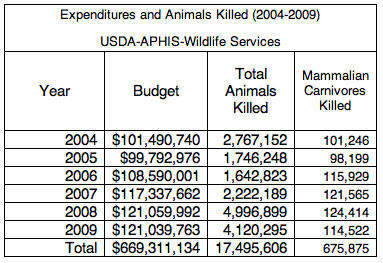
Wildlife Services Exterminates Over 4.1 Million Animals in 2009 , Agency’s Budget Shrouded from Public (Reports follow article.)
According to records released today by WildEarth Guardians, “Wildlife Services,” the ironically-named branch of the U.S. Department of Agriculture, killed more than four million wild animals and pets in 2009 while spending $121,039,763. Last month, WildEarth Guardians filed a Freedom of Information Act (FOIA) lawsuit (see below) seeking to track how this money is spent, but the agency continually sidesteps public scrutiny.
Click on each to view full size.
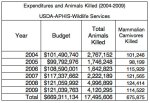
“Apparently, Wildlife Services is comprised of bands of secret agents. One group, the assassins, operates on our national forests and kills millions of the public’s wildlife using helicopters, guns, poisons, traps, and hounds. The second, the artful dodgers, play shell games in the dark with the public’s money,” said Wendy Keefover-Ring of WildEarth Guardians.
Wildlife Services’ carnivore eradications amount to a “sledgehammer” approach to wildlife management because of the breadth of the extermination.
In 2009, Wildlife Services reported it killed 4.1 million animals and “destroyed” 18,000 more. That total includes a staggering 27,314 beavers; 988,577 blackbirds; and 114,522 mammalian carnivores (e.g., 1,775 bobcats, 82,097 coyotes, 480 wolves, 571 river otters, and 443 black bears.)
Wolves in Idaho and Montana are now listed as federally endangered.
In response to WildEarth Guardians’ lawsuit, Wildlife Services and its parent agency, the USDA’s Animal and Health Inspection Service, stated that it could not answer the group’s simple request for line-item spending data. They agency stated that it tracks expenses using two different data bases: one that is “operational” and the other “financial”, but the accounting systems are “not interactive.” Thus, Wildlife Services claims it does not know how much it spends on its controversial operations such as shooting coyotes and wolves from helicopters. The agency further stated: “Wildlife Services does not have a managerial need for financial data at this finite level.”
Apparently, Wildlife Services is comprised of bands of secret agents. One group, the assassins, operates on our national forests and kills millions of the public’s wildlife using helicopters, guns, poisons, traps, and hounds. The second, the artful dodgers, play shell games in the dark with the public’s money …
“Federal agencies must be fiscally accountable to the public,” stated Steve Sugarman, WildEarth Guardians’ attorney. “It’s time for Wildlife Services to stop playing shell games and show the public what they’re doing with our money in the light of day,” he added.
From BUAV
(Please note that British Union for the Abolition of Vivisection – BUAV – has become Cruelty Free International and previous BUAV-specific links may no longer load.)
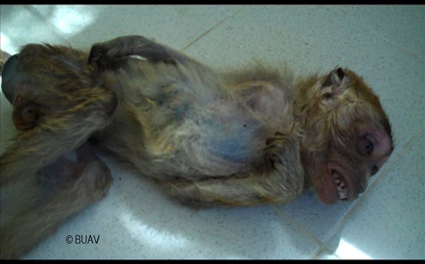
The BUAV investigation into the trade in monkeys for research on Mauritius has obtained shocking images of this secretive industry; images that were never meant to be viewed by the outside world (see end of page).
These additional images show yet again the cruelty and suffering inflicted on thousands of primates who are torn from their families and jungle homes to either be exported directly for research or imprisoned on farms to produce offspring who will be exported to laboratories around the world.
Footage obtained by the BUAV (see video below) from inside a facility connected to Bioculture, one of the main monkey supply companies, shows the extremely stressful methods of capture used. Monkeys, frantic in their attempts to escape, were grabbed and pulled by their tails to capture them from pens and transfer to small cages prior to export. Because this species of monkey does not have a prehensile tail, such handling could result in injury, including the separation of vertebrae in the tail leading to considerable pain and debilitation.
On the Mauritius monkey farms, wild-caught females are forced into captivity to produce offspring to be exported for research. Footage obtained by the BUAV shows a female with her new born baby inside a concrete pen. Her infant, likely to be one of those destined for research, will be cruelly separated from her at a young age – usually between 10-12 months old – but it could be as young as eight months. Long-tailed macaques normally wean their babies at around 14 months, but continue to have intimate contact for years after this. Females would remain in their family groups for life and males would remain at least until four years of age.
Read more…A Garbage Bag In Space

From MACLEANS
By Jane Swittzer
When clutter consumes your basement, a well-executed cleaning does the trick. When human-generated junk clogs the Earth’s orbit, things get a little more complicated.
Low Earth orbit space debris has increased since the dawn of the space age. But the wake-up call came last year, when the U.S. Iridium 33 and Russian Kosmos 2251 collided. It was the first accidental collision between an operational and defunct satellite, and it produced large amounts of debris. The NASA orbital debris program office at the Johnson Space Center now predicts eight or nine such collisions will occur in the next 40 years.
This animation shows the number of tracked objects in Earth’s orbit,
and the movement of them.
An American firm has proposed a fix: scoop up spent rocket bodies, defunct satellites and fragments with a big net. Jerome Pearson, president of Mount Pleasant, S.C.-based STAR Inc., says the electrodynamic debris eliminator, or EDDE, would zip around using solar power and electrodynamic thrust. Then, using a tissue-dispenser-like net manager, it would release a net to envelop debris before tossing it in the ocean, putting it on a trajectory to burn up upon re-entry, or recycling the material for future use. Pearson envisions the EDDE launching on an existing rocket. Once in orbit, it would be controlled from a ground station. A full fleet would get rid of all debris under two kilos in seven years.
But responsibility over ownership is an issue, says Eugene Stansbery, of the NASA orbital debris program office. “The country that launches and operates a satellite is responsible for that debris, but there’s no treaty that says anybody should go and clean it up,” he says. With funding for EDDE development coming from the U.S. Defense Advanced Research Projects Agency, security concerns have been raised. There is potential to develop space weapons to scoop operational satellites out of orbit, and Pearson says international treaties will need to be ironed out. A test flight will take place in 2014.
But, Pearson says, “if we want to be really serious about moving the space debris, we’ll need 10 or 12 EDDEs to get that down in a hurry.”
Space Debris & Junk orbiting Earth HD
Vodpod videos no longer available.
Astronauts On Alert Again Tonight–Space Junk
Originally published March 16, 2009
Last week astronauts aboard the International Space Station hustled themselves into a Russian space capsule as protection from some errant space junk. Orbiting the Earth at approximately 17,500 mph nearly any object can cause catastrophic damage. Tonight another alert! A cloud of 300 odd pieces of debris from an ill-fated 1981 Russian satellite will be in the neighborhood.
NASA kept close tabs on an old piece of space junk Monday that threatened to come too close to the international space station as the shuttle Discovery raced toward the orbiting outpost for a 220-mile-high linkup.
What’s the deal? Why has space become so much more dangerous?
Though space itself is limitless, satellite are forced into specific and very limited areas close to the Earth. The math is a little weighty for me, but Johannes Kepler had this stuff figured out back in the pre-calculator 1600s. The US, Russia and now the Chinese haven’t been particularly diligent in keeping the area clean. The flotsam and jetsam of decades of space launches is getting more and more dense.
Just yesterday the Christian Science Monitor reported:
Currently, the US Air Force Space Command is tracking some 18,000 to 19,000 objects larger than about 4 inches that are orbiting Earth. Some specialists estimate that another 500,000 to 700,000 objects out there are smaller than 4 inches.Of the large objects, around 900 are satellites zipping around the Earth. Roughly 45 percent of these do so in low-Earth orbit, between 100 and 1,200 miles out. This leads to hundreds if not thousands of close approaches, or conjunctions, each day.
It’s not getting any better. It’s not going to get any better. There are proposals for a space code of conduct, but it’s a code not a rule–no teeth at all.
WILD HORSE, BRAVEHEART, BREAKS NECK DEFENDING HIS FAMILY FROM B.L.M.
Dedicated to the Horses who spilled their blood, lost their lives,
and gave up their Freedom For BLM.

Braveheart standing guard over his mare moments before he broke his neck by charging the fence.
From The Persian Horse Blog
By Jude Love
Tragedy at Silver King: Braveheart’s Last Stand, as Reported by Eye Witness, Suzanne Roy, American Wild Horse Preservation Campaign.
http://www.wildhorsepreservation.org/news/?p=2264
In the early morning of Wednesday, October 6, 2010, amid the vast landscape of the Silver King Herd Management Area in southeastern Nevada, a mustang family lost everything in a BLM helicopter roundup.
I looked down from a hill above the entrance to the capture site to see a striking white mare, running at full speed, with her young foal at her heels. Galloping just ahead of the helicopter was a beautiful sorrel stallion, forehead lined with a wide white blaze. He lagged behind his family, torn between making a run for freedom and protecting his mare and foal, even if that meant following them into the jaws of the trap. The stallion, who we have named Braveheart, chose family over freedom, and it cost him his life.
Not long after his decision, Braveheart charged the bars of the trap pen, defending his mare and foal against an enemy he recognized: another horse. Though the BLM contractor clearly observed that his saddle horse was causing Braveheart’s agitation, he tied his mount just outside the stallion’s pen. To Braveheart, the saddle horse appeared to be within striking range. Braveheart didn’t know know men and their metal fences wouldn’t give way to his charge. And, slamming himself against the metal fences, he went down.
BLM often claims that horses with broken necks die instantly. They don’t.
Braveheart fell down after sustaining a mortal injury, but then he struggled to his feet. Head hanging down, he searched for his family. Could he see them nearby? Could he hear or smell them as he lifted his great red-gold head one final time?
As Braveheart lay dying or dead, the BLM wranglers loaded his white mare into a trailer. Dazed by defeat, she no longer struggled. Her stallion was dead, her foal forcibly taken from her.
Next the wranglers dragged the stallion’s body, covered by a tarp, onto the same trailer, forcing the pale mare to stand over her dead mate.
An endless 40 minutes later, the truck drove off, leaving the small foal, who looked just like his father, alone in the trap pen, never to see his mother or sire again.
At the holding site, dirt was piled atop the stallion next to mounds containing the bodies of numerous other victims of this roundup. Our requests to film the body were denied; when we filmed the backhoe and the stallion’s body awaiting burial from the distance, the government-contracted wrangler drove the truck and trailer around to block our view.
Ben Noyes, the BLM wild horse and burro specialist, refused our request to speak to him to get information about Braveheart’s death. Throughout the two days that we attended the roundup, Mr. Noyes refused to speak with the public and answer questions. The PR person charged with being the spokesperson often was unable to answer basic questions about the Silver King capture operation
My colleague Deniz Bolbol and I captured the whole scene on video, despite the best efforts of the BLM to prevent us from doing so. We participated in two days of “public observation” at Silver King, during which the BLM’s main objective was to prevent us from capturing and exposing the images that convey the anguish, the trauma and the suffering wild horses endure in the BLM roundups.
Dolphins save man from shark
From Animal Tales Blog
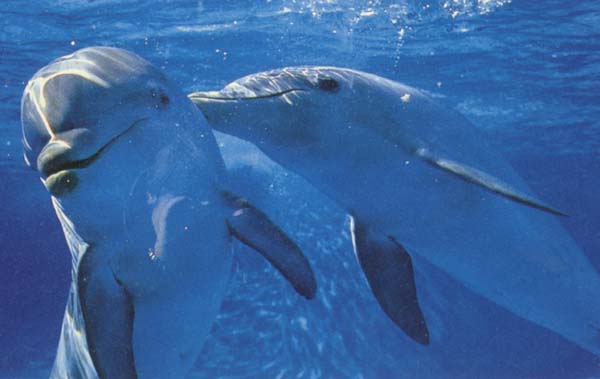
Swimmers have told how a pod of dolphins protected them from a great white shark off the northeastern coast of New Zealand.
Rob Howes and three other lifeguards were on a training swim about 100 metres offshore at Ocean Beach, near Whangarei, when the dolphins raced in and herded the group together.
“They started to herd us up, they pushed all four of us together by doing tight circles around us,” Mr Howe said.
When he tried to drift away from the group, two of the bigger dolphins herded him back.
He then saw why. A three metre great white shark was cruising toward the group about two metres below the surface.
“I just recoiled. It was only about two metres away from me, the water was crystal clear and it was as clear as the nose on my face,” he said, adding he then realised the dolphins had moved in to protect the swimmers.
RELATED, MY FRIEND (See below for actions.)
Vodpod videos no longer available.
The group were surrounded by the dolphins for 40 minutes before they were able to reach the shore.
Another lifeguard, Matt Fleet, was patrolling nearby in a rescue boat when he saw the dolphins’ unusual behaviour.
When he dived out of the boat to join the group he also saw the great white.
From The Province
By Jack Keating
Sixty animal rights advocacy groups from across Canada, the U.S. and Europe sent a letter to UBC president and vice-chancellor Stephen Toope Monday, urging the university to fully disclose information about its animal research programs.
“[University of B.C.] must lift its veil of secrecy surrounding animal research,” said Brian Vincent, spokesman for Stop UBC Animal Research. “Since much of UBC’s animal research is funded by taxpayers, the public has the right to know what the university is doing to animals with public money.”
Vincent said the letter was sent to the president after requests for meetings were declined and freedom of information requests were also denied.
“Most people [have] no idea that right down the street at UBC is one of the largest bio-medical campuses in Canada where 100,000 animals are distributed from the animal-care facility at UBC to UBC related research facilities,” said Vincent.
“We felt the broader public has a right to know about this and that there should be international attention focused on UBC.”
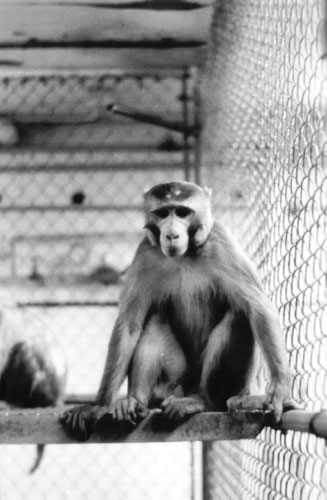
The research involves mice and rats, but cats, monkeys and baby piglets are also used, he said.
The letter endorsed by such groups as the Animal Alliance of Canada, Animal Defender International, Born Free U.S.A., International Networks for Humane Education and the Vancouver Humane Society voiced concern about the lack of transparency about experiments on animals.
The letter urges UBC to “fully disclose information about its animal research programs. That way students, donors, alumni and the public can make informed decisions about supporting a university that engages in activities many find objectionable and of questionable scientific merit.”
A spokesman for UBC was not available for comment.
According to the UBC student newspaper, the UBYSSEY, the University of British Columbia (UBC) is one of the largest bio-medical campuses in Canada. Each year, UBC’s Animal Care Center distributes some 100,000 animals, including cats, pigs, mice, rabbits, rats, non-human primates, and other animals to dozens of UBC-affiliated research projects. UBC maintains over thirty animal care facilities across its campus and throughout the rest of Vancouver.
Help to End the Suffering of Bulls in Nimes

From LACS
Immediate, please sign:
Help to End the Suffering of Bulls in Nimes
The Ferias of Nîmes are held twice a year and take place over five days. The Pentecost Feria is one of Europe’s most popular events, attracting nearly a million visitors.
These festivals historically centre around bullfighting (the corrida) and are held in celebration of the bull and his fighting spirit. The corrida involves various stages of weakening, angering, injuring, and finally killing the bull. Bullfights are held throughout the week and parties held every night. Paradoxically, cruelty to animals is banned in France – punishable by up to two years in prison and fines of €30,000 – however, corridas and cockfighting are permitted where there has been an ‘unbroken tradition of the activity taking place’.
The League and its partner organisations across Europe think the cruelty involved during the Ferias of Nimes is totally unacceptable and believe that there is no place for ritualised slaughter in the 21st century.
Please sign HERE. See below for printable petition to have others sign if online access is not possible.
French anti-bullfighting activists stage march
Police said 1,800 marched on Saturday (September 12, 2010) in the French city of Nimes to demand an end to bullfighting. Organisers sid up to 3,000 people marched in what was the first anti-bullfighting demonstration of its kind in France.
RELATED BLOG POST: Leading airline apologises for its promotion of bullfighting
Written by Liam on 12 October, 2010 : 15:35
Following pressure from the League and other animal welfare organisations, international airline Jet Airways has apologised for its glorification of bullfighting in its in-flight magazine JetWings, and has pledged never to promote bullfighting again.
Spokesman Manech Davar said: “We do understand the points raised and would not want to come across as an organisation and publication that encourages unjust endeavours. We assure you that there won’t be any more features on the same subject in JetWings.”
The League applauds Jet Airways for its decision and hopes that it will never again glorify the cruelty of the bullfight.
Add a comment HERE













 Our Compass