HighestWelfare.Humane.Assured.GoodPractices.Vegetarian. Regenerative.Flexitarian.Lies...
What is the difference between No Welfare, High Welfare, and Highest Welfare when they all require animals to die? Only human comfort, NONE protect the actual animals. The most humane, ethical, and honest Webster-defined "welfare" is NOT exploiting animals - not using, not wearing, not eating, not killing - animals. The only meaningful position is vegan, everything else is just how humans euphemize animals' required suffering and violent deaths: no human exploits animals because they honestly believe that NOT exploiting animals is UNethical or INhumane.
Mass Animal Suffering and the Collapse of Compassion

Click on for PCRM’s 21-Day Vegan Kickstart Program
Click on and Pledge to Be Vegan for 30 Days!
From ALDF
Posted by Matthew Liebman, ALDF Staff Attorney
A strange paradox constantly confronts activists in the animal protection movement: many members of the public express appropriate revulsion at cruelty against individual animals (e.g., the dog beaten by his owner) while simultaneously responding with indifference to the large-scale industrial exploitation that destroys the lives of billions of animals (e.g., the bloody slaughter that awaits every cow, chicken, and pig killed for his or her flesh).
A recent study in the Journal of Personality and Social Psychology sheds light on why this might be the case. In “Escaping Affect: How Motivated Emotion Regulation Creates Insensitivity to Mass Suffering,” two social psychologists from the University of North Carolina at Chapel Hill, C. Daryl Cameron and B. Keith Payne, examine people’s tendency to respond less compassionately to mass suffering than to individual suffering. They cite numerous studies that show that compassionate response decreases as the number of victims increases. Thus “large-scale tragedies in which the most victims are in need of help will ironically be the least likely to motivate helping.”
According to the authors, this “collapse of compassion” happens not because, as some have argued, people are less capable of caring about group suffering than individual suffering, but rather because they actively (if subconsciously) regulate their emotions to suppress the compassion they feel for mass suffering. In other words, caring less about mass suffering isn’t built into our makeup, but is instead an active process in which we downgrade our affective response to mass suffering.
Related | Farm To Fridge ~ What if this was your pet?
Vodpod videos no longer available.
But why do we do that? Self-interest. People tend to regulate emotions that they perceive as costly. If feeling compassion toward group suffering compels you to donate money, experience emotional anguish, or significantly change your lifestyle, you may choose to avoid that compassion altogether. Cameron and Payne summarize: “when faced with the prospect of mass suffering, people might find their emotions especially costly, and take steps to prevent or eliminate them.” Frankly put, sometimes it’s easier not to care.
Cameron and Payne’s study focuses on emotion regulation in response to mass human suffering (specifically the Darfur crisis), but its findings have important implications for animal activists who want to draw attention to mass animal suffering. Consider the examples mentioned above: it’s easier to care about the single dog abused by his owner than the billions of animals slaughtered for food, because the cost of compassion is less: one demands a simple moral indignation, the other a potentially drastic change in diet. If the hypothesis of this study is correct, people down-regulate their emotional response to mass animal suffering because, at least in part, they think the cost of helping will be too burdensome.
Furthermore, as the authors note, because emotional response influences moral judgment, when people dull their compassionate responses, they are less likely to adjudge the underlying conduct as immoral. For example, if we regulate our emotional response to minimize compassion for animals in slaughterhouses, we are more likely to condone that slaughter as morally permissible.
It’s depressing stuff and raises serious questions about how effective we can be in our campaigns to alleviate mass animal suffering. There are a few constructive lessons, though. First, the authors suggest that encouraging people to trust their emotional responses can help reduce their down-regulation of compassion. This highlights the importance of humane education to encourage children to foster, rather than suppress, the compassion they feel for animals. Second, we can reduce the “collapse of compassion” effect to the extent we can minimize the perceived costs of caring about mass animal suffering. For example, if we can show that adopting a vegan diet is easy, nutritious, and healthy, people will be less motivated to down-regulate their emotional response to exploited farmed animals.
(Thanks to the Humane Research Council for bringing this study to our attention.)
Need a vegan grocery shopping list? Check out PETA’s:
Accidentally Vegan … Really, it’s vegan!

Read more…
West Hollywood bans fur; please sign and send petition and sample letter to Nordstrom to do the same
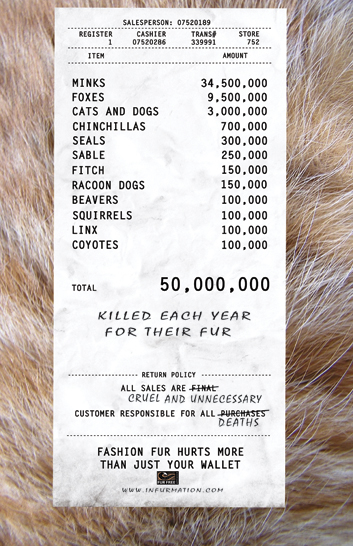
Artist, Elyse Bryan, Tyler School of Art, Temple University
Please see below for Petition and Sample Letter to sign and send regarding Norstrom’s continuous use of fur.
From AR News, AJ Shannon
Last night (Monday, September 19) the City Council of West Hollywood passed an historic ordinance unanimously prohibiting the sale of fur apparel products within the city! This great success culminated after months of canvassing and rallies spearheaded by the Fur-Free West Hollywood Campaign made up of activists from In Defense of Animals, Last Chance for Animals, Animal Alliance, PETA, OCPA, ARME, APRL and many hard-working individuals, most notably Ellen Lavinthal, Ed Bucks, Shannon Keith and Bryan Monell. Several stores in West Hollywood had voluntarily removed fur items from their stores prior to the City Council’s actions.
In 1989, West Hollywood passed resolution number 558 proclaiming West Hollywood a “cruelty free zone for animals”. Since that time West Hollywood has passed legislation banning the declawing of cats, prohibiting pet stores from selling puppy mill animals and resolutions banning cosmetic testing on animals and steel-jaw leg hold traps. In February of 2001 they adopted IDA’s guardian language which substitutes the word “guardian” for “owner“ in all discourse.
West Hollywood is the first city in the United States banning the cruel commerce of fur. It is a remarkable historic victory.
Want to help animals killed for their fur in your city? Visit furkills.org to find out!
This year’s Fur Free Friday is right around the corner. Visit http://www.furfreefridayida.org/2010summary/ to see what activists from around the world did last year and start planning your own events soon… more details on that coming soon!
VIDEO
Bloody Harvest: The Real Cost of Fur
Vodpod videos no longer available.
Tell Nordstrom to Stop Selling Fur
WHOM TO CONTACT
contact@nordstrom.com ,
designer@nordstrom.com ,
beauty@nordstrom.com
SAMPLE LETTER
To Whom It Concerns,
I am shocked to discover that Nordstrom is still commercially engaged with the fur industry. Due to the fundamentally-savage business of fur farming, any products derived from the suffering and killing of animals should be rejected, and I am respectfully requesting that Nordstrom finally discontinues profiting off the exploitation of animals; this request includes all non-Nordstrom brand fur products as well as your shearling merchandise. Furthermore, commercial demand is not justification to undertake such barbarism; indeed, child labor and human trafficking are considered financially beneficial as well, yet due to their inherent brutality and inequity, should not be sanctioned.
Please watch the undercover footage of the industry you promote: animals are forced to endure deplorable conditions including living in cramped, feces-crusted cages; suffering from sickness and disease; lacking an enriching environment; and being subjected to substandard diets and severe psychological trauma. They are then butchered via anal electrocution, gassing, skinning alive, and forced trauma. Why in the world would you WANT to cause such suffering?
http://www.youtube.com/watch?v=VTZQnQeAPJc&feature=player_embedded
Humans are capable, indeed obligated, to acknowledge animals as sentient beings who, like humans, experience love, anguish, pain, and suffering. Human apathy as established by the usage of fabrications and euphemisms reflects a lack of respect, not only for animals, but also for humans, and I implore upon you to examine your role in the suffering of animals and your unscrupulous conduct as host to such a cruel business. Regrettably, as long as you unnecessarily and selfishly capitalize on the mutilation, torture, and death of animals, I will not financially support you or your associated products. Furthermore, I will share this information with family, friends, colleagues, and members of online communities.
Please make both the ethical and responsible decision to discontinue your commercial support of fur immediately: join an increasing body of compassionate businesses and designers who are listening to a concerned and attentive consumer population who refuse to be complicit in the inherently malicious industry of fur farming. I hope this letter finds you willing to scrutinize your own involvement and desire to protect, rather than harm, animals.
Thank you for taking the time to read this important message.
NAME
FUR-FREE RETAILERS
Read more…
Clemency denied: last chance for Troy

Image | NAACP
Please click on and sign (you may have to sign up first with just your name and email addy):
From NAACP
We’ve received terrible news: Troy Davis’s clemency was denied by the Georgia Board of Pardons and Paroles, and he is set to be executed on Wednesday, September 21st at 7 PM.
But now is not the time to give up hope. Chatham County District Attorney Larry Chisolm is the man who requested the death warrant against Troy Davis, and he is in a unique position to petition the judge to withdraw the death warrant against Troy.
Since Troy Davis’s conviction, the facts of the case have changed dramatically. The evidence in the Troy Davis case has always been circumstantial due to a lack of relevant physical evidence and no murder weapon. The conviction was based almost wholly on witness testimony, and seven of the nine witnesses have recanted their testimony or changed their story.
In light of this knowledge, the evidence used to convict Troy Davis appears even weaker.
Sign the petition to District Attorney Larry Chisolm today. Tell him an innocent life hangs in the balance, and he has your support in preventing Troy Davis’ execution by coming forward to ask the Judge to withdraw the death warrant against Troy.
Sign the petition using the form HERE
Vodpod videos no longer available.
Please support Wolves, Burros, Arctic Waters, & GAPA
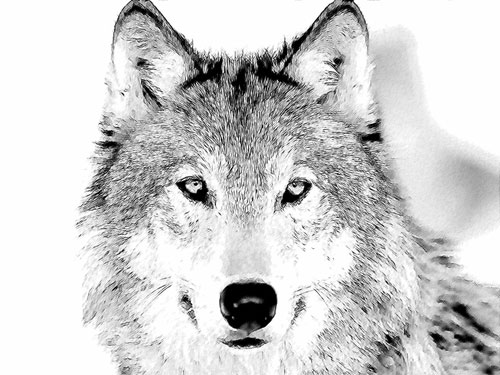
Image | Akvis Sketch
Please click on and sign/send the following:
1. End Wholesale Slaughter Of British Columbia Wolves
2. Texas, Stop Killing Wild Burros!
3. Keep Oil Out of Arctic Waters
4. USA Friends, Send a Fax To Support The Great Ape Protection And Cost Savings Act
1. Background | From Kinship Circle
In British Columbia a no-quota, all-year wolf hunt has begun. It overlaps whelping season as females nurse pups. Baiting is permitted. The government will go to any length to appease livestock interests — even though wolves statistically account for a marginal loss of farmed animals. In the same region, an experiment is underway to sterilize and kill wolves so hunters have more caribou and elk to shoot. BC wolves are under attack, just like western gray wolves in the U.S.
2. Background | From Change
Less than 300 wild burros remain but Texas Parks and Wildlife intends to kill these nationally protected burros to the “maximum extent possible”. The national protections do not extend to this State-held land. What Texas is doing may be legal, but we think its an atrocity.
This horrid policy is carried out quietly, behind the scenes, with efforts to keep visitors to the Big Bend Ranch State Park from realizing wild burros are there and wild burros are being killed. We want the world to know how Texas chooses to kill their own living legacies of natural, cultural and historical heritage of their State, the region and America.
Only 5,800 wild burros are held in the protected areas managed by the BLM. Texas has their own small but vitally precious relic herd of wild burros, documented as laying claim to these lands as their ancestral home for hundreds of years. Officially, the Parks Department states that these wild donkeys harm the resource of the Park.
As evidence they provide ancient documents from 1974 and videos produced by the US China Lakes Naval Base where a 1981 court case revealed the base killed 648 wild burros illegally. In addition, Parks staff have stated on the record, that they needed to kill these wild burros to ensure that they could release restored “native” bighorn to the park.
The bighorn are a high profile species that are prized by big game hunters. Their restoration is heavily subsidized by private individuals who believe that the wild burro is an “enemy” of the bighorn. The hunting permits for the bighorn are sold in an auction format, with the highest recorded winning bid being $152,000.
Texas is killing wild burros to make way for hunting opportunities for wealthy hunters. The local community supports bighorn restoration, but not killing wild burros. Please help the community to stand up against these powerful forces that have refused to hear pleas to keep the wild burros, alive.
3. Background | From Oceana
Don’t let oil poison seals
Seals, whales, and many other animals depend on both clean air and clean water to survive in the fragile Arctic environment. But oil drilling threatens both.
Spilled oil collects in the same breaks in the ice that seals and other animals use to come up for air. And in the remote Arctic, no one can clean up spilled oil fast enough to prevent animals from inhaling its toxic fumes or becoming coated by oil. But we can prevent Arctic oil spills – by not drilling there.
Oil companies are clamoring to drill in the Arctic, despite knowing the risks of spills. If we don’t stop them now, it might be too late for the seals and other animals in Arctic seas. Send the Department of the Interior a message today that we want a healthy, vibrant Arctic. Stand up for seals and other Arctic animals and put a stop to plans to drill in the Arctic.
4. Background | From IDA
The Great Ape Protection And Cost Savings Act has been reintroduced in the House of Representatives and the Senate! This landmark bill would ban invasive experiments on chimpanzees. IDA has been working for this since 1993.
The bills are H.R. 1513 and S. 810.
Representative Roscoe Bartlett of Maryland, one of the original co-sponsors, said:
“As a scientist who worked with chimpanzees on research projects, I believe the time has come to limit invasive research on these animals and rigorously apply existing alternatives.”
For 18 years, IDA has documented and battled against abuse, fraud, waste and cruelty in chimpanzee experiments. IDA shut down the world’s biggest chimpanzee laboratory – the notorious Coulston Foundation – resulting in the single largest effort ever accomplished on behalf of chimpanzees in labs: the permanent retirement of 266 chimpanzees and 61 monkeys by the state-of-the-art sanctuary Save the Chimps. IDA also secured criminal cruelty charges against NIH-contractor Charles River Laboratories and got an entire laboratory disqualified by the Food and Drug Administration. These actions were unprecedented in the history of U.S. medical research, and helped lay the groundwork for this landmark legislation.
Since 1993, IDA has repeatedly called for an end to chimpanzee experiments, documenting the cruelty that is inherent in experiments on chimpanzees. We urge you to support this historic legislation.
We’ve made it easy for you! Just fill out the form below and send, to tell your legislators, and President Obama and Vice President Biden, that you support the Great Ape Protection And Cost Savings Act! Feel free to edit, or send as is, and thank you for your support.
Important – since this form will send faxes to your specific Senators and Representative, entry of a valid U.S. zip code and address is required!
Related, The Real Planet of the Apes
Vodpod videos no longer available.
Tell Candymaker Mars Inc. to Drop Deadly Animal Tests | Vegan Candy Lists

Image | PETA
PETITION
Please click on and sign Tell Candymaker Mars Inc. to Drop Deadly Animal Tests!
BACKGROUND | FROM PETA
Got a sweet tooth? Think twice before picking up a Mars candy bar! You should know that candymaker Mars, Inc.,—the creator of M&M’s, Snickers, and other candies—continues to fund deadly animal tests, despite the fact that more reliable human tests are available and that none of the tests are required by law.
Mars recently funded a deadly experiment on rats to determine the effects of chocolate ingredients on blood vessels. Experimenters force-fed the rats by shoving plastic tubes down their throats and then cut open the rats’ legs to expose arteries, which were clamped shut to block blood flow. After the experiment, the animals were killed. Mars has also funded cruel experiments in which mice were fed a candy ingredient and forced to swim in a pool of paint and water. The mice had to find a hidden platform to avoid drowning, and after the experiment they were killed and dissected. In yet another experiment supported by Mars, rats were fed cocoa and then anesthetized with carbon dioxide. Their blood was collected by having needles jabbed directly into their hearts, which can lead to internal bleeding and other deadly complications.
Mars is also lying to the public claiming that it doesn’t fund cruel animal tests, even though we have uncovered a history of such experiments.
Mars’ top competitor, Hershey’s, has pledged to PETA that it will not fund or conduct experiments on animals. Please urge Mars to follow Hershey’s lead and immediately end all support for animal tests!
Vodpod videos no longer available.
RESOURCES | VEGAN CANDY
- Airheads Taffy (website)
- Allison’s Gourmet vegan caramels (website)
- Annie’s Organic Bunny Fruit Snacks (website)
- Azure Chocolat Beauty Bark (website)
- Biona Organic Wine Gums (link)
- BoomChocoBoom! Ricemilk Bar (website)
- Brachs Fruit Slices (website)
- Charms Blow Pops (website)
- Charms Pumpkin Flat Pops (website)
- Chick-o-Sticks (website)
- Chuao Chocolatier Spicy Maya (website)
- Clif Kid Organic Twisted Fruit (website)
- Crispy Cat Candy Bars (website)
- Crows (website)
- Cracker Jack (website)
- Cry Baby Candy (website)
- Diivies Super Stars (website)
- Dots (website)
- Dum-Dums (website)
- Endangered Species dark chocolate (website)
- Endangered Species Dark Chocolate Halloween Bug Bites (website)
- Ginger People Ginger Chews (website)
- Go Max Go candy bars (website)
- Goody Good Stuff Sours (website)
- The Humphrey Company Original Popcorn Balls (website)
- Jolly Ranchers hard candy (website)
- Let’s Do Organic Gummy Bears (website)
- Mamba Sour Fruit Chews (link)
- Mary Janes, regular and peanut butter kisses (website)
- Newman’s Own Licorice Twists (website)
- Now and Later (website)
- NuGo Organic Chocolate Bar (website)
- Panda Soft Licorice (website)
- Peanut Chews, Original Dark (website)
- Pez (website)
- Pure Fun Organic Halloween Pops (website)
- Q.Bel Double Dark Wafer Bars (website)
- Saf-T-Pops (website)
- Seitenbacher Gummy Candies (website)
- Sjaak’s Organic Chocolates (website)
- Sour Patch Kids (website)
- St. Claire’s Organic CandyTarts (website)
- Stockley’s Cinder Toffee Candy (link)
- Super Bubble (website)
- Surf Sweets Fruity Bears, Gummy Swirls, and Super Sour Bears (website)
- Swedish Fish (website)
- Sweet & Sara Marshmallow ghosts and bats (website)
- Tropical Source chocolate bars (website)
- VerMints (website)
- Whizzers Chocolate Beans (website)
- YummyEarth lollipops (website)
VEGAN CANDY
ACCIDENTALLY VEGAN
Please protest use of injured horse in rodeo, sample letter
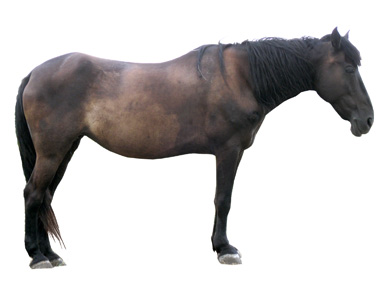
Please send Sample Letter protesting the Reno Rodeo’s use of an injured horse despite rules prohibiting such. The webform accepts sample letter length, but please modify and shorten if possible.
BACKGROUND | FROM PERSIAN HORSE’S BLOG
In spite of a bleeding mouth, a mare is bucked.
According to the rules of the Professional Rodeo Cowboys Association (PRCA), injured animals are not supposed to be used. Horses who excessively chute fight are supposed to be released. This injured, chute fighting horse was used in violation of PRCA rules, while three judges watch, because those rules are worthless. The rodeo announcers even make fun of the terrorized, injured animal.
VIDEO FOOTAGE
Vodpod videos no longer available.
WHOM TO CONTACT | CLICK ON LINK FOR WEBFORM
Nevada Governor Brian Sandoval
SAMPLE LETTER
Dear Governor Sandoval,
It has come to my attention via video documentation that a injured and bloody horse was forced to perform during the Reno Rodeo despite rules prohibiting such, and while it is a documented fact that rodeos subject animals to untold suffering, including severe injuries and death, greedy special interest groups dismiss their own regulations. As such, I respectfully request that you sever your relationship with rodeos.
Please allow me to elaborate. Animals are subjected to cruel rituals, including choking, bucking, shocking, roping, and pulling. Animals are frequently immobilized by being roped around the neck, roped around the hooves, pulled, beaten, slammed, and electrocuted, all for the purpose of unnecessary human entertainment. This brief description cannot adequately illustrate the dangerous conditions to which the animals are subjected, but video footage has repeatedly established dozens of injuries, many crippling, some lethal, and all incompatible with any written humane policy. Evidence substantiating these claims is available via video footage. Additionally, although visual documentation can reinforce the physical injuries animals suffer, it lacks the ability to convey the terror felt by these sentient beings, forced to endure unquestionably fearful conditions in frenzied and exploitative states.
Furthermore, although those personally involved assert that humane protocols must be followed in accordance with the Professional Rodeo Cowboys Association (PRCA) standards, the visual evidence validates the position that these directives are ignored; nevertheless, establishing a threshold of humane treatment is ambiguous at best, these standards being implemented by those professionally, personally, and financially involved with rodeos. As such, it is important to recognize that animals, being exploited in demonstrably cruel and unnecessary manners, are given no option to withdraw and are forced to endure undeniably painful conditions for trivial purposes:
http://www.youtube.com/watch?v=DGPbpjH3730&feature=player_embedded#!
As such, I hope you make the compassionate decision to publicly voice your censure of all current and future rodeos.
I know your time is limited and I thank you for your attention and consideration.
Please sign petition of protest: man shoots dog for “art”, gets $750,000 city contract yrs. later
Please click on and sign:
Do not waste tax payers’ money on dog killer Tom Otterness
Background | From SFGate City Insider
Update: Since this story was published this morning, Mayor Ed Lee has called for Tom Otterness’ planned public art installation in the Central Subway to be put on hold.
Lee, through his spokeswoman, called Otterness’ 1977 film “deeply disturbing” and asked his Central Subway project be put on hold.
The Arts Commission will investigate the situation, said P.J. Johnston, the commission’s president. The contract has been awarded to Otterness’ studio, but no money has been paid yet, he said.
“I understand the incident was 34 years ago,” he said, “but it certainly is disturbing and so we’re going to take a look at it.”
11:17 a.m.: A sculptor who shot a dog for an art film in the 1970s has won a $750,000 contract to create public art for the Central Subway.
Tom Otterness, a Brooklyn-based artist, has created public art all over Europe, Asia, Canada and the United States, with an emphasis on New York City.
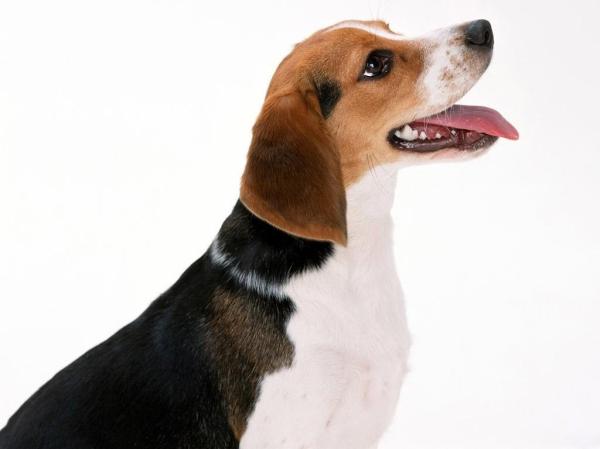
But he garnered notoriety in 1977 when he adopted a black-and-white dog from an animal shelter and shot it to death with the camera rolling. The footage ended up in his avant-garde movie Shot Dog Film.
Otterness has since apologized, telling the Brooklyn Daily Eagle in 2008, “Thirty years ago when I was 25 years old, I made a film in which I shot a dog. It was an indefensible act that I am deeply sorry for. Many of us have experienced profound emotional turmoil and despair. Few have made the mistake I made. I hope people can find it in their hearts to forgive me.”
For the Central Subway, Otterness will receive $750,000 to create a series of humorous bronze sculptures of transit riders. The news was first reported by the San Francisco Examiner.
Kate Patterson, a spokeswoman for the San Francisco Arts Commission, said the judging panel was not aware of the controversial film when it made its selection in July 2010.
“That said, the selection panel based its decision on the strength of his portfolio and his proposal,” she said.
Noting that the incident happened three decades ago, Patterson said, “Since then, his work has brought a lot of joy to a lot of people, and we think his proposal for the Central Subway is going to be wonderful and people will take a lot of pleasure in viewing it and enjoying it for many years.”
Not so, says Anita Carswell, campaign director of the Guardian Campaign, a local group created by In Defense of Animals.
“Who’s going to want to take the subway every day and see it and be reminded that a dog-shooter, who did something totally sociopathic for his own claim to fame, could get away with that?” she said.
10 billion animals are butchered for “food art” every year, just in the US. You can save 100 of them:
Judge Approves Landmark Settlement to Save 757 Species, Hunters Object

Related, please click on and sign:
Protect Our Wildlife and Waterways From Pesticides
Judge Backs Deal on Imperiled Species
By Matthew Brown and Matthew Daly, The Associated Press
A federal judge on Friday approved a pair of sweeping settlements that require the government to consider endangered protections for more than 800 animal and plant species.
The order by U.S. District Judge Emmet Sullivan means the government must act on imperiled species ranging from the northern wolverine and Pacific walrus to dozens of snails, mollusks, butterflies and plants. Some decisions could come by the end of the year and others by 2018.
The agreement between the Obama administration and environmental groups resolves more than a dozen lawsuits that challenged the government’s handling of roughly 250 so-called “candidate species.” Those are animals and plants that scientists say are in dire need of protection but that the government has lacked resources to address.
The agreements also cover more than 600 species for which groups had filed legal petitions seeking protections. The government agreed to address those petitions, although there is no guarantee of new protections.
Some of the species have languished in bureaucratic limbo for decades. Gary Frazer, assistant director of the U.S. Fish and Wildlife Service, said the settlement covers species that face possible extinction without government intervention.
“These are species that are in trouble,” Frazer said. “Once a species has been listed, with a few exceptions, we have kept them from becoming extinct. This is an important step toward conservation of all these critters.”
The settlement comes as the government’s endangered species program has been under assault on Capitol Hill, where House Republicans submitted a proposed Interior Department budget that have would barred any new listings under the Endangered Species Act. That proposal was defeated in a rare bipartisan vote this summer.
Related | Capturing America’s Endangered Species
Vodpod videos no longer available.
Frazer said current spending levels for the endangered program were sufficient to fulfill Friday’s settlement, adding that he was hopeful the agency would have enough money in future years to honor commitments made under the agreements with two environmental groups: Arizona-based Center for Biological Diversity and New Mexico-based WildEarth Guardians.
Some plants and animals covered under the administration’s agreements were first proposed for protection soon after the passage of the Endangered Species Act in 1973.
Government officials said the backlog was made worse by lawsuits and legal petitions that distracted wildlife agencies from needed scientific reviews and restoration work. Those legal actions have consumed money and staff time that could be spent on programs such as developing restoration plans for struggling plants and animals, officials said.
But WildEarth Guardians executive director John Horning said the lawsuits were prompted by the government’s past failures to live up to its obligation to shield species on the brink of devastation.
“We are rejoicing here today frankly,” Horning said. “I suspect there will be places where largely for political reasons the Fish and Wildlife Service punts or caves, but I expect a lot more good news than bad news on these” species.
The settlements require Horning’s group and the Center for Biological Diversity to limit their future legal actions against the government.
Safari Club International, a hunting group, had attempted to intervene in the case, but Sullivan issued a separate order Friday denying the request. Attorneys for the hunting group said they wanted to preserve the rights of its members to hunt animals covered under the agreements, including greater sage grouse and the New England cottontail rabbit.
Sullivan wrote in his order that the settlement does not necessarily mean the affected species will get protections and added that the Safari Club could file its own lawsuit against the government if that happens.
Copyright © 2011 ABC News Internet Ventures.
EU court rejects Inuit bid to challenge seal ban
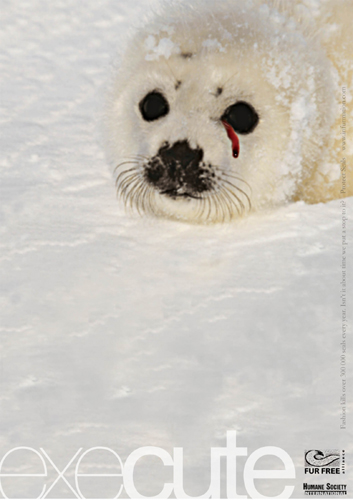
Artist, Trevor Blackstock
Related, please click on and sign:
Tell Canada to End Its Shameful Seal Slaughter
From CTV News
A court ruling in Europe has struck another blow to Canada’s embattled seal products industry.
The European General Court, in a judgment released Wednesday, rejected a bid by Canada’s largest Inuit organization to challenge the European Union’s year-old trade ban on seal products.
The court in Luxembourg dismissed the group’s case, saying the challenge from the Inuit Tapiriit Kanatami, several seal hunters and industry organizations was inadmissible.
Even though the EU ban exempts the trade in seal products from aboriginal groups, the Inuit say their markets will plummet along with the rest of the commercial industry unless the ban is overturned.
A spokesman for the Inuit Tapiriit Kanatami, which represents Canada’s 53,000 Inuit, said the group would comment on the ruling at a later date.
Rebecca Aldworth, executive director of the Canadian wing of Humane Society International, said the ruling “puts another nail in the coffin” of the commercial sealing industry.
“It’s a very important ruling,” she said in an interview from Strasbourg, France. “The ban remains in place and seals in Canada and around the world are going to be spared a horrible fate for many years to come.”
Aldworth said her group would like to see the industry mothballed and all seal hunters offered compensation.
Animal welfare groups have long argued that the annual hunt off the East Coast has left a stain on Canada’s international reputation because they believe the slaughter is inhumane.
“It’s time that the Canadian government recognize that the writing is on the wall,” said Aldworth, a Newfoundlander who has observed the hunt for more than a decade. “The commercial seal hunt is a dying industry.”
Vodpod videos no longer available.
In June, as the hunt drew to a close for another year, federal officials confirmed this season was one of the worst since the early 1990s, when the industry struggled to recover from a European ban on white pelts from young harp seals.
The total number of harp seals killed in the 2011 commercial slaughter was about 38,000 — less than 10 per cent of the total allowable catch.
The EU ban was blamed for pushing down pelt prices to between $20 and $30 — barely enough for seal hunters to cover the cost of fuel and insurance for their boats.
Still, the Canadian government is moving ahead with its own bid to challenge the ban through the World Trade Organization.
As well, the executive director of the Fur Institute of Canada, Rob Cahill, says the fight to save the industry will continue on another front.
He said the group that initially challenged the ban is disappointed with the latest ruling, but it is pursuing another court challenge aimed at the EU legislation that implements the ban.
As well, Cahill said some additional plaintiffs have joined the group’s cause, including a Scottish manufacturer of sealskin sporrans, the traditional pouch worn with the Scottish kilt.
“He’s found the restrictions are affecting his business in a big way,” Cahill said.
Nestea Crueltea: Please send sample letter protesting vicious animal experimentation for tea

From PETA
Before taking your next sip of iced tea, check the label on the bottle because you may be drinking a cupful of cruelty to animals. Nestlé, which makes Nestea, conducts—and pays others to conduct—painful and deadly tea tests on animals.The company causes animals to suffer simply to investigate the possible health benefits linked to tea products and ingredients, even though not one of these experiments is legally required for beverage manufacturers and regulators have stated that animal tests are not sufficient to prove health claims about food and beverage products.
In these cruel tests, mice and rats were tormented and then killed by decapitation and other methods. The following are some of the details of the horrors endured by the animals used in Nestea’s tea experiments:
- Mice bred to suffer from brain dysfunction and rapid aging were fed tea extracts and then locked in a dark chamber, where they received painful electric shocks to their feet. The mice were then killed.
- Mice bred to suffer from muscle degeneration were fed tea components, after which experimenters cut open the animals’ leg muscles and then decapitated them.
- Experimenters injected toxic chemicals into mice to destroy insulin-producing cells, causing the animals to develop diabetes. After this cruel procedure, the mice were force-fed tea extracts and then killed.
- After causing rats to suffer from high levels of fat and cholesterol in their bloodstreams, experimenters shoved tubes down the animals’ throats to force them to consume tea ingredients. The rats were then killed and dissected.
Modern, cruelty-free research methods are available and are in use by other leading beverage companies around the world. We need YOU to join us in telling Nestea to ditch CruelTEA to animals and to use non-animal methods instead.
Please take a moment to ask Nestea to stop testing on animals and join other brands—such as Arizona, Celestial Seasonings, Honest Tea, Lipton, Luzianne Tea, Snapple, Stash Tea, Tazo, Twinings, and others—that don’t experiment on animals.
Vodpod videos no longer available.
Whom To Contact
Paul Bulcke
CEO
Nestlé S.A.
paul.bulcke@nestle.com
Brad Alford
CEO
Nestlé USA
brad.alford@us.nestle.com
Subject Line
Stop Cruel Tea Experiments on Animals
Sample Letter
I was shocked to learn that your company, which makes Nestea, experiments on animals simply to make health claims about your tea products and ingredients.
Experimenters injected mice with toxic chemicals to give them diabetes, then force-fed them tea ingredients before killing them. In another experiment, mice were force-fed tea extracts and then had their leg muscles cut open before they were decapitated. Your company also funded an experiment in which brain-damaged and rapidly aging mice were locked in dark chambers and given painful shocks to their extraordinarily sensitive feet before being killed.
U.S. and international regulators have stated that animal tests are not sufficient to prove health claims about food and beverage products.
The makers of Arizona, Celestial Seasonings, Honest Tea, Lipton, Luzianne Tea, Snapple, Stash Tea, Tazo, Twinings, and other leading tea brands have confirmed in writing that they do not test their teas or ingredients on animals.
Please stop these cruel and archaic tests and institute a policy against conducting and funding tea tests on animals. I won’t buy Nestea products and will support only those tea companies that don’t test on animals until your company stops testing tea and tea ingredients on animals.
NAME
Resources
When you’re shopping for tea, make sure it’s cruelty-free! Check out the following list of tea companies that have confirmed in writing that they do not conduct or directly fund tests on animals for tea or tea ingredients:
- Adagio Teas (U.S.)
- Arizona Beverage Company (U.S.), maker of Arizona
- Art of Tea (U.S.)
- Associated British Foods (U.K.), maker of Twinings
- Australian Fruit Tea Company (Australia)
- Celcius Holdings, Inc. (U.S.)
- Ceylon Teas (U.S.)
- Cha Dao Tea Company Inc. (U.S.)
- Cliffstar Corporation (U.S.)
- The Coca-Cola Company (U.S.), maker of Gold Peak, Fuze, and Honest Tea
- Daintree Tea Company (Australia)
- Das Teehaus (Germany)
- Dr. Pepper Snapple Group (U.S.), maker of Snapple
- Dr. Tea’s Tea Garden & Herbal Emporium (U.S.)
- Fortnum & Mason (U.K.)
- Golden Star Tea Co. (U.S.)
- The Hain Celestial Group, Inc. (U.S.), maker of Celestial Seasonings
- Hari Har Chai Tea (Australia)
- Healthy Beverage Company (U.S.), maker of Steaz
- Intelligentsia Coffee & Tea Inc. (U.S.)
- ITO EN (Japan)
- Koala Tea Company (Australia)
- LOVA Tea (U.S.)
- Ostfriesische Tee Gesellschaft Laurens Spethmann GmbH (Germany)
- PeliTeas (U.S.)
- PepsiCo, Inc. (U.S.), maker of SoBe
- QTrade Teas and Herbs (U.S.)
- R.C. Bigelow, Inc. (U.S.), maker of Bigelow
- Reily Foods Company (U.S.), maker of Luzianne Tea
- The Republic of Tea (U.S.)
- Rishi Tea (U.S.)
- Shangri La Tea Company, Inc. (U.S.)
- Starbucks (U.S.), maker of Tazo
- Stash Tea Company (U.S.)
- Strand Tea Company (U.S.)
- Tata Global Beverages (India), maker of Tetley
- Teavana
- Special Teas (U.S.)
- Teas Etc., Inc. (U.S.)
- TeeGschwendner (Germany)
- Teekanne (Germany)
- Tesco (U.K.)
- Typhoo (U.K.)
- Unilever (U.K.), maker of Lipton tea
- Walters Bay International (U.S.)
Petions do work: Sri Lanka mass animal sacrifice banned
Related | Please click on and sign:
From News24
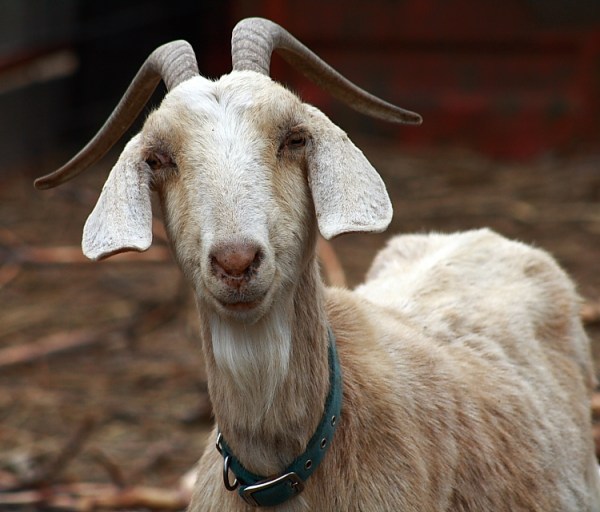
Colombo – A Sri Lankan court has ordered an annual sacrifice ritual in which hundreds of goats are slaughtered to be halted after a petition by animal rights activists, police said on Tuesday.
About 700 goats and scores of chickens were to be sacrificed on Tuesday during a traditional religious ceremony at the Munnewaram temple, just north of the capital Colombo.
The grisly ritual, in which goats are decapitated in public using a large hatchet, was first banned in the 1980s but was revived as locals believe the animals’ blood wards off evil spirits.
Related | Mass Animal Sacrifice in Nepal
Vodpod videos no longer available.
“The Appeal Court on Monday directed the police to prevent the slaughter of animals that would take place,” police spokesperson Prishantha Jayakkody said.
He said lawyers appearing for the petitioners argued that it was unclear who had authority over the temple, and that the slaughter was cruel.
The Sri Lanka Animal Welfare Trust had also appealed to President Mahinda Rajapakse to stop the ceremony, which saw about 300 goats sacrificed last year.
Read more…
Sign petitions to help end foie gras, elephant ride barbarity, & future Toro de la Vega fiesta cruelty
Please click on and sign the following petitions:
1. Speak Out Against Foie Gras
2. Please Ban Cruel Elephant Rides!
3. Help end the Toro de le Vega fiesta
1. Background | From Animal Legal Defense Fund
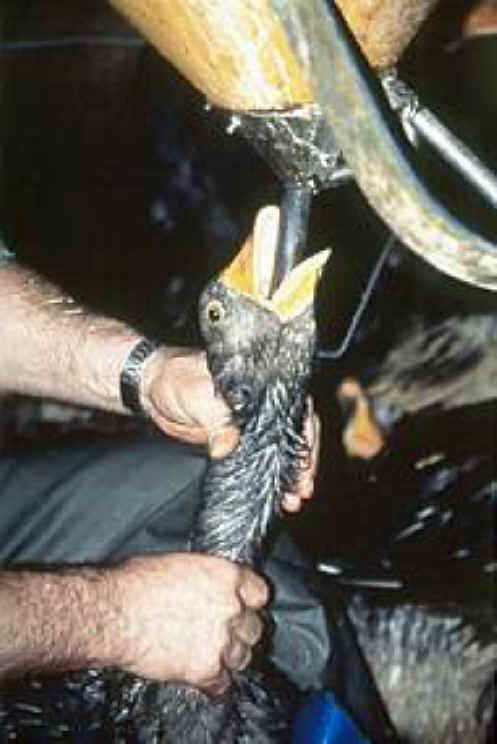
The Animal Legal Defense Fund filed a legal petition with the U.S. Department of Agriculture (USDA), urging that foie gras—the “fatty liver” of a force-fed duck or goose—bear a consumer warning label stating “NOTICE: Foie gras products are derived from diseased birds.” Because the USDA is responsible for ensuring that poultry products are wholesome and for approving only products from healthy animals, stamping foie gras products with the USDA seal without disclosing that those products are derived from diseased birds misleads consumers, contravening the Poultry Products Inspection Act.
Currently, on U.S. foie gras farms in New York and California, ducks are force fed three pounds of mash a day through a pipe shoved down their throats—the equivalent of force-feeding 45 pounds of food to an adult human—inducing liver disease known as hepatic lipidosis that often cripples and poisons the birds. The cruel and unhealthy force-feeding of birds for foie gras production has been banned in over a dozen countries, including the United Kingdom, Germany, Italy, and Israel, and a California state ban, passed in 2004, will go into effect on July 1, 2012. Even retailers like Whole Foods and Wolfgang Puck’s restaurants refuse to sell foie gras.
In addition to being diseased, foie gras products may induce disease. A 2007 study published in the Proceedings of the National Academy of Sciences found that protein fibers from foie gras enhanced the onset of Secondary Amyloidosis, a disease fatal to humans. In the past, ALDF and other animal protection groups have called on the USDA to ban foie gras outright as unfit for human consumption.
Join the Animal Legal Defense Fund in urging the USDA to place a consumer warning label on foie gras.
Sign the petition to the USDA now!
Vodpod videos no longer available.
2. Background | From PETA
So-called “elephant joyrides” are anything but joyful for the elephants who are forced to undergo them. A PETA-commissioned investigation of elephant training in Nepal revealed that elephants who are used to give rides are physically and emotionally abused every step of the way.
When they are just 2 years old, baby elephants are torn away from their loving mothers and tied up out of their reach. The frantic babies cry and struggle for days to reach their mothers, who are also tethered. Elephant calves are restrained during “training” for as long as 14 hours at a time with heavy chains and with ropes that cause painful burns.
Calves are repeatedly put through terrifying “desensitization” abuse, in which trainers tie the elephants tightly to poles, startle them with loud noises, hit them, prod them with sticks and wave flaming torches at them – often singeing the elephants’ skin.
Trainers routinely pierce the animals’ sensitive ears and yank on them with hooks to force them to walk a certain way. Restraints studded with iron nails, which dig into the elephants’ skin and cause infections, are used on their feet. Barbed shackles are frequently placed around one of their legs, and one end of the shackle is attached to the saddle so that the rider can punish the elephant for any misstep. Trainers routinely beat elephants on the head with sticks to punish them for “mistakes”, leaving many elephants with open wounds.
Please watch this undercover video footage of elephant training camps. This is just one example of the cruel ways that elephants are trained to give rides, but all elephant training methods are cruel. In India, chaining, beating and the use of ankuses (iron hooks) to jab and hit elephants is common. In Thailand, still-nursing baby elephants are literally dragged, kicking and screaming, from their mothers. They are immobilised, beaten mercilessly, and gouged with nails for days at a time. These ritualized “training” sessions leave the elephants badly injured, traumatized, or dead.
Vodpod videos no longer available.
3. Background | From Humane Society International
Help end the Toro de le Vega fiesta in the Castilla y León region of Spain, where bulls are pursued, taunted and tormented by spear-wielding men and then stabbed to death in an annual spectacle every September.
Vodpod videos no longer available.
Neighbor tortures dogs, displays one: please send letter asking for harshest penalty
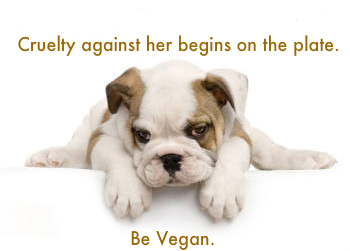
Please send Sample Letter and sign Petition asking the judge and prosecuting attorney to sentence perpetrator to harshest penalty; please modify letter so they receive a variety, thank you.
BACKGROUND
Click on and join the Facebook page HERE.
Randy Klatt stole his neighbor’s companion animals, tortured them to death, and hung one out for others to witness. He put them on a bus route so children could also see them.
Per Greg Bewley, Hamilton County Sheriff: “A ticket for Criminal Mischief, a $50 offense, was issued regarding this case several months ago. The accused individual has pled Not Guilty and is scheduled for trial in Hamilton County on September 29th at 9:00 a.m.”
Vodpod videos no longer available.
Justice for Boy & Zeak: Prosecute The Man Who Did This
WHOM TO CONTACT
County Attorney Mark Henkes
100 W. Main
PO Box 706
Hamilton, TX 76531
Office Phone: 254-386-3217
Fax: 254-386-8511
Email: mark_henkes@yahoo.com
Judge James Lively
102 North Rice
Hamilton, TX 76531
Phone: 254-386-5023
Fax: 254-386-8594
Email: jp1@hamiltoncountytx.org
Send two free faxes per day from HERE. (You must confirm email address from your email account before fax is sent.)
SAMPLE LETTER
RE: Mr. Randy Klatt, CASE# SO111627
Dear Judge Lively and County Attorney Henkes,
I have learned of extremely disturbing and malicious cases of animal cruelty in which Mr. Randy Klatt deliberately caused the suffering and death of two dogs and hung one outside on a school bus route for children to witness. These alleged incidents occurred in March and September 2011. I am writing today to encourage you to pursue every route investigating this hideous crime in order to effectively charge and prosecute Mr. Klatt and sentence him to the harshest penalty; his crimes causing unimaginable agony, fear, and death in the animals and distress and wanton endangerment in children and adults who witnessed the tortured animal on display deserve social justice, not community approval.
When I try to imagine what possible motive animal abusers entertain for subjecting their animal victims to such malicious, heinous acts of brutality, I fail, but I am thankful for a lack of cognitive understanding and rationalization. To voluntarily engage in such malicious behaviour suggests sadistic tendencies, and this person’s actions, causing unmitigated pain and suffering, demonstrates an incontrovertible lack of morality regarding other living beings and a gross disrespect for the law. In fact, a person who shows such a remarkable lack of compassion towards non-human animals has the ability to show such indifference towards human animals. This link between animal and human abuse has been established, and if society excuses Mr. Klatt’s criminal behaviour, or agrees to a lesser punishment, we only harm ourselves by unjustly nullifying cruelty as acceptable behaviour.
Please respect the victims by penalizing the guilty; doing so will demonstrate your commitment to justice, responsibility, and integrity, attributes unquestionably necessary in a legal setting: rejecting cruelty by maintaining an unyielding position towards it would be a model for all community members and would serve to characterize this type of behaviour as both impermissible and punishable.
I know your time is limited and I thank you for your attention to this urgent issue.
Name | Address | Email Address
Three actions to help cats, coyotes, wildlife from traps
Please click on and sign the following:
1. U.S. Fish & Wildlife: Stop Using Tax Dollars to Declare War on Cats
2. Help Stop Indiscriminate Coyote Killing in Calabasas, CA
3. Urge Your Representative to Co-Sponsor H.R. 2657 Today
1. Background | From Best Friends Animal Society
Is U.S. Fish and Wildlife Service poised to start taking out cats by the thousands? Such a project would be inhumane, not to mention a waste of precious taxpayer dollars in a time of deficit reduction. But believe it or not, this covert war on cats is already being waged and USFWS will be recruiting with a presentation scheduled for a Hawaii conference this fall.
In early November, USFWS personnel are going on a junket to beautiful Hawaii to teach conventioneers how to stop Trap Neuter Return programs in their towns. The program for the Wildlife Society’s annual conference states that USFWS folks will give a presentation that includes “role-playing” that can be used to defeat TNR programs across the nation. (How come I never get sent to Hawaii for role-playing?)
And what is the USFWS method of choice to control community cats? Killing. That’s pretty unconscionable in this humane age, especially considering that catch-and-kill doesn’t work. If it did, we wouldn’t have any community cats left by now.
If USFWS’s goal is to reduce the number of outside cats, which is laudable, they are being short-sighted by not encouraging Trap Neuter Return projects. Studies have shown that these programs work to reduce the cat population.
The nice thing about TNR programs is that they have broad public support because folks don’t want to see cats and kittens killed. You can also get humanitarians to help fund these projects, which helps with the programmatic bottom line. Maybe employing folks to trap, neuter and return cats would help create more jobs, too, including good jobs for vet techs and veterinarians.
But no innovative thinking for our government leaders. Instead of building on that humanitarian support to find solutions that protect cats, wildlife and the community, they view cats the same way they view Asian carp: search and destroy.
By holding a workshop with the goal of ending Trap Neuter Return programs, USFWS is promoting an approach that hasn’t been proven effective, but has been proven expensive. And they have no way to fund it. By leaving local governments to their own devices, they’re opening the door for so-called “solutions” like the publication put out earlier this year by the University of Nebraska Extension Service, which described numerous cruel ways to kill outside cats including shooting and using body-gripping traps. This is your tax dollars at work.
Best Friends Animal Society is asking the USFWS to declare a truce in their war on cats and embrace trap, neuter and return programs to reduce the community cat population. Please sign the Best Friends’s petition today. Politics is not a spectator sport.
2. Background | From Project Coyote
Join Project Coyote and the Animal Welfare Institute (AWI) in urging the City of Calabasas, California to make permanent its temporary ban on indiscriminate coyote killing
After public outcry against the indiscriminate and cruel trapping and killing of coyotes in the City by a county trapper, the City temporarily suspended the killing pending further review.
The City of Calabasas’ Environmental Commission is reviewing the issue and will make a recommendation to the City Council on how to proceed.
Your voice is needed: Please sign the petition and submit comments directly to the Environmental Commission by email- afarassati@cityofcalabasas.com
Talking points (please be respectful and personalize your message):
- Commend the City of Calabasas for its decision to stop coyote trapping and killing and urge them to make the temporary moratorium permanent.
- Indiscriminate trapping of coyotes is not an effective or humane solution to reduce real or perceived conflicts between people, coyotes, and domestic animals. Coyotes are here to stay. We must learn to coexist.
- Coyotes play an important role in keeping rodent populations in check and ecosystems clean of carrion (dead things). Coyotes also help to limit mescarnivoress (e.g. foxes, skunks) thereby helping boost bird population and diversity.
- There are many effective non-lethal methods for reducing negative encounters between people, coyotes, and domestic animals. More info. here.
- Encourage the City of Calabasas to work with Project Coyote and AWI in adopting and implementing an ecologically and ethically sound long-term coyote coexistence plan that emphasizes public education and reducing coyote/wildlife attractants as well as intentional and unintentional feeding.
Remember to include your name, address, and email when submitting public comments so that your comments will be counted in the official record!
Thank you for writing on behalf of America’s Native Song Dog!
Read more here:
Coyotes Seen as Friends, Not Enemies
Coyote Traps in Urban Area Cause Concern
Vodpod videos no longer available.
3. Background | From Born Free USA
Congresswoman Nita Lowey (D-N.Y.) has worked with Born Free USA and our colleagues to reintroduce the “Refuge from Cruel Trapping Act” (H.R. 2657). This important initiative finally would end the horrific practice of trapping on national wildlife refuges. Please ask your congressional representative to co-sponsor the bill.
When visiting a national wildlife refuge, most people expect to see wildlife in abundance without fear of stepping into a trap, or having to witness the pain and suffering of a trapped animal. More than half of America’s refuge lands, however, allow barbaric and indiscriminate trapping! We are horrified that the brutal practice occurs on some of the very last safe havens for wildlife in the United States.
H.R. 2657 aims to restore the original intent of the National Wildlife Refuge System — to maintain lands where wildlife are safe and free from unnatural intrusion. Congresswoman Lowey’s bill also would protect people and domestic companion animals incidentally caught by traps while visiting refuges.
As highlighted by Born Free USA’s 2011 trapping investigation and our online database of non-targeted incidents, trapping is a highly unregulated, inhumane and dangerous practice, and has remained this way for years.
“The use of steel jaw leghold traps and other barbaric mechanisms has no place in national wildlife refuges or other public lands,” Lowey said. “Body-gripping traps are cruel and inhumane, and it is time to end this brutal practice once and for all.”
Please help us pass the 2011 Refuge from Cruel Trapping Act. Ask your U.S. representative to co-sponsor H.R. 2657 today.
Read more…
Please ask library to cancel pro-Iditarod event
Vodpod videos no longer available.
Background | From The Sled Dog Action Coalition
Clark Public Library in Clark, New Jersey, invited Iditarod musher Kim Darst to speak at the library on October 2, 2011. The Iditarod has a long, well-documented history of dog deaths, illnesses, and injuries. Please tell the library to cancel Darst’s talk.
Whom To Contact
BoardPresident@clarklibrary.org ,
Sample Letter
Dear Library Staff:
The Iditarod has a long, well-documented history of dog deaths, illnesses, and injuries, and I am respectfully requesting you therefore please cancel musher Kim Darst’s talk. During racing and training, dogs experience paralysis, frostbite, bleeding ulcers, bloody diarrhea, lung damage, pneumonia, ruptured discs, viral diseases, broken bones, torn muscles, tendons, and sprains, and death. At least 142 dogs have died in the Iditarod, including two dogs, from a doctor’s team, who froze to death in the brutally cold winds. For more information, please visit Sled Dog Action Coalition website at the following: http://www.helpsleddogs.org .
Furthermore, during training runs, Iditarod dogs have been killed by moose, snowmachines, and various motor vehicles, including a semi tractor and an ATV. They have died from drowning, heart attacks, and being strangled in harnesses. Dogs have also been injured while training via being gashed, quilled by porcupines, bitten in dog fights, and suffered from broken bones, and torn muscles and tendons. Most dog deaths and injuries during training are not even reported.
Iditarod dog kennels are nothing more than puppy mills. Mushers breed large numbers of dogs and routinely kill unwanted ones, including puppies. Many dogs who are permanently disabled in the Iditarod, or who are unwanted for any reason, including those who have outlived their usefulness, are killed with a shot to the head, dragged, drowned, or clubbed to death. “Dogs are clubbed with baseball bats and if they don’t pull are dragged to death in harnesses…” wrote former Iditarod dog handler Mike Cranford in an article for Alaska’s Bush Blade Newspaper.
Dog beatings and whippings are common. During the 2007 Iditarod, eyewitnesses reported that musher Ramy Brooks kicked, punched, and beat his dogs with a ski pole and a chain. Jim Welch says in his book Speed Mushing Manual, “Nagging a dog team is cruel and ineffective. A training device such as a whip is not cruel at all but is effective. It is a common training device in use among dog mushers…”
Jon Saraceno wrote in his March 3, 2000, column in USA Today, “He [Colonel Tom Classen] confirmed dog beatings and far worse, like starving dogs to maintain their most advantageous racing weight. Skinning them to make mittens… Or dragging them to their death.”
During the race, veterinarians do not give the dogs physical exams at every checkpoint. Mushers speed through many checkpoints, so the dogs get the briefest visual checks, if that. Instead of pulling sick dogs from the race, veterinarians frequently give them massive doses of antibiotics to keep them running. The Iditarod’s chief veterinarian, Stu Nelson, is an employee of the Iditarod Trail Committee. Since the Iditarod is his employer, do you expect that he’s going to say anything negative about it?
When they aren’t hauling people, the dogs are routinely kept on four-foot chains or tethers. It has been reported that dogs who don’t make the main teams are never taken off their chains. Because chaining is cruel to dogs, many jurisdictions have banned or severely restricted the practice. For more information about the cruelties of tethering, please visit http://www.helpsleddogs.org/remarks-abuseinkennels.htm#chaining .
The Iditarod, with all the evils associated with it, has become synonymous with exploitation. The race imposes torture no dog should be forced to endure, and I hope you decide to cancel any event that sanctions such torturous conditions.
Thank you.
NAME













 Our Compass