Please Help Free the “Sentosa 25” from Resort World in Singapore
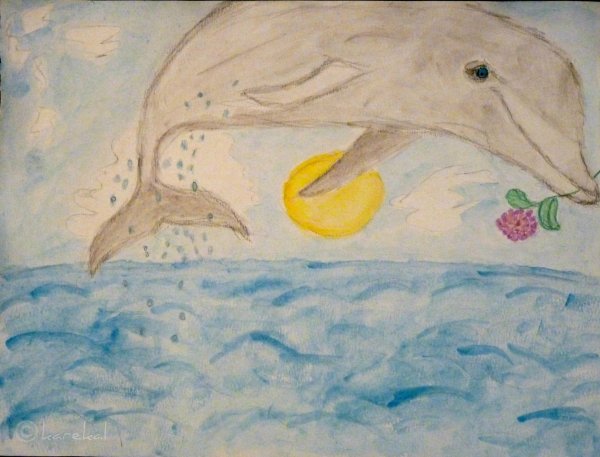
Painting by Karen Lyons Kalmenson
Please sign Petition and send Sample Letter protesting the capture and imprisonment of 27 (now 25) bottlenose dolphins by Resorts World Sentosa.
BACKGROUND | FROM CHANGE
News that 25 bottlenose dolphins that once roamed free and wild are now facing a life of captivity and sadness as permanent residents of Resorts World – Sentosa, Singapore. These 25 dolphins were captured in the waters of the Solomon Islands and are now being kept in the Philippines while the new facility at Resorts World Sentosa is being built. Two of them have already tragically died. Ric O’Barry, the marine mammal specialist has also offered his help to rehabilitate and release the dolphins back to the wild, in the Solomon Islands, off Papua New Guinea.
Some known facts about Dolphins:
53% of those dolphins who survive the violent capture die within 90 days.
The average life span of a dolphin in the wild is 45 years; yet half of all captured dolphins die within their first two years of captivity. Every seven years, half of all dolphins in captivity die from capture shock, pneumonia, intestinal disease, ulcers, chlorine poisoning, and other stress-related illnesses. Some may die due to stress while transport. To the captive dolphin industry, these facts are accepted as routine operating expenses.
In many tanks the water is full of chemicals as well as bacteria, causing many health problems in dolphins including blindness.
When a baby dolphin is born in captivity, the news is usually kept secret until the calf shows signs of survival. Although marine mammals do breed in captivity, the birth rate is not nearly as successful as the one in the wild, with high infant mortality rates.
Wild dolphins can swim 40 to 100 miles per day – in pools they go around in circles. Dolphins are predators of fish and spend up to half of their time in the wild hunting for food. Supplying dead fish results in less exercise and lack of mental stimulation, thus causing boredom.
Many marine parks subject their mammals to hunger so they will perform for their food. Jumping through hoops, tailwalking and playing ball are trained behaviors that do not occur in the wild. Confined animals who abuse themselves (banging their heads against the walls) are creating stimuli which their environment cannot supply. Dolphins in captivity tend to develop stereotypical behaviors (swimming in a repetitive circle pattern, with eyes closed and in silence) because of boredom and confinement. This is equivalent to the swaying and pacing of primates, lions, tigers and bears confined in cages.
Won’t you please help us and Say NO TO CAPTIVITY. ~RESORT WORLD FREE THE DOLPHINS.~
Thank you to Ric O’Barry, Save the Blood Dolphins, The Dolphin Project, Save Japan Dolphins and Earth Island Institute for their continued support.
RELATED | Please let the dolphins go: Saddest Dolphins
Vodpod videos no longer available.
Please Help Free the “Sentosa 25” from Resort World in Sentosa Singapore
WHOM TO CONTACT
SAMPLE LETTER
To Whom It Concerns,
I am writing today to encourage Resorts World Sentosa to relinquish the 25 bottlenose dolphins back to their home in the waters of the Solomon Islands. Individuals comprising a large global audience concerned with these dolphins have been encouraging you to relinquish them to freedom; sadly, corporate greed and indifference have resulted in their continuous enslavement, contributing to deteriorating mental and physical state by their continued imprisonment. By refusing to release them, you are establishing your approval of animal cruelty, and I am appalled to learn of your deliberate involvement in the exploitation of animals.
Although you may assert that humane protocols must be followed, the visual evidence validates the position that these directives are often ignored in favor of management; nevertheless, establishing a threshold of humane treatment is ambiguous at best, these standards being implemented by those with questionable interests. As such, it is important to recognize that all animals, fundamentally valuable beyond monetary benefit, are being exploited in demonstrably cruel and unnecessary manners.
I hope you make the compassionate decision to discontinue your imprisonment of the “Sentosa 25”. However, as long as you continue to unnecessarily capitalize on the exploitation, imprisonment, and maltreatment of them, I will not financially support you. It is important to recognize that consumers are increasingly rejecting those tourism destinations that are complicit in the suffering and unnecessary treatment of animals by shifting their loyalties to those that do not participate in the exploitation of them, and I hope that you will extend such an ethical and empathetic gesture as well.
I understand your time is limited and I want to thank you for your consideration of this urgent matter.
SEE MORE:
In freedom
My eyes reflect the blue of the sea
When they are in freedom, naturally
I can jump up so high
Chase and play
Catch my food
This is the dolphin way
But when in a small space
Entrapped and alone
Or even with others
All I can do is moan
The blue sea reflection
Flickers then dies
Lost in man’s deception
Why bother to try
Karen Lyons Kalmenson













 Our Compass